Borrowers in Chapter 13 bankruptcy may still be eligible to buy or refinance a home with an FHA loan. FHA guidelines permit applicants to obtain an FHA-insured mortgage while making payments under a Chapter 13 repayment plan. Wendy Lahn, a senior mortgage loan originator at Gustan Cho Associates says the following about FHA Chapter 13 bankruptcy manual underwriting guidelines:
Guide to FHA Chapter 13 bankruptcy manual underwriting with 12-month payment history, court approval, DTI, credit scores, and reserves.
Applicants seeking an FHA loan during Chapter 13 bankruptcy must follow additional steps. The loan undergoes manual underwriting instead of the standard process. The lender closely examines the applicant’s finances and bankruptcy circumstances and must obtain bankruptcy court approval before proceeding.
What is the Waiting Period to Qualify and Get Approved for an FHA Loan After Chapter 13 Bankruptcy
A common misconception is that a two-year waiting period is required after a Chapter 13 discharge to obtain an FHA loan. In practice, if the discharge occurred less than two years ago, FHA generally requires manual underwriting.
This guide explains the FHA Chapter 13 manual underwriting process, including payment history, key underwriting criteria, compensating factors, approval strategies, and court approval.
You may qualify for an FHA loan even if your Chapter 13 repayment plan is ongoing, as long as you have made on-time payments for at least 12 months and have written approval from the bankruptcy court. You must also meet all other FHA manual underwriting requirements.
What Is the FHA Chapter 13 Bankruptcy Manual Underwriting?
Manual underwriting involves a human underwriter reviewing the loan file rather than relying solely on automated systems to make a decision. FHA uses its TOTAL Mortgage Scorecard along with approved automated underwriting systems. Usually, an “Accept” recommendation allows the loan to move forward, while a “Refer” recommendation means a Direct Endorsement underwriter must conduct a full manual review. Because Chapter 13 borrowers require manual underwriting, the underwriter must review the bankruptcy payment plan, the borrower’s housing history, court documents, new credit accounts, savings, debt compared to income, and reasons for the bankruptcy.
Manual Underwriting Guidelines on FHA Loans
Manual underwriting does not automatically result in loan denial. Instead, applicants must meet the FHA manual underwriting guidelines rather than receive automated approval. Qualified applicants may be able to purchase a home before the discharge of a Chapter 13 bankruptcy.
The U.S. Department of Housing and Urban Development (HUD) has clear guidelines regarding Chapter 13 bankruptcy filings, stating that such filings do not disqualify applicants from applying for and receiving an FHA-backed mortgage.
FHA places greater emphasis on adherence to the repayment plan and payment history than on the bankruptcy filing date. At least 12 months of your bankruptcy payment plan must be completed with on-time, satisfactory payments before you can obtain an FHA case number. The lender also needs bankruptcy court approval before you can get a mortgage.
How Many Chapter 13 Payments Are Required for an FHA Loan?
The FHA guideline is often described as requiring “12 Chapter 13 payments,” but there is an important detail to keep in mind. According to HUD, the mortgagor must affirm that the borrower’s payment performance for the last twelve months was satisfactory and that all payments were made on time.
At the time of the FHA case-number assignment, a bankruptcy petition must include at least twelve months of the payout period. It is very important the borrower made the payments to the trustee timely.
A borrA borrower does not automatically qualify for an FHA loan one year after filing for Chapter 13 bankruptcy. Payment history and FHA case number assignment date may differ. The lender should review bankruptcy documents and the trustee’s payment history to confirm eligibility.
Chapter 13 Payments Have to Be Made on Time?
Yes. Payment history is one of the most important elements of a Chapter 13 bankruptcy FHA manual underwrite. HUD states that the mortgagee must affirm that during the last twelve months, the borrower’s payment performance was satisfactory and that the borrower made all required Chapter 13 plan payments. Missed or late payments significantly reduce the likelihood of loan approval. Borrowers should obtain a complete payment history from the Chapter 13 trustee or other documentation to verify when each required payment was made. Payments made before the application is submitted are not automatically considered satisfactory by the FHA. Underwriters prioritize payment habits over the current outstanding debt amount.
Do You Need Bankruptcy Court Approval for an FHA Loan?
Yes. For an active Chapter 13 bankruptcy, FHA requires the borrower to obtain written permission from the bankruptcy court before FHA will allow the mortgage transaction to occur. This requirement is sometimes called ‘trustee approval,’ but written permission from the bankruptcy court is necessary.
The Chapter 13 trustee is one of the key people in the administration of the bankruptcy repayment plan, and local bankruptcy practices may require the trustee to review or respond to a mortgage application.
However, the FHA guidelines state that written permission from the bankruptcy court is required. The bankruptcy attorney is best positioned to provide details on jurisdiction requirements. The attorney will need the lender’s information about the proposed purchase price, loan amount, interest rate, and other loan details to prepare the bankruptcy court request. Your mortgage company is not your bankruptcy attorney and should not give legal advice about court approval.
Chapter 13 Trustee Administratively Important
Although the FHA states that written permission from the bankruptcy court is required, the Chapter 13 trustee remains important. The trustee operates the repayment plan by accepting payments and distributing funds to creditors while overseeing the plan. The U.S. Courts also say Chapter 13 debtors should avoid taking on more debt because it likely limits their ability to fulfill the repayment plan.
In most cases, qualifying for a mortgage during Chapter 13 of bankruptcy involves the debtor, the mortgage lender, the bankruptcy attorney, the trustee, and the bankruptcy court.
Procedures may vary by jurisdiction. It is essential to follow a bankruptcy attorney’s advice rather than rely solely on general information. The following section explains the rationale for manual underwriting of FHA Chapter 13 Bankruptcy Loans. With FHA manual underwriting, underwriters can look at your situation in more detail than automated systems do.
How Does a Mortgage Underwriter Review a Manual Underwriting File
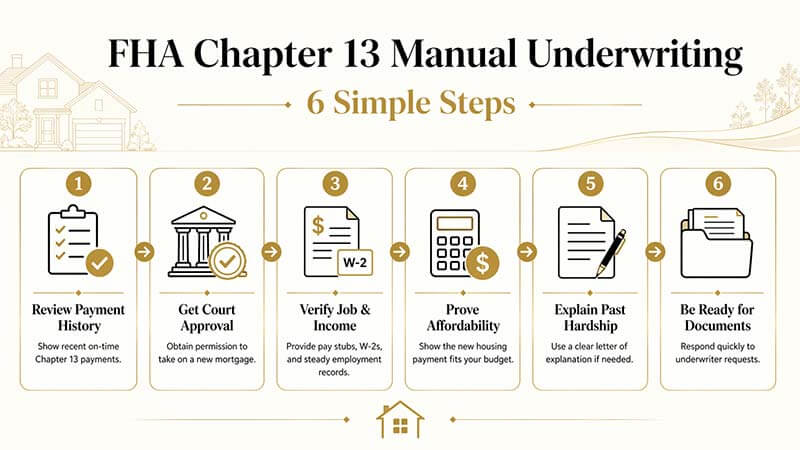 For the Chapter 13 borrower, the underwriter is tasked with answering the following question: Does the borrower, after the bankruptcy, demonstrate the ability and willingness to pay the mortgage and all other responsibilities? This analysis extends beyond the bankruptcy itself.
The underwriter will examine the borrower’s payment history for rent or mortgage payments, other installment and revolving debt, income and employment stability, bank statements, cash to close, reserves, bankruptcy documents, and explanations for financial issues prior to bankruptcy.
The objective of this process is not punitive. It is designed to show that the applicant has overcome previous financial setbacks and is prepared for new mortgage responsibilities. Credit scores matter in manual underwriting, but they are only one part of the decision. Under FHA manual underwriting, satisfactory credit typically includes no more than 12 months of late payments on either a housing payment or installment debt. FHA also looks at the last 24 months of payments and is concerned with serious derogatory revolving credit behavior in the last 12 months.
Underwriter Review of Special Considerations on Housing Payment History

There is a strong emphasis on housing payment history when a loan is underwritten manually. HUD requires the mortgagee to verify the borrower’s payment history for the last 12 months with documentation. During this period, the mortgagee may need to review a credit report, provide a worksheet, verify rent, obtain verification from a mortgage loan servicing company, or verify a mortgage payment with a canceled check or money order.
Borrowers who live for free are not automatically disqualified. The lender must document the borrower’s living arrangement when the borrower lives for free, per FHA requirements.
Comprehensive and well-organized documentation is essential. Rent payments made in cash are difficult to verify without receipts. Using checks or other traceable methods makes it easier to verify payment history. If the credit history is insufficient, the lender will investigate reasons for late payments, such as financial hardship or difficulties managing bills. It is important to avoid new negative credit marks while preparing for an FHA loan during Chapter 13. While bankruptcy can be explained, new missed payments are harder to justify and may indicate ongoing financial instability.
What Credit Score Is Needed for an FHA Loan During Chapter 13?
FHA does not have a specific minimum credit score for Chapter 13 cases, unlike the credit scores used in other cases that qualify for FHA financing. For an ordinary purchase, the financing amounts to a 96.5% loan-to-value ratio.
For a Minimum Decision Credit Score of 580 or higher, the borrower can qualify for financing of up to 96.5% of the sale price or the appraised value, subject to the current FHA loan-to-value ratio.
For a credit score of 500 to 579, the maximum financing is limited to 90% of the property’s value. With a credit score of 580 or higher, a borrower is qualified for a minimum down payment of 3.5% and maximum financing on an FHA purchase. A credit score of 500 to 579 limits the borrower to a 90% loan-to-value ratio. It is important to note that FHA guidelines and individual lender requirements may differ. Some lenders impose higher credit score requirements or additional criteria, known as lender overlays.
What Is a Lender Overlay on an FHA Chapter 13 Loan?
FHA prescribes the minimum program standards that FHA-approved lenders must meet. Individual lenders may establish higher risk standards. Each individual mortgage lender need to abide by HUD’s minimum agency manual underwriting mortgage guidelines. However, each individual can set higher lending requirements above and beyond the minimum HUD agency guidelines, called lender overlays. Overlays is the reason why every mortgage company can have different guidelines on FHA loans during Chapter 13 bankruptcy.
A borrower stated that an FHA mortgage is not possible during Chapter 13; verify if this is based on a HUD requirement or the lender’s policy. Lenders won’t change FHA rules, but requirements may differ if it is the lender’s policy rather than a HUD rule.
For instance, FHA may permit a transaction that aligns with its guidelines, while a lender may require a higher credit score, a lower debt-to-income ratio, higher reserves, a longer credit history, or a completed bankruptcy discharge. This is important for FHA Chapter 13 loans because not every lender is willing to do manual underwriting for active bankruptcies.
Manual Underwriting of FHA Debt-to-Income Requirements
Monthly debt obligations are compared to monthly gross income. This ratio is called debt-to-income, and it is used to determine a borrower’s ability to repay a loan. Manual underwriting often uses stricter credit ratios than automated FHA approval does.
- For borrowers with a minimum FHA credit score of 580, FHA’s standard ratios on a case-by-case basis may be 31%/43% without compensating factors.
- For borrowers with a minimum FHA credit score of 580, FHA may allow qualifying borrowers to have a Case Rating of 37% or 47% with compensating factors.
- For cases without any discretionary debt, FHA allows a 40%/40% ratio.
- For borrowers with two compensating factors, FHA may allow a 40%/50% ratio.
- Individuals with a credit score between 500 and 579, and those without a credit score, are typically unable to meet the 31%/43% standard under manual underwriting.
These are the highest limits allowed for FHA manual underwriting, but they do not guarantee approval. The underwriter still needs to decide if the loan is too risky.
What Are the FHA Manual Underwriting Compensating Factors?
Compensating factors refer to strengths in loan documentation that may, in some cases, support an approval of a loan file that exceeds the FHA’s standard manual underwriting guidelines. Not every good part of your loan will count as a compensating factor under FHA rules. FHA has provided guidance on compensating factors for manual underwriting of higher ratios. Based on the ratio requested, factors may include a modest increase in the borrower’s housing expense, positive residual income, an increase in other significant non-income-related cash flow, or verified cash reserves. The underwriter can’t decide on their own what counts as an ‘excellent compensating factor.’ Compensating factors must meet FHA’s official definitions and standards.
Cash Reserves as a Compensating Factor
The cash reserves you need for a manually underwritten FHA loan may be different from the amount needed to count as a compensating factor. According to HUD, to be considered an FHA compensating factor, a reserve is typically required to cover three total monthly mortgage payments for a one- or two-unit property, or six total monthly mortgage payments for a three- or four-unit property. Funds from gifts or mortgage loans are not included in calculating reserves for this compensating factor.
Minimal Increase in Housing Payment
Low payment shock can also qualify as a compensating factor when FHA’s requirements are met. Under the FHA standard, the proposed total monthly mortgage payment cannot exceed the borrower’s current housing payment by more than $100 or 5%, whichever is less. The borrower must also have the required documented housing-payment history. A borrower going from a $1,900 monthly rent payment to a $1,950 mortgage payment may therefore present a different risk profile from a borrower going from no housing payment to a $2,500 mortgage payment.
What is Residual Income
Residual income is the income left after the borrower’s obligations and certain expenses are taken into consideration. Meeting FHA’s applicable residual income standard can be used as a compensating factor for eligible manually underwritten loans.
Significant Additional Income
Certain additional income that is not being counted as qualifying income may also be used as a compensating factor when FHA’s requirements are met. The income must be properly evidenced and meet the FHA’s definition. Merely having occasional overtime, bonuses, side income, or irregular inflows cannot create an acceptable compensating factor.
Still in Chapter 13? FHA Financing May Be Possible
FHA manual underwriting may allow eligible borrowers to buy or refinance during an active Chapter 13 plan when the file meets HUD guidelines and lender requirements.Requirements for Manual Underwriting for FHA Loans
Manually underwritten FHA loans have reserve requirements. FHA, when qualifying one-unit properties with income from an accessory dwelling unit, requires 2 months of PITI reserves.
A one- or two-unit property requires a lender to show reserves for one month of principal, interest, taxes, and insurance (PITI) after the loan closing. For a three- or four-unit property, a lender must document three months of PITI.
FHA, for manual underwriting, excludes gift funds, borrowed money, equity from another property, and certain cash from refinance transactions when determining needed reserves. These are only the minimum reserve requirements. If you want to use reserves as a compensating factor, you will likely need a lot more.
What Documents Does Southwest Require for FHA Chapter 13 Bankruptcy Manual Underwriting?
A Chapter 13 bankruptcy loan usually requires more paperwork than a standard automated loan. The actual documents will depend on the borrower, but the lender will require documentation of the bankruptcy, bankruptcy repayment plan, payment history, income, employment, assets, liabilities, housing history, and the contemplated mortgage transaction.
Some borrowers have nontraditional or variable income, while others are self-employed. These borrowers may need to provide additional documentation.
The borrower should have the bankruptcy petition and the schedules; the confirmed Chapter 13 plan; trustee payment history; court orders; pay stubs or another income document; tax documents; W-2; bank statements; assets; housing payment documents; and explanations for significant credit events. The bankruptcy attorney may also request financing or loan approval documents prior to seeking bankruptcy court approval.
How to Apply for an FHA Loan While in Chapter 13 Bankruptcy
Before making an offer, ensure that at least 12 months of the required Chapter 13 payout period will have elapsed by the anticipated date for the FHA case number assignment. Lenders should review the bankruptcy trustee’s payment history rather than relying on the bankruptcy filing date. Ensure 12 months of the required Chapter 13 payout period will have elapsed by the anticipated FHA case number assignment date before making an offer.
Lenders Should Review the Payment History of the Chapter 13 Bankruptcy Trustee
Lenders must calculate qualifying income, debts, proposed housing payment, credit score, cash to close, and minimum reserves.
Lenders should also determine the applicable FHA debt ratio limit and whether compensating factors will be necessary for a manual underwriting.
A complete trustee payment history and Chapter 13 documents must be submitted to the lender. Address any missing information early in the process, as delays in providing documentation can postpone closing.
Housing and Credit Payments Must Be Documented
Rental, mortgage, and all installment payments must be documented along with revolving accounts and plan payments. Consult a financial or legal professional before making any changes to finances or credit. All financial and credit activities, including incurring new debt, should be discussed with a professional prior to any significant changes.
Step 5: Work with Your Bankruptcy Attorney
If the Chapter 13 case is still open, let your bankruptcy attorney know you are working with FHA financing. The attorney will explain the court’s process for obtaining permission to incur the new debt and what loan-related documents the court or trustee would need. HUD requires written permission from the bankruptcy court for the Chapter 13 mortgage transaction.
Step 6: Complete FHA Manual Underwriting
An FHA Direct Endorsement underwriter reviews the complete mortgage file. Conditions may include updated income documents, bank statements, housing verification, explanations, bankruptcy documents, trustee payment history, reserves, or the court order authorizing the mortgage.
Step 7: Complete the Property and Closing Requirements
Getting approved for the mortgage is only one step in the FHA loan process. The property must also meet FHA eligibility and appraisal requirements, and the lender must complete the necessary requirements for title, insurance, closing documents, and other requirements prior to funding.
FHA Loan After Chapter 13 Discharge
One myth surrounding the FHA Chapter 13 bankruptcy is that all borrowers must wait 2 years after discharge to qualify. This requirement is not accurate. Under the guidelines in the FHA TOTAL Mortgage Scorecard, an otherwise automated loan must be downgraded to a Refer and manually underwritten when the bankruptcy was discharged within the two-year period prior to FHA case number assignment.
Manual underwriting does not mean you have to wait two years. After two years post-discharge, bankruptcy does NOT generally impose the total downgrade requirement.
However, the borrower must still meet all other FHA eligibility and underwriting requirements. This is especially important for Chapter 13 borrowers who have been told they must wait another 2 years due to an automatic waiting period.
FHA Chapter 13 Bankruptcy Purchase Versus Refinance
FHA financing DOES apply to purchase and refinance transactions; however, the requirements for each are different. Purchase financing has requirements relating to investment, property eligibility, occupancy, and appraisal.
Refinancing transactions may impose different loan-to-value, seasoning, and mortgage-payment-history requirements, depending on whether it is a cash-out, no-cash-out, or streamline refinance.
Qualification for an FHA purchase does not automatically confer eligibility for an FHA cash-out refinance. While the Chapter 13 bankruptcy is still active, any proposed refinance must comply with the bankruptcy case and the bankruptcy court order.
Can You Use an FHA Cash-Out Refinance During Chapter 13 Bankruptcy?
A cash-out refinance in Chapter 13 is more complex than other traditional purchase or refinance transactions. The borrower needs to comply with FHA cash-out refinance requirements, manual underwriting requirements, if applicable, bankruptcy requirements, property equity requirements, mortgage payment history requirements, and bankruptcy court authorization. It should not be assumed that FHA cash-out funds can be used to pay off a Chapter 13 plan. Paying off a Chapter 13 plan early could have implications in bankruptcy due to the confirmed plan, debts, disposable income, income opportunities, the needs of the local court, and other factors. This should be reviewed by the borrower’s bankruptcy attorney before a plan is put in place to effect a refinance.
What Could Lead to an FHA Chapter 13 Loan Being Rejected or Delayed?
A borrower may meet the 12-month Chapter 13 requirement and still not qualify for a mortgage. Recent late Chapter 13 payments may have adverse effects, along with newer late rent or mortgage payments, unstable income, high debt-to-income ratios, low reserves, large deposits with no explanation, undeclared debts, newly created credit accounts, inconsistent bankruptcy paperwork, delays in obtaining court permission, or any other reason. Missing documents can cause delays, too. A manual underwrite relies heavily on the lender to explain why the loan meets FHA requirements. If your documentation is incomplete or inconsistent, it will be harder for the underwriter to make a decision.
How to Strengthen an FHA Chapter 13 Loan with a Manual Underwrite
The most effective way to avoid complications is to prepare thoroughly before entering into a purchase agreement. Make all Chapter 13 payments to the full satisfaction of the court. Stay current on your housing and other necessary debts. Limit new credit and restrict spending to funds documented in financial accounts. Avoid excessive cash deposits and transfers. Keep your employment and income records. When possible, increase your savings.
If your proposed mortgage payment is likely to be a material increase from your current housing payment, check if the debt ratios will necessitate compensating factors.
Transparency with the lender regarding all relevant details is essential. Manual underwriting is most effective when the loan officer and underwriter are informed of potential issues early in the process. If the bankruptcy court grants the necessary written permission and the borrower satisfies the FHA, lender, and property requirements, the active Chapter 13 bankruptcy does not stop the mortgage loan from closing. This scenario serves as an example. Loan approval depends on the bankruptcy court, local procedures, and the complete loan file.
Simplified Chapter 13 Bankruptcy Example
Suppose the borrower sought Chapter 13 protection when earnings were reduced and the borrower accumulated unsecured debt. The borrower has now made 18 payments under the plan. The last 12 payments have been made in a timely fashion.
The borrower has a steady job, has recovered income, has kept up agreed rent payments, and has no recent derogatory credit. The borrower’s goal is to purchase a primary residence using FHA financing.
The lender checks the bankruptcy court records, determines whether underwriting income and debt ratios are acceptable, verifies that the borrower has funds to cover the housing investment, reserves, and all closing costs, and reviews the proposed housing payment. The bankruptcy attorney for the borrower pursues the local procedure for the approval of the mortgage request.
Chapter 13 Bankruptcy and the Importance of Using the Right FHA Lender
Not every FHA lender handles Chapter 13 loans the same way. Some lenders put their own rules on Chapter 13 loans, requiring additional itemized documentation and challenges to the loan that go beyond what FHA requires. There are lenders who take a less complicated approach and understand that a Trustee payment history, as well as bankruptcy documents and Court Authorization (along with other underwriting requirements) are important to the loan approval process. Chapter 13 borrowers should determine if the lender has a preference for FHA loans with Chapter 13 repayment plans.
FHA Chapter 13 Bankruptcy Does Not Mean Homeownership Is Over
Chapter 13 bankruptcy may make it more difficult to obtain an FHA loan, but it does not preclude homeownership. HUD does have guidelines borrowers must follow to obtain an FHA loan while in Chapter 13. Per HUD’s guidelines, borrowers must have adequate time remaining on their repayment plans, on-time payment performance, written permission from the bankruptcy court, acceptable income and credit, and conform to FHA’s limits on debt-to-income ratios, reserves, and acceptable underwriting standards.
Borrowers who have already received a Chapter 13 discharge may qualify sooner than they think. A discharge within two years may require manual underwriting, but does not create a mandatory two-year waiting period.
Awareness of these guidelines can help prevent delays during the home-buying or refinancing process. Gustan Cho Associates allows borrowers with more complex credit or bankruptcy histories to have their circumstances reviewed before committing to a property purchase. A thorough upfront review allows us to determine whether the loan meets FHA guidelines, whether manual underwriting will be required, which supporting documents are missing, and what is needed prior to bankruptcy court approval.
Frequently Asked Questions on FHA Chapter 13 Bankruptcy
Mortgage industry guidelines are subject to change, and bankruptcy procedures vary by court. Borrowers in an active bankruptcy must consult with their bankruptcy attorney regarding bankruptcy procedures that apply to their case.
Can I Get an FHA Loan with Chapter 13 Bankruptcy?
Yes, under certain circumstances, the FHA Bank insures loans to individuals in active Chapter 13 bankruptcy proceedings, provided that 12 months have passed since the planned repayment began, recent required payments have been made on time, and written court approval has been obtained.
How Many Chapter 13 Payments are Required Prior to Obtaining an FHA Loan?
In order to obtain an FHA loan, an applicant must have an FHA case-number assignment and at least 12 months of satisfactory payment performance during the most recent 12 months.
Will My Chapter 13 Trustee Have to Approve My Purchase of a New House?
Depending on what is required under the bankruptcy court procedures where you file, your trustee may be required to approve the purchase of a new house. However, FHA specifically requires written court approval to obtain a loan while your Chapter 13 case is active.
What is the Minimum Credit Score for an FHA Loan with Chapter 13 Bankruptcy?
FHA financing limits for borrowers with credit scores of 580 and above are generally equal to the maximum financing limits. Borrowers with credit scores between 500 and 579 are limited to financing of 90 percent of the sales price. Individual lenders may set higher minimum scores when applying lender overlays.
What Are The Maximum DTIs for the FHA Chapter 13 Manual Underwriting?
The general threshold for manual underwriting is 31%/43%. Borrowers with scores equal to or greater than 580 may have the opportunity to qualify with a DTI equal to or less than 37%/47% when compensating factors are present, with a DTI equal to or less than 40%/50% when two compensating factors are present, or with a DTI equal to or less than 40%/40% under the no discretionary debt requirements.
Does FHA Require Reserves On A Chapter 13 Manual Underwrite?
Yes. Manual FHA underwriting generally requires one month of PITI reserves for a one or two-unit property and three months of PITI reserves for a three or four-unit property. More reserves may be required to use cash reserves as a compensating factor.
Do I Have to Wait Two Years After Chapter 13 Discharge for an FHA Loan?
No. Not necessarily. If a bankruptcy was discharged less than two years prior to FHA case number assignment, FHA’s TOTAL rules require the loan to be manually underwritten. This should not be confused with an automatic two-year waiting period.
Can I Buy a House Before My Chapter 13 Is Discharged?
Potentially. A borrower whose Chapter 13 petition is pending is eligible for consideration for FHA financing under the satisfaction of applicable requirements, including plan payments, a court endorsement, credit, income, debt, asset, and underwriting criteria.
What Happens if I Have a Late Chapter 13 Payment?
FHA requires satisfactory payment performance and timely payments in the previous 12 months for borrowers under the active Chapter 13 provision. As a result, late Chapter 13 payments can affect eligibility. Have your lender review your payment history before you make an offer on a home. (Claude for Compliance)
Can I Refinance My Home When I Have a Chapter 13 Bankruptcy?
This may be the case. The borrower must comply with the applicable FHA refinance program, Chapter 13, and manual underwriting guidelines. There also needs to be the required permission from the applicable bankruptcy court.
Is the FHA Manual Underwriting More Difficult Than Automated Underwriting?
Manual underwriting relies more on documentation and contains more rigid guidelines. This does not mean that a borrower will be automatically rejected. Manual underwriting provides an FHA Direct Endorsement underwriter the opportunity to consider and determine the eligibility of a loan that could not be approved under the automated underwriting system.
Can a Lender Deny My FHA Loan Even Though I Meet HUD Guidelines?
Yes. FHA sets minimum program requirements; however, lenders can set their own credit and risk standards, known as lender overlays. Because of this, a denial from one lender does not mean that FHA automatically denies the loan.