The New Jersey housing market is expected to remain competitive in 2026, as buyer demand remains strong, housing inventory remains limited, and home prices are not expected to collapse statewide. Although New Jersey has the highest property tax rates in the nation, it still attracts homebuyers seeking easy access to New York City and Philadelphia, solid job opportunities, good schools, and more space than in pricier nearby areas.
However, buying a home in New Jersey in 2026 will still require careful planning. High property taxes, mortgage rates, homeowners’ insurance, HOA dues, and closing costs can affect affordability fast. Buyers should focus on the full monthly housing payment, not just the purchase price. Sellers may still have an advantage in many areas, but overpriced homes may sit longer as buyers become more payment-sensitive.
The New Jersey housing market is not expected to be a wild 2021-style frenzy, but it is not expected to become a deep buyer’s market either. Instead, 2026 may bring a more normal, yet still competitive, market where well-prepared buyers and realistic sellers have the best chance of success.
In this guide, we will break down the New Jersey housing market forecast for 2026, including home prices, inventory, property taxes, buyer demand, mortgage options, and what buyers and sellers should expect before making their next move.
Why New York Buyers Continue To Influence The New Jersey Housing Market
New York buyers continue to play an important role in the New Jersey housing market. Many buyers who work in New York City still look across the Hudson River for more space, suburban neighborhoods, and housing options that may be more practical for their long-term budget. New Jersey gives many buyers access to major job centers while offering a different mix of homes, schools, communities, and commuting choices.
One major reason New York buyers consider New Jersey is location. Many towns in Bergen, Hudson, Essex, Union, Middlesex, and Monmouth Counties offer access to New York City by train, bus, ferry, or major highways. For buyers who need to commute a few days a week, New Jersey can provide a balance between career access and suburban living.
More space is another major factor. Buyers moving from New York City apartments may be looking for a single-family home, a larger townhouse, a yard, parking, extra bedrooms, or space for a home office. Remote and hybrid work have made these features more important. Many families now want homes that can support work, school, storage, pets, and daily life without feeling crowded.
School districts also drive demand in many New Jersey communities. Buyers with children often compare towns based on schools, safety, commute times, property taxes, and long-term resale value. This demand can keep competition strong in popular suburbs, especially when inventory is limited.
Relative affordability also matters. New Jersey is not a low-cost state, and property taxes can be high. However, some buyers still find better value in New Jersey compared to certain parts of New York City or nearby New York suburbs. The key is not just comparing purchase prices, but comparing the full monthly payment, including mortgage principal and interest, property taxes, homeowners’ insurance, HOA dues, commuting costs, and maintenance.
For these reasons, New York buyer demand may continue to support the New Jersey housing market in 2026. However, buyers should not assume every New Jersey market is the same. Some commuter towns remain highly competitive, while other areas may give buyers more room to negotiate. The best approach is to compare local prices, taxes, inventory, and monthly payments before making an offer.
Why New Yorkers Migrate To New Jersey
Over the years housing market in New Jersey has shown adaptability in the market. According to the predictions for 2026, New Jersey is expected to do better than what is expected for the state. This is due to the stable mortgage rates, increased demand and balanced inventory.
This guide provides the finest insights in 2026 housing market for New Jersey and offers the buyers and sellers the needed information.
Many who work in New York are moving to New Jersey due to the lower cost of living. Property taxes are higher in New Jersey but home prices are more reasonable. New Jersey does not face the financial disaster New York does. Despite having the highest property taxes in the nation, New Jersey’s demand for homes is stronger than ever. In this blog, we will discuss the New Jersey Housing Market and how strong it is for 2026.
New Jersey Housing Market Expected To Be Stronger Than Expected
The New Jersey Housing Market has enjoyed countless New York residents moving to their state. Now with the financial mess New York is in, more and more home buyers are crossing the border to New Jersey from New York. To add the fuel to the fire, the demand is increasing due to lower mortgage rates and lenders launching new loan programs like NON-QM loans, bank statement loans for self-employed borrowers, and other alternative financing programs.
There is now a more balanced market, which has not been the case in the past. This can be readily seen in the townhouse and condo market segments.
Providing buyers with more negotiating power can be seen through the relative increase in the time a home remains unsold (market time). This balance is important to preserve market health and avoid reckless price warnings. There is more demand for housing in New Jersey than there is inventory. This is creating a stronger than expected demand on the New Jersey Housing Market for 2026. Housing prices are still lower in New Jersey versus New York. Many wage earners from New York are leaving the state for New Jersey. You can get more house for the money in the state of New Jersey versus New York.
Local New Jersey Housing Factors Buyers Should Watch
New Jersey is a local market, not one single housing market. A homebuyer shopping in Bergen County may have a very different experience than one looking in Ocean, Camden, Monmouth, or Sussex Counties. Prices, property taxes, commute options, school demand, insurance costs, and inventory can change quickly from one town to the next.
Property Taxes Can Change The Monthly Payment
Property taxes are one of the biggest affordability factors for New Jersey homebuyers. Two homes with the same purchase price can have very different monthly payments depending on the county, town, assessed value, and local tax rate. Buyers should carefully review the total cost before making an offer. This includes the loan amount, interest, property taxes, homeowners’ insurance, mortgage insurance, and any HOA fees, if applicable.
Commuter Towns May Stay Competitive
Many New Jersey towns remain attractive because they offer access to New York City, Philadelphia, major highways, train stations, bus routes, and ferry service. Homes near strong commuter routes may continue to draw buyer demand, especially from hybrid workers who do not need to commute every day but still want reasonable access to major job centers.
School District Demand Can Drive Prices
School districts play a major role in New Jersey housing demand. Buyers with children often compare towns based on school ratings, safety, taxes, commute times, and resale value. Homes in popular school districts may sell faster and attract stronger offers, even when the broader market cools.
Condos And Townhomes May Offer More Affordable Options
Single-family homes can be expensive in many New Jersey markets. Condos and townhomes give buyers a more affordable path into desirable areas. However, buyers should review HOA dues, condo association rules, reserves, insurance coverage, pending assessments, and whether the condo project meets mortgage guidelines.
Coastal And Flood-Zone Homes Need Extra Review
Buyers looking near the Jersey Shore or other flood-prone areas should review flood insurance requirements before making an offer. Flood insurance can add a major monthly cost, and some properties may require extra inspections, elevation certificates, or additional lender review. A lower purchase price may not always mean a lower total housing payment if insurance costs are high.
HOA Dues Can Affect Loan Approval
HOA dues are part of the borrower’s monthly housing expenses. Higher HOA dues can reduce buying power because lenders include them in the debt-to-income ratio. Buyers should ask about monthly dues, special assessments, parking fees, amenities, reserves, and any pending litigation before committing to a condo, townhouse, or planned community.
Appraisals Can Be Challenging In Fast-Moving Markets
In competitive New Jersey neighborhoods, homes may sell above list price when inventory is tight. If the appraised value is lower than the contract price, buyers may need to renegotiate, bring additional cash, request a reconsideration of the value, or review other options with their lender and real estate agent. Buyers should understand appraisal risk before waiving protections or offering above the asking price.
What Recent Housing Data Says About New Jersey Buyers And Sellers
Recent housing data shows that the New Jersey housing market remains competitive, though not as frenzied as the peak pandemic market. Prices are still rising, inventory has improved slightly, and homes are taking longer to sell than they did one year ago. That gives buyers more room to think, but it does not mean New Jersey has become a true buyer’s market.
According to Redfin, New Jersey home prices were up 3.7% year over year in March 2026, with a median sale price of $545,300. The number of homes sold was slightly lower than the year before, while the median days on market increased to 50 days, up five days from the prior year. This shows that buyer demand remains active, but buyers are moving more cautiously due to affordability pressures, mortgage rates, property taxes, and insurance costs.
Inventory is improving, but it is still limited. Redfin reported 27,461 homes for sale in New Jersey in March 2026, up 2.3% year over year. New listings were also up slightly, and the state had about three months of housing supply. A balanced market is usually closer to five to six months of supply, so New Jersey remains tighter than a normal buyer’s market.
Competition is still present, but it has cooled from the most aggressive years. In March 2026, 43.6% of New Jersey homes sold above list price, down from the year before. The sale-to-list price ratio was 100.7%, which means homes were still selling slightly above asking price on average. At the same time, price drops increased slightly, showing that sellers cannot overprice homes and expect buyers to chase every listing.
Zillow also shows continued price strength in New Jersey. Zillow reported the average New Jersey home value at $569,411 as of March 31, 2026, up 3.5% over the past year, with homes going pending in about 24 days. This supports the same overall picture: New Jersey home values are still rising, but buyers are more selective than they were during the strongest bidding-war years.
For buyers, the data means preparation matters. A buyer should get fully pre-approved, review the full monthly payment with property taxes and insurance, and compare towns carefully before making an offer. Homes in strong commuter areas, popular school districts, and low-inventory neighborhoods may still move quickly.
For sellers, the data indicates the market remains favorable, but pricing must be realistic. Homes that are clean, well-prepared, and priced correctly can still attract strong offers. Overpriced homes may sit longer, require price reductions, or require seller concessions to help buyers manage monthly payments.
Get pre-approved before spring competition hits
Lock a real budget and move fast in hot NJ neighborhoodsHome Sales Statistics

Home sales for the month of December 2024 have gone up 2.4% to an adjusted annual rate of 5.04 million compared to the November 2024 figures of 4.92 million. December 2019 rates were up by 3.5% from December 2024 rates. The spring will most likely bring an extremely strong seller’s market. Inventory of housing has dropped 11.1% in December 2024 to 1.85 million of existing housing available that were for sale.
There is no denying that New Jersey real estate is not a one size fits all model. For example, in some sub-markets single family homes continued being the dominant price leaders, while the townhouse-condo segment started showing signs of cooling.
Recognizing such regional patterns can assist both buyers and sellers in making the correct choices. Foreclosure rates and short sale rates were slightly increased in December 2024 to 11% from November 2024 statistics of 9%. However, the good news is that both foreclosure rates and short sale rates were dropped 14% from the same time of 2024 figures.
How Mortgage Rates Affect The New Jersey Housing Market In 2026
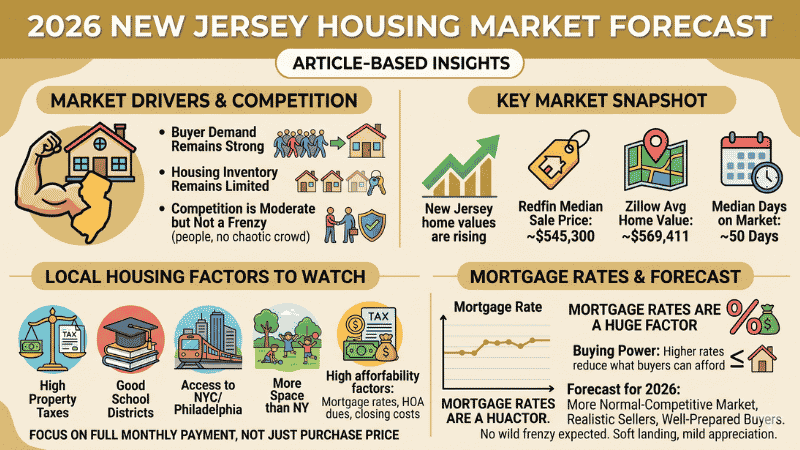
Mortgage rates will remain one of the biggest factors affecting the New Jersey housing market in 2026. Even a small change in rates can make a major difference because New Jersey buyers must also account for high property taxes, homeowners’ insurance, HOA dues, commuting costs, and possible condo or HOA fees.
For buyers, the most important number is not only the purchase price. It is the full monthly housing payment. That includes principal, interest, property taxes, homeowners’ insurance, mortgage insurance when required, HOA dues, and any other housing-related costs. In a high-tax state like New Jersey, two homes with the same purchase price can have very different monthly payments depending on the town, county, tax assessment, insurance cost, and property type.
Higher mortgage rates can reduce buying power because the same income qualifies for a smaller loan amount. This can make buyers more cautious, especially first-time buyers and families shopping near the top of their budget. When rates rise, some buyers may narrow their price range, increase their down payment, request seller concessions, or consider different loan programs.
If mortgage rates remain steady or decline, more buyers who paused their home searches may return to the market. This could increase competition, especially in popular commuter towns, school districts, and areas with limited inventory. However, affordability will still matter. Buyers should not rely only on rate forecasts when deciding whether to purchase a home.
For sellers, mortgage rates can affect how quickly a home sells and how aggressively buyers make offers. A well-priced home in a strong location may still attract serious buyers. However, overpriced homes may sit longer because buyers are more focused on monthly payment comfort than they were during the low-rate years.
The best strategy for New Jersey buyers in 2026 is to get fully pre-approved, review the full payment with taxes and insurance, and compare several loan options before making an offer. Sellers should understand how rates affect buyer affordability and price their homes based on current market conditions, not peak-market expectations.
New Jersey Housing Market Stronger Than Expected For 2026
While some have projected a significant drop in New Jersey’s market after the recent surge in prices, the New Jersey housing market is stronger than expected for 2026. Prices continue to increase, inventory levels are rising slowly, and demand from New Jersey, New York City, and out-of-state buyers remains solid in the long term.
For homebuyers and current homeowners looking to sell in 2026, it is crucial to understand the underlying reasons for this durability. Gustan Cho Associates offers a New Jersey housing market overview and provides preparation steps for a successful 2026.
With the new “Fourth Round” as recently unveiled affordable housing requisites, it has the ability to increase market growth. The initiative addresses the Affordable Housing 60,000 to 80,000 targeted units and will increase market inventory, providing additional options for buyers 6.
2025 Recap: Why the New Jersey Housing Market Stayed Resilient
Buyers face a peculiar market that has both positive and negative traits. The higher competition in the market for sellers is balanced out by the increased demand in some segments. Buyers will also benefit from the fact that mortgage interest rate is relatively low compared to the past. Buyers in today’s market need to hire a realtor who can guide them in order to maximize the value of the properties purchased.
Sellers in New Jersey are seeing homes fly off the market and in return selling themselves homes at record prices. Many are still able to retain the selling profit margin.
However, the selling profit margin can be lost. Competitive and accurate pricing must be set in order to attract and capture a larger sphere of serious buyers. Moreover, sellers should also analyze the selling period, as most buyers in the market tend to be out during spring. 5,4 and other literature sources.
Home Prices in New Jersey Are Still Rising
- Although concerns persist about mortgage rates and the likelihood of a recession, home prices in New Jersey have actually increased in 2024 and 2025.
- According to Zillow, the average home value in New Jersey is approximately $564,000, representing a 3-5% increase from the previous year.
- Typical homes are contracted in under three weeks.
Additional analyses from across the state indicate:
- Median sale prices of $ 580,000 or more indicate an approximate 5-6% increase from the previous year.
- Homes for sale are up 10% compared to last year, still below the standard set before the pandemic.
- A three-month supply during the 2021-2022 period was a frenzy; a less severe supply is still not a true buyer’s market.
- For this very reason, experts are declaring that the New Jersey housing market is stronger than initially predicted for 2026.
Local Markets Demonstrate Enduring Strength
The same story of pricing moderation – as opposed to collapse – emerges as we zoom in on selected counties:
- Bergen County: Average home value around $753,000, up around 3 to 4% year on year, and homes going pending in around 24 days.
- Monmouth County: Average home value around $741,000, year over year, increasing by almost 2%, and going under contract in about 20 days.
- More urban centers, such as Jersey City, exhibited an even stronger appreciation.
- In the latter half of 2025, the mid-sale price increased by approximately 7% year-over-year, and homes in the area continued to sell, albeit at a reduced rate compared to the previous year.
- To put things in perspective, despite the height of bidding wars in 2021 and 2022, the New Jersey market remains in demand, with prospects, as most markets are still heading up rather than down.
For Whom Is the New Jersey Housing Market Stronger?
Increase In Population And Housing Demand
- The reason the New Jersey market is the strongest of all for 2026 is quite evident: New people continue to arrive.
- The New Jersey state government reports that the state gained approximately 9.5 million residents and experienced the fastest growth rate in the Northeast, increasing by about 1.3% from 2023 to 2024.
Greater Population Means:
- An increase in the number of underserved families that are looking to purchase a house.
- There is still a demand in the commuter suburb regions that caters to New York City as well as Philadelphia.
- There is a strong demand for rentals, which permits investor activities and property demand to increase.
- Even as residents flee the high-tax regions, New Jersey still receives a large amount of inbound migration from New York City and other pricey metropolitan areas, which keeps the real estate market in New Jersey competitive.
Employment, GDP, and the Slow, Still Growing Economy
Economists predict relatively slower GDP growth for New Jersey between 2025 and 2026 compared to the rest of the country, specifically 0.5% and 0.7%, compared to significant national growth. ([NJTPA][7])
More advanced predictions claim New Jersey’s job growth will trail the U.S. in 2025, but significantly surpass the national average the following year when current downturns improve.
This typically indicates for housing:
- No significant, explosive growth, however,
- Sufficient job and income stability to avoid a housing market crash, moderately increasing the likelihood of stagnant growth.
Limited Supply and Structural Problems with Affordability
New Jersey goes deeper with its supply constraints:
- High construction costs due to stringent local zoning regulations.
- Built suburban areas with scarce space.
- Poorly functioning, scarce housing units.
- Reports indicate that in New Jersey, the housing needs of low-income individuals are met by fewer than 2,000 units, and housing prices have surged by nearly 45% over the past four years.
- At the same time, evaluations of the suburbs have found that New Jersey has the most suburbs, 39, in which there are a greater number of renters than homeowners.
- This mix of high demand and limited supply, along with affordability hurdles, means price growth will not be as staggering as it was in 2021.
- However, it also makes steep price reductions in 2026 increasingly unlikely.
First-time buyers—maximize programs and credits
Layer NJ assistance, lender credits, and seller concessions to lower cash to closeNew Jersey Housing Market Forecast 2026: Prices, Sales, and Inventory
What Is the Future of New Jersey Home Prices in 2026?
Recent independent forecasts anticipate sustained appreciation in home prices in New Jersey at a slower, healthy pace:
- One of the popular forecasts predicts that New Jersey home prices may increase by roughly 2-4% in 2025 and by an additional 1-3% in 2026, resuming the upward trajectory during 2027-2029 at a much slower pace.
- Along with current-day Zillow and Redfin data, this supports the proposition that the New Jersey housing market is performing better than expected in 2026, more akin to a soft landing than a collapse.
Inventory: It Offers More Opportunity, but Not a Buyer’s Market
Compared to the tightest years of the pandemic, the inventory has increased, but New Jersey is not swimming in houses:
- Homes for sale increased by 10-11% on average every year.
- Months of supply at around 3 months, below the 5-6 months associated with a balanced or buyer’s market.
- About half of the homes that sold closed above list price, though that share is lower than peak levels.
In 2026, buyers are likely to have more alternatives with fewer intense bidding wars. However, homes in popular commuter towns and those with excellent schools may still sell quickly.
Mortgage Rates and Affordability in 2026
- Even though mortgage rates are higher than they were before the COVID outbreak, buyers’ expectations are starting to adjust, and the shock of the initial jump is starting to fade.
- Suppose rates remain flat or decrease only slightly in 2026.
- In that case, a notable percentage of buyers who remained inactive during 2023 and 2024 will likely decide to re-enter the market.
This suggests:
- Although payments are likely to feel elevated, with New Jersey’s property taxes added in,
- Pent-up demand is likely to keep the New Jersey housing market stronger than expected for 2026.
- This will, in turn, prevent prices from falling enormously, even in the event of an economic downturn.
New Jersey Housing Market Stronger Than Expected for 2026: Implications For Buyers
No 2021-Style Frenzy, But A Normal-Competitive Market Instead
For buyers in New Jersey, the stronger-than-expected forecast for 2026 is illustrated as:
- Barely any of the wild, twenty-offer bidding wars.
- Inventory that is still scarce in ideal suburbs, particularly in the vicinity of major highways, train lines, and top-rated schools.
- Only modest, as opposed to double-digit, price appreciation.
- Unlike buyers in 2021-2022, you will have more time to think, but 2026 is not one that you can consider to be a distressed-sale environment.
Strategies for Buying a Home in New Jersey in 2026.
Here are practical guidelines to approach a 2026 market that is likely to be stronger than anticipated:
Obtain a Strong Pre-Approval Letter From The Lender. Do Not Settle For a Pre-Qualification
- In some cases, even in competitive markets, a well-prepared offer can be beneficial.
- To assist in securing a property in the competitive market, Gustan Cho Associates issues a strong mortgage pre-approval rather than a quick pre-qualification letter.
Identify The Monthly Payment, Including Escrow Payment
- In New Jersey, HOA fees, premiums, and property taxes are considerably higher than in other places.
- It is essential to recognize that any loan structure with a lender willing to work with you will be beneficial.
- New Jersey’s lender mortgage environment is not ideal, so consider a loan that has a prepayment penalty.
Inquire About The Distance From The Property and The Property Type
In certain cases, there are better alternatives:
- Suburbs that are more distant from Manhattan or Philadelphia.
- In commuter towns that are emerging.
- In attached housing (condos/townhomes) rather than detached single-family housing, as published in the New York Post.
Obtain a Loan Creatively
- There are government-sponsored loans that do not have any overlays.
- Gustan Cho Associates has been fully dedicated to providing seamless phenomenal service in New Jersey without adding the expensive overlays.
- If you are a buyer with significant student debt, you don’t have to suffer.
- There are numerous loan products available to assist you, including FHA, VA, USDA, and Conventional loans with overlays.
Implications for Sellers for The New Jersey Housing Market Stronger Than Expected For 2026
You Still Have The Advantage—If You Price Wisely
As far as sellers are concerned, the New Jersey housing market is stronger than expected for 2026, which is fantastic:
- Most areas still have housing prices higher than they were a year ago.
- Homes are taking longer to sell, but if a home is priced correctly, the time is still only a few weeks.
- However, compared to the zero-rate period, there is far more sensitivity to prices.
- The viability of the strategy of overpricing a home, waiting for a period of time, and hoping to find a unicorn buyer is far less likely to be realized in 2026.
Seller strategies for the upcoming year of 2026:
- Mark the asking price above the market,” not at the high price value of last year.
- Give greater importance to minor repairs, cosmetic renovations, and decluttering activities.
- Focus on closing cost concessions and rate buydowns instead of price concessions.
Timing of Your Sale For 2026
- Seasonality has returned to the NJ housing market.
- Spring and early summer (March-June) is still the premier listing period.
- Late fall and winter still work for serious, motivated buyers and relocators, but the shopper pool will be sparse.
- Suppose you have to sell during this slow time of the year.
- In that case, your chances of a successful listing will be better working with an experienced realtor and a lender who can help you structure competitive financing.
Will the New Jersey Housing Market Collapse in 2026?
A real housing market crash involves:
- An extreme abundance of available homes.
- An extreme increase in necessitated selling.
- An extreme decrease in home value over a specified duration.
As of Now, The Data Does Not Uphold That Argument For New Jersey:
- While still below the long-term national averages, housing inventory has increased.
- Foreclosures and Delinquencies remain under control.
- Most credible forecasts show modest price growth for 2026, not negative.
Will some localized markets stagnate or see price erosion?
- Yes.
- However, the New Jersey housing market is predicted to have a soft landing with mild appreciation in 2026, rather than a bust.
How Gustan Cho Associates Can Help You Win the New Jersey Housing Market in 2026
- We serve New Jersey buyers, homeowners, and investors, having worked with Gustan Cho Associates for the New Jersey Housing Market in 2026.
- Pre-approval must be reliable and obtained from real agencies (no overlays).
- AAA has: Access to FHA, VA, USDA, conventional, jumbo, bank statement, DSCR, and other non-QM options.
- We have a staff who understands New Jersey’s high property taxes, HOA restrictions, condo approval problems, and appraisals.
Whether you’re a first-time buyer looking to get into a home in Bergen County, moving “up” in Monmouth County, or are looking to invest in a small multi-unit dwelling next to a commuter rail, we can help you find a suitable loan.
With loans available at the most competitive interest rates, you have the advantage that most loans can be paid back in a much shorter period, enabling you to get mortgage-free much faster.
Final Thoughts On The New Jersey Housing Market In 2026
The New Jersey housing market is expected to remain competitive in 2026, but buyers and sellers should approach the market with realistic expectations. Home prices probably aren’t going to crash across the state, but finding a place you can actually afford is still going to be tough. With mortgage rates, high property taxes, homeowners’ insurance, HOA fees, and a shortage of homes in popular areas, it’s going to be a challenge.
For buyers, the key is preparation. Before making an offer, review the full monthly payment, not just the purchase price. Property taxes can vary widely by town and county, and that difference can change how much home you can truly afford.
A strong pre-approval, realistic budget, and clear understanding of your loan options can help you compete without overextending yourself.
For sellers, New Jersey still offers opportunity, especially in strong commuter towns, popular school districts, and neighborhoods with limited housing supply. However, buyers are more payment-sensitive than they were during the peak bidding-war years. Homes that are clean, updated, and priced correctly may still attract strong interest. Homes priced too high might take longer to sell or require price breaks to attract buyers.
The best way to navigate the New Jersey housing market in 2026 is to focus on facts, not fear. Buyers should compare towns, taxes, loan options, and monthly payments before making a decision. Sellers should price based on current market conditions, not past peak-market expectations.
Gustan Cho Associates can help New Jersey buyers, homeowners, and real estate investors review mortgage options, compare payments, and prepare for the market with confidence. Whether you are buying your first home, selling and moving up, refinancing, or investing, the right mortgage plan can make a major difference in a high-cost state like New Jersey.
FAQs About The New Jersey Housing Market In 2026
Will New Jersey Home Prices Go Down In 2026?
New Jersey home prices are not expected to drop sharply statewide in 2026. Recent data shows that New Jersey home values are still rising, although at a slower pace than the peak bidding-war years. Redfin reported that New Jersey home prices were up 3.7% year over year in March 2026, with a median sale price of $545,300. Zillow also reported the average New Jersey home value at $569,411, up 3.5% over the past year. Some local markets may cool, and overpriced homes may need price reductions. However, limited inventory, commuter demand, school district demand, and strong household income in many areas may help prevent a major statewide price decline.
Is New Jersey A Buyer’s Market Or Seller’s Market In 2026?
New Jersey is still closer to a seller’s market than a true buyer’s market in many areas. Inventory has improved, but supply remains limited compared to what would normally create a balanced market. Redfin reported about 3 months of housing supply in March 2026, while a balanced market is often closer to 5 or 6 months of supply. That does not mean sellers can overprice their homes. Buyers are more payment-sensitive because of mortgage rates, property taxes, insurance, and HOA dues. Affordable homes in good neighborhoods tend to sell fast, but if a place is overpriced, it might hang around on the market for a while.
Will The New Jersey Housing Market Crash In 2026?
A major New Jersey housing market crash does not appear likely based on current price, inventory, and demand trends. A crash usually requires a large oversupply of homes, major forced selling, and sharp price declines. Current New Jersey data shows the opposite: prices are still rising, inventory remains tight, and many homes continue to sell near or above asking price. However, the market can still slow down. Some neighborhoods may see longer days on market, fewer bidding wars, or small price adjustments if affordability weakens.
Is 2026 A Good Time To Buy A House In New Jersey?
2026 can be a good time to buy a house in New Jersey if the monthly payment fits your budget and you plan to stay in the home long enough to benefit from ownership. Buyers may have more choices than they had during the tightest inventory years, but desirable towns can still be competitive. The key is to focus on the full payment, not just the home price. New Jersey buyers should compare mortgage principal and interest, property taxes, homeowners’ insurance, mortgage insurance, HOA dues, commuting costs, and maintenance before making an offer.
Why Is The New Jersey Housing Market So Expensive?
The New Jersey housing market is expensive because demand is high and supply is limited in many areas. Buyers are often attracted to New Jersey because of access to New York City, Philadelphia, major job centers, commuter routes, school districts, and established suburban communities. New Jersey also has high property taxes, limited buildable land in many developed areas, and strong demand for homes near trains, highways, schools, and employment centers. These factors can keep prices elevated even when mortgage rates make affordability more difficult.
How Do High Property Taxes Affect Buying A Home In New Jersey?
High property taxes can significantly affect how much home a buyer can afford in New Jersey. Lenders count property taxes as part of the monthly housing payment when calculating the debt-to-income ratio. That means two homes with the same purchase price can have very different qualifying payments depending on the town, county, tax assessment, and local tax rate. Before making an offer, buyers should check out the total PITI payment, which includes principal, interest, taxes, and insurance. If the home has HOA dues or mortgage insurance, those costs should also be included in the budget.
This article about “New Jersey Housing Market Stronger Than Expected For 2026” was updated on May 6th, 2026.