Quick Answer: The VA funding fee is a one-off charge on most VA loans (unless you qualify for an exemption). The amount depends on the type of loan, whether you’ve previously used your VA benefits, and, in the case of a purchase, your down payment. You can generally pay it at closing or finance it. Knowing what the VA funding fee is helps you compare the up-front costs, check whether you qualify for an exemption, and avoid having an extra charge on your mortgage.
What Is the VA Funding Fee?
The funding fee helps support the VA home loan program. It is paid to the Department of Veterans Affairs. It is separate from the lender’s origination charges, discount points, and other settlement expenses.
VA loans do not require monthly mortgage insurance. However, borrowers who are not exempt generally owe a funding fee when obtaining a new VA loan. Financing the fee spreads its repayment over time; it does not turn it into mortgage insurance.
For military eligibility, credit, income, and property requirements, see our separate guide to VA home loan requirements.
Current VA Funding Fee Rates
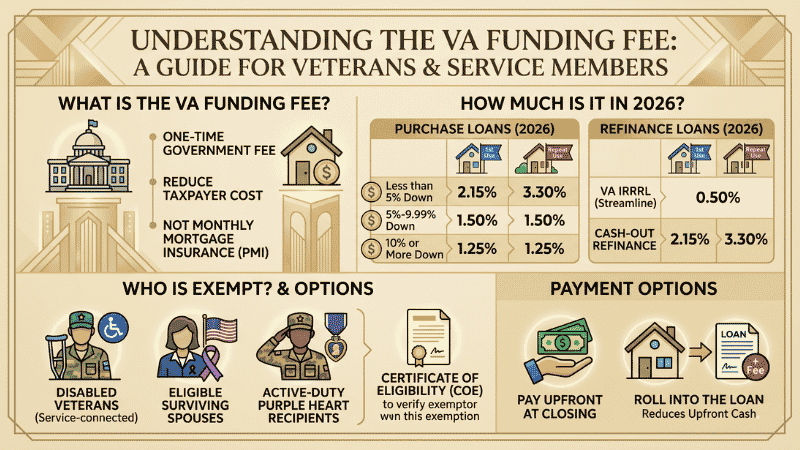
The purchase and cash-out rates below took effect on April 7, 2023, and remain current as of October 31, 2026. These rates apply to nonexempt borrowers.
| Down payment | First use | Subsequent use |
|---|---|---|
| Less than 5% | 2.15% | 3.30% |
| At least 5% but less than 10% | 1.50% | 1.50% |
| 10% or more | 1.25% | 1.25% |
The same schedule applies to eligible veterans, active-duty service members, National Guard members, and Reservists. “First use” refers to use of the VA loan benefit, rather than whether you have ever owned a home.
| Refinance transaction | Funding fee |
|---|---|
| VA Interest Rate Reduction Refinance Loan (IRRRL) | 0.50% |
| VA cash-out refinance: first use | 2.15% |
| VA cash-out refinance: subsequent use | 3.30% |
The cash-out funding-fee rate does not decrease because you have more equity. For help choosing a refinance program, read our comparison of VA refinance options. Other transactions, including certain manufactured-home loans and Native American Direct Loans, have separate schedules. Check the VA’s official funding-fee charts for the applicable category.
Who is Not Required to Pay the VA Funding Fee?
An exemption removes the funding fee entirely. You may qualify if you:
- Receive VA compensation for a service-connected disability.
- Are entitled to that compensation but receive retirement or active-duty pay instead.
- Receive Dependency and Indemnity Compensation as a qualifying surviving spouse.
- Are a service member with a planned or recorded rating
- Received before closing that establishes eligibility for compensation through a pre-discharge claim.
- Are on active duty and provide evidence, on or before closing, that you received a Purple Heart.
A 100% disability rating is not required. The question is whether you meet a qualifying exemption category. Ask the lender to confirm your funding-fee status early. If your Certificate of Eligibility shows an unresolved status or does not reflect your circumstances, provide the supporting VA documentation so the lender can obtain clarification.
How to Calculate Your VA Funding Fee
For a standard purchase, multiply the base loan amount, before adding the fee, by the applicable percentage. Base loan amount × funding-fee rate = funding fee The following example compares three down payment options for the same $300,000 home purchase. It assumes first use, no exemption, and financing the entire funding fee.
| Down payment | Base loan | Fee rate | Funding fee | Loan including fee |
|---|---|---|---|---|
| $0 | $300,000 | 2.15% | $6,450 | $306,450 |
| $15,000 (5%) | $285,000 | 1.50% | $4,275 | $289,275 |
| $30,000 (10%) | $270,000 | 1.25% | $3,375 | $273,375 |
A down payment reduces both the amount borrowed and, at these thresholds, the fee percentage. That does not automatically make a larger down payment the best use of your savings. Compare the fee reduction with the cash you would retain for repairs, moving, and emergencies. These figures exclude other closing expenses and prepaid items.
Should You Pay the Funding Fee at Closing or Finance It?
Paying the fee at closing keeps it out of your mortgage balance. Financing it preserves cash but increases the balance on which you pay interest.
In the zero-down example above, paying the $6,450 fee separately leaves a $300,000 mortgage. Financing it creates a $306,450 mortgage. With the same rate and term, the larger balance produces a higher principal-and-interest payment.
Ask for both versions of the estimate. Compare the cash required, monthly payment, and savings remaining after closing. On a purchase, permission to finance the funding fee does not mean other closing costs can also be added to the loan. Cash-out refinancing has separate loan-to-value limits that can restrict financing the fee. See our VA cash-out refinance guide for those transaction rules.
Can the Seller Pay Your VA Funding Fee?
Yes. A negotiated seller contribution can cover the buyer’s funding fee. That payment counts as a seller concession. VA limits total seller concessions to 4% of the property’s established reasonable value, as shown on the VA Notice of Value. Ordinary allowable closing-cost payments are treated separately from concessions. For a home with a VA reasonable value of $300,000, the concession ceiling is $12,000. If the seller pays a $6,450 funding fee, that amount counts toward the ceiling, leaving $5,550 for other qualifying concessions. The seller must agree to the contribution, and the lender must review its allocation. Do not assume a general contract credit will automatically be assigned to the funding fee.
Can You Receive a VA Funding Fee Refund?
You may qualify for a refund if you pay the fee and are later awarded VA disability compensation with an effective date before your loan closed. The effective date matters. Receiving an award after closing does not, by itself, establish refund eligibility. A proposed or memorandum rating received only after closing does not, by itself, establish a refund entitlement. If you believe a refund is due, contact your mortgage lender or servicer, or a VA regional loan center. Have your Closing Disclosure and VA award information available.
What Should You Check Before Closing?
Review these details with your loan officer:
- Exemption status: Has the VA confirmed if you need to pay the fee?
- Loan category: Are you using the right schedule for purchase, refinance, or another type of loan?
- Prior benefit use: Has the lender checked if this is your first use or a subsequent use?
- Calculation: Is the fee amount correct based on the rate and your loan amount?
- Payment source: Are you planning to pay the fee, finance it, or use an approved contribution?
Compare the funding fee amount on your Loan Estimate with the amount on the Closing Disclosure. Ask about any difference before signing. Gustan Cho Associates can help borrowers review the funding fee estimate and identify the documentation needed to clarify their exemption status.
Frequently Asked Questions About the VA Funding Fee:
Can a Lender Waive the Funding Fee to Match Another Offer?
A lender can’t create a VA exemption or alter the government fee schedule. If the offers show different funding fee amounts, you need to ask the lenders whether they’re using different loan amounts, down payments, prior use information, or exemption assumptions. You need to look at the lender charges in isolation.
Does a Funding Fee Exemption Eliminate Other Closing Costs?
No. An exemption will remove the VA funding fee. The appraisal, title, lender, recording, and other applicable fees will remain. Always check the full estimate rather than assume that an exempt borrower has no closing costs at all.
Is There a Funding Fee When Someone Assumes a VA Loan?
A VA loan assumption generally carries a 0.50% funding fee unless an exemption applies. It is calculated using the unpaid principal balance at the time of transfer. Assumption-related processing charges are separate.
Can a Funding Fee Estimate Change Before Closing?
Yes. A change to the loan amount, purchase down payment, loan category, or confirmed fee status can change the calculation. Ask the lender to explain the reason and provide updated figures.
Where Does a Refund Go if You Financed the Fee?
VA generally pays a funding fee refund owed to the borrower directly to the borrower, even when the fee was financed. The refund does not automatically reduce the mortgage balance. You may choose to apply it toward principal through your servicer.
Final Thoughts About the VA Funding Fee
To understand the VA funding fee, first check if it applies to you, then find the right rate and decide how you want to pay. Make sure to confirm your exemption status before closing and use your real loan numbers to figure out the fee. Paying less upfront can help, but if you finance the fee, it will increase your mortgage balance. Look at both ways to pay and keep your records, especially if you have a pending disability decision that might make you eligible for a refund.
This article about “Understanding the VA Funding Fee: Rates, Exemptions, and Refunds” was updated on October 30th, 2026.