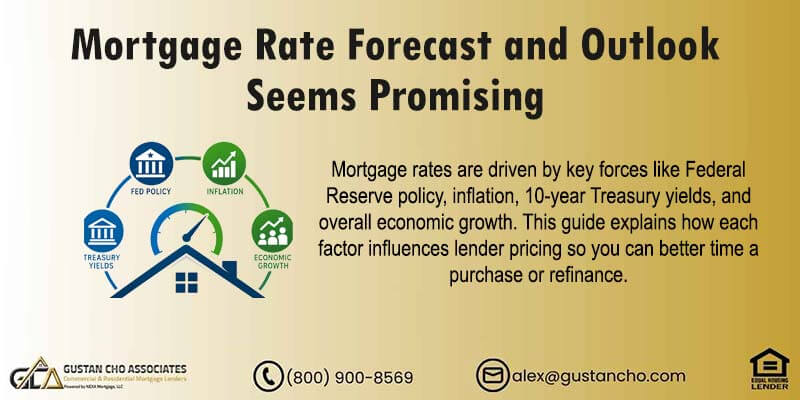
This guide covers mortgage rate forecast and outlook seem promising with the election of a new President. Mortgage rate forecast is expected to move lower in 2025 into 2026. Mortgage rate forecast and outlook seem like rates will move lower but not quickly due to inflation and the Trump tariffs. John Strange, a senior mortgage loan originator at Gustan Cho Associates says the following about mortgage rate forecast and outlook for 2025 into 2026:
The 2025-2026 mortgage rate forecast and outlook seems promising and positive for first time home buyers, seasoned homebuyers, and homeowners thinking of refinancing their current home loans.
2025 has brought on many changes in the mortgage industry such as HUD and FHFA increasing the maximum FHA lending limit to $524,225 and Conventional loan limit to $806,500 unless the property was in a high-cost area. High cost loan limit for FHA and Conventional loans is capped at $1,209,750. There were changes to government-backed and conventional loans as well as non-QM loans. On Qualified Mortgages (QM Mortgages), the ability to repay got implemented and got more strick on the different types of Non-Qualified loan programs. HomePath conventional loans are no longer in existence. In the following paragraphs, we will cover the 2025-2026 mortgage rate forecast and outlook.
Impact of High Inflation, High Home Valuation, and Bad Economy on Mortgage Rate Forecast

Fannie Mae has changed rules on getting a conventional loan after a deed in lieu of foreclosure and short sale from 2-year waiting period after a deed in lieu or short sale with 20% down payment to a 4 year waiting period after the deed in lieu or short sale with a 5% down payment. Alex Carlucci, a senior mortgage loan originator at Gustan Cho Associates says the following about borrowers who had a mortgage included in their bankruptcy:
Another positive new Fannie Mae guidelines are that Fannie Mae has implemented changes on the waiting period requirements for borrowers with a prior mortgage included in bankruptcy.
The waiting period will go off the bankruptcy discharge date and not the recorded date of the foreclosure, deed-in-lieu of foreclosure, or short sale. The mortgage that is included in the bankruptcy cannot be reaffirmed. This will help tens of thousands of homebuyers who had a mortgage as part of their bankruptcy without having to wait for the recorded date of the foreclosure. In this article, we will discuss and cover mortgage rate forecast and outlook for 2025 into 2026.
Current 2026 Housing Market Conditions
The 2026 housing market outlook shows a market adjusting to high borrowing costs, slower price growth, and improving—but still uneven—housing supply. National data can provide direction, but buyers and sellers should also review local prices, inventory, property taxes, insurance costs, and employment trends.
Mortgage Rates
Mortgage rates remain the largest affordability challenge. As of August 6, 2026, Freddie Mac reported average rates of 6.69% for a 30-year fixed mortgage and 6.01% for a 15-year fixed mortgage. The 30-year rate was slightly above the 6.63% average recorded one year earlier.
These figures are national averages, not guaranteed offers. A borrower’s actual rate depends on credit, down payment, loan program, property type, points, and market conditions. Buyers should compare the interest rate, APR, lender fees, and total monthly payment instead of waiting for a specific national rate.
Home prices are still rising nationally, but appreciation has slowed. The FHFA House Price Index increased 2.2% from May 2025 to May 2026, compared with the much faster gains seen earlier in the decade. Monthly prices rose 0.3% in May after declining 0.1% in April.
Regional conditions differ sharply. FHFA reported annual changes ranging from a 0.3% decline in the Pacific division to a 4.5% increase in the Middle Atlantic division. This means national headlines may not accurately describe an individual city or neighborhood.
The National Association of REALTORS reported a $440,600 median existing-home price in June 2026, up 1.8% from one year earlier. The NAR figure measures homes sold during the month, while the FHFA index tracks repeat sales, so the two statistics should not be treated as identical measures.
Inventory and Home Sales
Existing-home inventory reached 1.56 million properties in June, an increase of 1.3% from one year earlier. That represented a 4.6-month supply at the current sales pace. Supply has improved from the severe shortages of recent years, but it remains uneven across markets and price ranges.
In June, existing-home sales were at a seasonally adjusted annual rate of 4.09 million. Sales declined 2.4% from May but increased 2.8% from June 2025. The mixed results show that buyers remain highly sensitive to changes in mortgage rates and payments.
Properties were sold in an average of 28 days. Well-priced homes in low-inventory areas may still receive strong interest, while overpriced properties can take longer to sell or require concessions.
New Construction
New construction presents a mixed picture. Total housing starts reached an annual rate of 1.427 million units in June 2026, up 19% from May. However, much of that increase came from multifamily construction. Single-family starts were nearly unchanged at 895,000.
Building permits—a sign of future construction—fell to an annual rate of 1.367 million units, down 3% from May and 2.3% from June 2025. Single-family permits also declined, suggesting that builders remain cautious about future demand.
New-home sales reached an annual rate of 628,000 in June, while builders had an estimated 485,000 new homes for sale, equal to a 9.3-month supply. The median new-home sales price was $398,300. In markets with substantial builder inventory, buyers may find price reductions, closing-cost assistance, or temporary mortgage-rate buydowns, but every incentive should be weighed against the home’s price and total financing costs.
What Current Forecasts Predict for the Rest of 2026
The major housing forecasts point to a slow and uneven market through the end of the year. Most economists expect mortgage rates to remain above 6%, home prices to rise at a modest pace, and home sales to improve only if affordability and inventory get better. The housing market outlook for 2026 does not suggest a nationwide crash or a rapid return to the low-rate market of prior years.
Fannie Mae Forecast
Fannie Mae’s July 2026 forecast projects the average 30-year fixed mortgage rate to remain near 6.4% during the third and fourth quarters. The organization expects approximately 4.76 million total home sales for the full year, nearly unchanged from 2025.
Fannie Mae also forecasts:
- Approximately 4.13 million existing-home sales
- About 637,000 new-home sales
- Home-price growth of approximately 2.3%
- About 1.34 million total housing starts
- A 4.2% annual decline in single-family construction
These estimates point to a market with limited sales growth, modest appreciation, and continued affordability pressure. Fannie Mae expects sales to improve during 2027, but its 2026 forecast remains cautious.
Freddie Mac Forecast
As of August 6, 2026, Freddie Mac’s public research page does not provide an updated numerical forecast for the remainder of 2026. Its most recent listed Economic, Housing, and Mortgage Market Outlook is dated January 24, 2025. Therefore, an article should not attribute a specific year-end rate, sales total, or price forecast to Freddie Mac without a newer published forecast.
Freddie Mac’s current market data still show the forces shaping the outlook. The average 30-year fixed rate was 6.69% on August 6, while inventory had improved from the severe shortage of prior years. Freddie Mac also reported that listing prices were modestly below year-earlier levels. These conditions suggest gradual market adjustment, but not a broad affordability recovery.
Other Housing-Economist Forecasts
The National Association of REALTORS revised its forecast in June 2026. NAR Chief Economist Lawrence Yun now expects:
- Existing-home sales to rise approximately 4% in 2026
- The median home price is expected to increase by about 4%
- Mortgage rates are expected to average approximately 6.5%
- Sales activity is expected to improve modestly during the second half of the year
This forecast is much more cautious than NAR’s earlier projection of a 14% increase in 2026 existing-home sales. The revision shows why forecasts should be dated and updated as rates, inflation, employment, and buyer demand change.
The broad agreement among housing economists is that the market should remain highly sensitive to mortgage rates. A meaningful rate decline could improve purchasing power and release some pent-up demand. If rates remain near current levels, however, home sales may stay subdued, and price trends will continue to vary widely by location.
Will the Federal Reserve Cut Rates in 2026?
A Federal Reserve rate cut is still possible in 2026, but current Fed projections do not make it the most likely outcome. On July 29, the Federal Open Market Committee kept the federal funds rate at 3.50% to 3.75%. Three voting members preferred a quarter-point increase because inflation remained above the Fed’s 2% goal.
The Fed’s June projections also showed a median year-end federal funds rate of approximately 3.8%, slightly above the current range’s midpoint. Only one of the 18 participants projected a lower year-end rate. These projections can change, but they suggest that a 2026 rate cut would likely require clearer evidence that inflation is falling or the labor market is weakening.
The Fed has three scheduled meetings remaining in 2026: September 15–16, October 27–28, and December 8–9. Officials will review inflation, employment, economic growth, and financial conditions before each decision.
Why a Fed Cut Does Not Guarantee Lower Mortgage Rates
The Federal Reserve does not set mortgage rates directly. The federal funds rate applies to short-term lending between banks, while 30-year mortgage rates are influenced more by:
- Long-term Treasury yields
- Inflation expectations
- Mortgage-backed securities demand
- Economic growth and employment
- Investor risk and lender pricing
Mortgage rates can fall before a Fed cut if investors expect slower growth or lower inflation. They can also remain unchanged—or even rise—after a cut if inflation concerns push long-term yields higher.
For the 2026 housing market outlook, buyers should not assume that waiting for a Fed decision will result in a lower mortgage payment. A better approach is to compare current loan options, purchase only when the payment is affordable, and ask whether refinancing could make sense if rates decline later.
What Moves Mortgage Rates? A Quick Recap
Mortgage rates don’t just pop up out of thin air; they run on several big engines:
- Fed Policy: When the Federal Reserve tweaks its benchmark rate, it indirectly sets the cost banks pay to borrow money, which trickles down to mortgage loans.
- Inflation: If prices keep climbing fast, lenders usually raise mortgage rates so they don’t lose profit over time.
- Treasury Yields: The yield on 10-year U.S. Treasury bonds acts like a North Star for mortgages; when those yields go up or down, mortgage rates tend to follow.
- Economic Growth: A booming job market and rising GDP may increase rates, while recessions or slowdowns often pull them lower.
What the Outlook Means for Homebuyers
The housing market outlook for 2026 gives homebuyers more choices in many areas, but affordability remains a challenge. Higher inventory may reduce bidding pressure and create opportunities to negotiate. However, mortgage rates, home prices, property taxes, homeowners’ insurance, and HOA fees can still make the total monthly payment difficult to manage.
Buyers should focus on their finances and the local market rather than trying to predict the perfect time to purchase.
Compare the Total Monthly Housing Payment
A lower home price does not always make a property affordable. Before making an offer, estimate the complete monthly cost, including:
- Principal and interest
- Property taxes
- Homeowners insurance
- Mortgage insurance, when required
- HOA dues
- Flood insurance or other location-specific coverage
Buyers should also budget for maintenance, repairs, utilities, and closing costs. Comparing Loan Estimates from different lenders helps you spot differences in rates, fees, and projected payments.
Get Preapproved—and Keep the Preapproval Updated
Mortgage rates and borrower finances can change during a home search. A buyer who was approved several months ago may qualify for a different loan amount today.
Ask the lender to update the preapproval before making an offer if:
- Mortgage rates have changed
- Income or employment has changed
- Credit-card balances have increased
- New debt has been opened
- The target home price or property type has changed
- Property taxes, insurance, or HOA dues are higher than expected
An updated preapproval can reduce the risk of offering more than the current budget supports.
Look for Negotiating Opportunities
Buyers may have more leverage in markets where listings are rising, and homes are taking longer to sell. Depending on the property and local demand, a buyer may be able to negotiate:
- A lower sales price
- Seller-paid closing costs
- Repair credits
- A temporary or permanent mortgage-rate buydown
- Replacement of major systems or appliances
- A flexible closing or occupancy date
Seller concessions must comply with the selected loan program, and a concession should not justify paying more than the home is worth.
Do Not Buy Based Only on a Forecast
No national forecast can predict mortgage rates or home prices in a specific neighborhood. Waiting for rates to decline could reduce the future payment, but lower rates may also bring more buyers into the market and increase competition. Buying now with plans to refinance later is also risky because refinancing is never guaranteed.
The best time to purchase is generally when the buyer has stable income, manageable debt, adequate savings, and a payment that remains affordable without depending on future rate cuts or rapid home-price growth. A mortgage professional can compare FHA, VA, USDA, conventional, and non-QM options, but the final decision should be based on the buyer’s complete financial picture.
What the Outlook Means for Home Sellers
The housing market outlook for 2026 gives home sellers reasons for cautious optimism, but pricing and location matter more than national headlines. Homes may still sell quickly in areas with limited inventory. In markets with increased listings, sellers may face longer marketing times, more price competition, and requests for concessions.
Price the Home for Current Conditions
Sellers should base the asking price on recent comparable sales, active competing listings, property condition, and local buyer demand. Pricing a home based on last year’s market can cause it to sit unsold.
An overpriced home may require several reductions, while a well-priced property can attract stronger interest from the start. Sellers should review local data with a qualified real estate agent before listing.
Prepare for More Selective Buyers
High mortgage rates and housing costs have made many buyers careful about which homes they pursue. Before listing, sellers should consider addressing visible problems such as:
- Peeling paint or damaged flooring
- Plumbing or electrical concerns
- Roof or HVAC issues
- Poor curb appeal
- Unfinished repairs
- Cluttered or poorly staged rooms
Not every repair produces a full return. A pre-listing inspection or agent walkthrough can help identify improvements that prevent delays without encouraging unnecessary spending.
Consider Concessions Strategically
Seller concessions may help a property compete, especially in areas with rising inventory. Depending on the buyer’s loan program and negotiated contract, a seller may contribute toward:
- Closing costs and prepaid expenses
- Temporary or permanent mortgage-rate buydowns
- Inspection-related repairs
- Home warranties
- Survey or title-related costs
A concession may be more effective than a price reduction when the buyer’s primary concern is the cash needed at closing or the monthly payment. However, sellers should compare the estimated net proceeds from each option.
Expect Local Conditions to Drive the Sale
Some homes may still receive multiple offers, while others may take weeks or months to sell. Property type, price range, neighborhood, condition, insurance costs, taxes, and local employment can all affect demand.
Sellers should monitor showing activity and buyer feedback during the first few weeks. Limited interest may indicate that the price, presentation, or marketing strategy needs to change.
Homeowners who also plan to purchase another property should review both sides of the transaction. Their current home may sell for less than expected, but they may gain negotiating power when buying the next home. A realistic pricing plan, an estimated net sheet, and an updated mortgage preapproval can help sellers make decisions based on their full financial position.
What the Outlook Means for Homeowners Considering Refinancing
The housing market outlook for 2026 suggests homeowners should evaluate refinancing based on current loan terms and personal goals—not predictions about future Federal Reserve decisions. Mortgage rates remain elevated, so many homeowners who secured low rates in prior years may not benefit from a standard rate-and-term refinance. However, refinancing may still make sense in certain situations.
Compare the New Loan With Your Current Mortgage
Homeowners should compare the proposed interest rate, monthly payment, closing costs, and remaining loan term with their existing mortgage. A lower monthly payment doesn’t always mean lower overall borrowing costs, especially if refinancing starts a new 30-year term.
Before refinancing, ask the lender to provide:
- The new interest rate and APR
- Estimated closing costs
- The new monthly principal-and-interest payment
- The total payment with taxes and insurance
- The amount of interest paid over the new loan term
- The number of months required to recover the closing costs
For example, if refinancing costs $6,000 and reduces the monthly payment by $200, the simple break-even period is 30 months. The refinance may be less useful if the homeowner expects to sell or pay off the loan before then.
Consider the Purpose of the Refinance
A refinance can serve purposes beyond lowering the interest rate. Depending on the homeowner’s equity, qualifications, and loan program, refinancing may help:
- Change your adjustable-rate mortgage to a fixed-rate loan
- Shorten the repayment term
- Remove private mortgage insurance
- Access equity through a cash-out refinance
- Consolidate higher-interest debt
- Remove or add a borrower
- Replace an FHA loan with a conventional mortgage
Cash-out refinancing should be reviewed carefully. It increases the mortgage balance, reduces available equity, and may carry a higher rate than a limited cash-out or rate-and-term refinance. Using home equity to pay unsecured debt can also convert that debt into a home-secured obligation.
Review Alternatives Before Replacing the Mortgage
Homeowners with low first-mortgage rates should compare home equity loans or lines of credit with cash-out refinancing. These alternatives can keep the existing mortgage in place, though second mortgages may have higher or adjustable rates.
Borrowers should also check whether they qualify for a streamlined refinance, such as an FHA Streamline Refinance or a VA Interest Rate Reduction Refinance Loan, keeping in mind that program rules, seasoning requirements, closing costs, and net tangible benefit standards still apply.
Do Not Assume Refinancing Later Is Guaranteed
Mortgage rates could decline, remain near current levels, or move higher. Even if market rates fall, approval will still depend on the homeowner’s income, credit, debts, equity, property value, employment, and loan-program requirements at that time.
Before proceeding, homeowners should compare Loan Estimates from multiple lenders and calculate both the short-term savings and long-term costs. Refinancing generally makes the most sense when it provides a clear financial or practical benefit that does not depend on an uncertain future rate forecast.
Regional Housing Trends
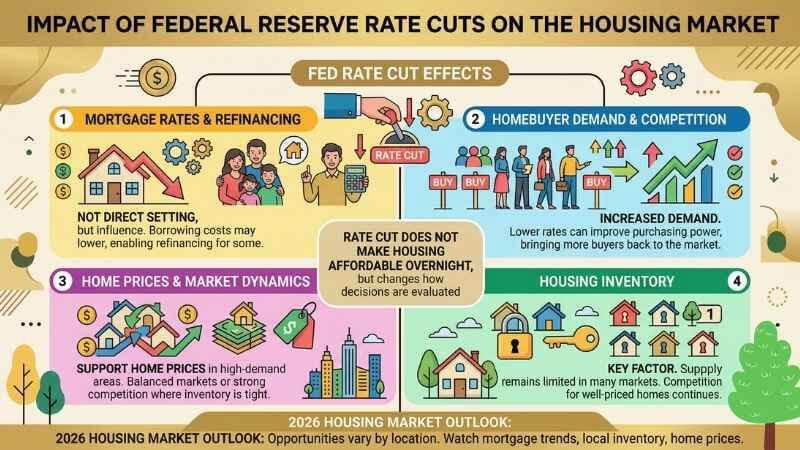
The housing market outlook for 2026 varies widely by region. Some Southern and Western markets offer buyers more room to negotiate, while parts of the Northeast and Midwest still have limited supply and strong competition. Even within the same state, conditions can change by city, neighborhood, price range, and property type.
Markets Becoming More Favorable to Buyers
Many Southern and Western markets have moved closer to balanced conditions because their housing supply has recovered more than in other regions. In June 2026, active listings were 4.7% above pre-pandemic levels in the South and 11.7% above them in the West.
Other signs of increased buyer leverage included:
- Median list prices fell 2.5% annually in the South and 4% in the West.
- Approximately 20.7% of Southern listings and 20.4% of Western listings had price reductions.
- Homes took a median of 61 days to sell in the South and 52 days in the West.
- Austin, Phoenix, and Denver had some of the nation’s highest shares of reduced-price listings.
These conditions may give qualified buyers more time to compare homes, request seller concessions, or negotiate repairs. However, buyers should not assume that every Southern or Western market is affordable. The West had the nation’s highest median existing-home sales price in June at $633,600.
Markets Where Inventory Remains Tight
The Northeast and Midwest generally remain more competitive because their housing supplies are still far below pre-pandemic levels. Despite recent listing growth, June inventory remained 47.3% below 2017–2019 levels in the Northeast and 36% below those levels in the Midwest.
Homes also sold faster in these regions:
- The median time on the market was 42 days in the Northeast.
- The median time on the market was 43 days in the Midwest.
- Only 12.5% of Northeastern listings had a price reduction.
- Homes in the Northeast sold above their asking price on average.
Price growth also remained stronger in several supply-constrained areas. FHFA reported that home values rose 4.4% annually in the East North Central division through April 2026, compared with only 0.2% in the Pacific division. NAR reported June price gains of 3.9% in the Northeast and 2.7% in the Midwest, compared with 0.9% in both the South and West.
Regional figures provide useful context, but they should not replace a local market review. Buyers should compare recent sales, active listings, days on market, seller concessions, property taxes, homeowners’ insurance, and estimated mortgage payments in the specific area where they plan to purchase.
What Could Change the Housing Market Forecast?
The housing market outlook for 2026 is not guaranteed. Forecasts rely on current data and assumptions, which may change as new information emerges. Several economic and housing factors could cause mortgage rates, home sales, inventory, or prices to perform differently than economists expect.
Inflation and Mortgage Rates
Inflation is one of the most important variables. If inflation moves closer to the Federal Reserve’s 2% goal, long-term bond yields and mortgage rates could decline. Lower rates may increase buying power and attract more buyers to the market.
If inflation remains high or starts rising again, mortgage rates could stay elevated or rise further. That would place additional pressure on affordability and could slow home sales.
Employment and the Broader Economy
A stable job market can support housing demand because borrowers are more confident about making long-term financial commitments. Strong wage growth may also help some households manage higher housing costs.
A sharp increase in unemployment or a recession could weaken buyer demand, increase mortgage delinquencies, and place downward pressure on prices in vulnerable markets. However, an economic slowdown could also reduce mortgage rates, making the effect on housing difficult to predict.
Housing Inventory and New Construction
A larger supply of homes could give buyers more choices, reduce bidding wars, and slow price growth. Inventory may increase if more homeowners decide to sell or builders complete additional homes.
Supply could remain limited if existing homeowners keep their low-rate mortgages, builders reduce construction, or zoning and development costs restrict new housing. Markets with persistent shortages may continue to experience strong competition even when national sales are slow.
Changes in Lending and Government Policy
Housing conditions could also shift because of changes to:
- Mortgage credit standards
- FHA, VA, USDA, or conventional loan guidelines
- Down payment assistance programs
- Property tax or insurance costs
- Tariffs and construction-material prices
- Federal, state, or local housing policies
Tighter lending standards could reduce the number of qualified buyers. Expanded financing options or assistance programs could improve access to homeownership, although increased demand without additional supply may also support higher prices.
Unexpected Events
Natural disasters, geopolitical conflicts, financial-market disruptions, or sudden changes in consumer confidence can quickly alter the forecast. Rising homeowners’ insurance costs may also affect affordability and property values in areas exposed to hurricanes, wildfires, flooding, or other hazards.
Because these variables can change, buyers, sellers, and homeowners should treat a housing forecast as a planning tool—not a promise. Decisions should be based on current local conditions, reliable financial estimates, and personal financial readiness.
Mortgage Rates Are Trending Down—Act Now!
Take advantage of lower rates before they climb again.
Why People Feel Hopeful Right Now
Even though future borrowing costs could climb, many in real estate still sound upbeat about home loans and the broader market during a Trump term:
- Stronger Economy: Tax cuts mixed with lighter rules have sometimes increased growth.
- Home demand can stay strong when shoppers feel confident and jobs stay solid.
- If the Fed keeps inflation in check, that energy might help keep rates steady or nudge them down over time.
- Easier Lending: Moving red tape away from banks and builders could lower compliance costs.
- When lenders spend less, they can pass some savings on to buyers, and more relaxed rules can speed up new projects.
- Refi Window: Should short-term rates drop after a healthy growth spell, experts expect a huge wave of refinancing as current borrowers chase lower monthly bills.
- That jolt alone may keep lenders busy and keep mortgage products front and center for shoppers.
- Boosting Supply: A tough immigration stance and lighter codes could let cities add homes faster.
- More permits and quicker builds ease the strain of low inventory, hopefully slowing runaway prices in hot areas.
- Still, these upsides share the stage with risks, including inflation pushed higher by tariffs and financing made pricier by larger budget deficits.
Challenges for Homebuyers
Even though the housing outlook has a few bright spots, prospective buyers should keep these hurdles in mind:
- Higher Rates: Tariffs and tax breaks might keep inflation stubborn, leaving long-term fixed mortgage rates stuck in the 6-7% range or even higher.
- Affordability Issues: Since 2020, many markets have seen prices jump more than 40 percent, and new tariffs could push building costs up again, squeezing budgets even harder.
- Market Volatility: An unpredictable policy playbook often creates nervousness, which causes mortgage rates and home values to fluctuate.
- Limited Inventory: Firmer immigration rules usually mean fewer workers on site, slowing the pace of new homes and tightening supplies for years to come.
- To read deeper expert takes, type phrases like “Trump mortgage rate impact 2025” or “housing market under Trump Trump” into your search bar.
Tips for Homebuyers in 2025
While rates are swirling, buyers can still clear a path through the fog with these focused steps:
- Shop around for Lenders: Because every lender weighs risk differently, gathering quotes keeps the smallest spread from costing tens of thousands.
- Get Pre-Approved: A fast pre-approval shows sellers you mean business and serves as a budget map when every point uptick feels heavier.
- Think About ARMs: If fixed loans stay steep, an adjustable mortgage may offer a leaner early payment, but be ready for that rate to tilt up later.
What the Market Is Telling Us
- Watch Key Numbers: Stay on top of inflation figures, Treasury bond yields, and every Fed press release.
- These signals set the stage for any rate move.
- Partner with a Pro: An experienced real estate agent does more than open doors.
- She matches your budget with listings and steadies you through sudden price swings.
- Be Ready to Act: With housing supply up 17 percent from last year, buyers have a rare chance to push back on terms.
- Waiting for a dramatic rate drop is risky, since analysts expect 6-plus percent until late 2026.
-
GCA Mortgage Approval Example
The following is an illustrative example of how Gustan Cho Associates may evaluate a borrower when mortgage rates change. Names and figures are hypothetical, and the outcome is not a promise of approval.
A homebuyer earned $9,000 in gross monthly income and had $1,100 in recurring monthly debts. The buyer planned to purchase a $400,000 home with 5% down using a conventional loan.
When the buyer was first preapproved, the estimated 6.25% interest rate produced a principal-and-interest payment of about $2,340. After adding estimated taxes, homeowners’ insurance, and private mortgage insurance, the total housing payment was approximately $3,150. The buyer’s estimated debt-to-income ratio was 47.2%.
Mortgage rates later increased to 6.75%. The principal-and-interest payment rose to approximately $2,465, pushing the total housing payment to about $3,275 and the DTI ratio to 48.6%. Although the file might still receive automated underwriting approval, the higher payment left little room for unexpected property taxes, insurance premiums, or HOA dues.
GCA reviewed the updated numbers before the buyer made an offer. The borrower chose a $385,000 home and negotiated a seller credit that helped pay for a permanent rate buydown to 6.375%. The revised figures included:
- $365,750 estimated loan amount
- $2,282 monthly principal and interest
- Approximately $3,070 total estimated housing payment
- 46.3% estimated total DTI ratio
- Funds remaining for closing costs and cash reserves
The lower purchase price and negotiated financing reduced the projected payment by more than $200 per month compared with the $400,000 home at 6.75%. The buyer then received an updated preapproval based on documented income, debts, assets, credit, and the new property expenses.
This example shows why the housing market outlook for 2026 should not replace a loan-level review. A small rate change can affect buying power, DTI, and cash needed at closing. Buyers should update their preapproval before submitting an offer. They should never depend on a future rate decline or refinance to make today’s payment affordable.
Sources and Editorial Methodology
This housing market outlook is based primarily on data from government agencies, housing-finance institutions, and established industry organizations. Sources include the Federal Reserve, U.S. Census Bureau, Bureau of Labor Statistics, FHFA, Freddie Mac, Fannie Mae, and National Association of REALTORS.
Our editorial process follows these standards:
- Statistics are identified by their reporting period or release date.
- Observed market results are separated from economic forecasts.
- Forecasts identify the organization making the projection and the period covered.
- National averages are not presented as guarantees for individual borrowers or local markets.
- Different price measurements, such as median sales prices and repeat-sales indexes, are explained rather than treated as identical.
- Regional findings are based on available inventory, price, sales, and market-time data but may not represent every city or neighborhood.
- Mortgage-payment examples use stated assumptions and rounded figures. Actual payments depend on the loan program, interest rate, credit profile, taxes, insurance, mortgage insurance, HOA dues, and lender fees.
- GCA borrower scenarios are anonymized or illustrative. They explain the mortgage review process but do not promise approval, rates, terms, or future results.
Housing data and forecasts can change as new reports are released. Gustan Cho Associates reviews this article periodically and makes substantial updates when newer information materially changes the analysis. Readers should confirm current market data and obtain a personalized mortgage review before making a financial decision.
Final Thoughts on the Housing Market Outlook for 2026
The housing market outlook for 2026 points to gradual adjustment rather than a nationwide boom or crash. Buyers have more choices in many markets, but mortgage rates and total housing costs remain challenging. Sellers can still succeed, although realistic pricing and property condition matter more as inventory rises. Homeowners considering refinancing should proceed only when the new loan provides a clear benefit.
No forecast can determine whether buying, selling, or refinancing is right for one household. Local inventory, income stability, credit, debts, savings, insurance costs, property taxes, and long-term plans should guide the decision.
Gustan Cho Associates can review your financial profile and compare available mortgage programs using current terms. This personalized review can help you understand your estimated payment and qualification options without depending on uncertain forecasts or future rate cuts.
Gustan Cho Associates is a DBA of Coast2Coast Mortgage, LLC, NMLS 376205. All mortgage programs are subject to borrower eligibility, underwriting approval, and program availability.
Frequently Asked Questions About the Housing Market Outlook
Is Renting or Buying a Home Better in 2026?
- Neither choice is automatically better. Buying may make sense when you have a stable income, sufficient savings, an affordable total payment, and plans to remain in the home for several years. Renting may be more practical if you need flexibility, expect to relocate, or would have little money left after closing. Compare rent with the complete cost of ownership, including taxes, insurance, HOA dues, maintenance, closing costs, and possible selling expenses.
Do I Need a 20% Down Payment to Buy a House?
- No. The CFPB states that many mortgages require at least 3% to 5% down. FHA financing may require as little as 3.5%, while qualified VA and USDA borrowers may be eligible for zero-down-payment financing. If you put down less than 20%, you may need mortgage insurance or pay additional fees. Eligibility depends on the loan program, property, income, credit, occupancy, and lender requirements.
What Credit Score is Needed to Buy a Home in 2026?
- There is no single minimum score for every mortgage. FHA guidelines permit a 3.5% minimum down payment with a score of at least 580 and require at least 10% down for scores from 500 through 579. VA does not establish a universal minimum score for agencies, although individual lenders may. Conventional requirements depend on the loan product, lender, credit history, and automated underwriting result. A higher score may improve available rates and terms.
Does Comparing Mortgage Lenders Hurt My Credit Score?
- Mortgage preapprovals generally involve credit inquiries, but buyers should still compare lenders. The CFPB explains that multiple mortgage credit checks made within a 45-day shopping window are generally treated as a single inquiry for scoring purposes. Credit-scoring models can differ, so completing rate shopping within a short period is wise. Comparing lenders may help you find better rates, fees, and loan terms.
Can I Qualify for a Mortgage if I have Student Loan Debt?
- Yes. Student loan debt does not automatically prevent mortgage approval. The lender must determine the qualifying monthly payment and include it in the debt-to-income calculation, in accordance with the selected loan program. Approval also depends on income, credit, other debts, savings, and the proposed housing payment. Borrowers should provide current student loan statements and documentation showing the required payment or repayment status.
Is Earnest Money the Same as a Down Payment?
- No. Earnest money is a good-faith deposit submitted with or shortly after an accepted purchase offer. The down payment is the buyer’s contribution toward the purchase price at closing. Earnest money is generally credited toward the buyer’s down payment or closing costs if the transaction closes. Whether it is refundable when a sale is canceled depends on the contract, contingencies, deadlines, and applicable state law.
Can Two Unmarried People Apply for a Mortgage Together?
- Yes. Two unmarried applicants may apply jointly for a mortgage. The lender generally reviews each applicant’s income, credit, debts, and assets. Both buyers should understand how ownership, payments, repairs, and sale proceeds will be handled. The CFPB recommends discussing each person’s financial responsibilities and considering a written cohabitation or ownership agreement.
This article about “2026 Housing Market Outlook: Rates, Prices and Inventory” was updated on August 6th, 2026.
Smart Borrowers Move When Rates Are Low
Let’s run the numbers and show you how much you could save.