Jumbo mortgages for self-employed borrowers are available, but qualifying can be more challenging than it is for W-2 employees. Jumbo lenders need to verify stable income, strong credit, sufficient cash reserves, and the borrower’s ability to repay a larger mortgage loan.
The main challenge is income documentation. Many business owners, independent contractors, consultants, doctors, real estate investors, and high-income 1099 earners legally reduce taxable income through business deductions, depreciation, and write-offs. This can make tax returns show less income than the borrower’s actual cash flow.
The good news is that self-employed borrowers have several jumbo mortgage options. Depending on the borrower’s credit, down payment, assets, reserves, and income documentation, possible options may include full-documentation jumbo loans, bank-statement jumbo loans, asset-depletion loans, profit-and-loss-statement loans, 1099-income loans, or other non-QM jumbo mortgage programs. This guide explains how jumbo mortgages for self-employed borrowers work, what lenders look for, what documents may be required, and how business owners can improve their chances of approval even when tax returns do not fully reflect their income.
What Is A Jumbo Mortgage?

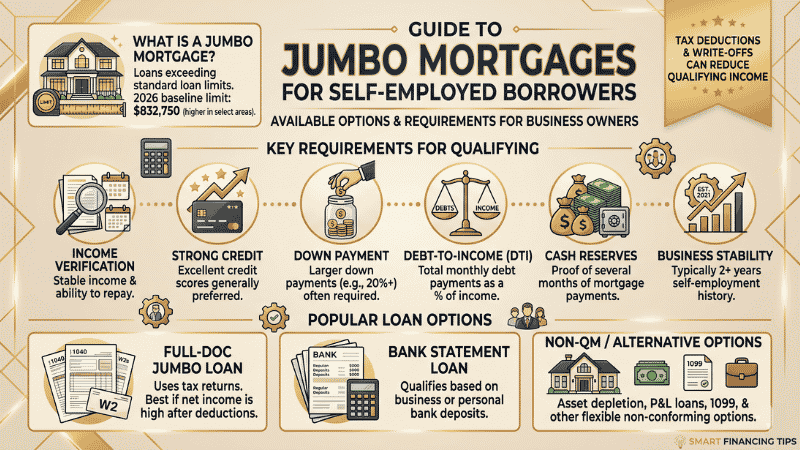
A jumbo mortgage is a home loan that goes beyond the standard loan limit for the area where the property is. Every year, they update these limits to determine how much cash Fannie Mae and Freddie Mac can usually collect. For 2026, the baseline one-unit conforming loan limit is $832,750 in most areas. In higher-cost markets and certain special areas, the limit can be higher. Fannie Mae lists the 2026 one-unit limit at $1,249,125 for Alaska, Guam, Hawaii, and the U.S. Virgin Islands. Any loan amount above the applicable county loan limit is generally considered a jumbo mortgage. This is important for self-employed borrowers because jumbo mortgages often have stricter requirements than standard conforming loans. Lenders may look more closely at income documentation, business cash flow, credit scores, down payment, debt-to-income ratio, and cash reserves. For self-employed borrowers, securing jumbo mortgages presents unique challenges beyond just the loan amount. A significant hurdle is demonstrating a stable income, as tax returns, business deductions, depreciation, and write-offs can lower the income reflected on paper. This is why many individuals explore various options, such as full-documentation jumbo loans, bank statement jumbo loans, asset-depletion loans, and other non-QM jumbo mortgages for self-employed borrowers before applying.
Self-Employed Jumbo Mortgage Requirements
Self-employed jumbo mortgage requirements are more detailed than standard mortgage requirements because lenders must verify both the borrower’s personal finances and the stability of the business income. A borrower may have strong cash flow, excellent credit, and a large down payment, but still run into problems if the income cannot be documented in a way the lender accepts. The main question is not only whether the borrower makes enough money. The real question is whether the lender can document enough qualifying income to support the jumbo mortgage payment, debts, taxes, insurance, and other obligations.
Income Documentation
Income documentation is the most important part of qualifying for jumbo mortgages for self-employed borrowers. Traditional jumbo lenders usually take a look at a bunch of documents to understand how you make your money. This includes personal and business tax returns, profit and loss statements for the year, your business bank statements, K-1s, 1099s, corporate returns, and other stuff that shows your income.
The challenge is that many business owners use legal deductions, depreciation, write-offs, and business expenses to lower taxable income. This may help reduce taxes, but it can also reduce the income a mortgage lender can use for qualifying.
For example, a business owner may have strong gross revenue and healthy cash flow, but if the tax returns show low net income after deductions, a full-documentation jumbo lender may not be able to use the full cash flow. In that case, a bank statement jumbo loan, an asset-depletion loan, a profit-and-loss loan, or another non-QM jumbo option may be a better fit.
Credit Score Requirements
The credit score requirements for jumbo mortgages for self-employed borrowers vary by loan program, down payment, loan amount, reserves, and the type of income documentation provided. Typically, traditional full-documentation jumbo loans necessitate a higher credit score than standard conforming loans, as they involve larger loan amounts and increased risk for the lender. Some non-QM jumbo mortgage programs may allow lower credit scores, but borrowers may need stronger compensating factors. These can include a larger down payment, more cash reserves, a lower debt-to-income ratio, a clean recent payment history, or stronger documented business deposits. The better your credit score is, the more choices you’ll have as a self-employed borrower. Strong credit can also help with pricing, approval flexibility, and overall loan terms.
Down Payment Requirements
Jumbo mortgages usually require a larger down payment than standard conforming loans. The exact down payment depends on the lender, loan amount, property type, credit score, occupancy, and documentation type.
A borrower using full tax-return documentation may qualify with a different down payment than a borrower using bank statements or other non-QM income documentation. In general, the greater the risk in the file, the more the lender may require as a down payment.
Self-employed borrowers should keep in mind that down payments and reserves are distinct. Even if a borrower has sufficient funds for the down payment, they may still need additional funds remaining after closing to meet reserve requirements, especially when considering jumbo mortgages for self-employed borrowers.
Debt-To-Income Ratio Guidelines
The debt-to-income ratio measures the portion of your monthly earnings that is allocated to repaying your debts, including the new mortgage. If you’re self-employed and looking at jumbo mortgages, know that the rules for DTI can really differ based on the loan program. The lender may review the borrower’s mortgage payment, property taxes, homeowners’ insurance, HOA dues, business debts, personal debts, credit cards, auto loans, student loans, and other recurring obligations. Self-employed borrowers need to be careful because qualifying income may be lower than actual cash flow if tax returns show heavy deductions. A borrower may feel comfortable making the payment, but the lender can only use income that meets the program’s documentation rules.
Cash Reserve Requirements
Cash reserves are especially important on jumbo mortgages. Reserves are funds left over after closing that can be used to cover future mortgage payments if income slows down or the business has a difficult month.
Jumbo mortgages for self-employed borrowers typically require that the individual have adequate savings, investments, or liquid assets to cover multiple months of mortgage payments. Those reserve requirements may be elevated for larger loan amounts, second homes, investment properties, borrowers with lower credit scores, higher debt-to-income ratios, or non-QM jumbo loans.
For self-employed borrowers, reserves can be a major compensating factor. Strong reserves show the lender that the borrower has financial strength beyond monthly income.
Business Stability And Time Self-Employed
Lenders are interested in ensuring that the borrower’s business is stable and has the potential for longevity. For jumbo mortgages for self-employed borrowers, many lenders typically seek a minimum of two years of self-employment history. Nonetheless, certain programs may permit exceptions depending on factors such as the borrower’s background, industry experience, income trends, and the overall strength of the application. The lender may review whether the business income is stable, increasing, or declining. Declining income can be a problem because the lender may use a lower income figure or require additional explanation. If income dropped due to a one-time event, seasonal issue, business expansion, or an unusual expense, the borrower may need to clearly document the reason. A CPA letter, year-to-date profit and loss statement, business bank statements, or explanation letter may help support the file, depending on the lender’s requirements.
Full-Doc Versus Bank Statement Jumbo Loans
Self-employed borrowers usually fall into one of two broad categories: full-documentation jumbo loans or alternative-documentation jumbo loans.
A full-documentation jumbo loan uses traditional income documents, such as tax returns, W-2s, K-1s, 1099s, business returns, and profit-and-loss statements. This option may work well when the borrower’s tax returns show enough income to qualify.
A jumbo bank statement loan may be a better fit when the borrower has strong business or personal bank deposits, but tax returns do not show sufficient qualifying income. When it comes to lenders, they might figure out your income based on either 12 or 24 months’ worth of your business or personal bank statements. The lender may average deposits and apply an expense factor to estimate usable income. This is why choosing the right documentation method matters. A self-employed borrower denied under a full-documentation jumbo program may still qualify under a bank statement, asset-depletion, profit-and-loss, 1099, or other non-QM jumbo mortgage program. The best option depends on how the borrower earns income, how that income is documented, and the overall strength of the file.
Denied for a Jumbo Loan? Get a Second Opinion
Jumbo guidelines vary by lender. We’ll review your file and match you with options that fit self-employed income—without wasting timeHow To Prepare For A Jumbo Mortgage When You Are Self-Employed
 Getting approved for a jumbo mortgage when you are self-employed starts before the loan application is submitted. The stronger and cleaner your file is upfront, the easier it is for the lender to document income, verify assets, and match you with the right jumbo mortgage program. Self-employed borrowers should not assume that strong cash flow automatically means high qualifying income. Mortgage lenders must follow documentation rules. That means the way your income appears on tax returns, bank statements, profit-and-loss statements, and business records can affect approval.
Review Two Years Of Tax Returns Before Applying
Before applying for a jumbo mortgage, review your last two years of personal and business tax returns. Many full-documentation jumbo lenders use tax returns to calculate self-employed income. This matters because legal business write-offs, depreciation, deductions, and expenses can reduce the income shown on paper. A borrower may earn strong gross revenue but still show lower taxable income after deductions. If the tax returns do not support the jumbo mortgage payment, a bank statement jumbo loan or non-QM jumbo mortgage may be a better option.
Separate Business And Personal Deposits
Self-employed borrowers should keep business and personal deposits as clean and organized as possible. Mixing business revenue, personal transfers, cash deposits, and unrelated funds can complicate underwriting. For bank statement jumbo loans, the lender may review deposits over 12 or 24 months. Clean records make it easier to identify business income, calculate average monthly deposits, and determine usable income.
Avoid Large Undocumented Deposits
Large undocumented deposits can create problems during mortgage underwriting. Jumbo lenders may ask where the money came from, whether it was borrowed, whether it must be repaid, and whether it can be counted as eligible funds. Before applying, borrowers should be prepared to document large deposits with invoices, contracts, settlement statements, sale records, transfer records, or other acceptable paper trails. The cleaner the asset history, the fewer conditions are likely to arise later.
Prepare Year-To-Date Profit And Loss Statements
A year-to-date profit and loss statement is a great way to see how the business is doing this year. This is especially important if the borrower’s most recent tax return does not tell the full story or if income has changed since the last filing. Some lenders may request a borrower-prepared P&L, while others may require a CPA-prepared P&L. The lender may also compare the P&L with business bank statements to determine whether the reported income is reasonable.
Gather Business Bank Statements Early
Business bank statements are often needed for self-employed jumbo borrowers, especially when using a bank statement loan or when the lender needs to verify business cash flow. The lender may request your business bank statements from the last 12 to 24 months, depending on the program. The deposits may be averaged, and an expense factor may be applied to estimate usable income. Borrowers should gather these statements early so the lender can review income before the file reaches underwriting.
Document Business Ownership Percentage
Lenders need to know how much of the business the borrower owns. Ownership percentage can affect how income is calculated and what documents are required. For example, a borrower who owns 100% of the business may be reviewed differently from someone who owns a smaller percentage. The lender may ask for corporate documents, K-1s, operating agreements, CPA letters, or tax returns to confirm ownership.
Explain Declining Income Before Underwriting
Declining income can be one of the biggest challenges for self-employed jumbo borrowers. If income dropped from one year to the next, the lender may use the lower income, average the income differently, or ask for a written explanation. A decline does not always mean the borrower cannot qualify. The issue is whether the decline is ongoing or caused by a one-time event, an unusual expense, business expansion, a seasonal slowdown, or a temporary disruption. Explaining this before underwriting can help avoid delays.
Verify Cash Reserves Early
Cash reserves are funds left over after closing. Jumbo mortgage lenders often require more reserves than standard mortgage lenders because the loan amount is larger. Self-employed borrowers should verify reserves early in the process. Acceptable reserves may include checking, savings, money market, investment, and retirement accounts, as well as other eligible liquid assets, depending on the lender. Strong reserves can help offset risk, especially when the borrower has variable income.
Do Not Assume Taxable Income Equals Qualifying Income
One of the biggest mistakes self-employed borrowers make is assuming that taxable income and qualifying income are the same. They are not always the same.
A lender may add back certain non-cash expenses, but not every deduction can be added back. Some business expenses reduce qualifying income. That is why a borrower with strong deposits, strong revenue, and strong real-world cash flow may still need an alternative documentation jumbo loan if the tax returns do not show enough income.
It’s important to evaluate the income structure before applying. When it comes to jumbo mortgages for self-employed borrowers, qualification may be possible via tax returns, bank statements, asset depletion, profit-and-loss statements, 1099 income, or other non-QM jumbo mortgage options, depending on the specifics of the file.
Jumbo Mortgage Options For Self-Employed Borrowers
Self-employed borrowers do not all qualify the same way. Some business owners have tax returns that show enough income after deductions. Others have strong bank deposits but lower taxable income. Some have large assets but limited traditional income. The right jumbo mortgage option depends on how the borrower earns money, how the income is documented, and how strong the overall file is.
Full-Documentation Jumbo Loan
A full-documentation jumbo loan is best for borrowers whose tax returns show enough income to qualify after business deductions, depreciation, and write-offs are reviewed. This option usually requires personal tax returns, business tax returns (if applicable), K-1s, 1099s, W-2s if the borrower pays themselves wages, year-to-date profit-and-loss statements, and other business income documents. The lender reviews the borrower’s income history to determine whether the income is stable, likely to continue, and strong enough to support the jumbo mortgage payment. This may be a good fit for self-employed borrowers with high net income, clean tax returns, good credit, solid reserves, and a manageable debt-to-income ratio.
Bank Statement Jumbo Loan
A jumbo bank statement loan is best for business owners whose bank deposits show strong cash flow but whose tax returns show lower taxable income due to legal business deductions and write-offs.
Instead of primarily depending on tax returns, lenders may evaluate personal or business bank statements from the past 12 to 24 months. They typically calculate monthly income by averaging deposits. When using business bank statements, lenders might incorporate an expense factor to account for operating costs, which is particularly relevant for jumbo mortgages for self-employed borrowers.
This option may work well for business owners, contractors, consultants, real estate professionals, entrepreneurs, and other self-employed borrowers who have consistent deposits but do not qualify under traditional full-documentation jumbo guidelines.
Asset-Depletion Jumbo Loan
An asset-depletion jumbo loan is best for high-net-worth borrowers who have significant liquid assets but limited traditional income. Instead of qualifying mainly through employment income or business income, the lender calculates income based on eligible assets. These assets may include checking, savings, investment, or retirement accounts, or other acceptable liquid assets, depending on lender guidelines. This option may be useful for retirees, investors, business owners who recently sold a company, borrowers with low taxable income, or high-net-worth individuals with strong assets but insufficient monthly income on tax returns.
Profit-And-Loss Jumbo Loan
A profit-and-loss jumbo loan is best for borrowers who can document business cash flow through a profit-and-loss statement, depending on the lender’s requirements.
Some lenders may accept a borrower-prepared P&L, while others may require a CPA-prepared P&L. The lender may compare the P&L with business bank statements to confirm that the income appears reasonable and consistent.
This option could be beneficial for self-employed borrowers seeking jumbo mortgages, especially if their current business income exceeds what is reflected on their latest tax return. It also provides a more up-to-date view of business performance for those who need it.
1099 Jumbo Mortgage
A 1099 jumbo mortgage is best for independent contractors who receive 1099 income but do not fit neatly into traditional W-2 underwriting. Many 1099 earners work in sales, consulting, healthcare, technology, insurance, real estate, transportation, or other commission-based or contract industries. These borrowers may have high income but variable deposits, business deductions, or non-traditional documentation. Depending on the lender, 1099 income may be verified through tax returns, year-end 1099 forms, bank statements, profit-and-loss statements, or other documentation. This option may work well for borrowers with a strong history in the same line of work and who can document stable or increasing income.
Non-QM Jumbo Mortgage
A non-QM jumbo mortgage may be a good fit for self-employed borrowers who do not qualify under traditional jumbo mortgage guidelines but can still repay.
Non-QM does not mean bad credit or unsafe lending. It means the loan does not fit the standard qualified mortgage box. For self-employed borrowers, non-QM jumbo loans may accept alternative income documentation, such as bank statements, asset depletion, profit-and-loss statements, or 1099 income.
This option may help borrowers with strong cash flow, large down payments, significant reserves, recent credit events, complex income, or tax returns that do not show enough qualifying income. The right program depends on the borrower’s full financial profile, property type, occupancy, loan amount, and documentation available.
Don’t Want to Use Tax Returns? Explore Bank Statement Jumbo Options
If write-offs lower your taxable income, bank statement jumbo programs may work. We’ll review deposits, calculate qualifying income, and outline the cleanest path to approvalInterest Rates For Jumbo Mortgages For Self-Employed Borrowers
Interest rates on jumbo mortgages for self-employed borrowers differ a lot. Since jumbo loans are larger and pose greater risk to lenders, they tend to have more rate fluctuations. Self-employed borrowers may also have more complex income than W-2 employees, especially when tax returns show lower income after business deductions, depreciation, and write-offs. The rate a borrower receives depends on the full strength of the file. Lenders review credit, down payment, loan amount, property type, reserves, income documentation, occupancy, and whether the loan is full-documentation or non-QM.
Full-Documentation Versus Bank Statement Jumbo Loans
Full-documentation jumbo loans often offer more competitive rates because lenders can verify income using traditional documents such as tax returns, W-2s, K-1s, 1099s, and business returns. Jumbo mortgages for self-employed borrowers often come with higher interest rates since lenders utilize alternative income documentation. Rather than relying primarily on tax returns, the lender examines business or personal bank deposits over 12 or 24 months. Due to this non-traditional documentation, the lender may set the loan rate higher.
Primary Residence, Second Home, Or Investment Property
Occupancy can affect jumbo mortgage rates. A primary residence usually has better pricing than a second home or investment property because the borrower lives in the home and is considered less likely to default. Second homes and investment properties may come with higher rates, larger down payment requirements, and stricter reserve requirements. Self-employed borrowers buying an investment property may also need to show stronger overall qualifications.
Loan Amount And Loan-To-Value Ratio
The loan amount and loan-to-value ratio can affect pricing. Loan-to-value ratio, also called LTV, compares the loan amount to the property value. A lower loan-to-value (LTV) ratio typically indicates that the borrower has more equity or a larger down payment. This situation can mitigate lender risk and help the borrower secure more favorable loan terms. Conversely, a higher LTV ratio may result in elevated interest rates, more stringent approval processes, or a limited selection of jumbo mortgages for self-employed borrowers.
Credit Score Tier
Credit score is one of the biggest pricing factors. A borrower with a higher credit score may qualify for better jumbo mortgage rates and more loan options. Self-employed borrowers with lower credit scores may still qualify through certain non-QM jumbo programs, but they may need a larger down payment, more reserves, or a lower debt-to-income ratio to offset the added risk.
Cash Reserves
Cash reserves can help strengthen a jumbo mortgage file. Reserves are funds left over after closing that can cover future mortgage payments. Having strong reserves might not always guarantee a lower interest rate, but they can strengthen a loan application. This is especially important for jumbo mortgages for self-employed borrowers, as their business income can vary significantly from month to month.
Interest-Only Option
Some jumbo mortgage programs offer interest-only payment options. This can lower the monthly payment during the interest-only period, but the borrower is not paying down principal during that time. Interest-only jumbo loans may come with higher rates, stricter guidelines, larger down payment requirements, and stronger reserve requirements. Borrowers should understand both the short-term payment benefit and the long-term cost before choosing this option.
Fixed-Rate Versus Adjustable-Rate Jumbo Loans
Self-employed borrowers can choose between fixed-rate and adjustable-rate jumbo loans. A fixed-rate mortgage keeps the same interest rate for the life of the loan. An adjustable-rate mortgage, also called an ARM, usually starts with a fixed period and then can adjust based on market conditions. An ARM may offer a lower starting rate than a fixed-rate jumbo loan, but the payment can change later. This may work for some borrowers, but it requires careful planning.
Prepayment Penalties On Some Non-QM Jumbo Loans
Some non-QM jumbo mortgage programs may include a prepayment penalty. This means the borrower may have to pay a fee if the loan is paid off, refinanced, or sold within a certain period. Not every non-QM loan has a prepayment penalty, and some borrowers may have options to choose a loan with or without one. However, the rate and terms may differ. Self-employed borrowers should review this carefully before closing.
Business Bank Statement Expense Factor
For bank statement jumbo loans, lenders may apply an expense factor when business bank statements are used. The expense factor estimates how much of the business deposits are needed to operate the business. For example, a lender may count only a percentage of the deposits as usable income after estimating business expenses. The lower the usable income, the harder it may be to qualify. This can also affect loan options, pricing, and approval strength.
Cash-Out Refinance Versus Purchase
Rates may also differ depending on whether the borrower is purchasing a home or doing a cash-out refinance. A purchase loan may be priced differently from a refinance, and cash-out refinances can carry more risk because the borrower is withdrawing equity from the property. For self-employed borrowers, a cash-out refinance may require stronger credit, lower LTV, more reserves, and clearer income documentation than a purchase transaction.
How Self-Employed Borrowers Can Improve Pricing
Self-employed borrowers may improve their chances of better jumbo mortgage pricing by strengthening their file before applying. This can include improving credit scores, lowering credit card balances, increasing the down payment, documenting reserves, keeping business deposits clean, avoiding large, undocumented deposits, and choosing the right income documentation method. The best rate is not always the one from the loan with the lowest advertised rate. The best jumbo mortgage is the one that fits the borrower’s income documentation, assets, credit profile, property type, and long-term financial goals.
Tips for Improving Your Chances of Approval
Getting approved for jumbo mortgages for self-employed borrowers can seem tough, but there are ways to help your chances:
- Improve Your Credit Score: To increase your credit score, reduce your debt, always pay on time, and fix any mistakes on your credit report.
- Save for a Bigger Down Payment: Putting more downpayment can improve rates and conditions.
- Keep Your Financial Records Up to Date: Ensure that all your financial papers, such as profit and loss statements and bank statements, are correct and recent.
- Find a Skilled Mortgage Broker: A broker who knows about jumbo mortgages for self-employed borrowers can guide you through the process and help you pick the right loan.
- Plan for Cash Reserves: Having extra money saved shows lenders you’re in a good spot financially.
By following these steps, including working with the right broker and focusing on your financial health, you can improve your chances of getting jumbo mortgages for self-employed borrowers.
Comparing Jumbo Mortgage Offers
When you’re digging into jumbo mortgages for self-employed borrowers, remember a few simple things to make sure you’re getting the best deal:
- Interest Rates: Check out what different places offer to see who has the lowest rate.
- Loan Terms: Look into how long you’ll be paying back the loan, what your payments will look like, and if there are any extra perks.
- Fees and Costs: Keep an eye on any upfront fees or costs you must pay to get the loan.
- Lender Reputation: Stick with a lender known for treating self-employed borrowers right and who’s known for good customer service.
Final Thoughts On Jumbo Mortgages For Self-Employed Borrowers
Jumbo mortgages for self-employed borrowers are available, but the right loan program depends on how the borrower’s income is documented. Some business owners qualify for traditional tax returns. In contrast, others may need a bank statement jumbo loan, an asset-depletion loan, a 1099 income program, a profit-and-loss statement loan, or another non-QM jumbo mortgage option.
Before applying, self-employed borrowers should review their tax returns, business deposits, credit profile, down payment, cash reserves, property type, and debt-to-income ratio. The stronger and cleaner the file is upfront, the easier it is to determine which jumbo mortgage program may be the best fit.
The most important thing to understand is that taxable income is not always the same as qualifying income. Business deductions, depreciation, write-offs, and fluctuating income can affect the amount of income a lender can use to calculate the loan amount. That is why self-employed borrowers should work with a mortgage team that understands both traditional jumbo loans and alternative documentation jumbo mortgage options. If you are a self-employed borrower planning to buy or refinance a higher-priced home, Gustan Cho Associates can review your income documentation, assets, credit, and loan goals to help you understand which jumbo mortgage options may be available.
FAQs About Jumbo Mortgages For Self-Employed Borrowers
Can Self-Employed Borrowers Qualify For A Jumbo Mortgage?
Yes. Self-employed borrowers can qualify for a jumbo mortgage if they can document stable income, sufficient assets, strong credit, acceptable debt-to-income ratios, and enough cash reserves. The main challenge is proving qualifying income, especially when tax returns show lower taxable income because of business deductions, depreciation, or write-offs.
Can I Get A Jumbo Mortgage Without Tax Returns?
Yes, some self-employed borrowers may qualify for a jumbo mortgage without using traditional tax returns. Alternative documentation options may include bank statement jumbo loans, asset-depletion loans, profit-and-loss statement loans, 1099 income programs, or other non-QM jumbo mortgage options. The lender still needs to verify the borrower’s ability to repay the loan.
How Do Lenders Calculate Income For Self-Employed Jumbo Borrowers?
Lenders may calculate self-employed income by reviewing tax returns, business returns, K-1s, 1099s, year-to-date profit and loss statements, and bank statements. For bank statement loans, lenders may average deposits over 12 or 24 months and apply an expense factor to estimate usable income. This is one reason jumbo mortgages for self-employed borrowers require a detailed income review before applying.
What Credit Score Is Needed For A Self-Employed Jumbo Mortgage?
The credit score requirements can differ depending on the lender and the type of loan. Traditional jumbo loans often require stronger credit, while some non-QM jumbo programs may offer more flexibility, including larger down payments, strong reserves, lower debt-to-income ratios, or strong documented cash flow. In general, the higher the credit score, the more jumbo mortgage options the borrower may have.
How Much Down Payment Do Self-Employed Borrowers Need For A Jumbo Loan?
The down payment depends on the lender, loan amount, credit score, property type, occupancy, and income documentation method. A borrower using full tax-return documentation may have different down payment requirements than a borrower using bank statements or another non-QM jumbo option. Larger down payments can help offset risk when the borrower has complex income.
Are Bank Statement Loans Good For Self-Employed Jumbo Borrowers?
Bank statement loans are a solid choice for business owners with healthy cash flow in their bank deposits, even if their tax returns don’t reflect enough qualifying income. Instead of relying mainly on tax returns, the lender reviews personal or business bank statements to estimate income. This can make jumbo mortgages for self-employed borrowers more realistic when taxable income does not reflect actual business cash flow.
This article about “Jumbo Mortgages For Self-Employed Borrowers ” was updated on May 7th, 2026.