Can you get a mortgage with a short employment history?
Yes, you may qualify for a mortgage with short employment history. You do not always need to work for the same employer for two years. Lenders mainly evaluate whether your income is documented, stable, and reasonably expected to continue. Time spent in college, trade school, or the military may help establish your history. Prior work in the same field may also support approval after a recent job change. Requirements depend on the loan program, income type, employment gap, and lender guidelines.
Changing Employers or Careers
When you change jobs, the lender reviews how the move affects the income available for your mortgage payment. A new employer, promotion, or different job title may require updated documentation without changing the amount of income you can use.
A change in compensation can require more analysis. Moving from a salaried position to commission-based work, for example, introduces income-history requirements that your previous salary may not satisfy. Before changing jobs during the mortgage process, provide the new offer, start date, and compensation details so the lender can evaluate the effect on your application.
A career change may also require documentation of relevant education, training, or experience. Explain what changed and provide records supporting the new position.
Work History vs. Income History
Employment history shows your work pattern. Income history shows how long you have received the particular earnings being used to qualify. An acceptable employment record does not automatically make every component of your pay eligible.
For example, you might have five years with an employer but only eight months of overtime earnings. Your regular base pay and overtime require separate evaluations. The lender may be able to use the base pay while excluding the overtime until it meets the applicable program’s requirements.
The same distinction matters for bonuses, commissions, second jobs, and fluctuating hours. Document each income source separately, so your preapproval reflects the earnings the lender can actually use.
Do You Need Two Years of Employment History for a Mortgage?
You do not always need two full years of employment to qualify for a mortgage. Lenders commonly review the most recent two years to understand your work history, but that does not mean you must remain with the same employer or in the same position for two years.
A borrower may qualify for a mortgage with short employment history after graduating from college or trade school, completing military service, returning to the workforce, or starting a new salaried job. Education, training, military service, and prior work in the same or a related field may help demonstrate that the current employment is sensible and likely to continue.
The amount of history needed also depends on the type of income being used. A fixed salary or hourly income may be easier to manage after a recent job change. Over time, bonuses, commissions, tips, part-time earnings, and income from a second job usually require a longer history because the amount can change. Self-employed and 1099 income also have separate documentation requirements. The lender will review the complete file, including any employment gaps, income changes, job offers, pay stubs, W-2s, tax returns, and verification of employment. The final requirements depend on the loan program, automated underwriting findings, and any lender overlays.
Short Work History Versus a Short Time at Your Current Job
A short overall work history is different from having a short time at your current job. Understanding that difference is important when applying for a mortgage with short employment history. A borrower with a short work history may have recently graduated, completed military service, entered the workforce for the first time, or returned to work after a long absence. Because there is less employment history to review, the lender may request school transcripts, military records, prior employment information, an offer letter, pay stubs, or a written explanation. A borrower who recently changed employers may still have a strong two-year employment history. Changing companies does not automatically restart the employment clock. A move to a similar position with equal or higher pay may help stabilize income, especially when the borrower receives a fixed salary or consistent hourly earnings. The type of job change matters. Moving from a salaried position to commission, 1099, contract, or self-employed work may require a longer income history before the new earnings can be used. A decrease in hours or income can also require additional review. Underwriters evaluate the borrower’s complete employment pattern, not simply the start date shown on the most recent pay stub.
Qualifying After College, Trade School, or Military Service
Recent graduates and former service members may qualify for a mortgage with short employment history, even if they have not worked for two full years. Time spent in college, trade school, professional training, or the military may help explain the borrower’s limited civilian work history. A lender may review whether the borrower’s education, training, or military experience supports the new position. For example, a recent nursing graduate who begins working as a nurse may have a clear path from school to employment. A veteran who accepts a civilian job using skills gained in the military may also present a reasonable and stable employment pattern. The borrower may need to provide documents such as:
- College or trade-school transcripts
- A diploma, degree, license, or professional certificate
- Military discharge papers, service records, or current orders
- An employment offer or contract
- Recent pay stubs and W-2 forms
- Verification of employment
Graduation or military service does not automatically make every type of income acceptable. Fixed salary or regular hourly income may be easier to use than commission, bonus, overtime, contract, or self-employed income when there is little history. The lender must still confirm that the borrower has started or will start the job, is qualified for the position, and has income that meets the applicable loan program’s documentation and continuance requirements.
Qualifying With a Shorter Work History After School or Training
If you have recently graduated or completed vocational or professional training, you may still qualify even if you do not yet have 2 years of work experience. In some loan programs, your education and training can help meet the employment requirements.
You can use documents such as transcripts, completion certificates, job offers, and recent pay records. These help show your move from school to work and explain the details of your current job.
How you are paid is still important. Getting a fixed-salary job is different from starting a job where your pay depends on commissions or changing hours. While your education can help with your work history, it does not always meet the requirements for every type of income.
Getting a Mortgage After Re-Entering the Workforce
Returning to work after an extended absence does not automatically prevent someone from qualifying for a mortgage. Parents returning after raising children, caregivers, students, military members, and people recovering from a layoff may be able to get a mortgage with short employment history once their current income can be documented and used under the chosen loan program. The lender will usually review the borrower’s employment before the absence, the length of the gap, the current position, and the type of income being earned. Returning to a fixed salary or regular hourly position may be easier to document than starting a job that relies mainly on commission, bonuses, overtime, or fluctuating hours. An extended employment gap can create additional requirements. For example, FHA guidelines generally require borrowers who were out of the workforce for six months or longer to have at least six months in their current job and a documented two-year work history before the gap. Conventional, VA, and USDA requirements can differ, so borrowers should not assume that one rule applies to every mortgage. Underwriters may request:
- A written explanation of the employment gap
- Information about employment held before the gap
- Recent pay stubs and W-2 forms
- Verification of current employment
- An employment offer or contract
- Documents supporting education, training, or military service
Approval depends on whether the current income is stable, properly documented, and permitted under the applicable loan guidelines.
Short Employment History? You May Still Qualify for a Mortgage
A limited job history does not always stop mortgage approval. We’ll review your income, work history, education, job change, pay structure, and loan options.
How Employment Gaps Affect Mortgage Approval
An employment gap does not automatically disqualify a borrower from getting a mortgage. However, the lender may need to determine why the gap occurred, how long it lasted, and whether the borrower’s current income is stable and likely to continue. A short gap between jobs may require little more than employment dates or a brief letter of explanation. A longer gap can receive closer review, especially when the borrower recently returned to work or entered a different occupation. The underwriter may compare the borrower’s employment before the gap with the current position, income type, hours, and pay structure. When applying for a mortgage with a short employment history, borrowers may be asked to provide:
- A factual letter explaining the dates and reason for the gap
- W-2 forms or employment records from before the gap
- Recent pay stubs
- An employment offer or contract
- Verification of current employment
- School, training, or military records, when applicable
The reason for the gap may help explain the borrower’s history, but it does not replace the need for acceptable qualifying income. The current earnings must still meet the applicable loan program’s documentation, history, and continuance requirements. Requirements can differ for FHA, VA, USDA, conventional, and Non-QM loans. Lender overlays and automated underwriting findings may also affect the amount of current employment history required.
Mortgage Work-History Requirements by Loan Program
FHA Work History and Employment Gaps
FHA lenders evaluate the borrower’s employment history and current earnings to determine whether the income meets the requirements for qualification. Prior employment, relevant education, and training may help document the borrower’s work pattern.
Under FHA’s standard provision for employment absences of six months or more, the lender may use current income as effective income when it verifies and documents both conditions: the borrower has been employed in the current line of work for at least six months at the time of FHA case-number assignment, and the borrower had a two-year work history before the absence. These conditions appear in HUD Mortgagee Letter 2022-09, “Addressing Gaps in Employment”.
A gap shorter than six months does not trigger this particular extended-absence provision. The lender must still evaluate current employment, qualifying income, and the applicable documentation requirements.
Fannie Mae Work-History Requirements
Fannie Mae requires the lender to look at the borrower’s work history over the preceding two years to assess whether it demonstrates a stable employment pattern. A shorter work history may be acceptable in circumstances where other positive factors support the stability of the current employment. Frequent job changes don’t in themselves preclude qualification where the borrower is still in receipt of a steady, predictable income.
The gaps in employment over the last 12 months need to be examined carefully to determine whether current employment is likely to continue. The lender will also have to apply the requirements in respect of each source of income. An acceptable employment record does not, in itself, mean that newly earned commissions, overtime, or income from a second job will be acceptable.
Freddie Mac Work-History Requirements
Freddie Mac generally expects a two-year history of primary employment, but a shorter history may be acceptable when the lender can document employment stability. Recent education, work experience, and returning to the workforce after a break can all support that assessment.
The review considers the overall employment pattern, current position, and compensation. A borrower who recently changed employers may still have an established work history. Fluctuating earnings and additional employment income have separate requirements, so the lender must evaluate both the income being used and the employment itself.
VA Work-History Requirements
VA lenders usually require 2 years of work history, including both current and previous jobs. If they cannot fully confirm this history, they need to explain the reason. You do not have to be with the same employer for the full two years.
If you have worked at your current job for less than 12 months, the VA usually does not see your income as stable or reliable unless you provide extra facts and documents. The lender will look at your past jobs, education, or training to determine whether you are likely to continue working in your current role.
If a lender counts income from a job you have held for less than 12 months, they must explain why on VA Form 26-6393, Loan Analysis, as described in the VA Lenders Handbook, Chapter 4, Topic 2(f). In these cases, the lender needs to show clear reasons for their decision. Just having a job and a stated salary is not enough to qualify.
USDA Work-History and Income-Verification Requirements
For the USDA Single Family Housing Guaranteed Loan Program, the minimum history required for an income source is different from that required for the overall documentation review. The USDA Chapter 9 requires verification of the income of all adult household members for the prior two years (with appropriate exclusions). That review is used to determine household income eligibility and the amount of income available for repayment.
Attachment 9-A contains the requirements for individual income types. Certain employment income categories will allow a one-year history to be established through employer, education, or military sources. Seasonal employment generally requires two years in the same line of work, and secondary employment generally requires one year of concurrent work in both the primary and secondary employment. Meeting a shorter minimum history does not in any way relieve the lender of their obligation to carry out the full income verification review as per the broader requirements.
Recent graduates can take advantage of this. In the USDA loan origination FAQ, a college graduate is defined as someone who has worked in their field of study for just two months. Education will count towards the required work history, but the lender will still have to review the full file, calculate income accurately, and determine that the income is stable and verifiable. The two-month example doesn’t automatically qualify anyone.
Can You Qualify With a New Job or Employment Offer?
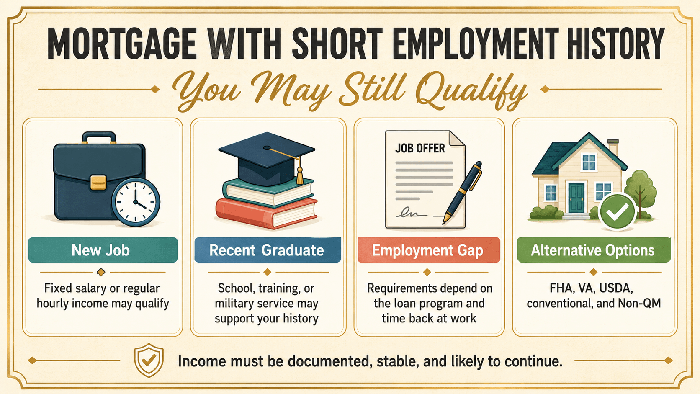
Starting a new job does not automatically prevent you from qualifying for a mortgage. A borrower may be approved for a mortgage with a short employment history when the lender can document the new position, confirm income, and determine that earnings meet applicable loan guidelines. If the borrower has already started working, the lender may request recent pay stubs, an employment offer, W-2 forms, and employer verification. A move into a similar occupation with fixed salary or regular hourly pay is often easier to evaluate than a new position based on commission, bonuses, overtime, contract work, or changing hours. Some loan programs may also allow a lender to use income from an employment offer when the borrower has not started the job. Approval may depend on:
- A signed and accepted employment offer or contract
- A clearly stated start date
- Fixed salary or guaranteed base pay
- No unresolved conditions that could cancel the offer
- Enough funds to cover the mortgage payment and other obligations until employment begins
- Compliance with the loan program’s start date and documentation limits
An employment offer alone does not guarantee approval. The lender must also review the borrower’s prior work, education, training, employment gaps, credit, debts, assets, and complete loan profile. Borrowers should not quit or change jobs after preapproval without first speaking with their loan officer. Employment is commonly verified again shortly before closing, and an unexpected change could delay or invalidate the approval.
Changing Jobs Without Starting Your Work History Over
Changing employers does not normally erase your previous work history. Mortgage underwriters review the complete employment history, not only the amount of time spent with the current company. A borrower may still qualify for a mortgage with short employment history after a recent job change if the new earnings meet the loan program’s requirements. A move to a similar position with equal or higher fixed pay may support employment and income stability. Career advancement, relocation, better benefits, or accepting a position that matches the borrower’s education and training can also provide a reasonable explanation for the change. However, the new income may require additional review when the borrower:
- Moves from salary to commission-based pay
- Changes from W-2 employment to 1099 or contract work
- Becomes self-employed
- Takes a position with fewer or changing hours
- Receives lower pay
- Starts relying on overtime, bonuses, tips, or other variable earnings
- Has an extended gap between jobs
The lender may request employment offers, pay stubs, W-2 forms, prior employment records, or written verification from the new employer. Variable or self-employed income may need its own history before it can be counted. Borrowers should tell their loan officer about a planned job change before accepting the position or leaving the current employer. A change in employer, pay structure, start date, or income can require the lender to recalculate the debt-to-income ratio and update the loan approval.
Conventional Loan Guidelines for Short Employment History
Conventional loans follow Fannie Mae or Freddie Mac guidelines. Both agencies require lenders to determine that the borrower’s income is stable, documented, and reasonably expected to continue. However, a borrower does not always need two years with the same employer to qualify for a mortgage with short employment history. A recent job change may be acceptable when the borrower has started a fixed salary or regular hourly position. The lender can consider previous employment, education, professional training, or military service when evaluating the overall history. Depending on the circumstances, the borrower may need to provide pay stubs, W-2 forms, transcripts, an employment offer, and employer verification. Some conventional purchase loans may allow qualifying income from an accepted employment offer before the borrower starts work. These loans have additional conditions involving the type of income, start date, property occupancy, documentation, and funds available to cover expenses before the first paycheck. Income that changes from month to month usually requires more history. This may include:
- Overtime
- Bonuses
- Commissions
- Tips
- Variable hourly earnings
- Part-time or secondary employment
- Seasonal income
A two-year history may be recommended or required for certain income sources, although some variable income received for at least 12 months may be considered when the file contains supporting positive factors. Self-employment and 1099 income generally require a longer documented history and tax return analysis. The lender will normally submit the file through Desktop Underwriter or Loan Product Advisor. Automated underwriting findings, the income type, and lender overlays can affect the final documentation and approval requirements.
FHA Employment History Guidelines
FHA does not require borrowers to stay with the same employer for two years. The lender generally reviews and documents the borrower’s employment history for the most recent two years, but school, military service, job changes, and certain employment gaps may be included in that review. A borrower may qualify for an FHA mortgage with short employment history when the current income is stable, properly documented, and expected to continue. Recent graduates may be able to use transcripts or training records to support a new position. Borrowers who change employers may also qualify without waiting two years, especially when they continue working in the same field or accept a position with equal or higher pay. FHA requires additional review when a borrower changes jobs more than three times during the previous 12 months or changes to a different line of work. The lender may need documents showing that the borrower has the education or training required for the new position, or that the job changes resulted in continuing increases in income or benefits. For an employment gap lasting six months or longer, FHA generally requires the lender to document that the borrower:
- Has worked in the current line of work for at least six months by the FHA case number assignment date
- Had a two-year work history before the extended absence
Over time, bonuses, commissions, tips, part-time earnings, and other variable income have separate histories and calculation requirements. FHA approval also depends on the borrower’s credit, debt-to-income ratio, assets, automated underwriting findings, and any lender overlays.
VA and USDA Employment-History Guidelines
VA and USDA loans do not require borrowers to remain with the same employer for two years. Both programs focus on whether the income is documented, stable, and expected to continue. A borrower with a short employment history may still qualify if the overall employment pattern supports current earnings.
VA Employment History Guidelines
VA lenders generally review the borrower’s employment during the previous two years. A shorter history may be acceptable when the borrower’s education, military training, prior work, or professional qualifications support the current position. A recent job change may not be a problem when the borrower moves into a similar occupation or receives a fixed salary or regular hourly pay. Income from overtime, bonuses, commissions, part-time work, or other variable sources may require a longer history before it can be counted. For active-duty servicemembers, the lender may review the Leave and Earnings Statement, military orders, remaining term of service, and plans for continued employment. If separation from service is approaching, additional documentation may be required to show that qualifying income will continue. VA approval also requires the borrower to meet eligibility, credit, debt-to-income, and residual-income requirements.
USDA Employment History Guidelines
USDA lenders also evaluate the borrower’s recent employment history and the likelihood that the income will continue. Less than two years of employment may be acceptable when supported by prior related work, education, training, military service, or another reasonable explanation. A fixed salary and regular hourly income may be easier to manage after a recent job change. Commission, bonus, overtime, tips, part-time earnings, and self-employed income generally require more history and may need to be averaged. USDA loans have two separate income reviews. Repayment income determines whether the borrower can afford the mortgage, while annual household income determines whether the household is within the program’s income limit. Approval also depends on USDA property eligibility, the Guaranteed Underwriting System findings, and any lender overlays.
Starting a New Job Before Closing
A borrower can sometimes qualify for a mortgage shortly after starting a new job.
The lender verifies employment, compensation, start date, and whether the income meets the loan program’s requirements.
A recent job start should not automatically be treated as a reason to wait two years.
Qualifying With an Employment Offer
Fannie Mae’s employment-offer option, allowing delivery without first obtaining a pay stub, is limited to purchases of a one-unit principal residence using fixed base income. The employer cannot be a family member or an interested party to the transaction. Employment must begin between 30 and 90 days before or after the mortgage note date.
The lender must review the accepted, fully executed, noncontingent offer or contract identifying the borrower, employer, position, compensation, and start date. Any employment conditions must be satisfied and documented before closing, and required employer verification must be completed.
Beyond other required reserves, the borrower must document either six months of the property’s principal, interest, taxes, insurance, and association dues—PITIA—or financial resources covering all monthly obligations included in the debt-to-income ratio, including PITIA, for the months between the note date and employment start date, plus one. Partial months may count as full months. Resources for the second alternative may include reserves and documented current net income expected to be generated between the note date and job start.
Salary, Hourly, Bonus, Overtime, or Commission? Income Type Matters
Underwriters review each income type differently. We’ll calculate qualifying income and explain whether your short employment history creates any approval concerns.
Variable, Part-Time, Commission, and Second Job Income
Variable income usually requires more history than fixed salary or regular hourly pay. Lenders need enough information to determine whether the earnings are stable, likely to continue, and reasonable to use when calculating the borrower’s debt-to-income ratio. This can affect someone applying for a mortgage with short employment history when part of the current earnings comes from:
- Overtime or bonuses
- Commissions
- Tips
- Changing work hours
- Seasonal employment
- Part-time work
- A second job
- Shift differentials or other extra pay
Receiving this income today does not guarantee that the full amount can be used for mortgage qualification. The lender may average earnings over the required period and compare the most recent income with prior years’ income. If the income is declining, irregular, or no longer expected to continue, the underwriter may reduce the amount or exclude it. A two-year history is commonly preferred for variable, part-time, commission, and second-job income. However, certain loan programs may permit a shorter history when the borrower has received income for at least 12 months, and the file contains positive factors supporting stability. Other programs or lenders may still require the full two years. The borrower may need to provide pay stubs, W-2 forms, tax returns when applicable, and verification of employment showing the pay rate, average hours, year-to-date earnings, and likelihood of continued employment. A borrower may still qualify using acceptable base income even when newer overtime, commission, or second-job earnings cannot be counted. The lender should calculate the usable income before the borrower begins shopping for a home.
Non-QM Options When Traditional Income Guidelines Are Not Met
A borrower who cannot meet FHA, VA, USDA, or conventional income history requirements may have another option with a Non-QM loan. Non-QM mortgages use alternative underwriting methods for borrowers whose income does not fit standard agency guidelines. These programs may help someone seeking a mortgage with short employment history, especially when the borrower is self-employed, receives 1099 income, has substantial assets, or recently changed how income is earned. Depending on the lender and loan program, possible options may include:
- Bank-statement loans based on qualifying deposits
- 1099-only programs
- Profit-and-loss statement loans
- Asset-depletion loans
- Full-documentation Non-QM loans with a shorter employment or self-employment history
- Debt-service coverage ratio loans for eligible investment properties
A Non-QM loan is not a no-income or no-qualification mortgage. The lender must still evaluate the borrower’s ability to repay when required. Bank-statement lenders may review deposits, business expenses, account activity, and the length of self-employment. Asset-depletion programs require enough eligible assets to produce a qualifying monthly income. DSCR loans generally evaluate the investment property’s rental income rather than relying primarily on the borrower’s personal employment income. Non-QM requirements vary widely. These loans may require a larger down payment, a higher credit score, additional reserves, or a higher interest rate than agency-backed mortgages. Some programs also have restrictions involving property type, occupancy, loan purpose, or recent credit events. Borrowers should compare both agency and Non-QM options before deciding. A shorter employment history does not always require alternative financing, and a traditional loan may offer better terms when the borrower meets its guidelines.
Documents Needed With a Short Employment History
Borrowers applying for a mortgage with short employment history should prepare documents that explain their work background and verify their current income. Providing complete information early can help prevent questions and delays during underwriting. Depending on the borrower’s situation, the lender may request:
- Recent pay stubs
- W-2 forms from current and previous employers
- A signed employment offer or contract
- Written or electronic verification of employment
- Contact information for previous employers
- College or trade-school transcripts
- A diploma, professional license, or training certificate
- Military service records, current orders, or a Leave and Earnings Statement
- A letter explaining any employment gaps
- Tax returns when required for commission, 1099, or self-employed income
- Year-to-date income records for overtime, bonuses, commissions, or changing hours
- Bank statements or asset statements when reserves are required
An employment offer should clearly identify the employer, job title, start date, pay structure, and any conditions that must be satisfied. A letter explaining an employment gap should be brief, factual, and consistent with the dates shown on the mortgage application. Documents must also agree with one another. Differences in job dates, income, employer names, or pay structure can lead to additional conditions. Borrowers should not alter documents or estimate missing information. The exact documentation depends on the loan program, income type, automated underwriting findings, and lender requirements. A loan officer should review the borrower’s history before submitting the file to underwriting and request only the documents needed for that particular situation.
Mortgage Examples With Different Employment Profiles
The following hypothetical examples show how underwriters may evaluate borrowers applying for a mortgage with short employment histories. Actual approval depends on the completeness of the loan file, program guidelines, and lender requirements.
Recent Graduate Starting a Salaried Career
Maria recently completed nursing school and started working as a registered nurse. She has only been employed for three months but receives a fixed salary. Her transcripts, nursing license, pay stubs, and verification of employment connect her education to her new career. Maria may qualify without waiting two years because her education supports the position, and her fixed salary can be documented.
Employee Who Recently Changed Companies
David has worked as an electrician for four years, but joined a new electrical contractor two months ago. His new job pays more and does not change how he earns his income. Although David has only been with the current employer briefly, he still has a continuous history in the same occupation. His employment clock does not start over simply because he changed companies.
Borrower Returning After an Extended Absence
Angela worked for five years before leaving to care for a family member. She recently returned to a full-time position after a three-year absence. The lender will review her employment before the gap and the amount of time she has been back at work. If she applies for an FHA loan, she may need to have six months in her current line of work by the case number assignment date and a documented two-year work history before the absence.
Employee Moving From W-2 to 1099 Income
Robert worked as a salaried salesperson for several years before becoming an independent 1099 sales contractor six months ago. Although he remained in the same industry, the way he earns income changed. His new 1099 income may not have enough history for an agency mortgage. He may need to wait, qualify using other acceptable income, or explore an eligible Non-QM program.
Borrower With a New Second Job
Lisa has stable full-time employment and started a weekend job eight months ago. Her primary income is sufficient to qualify for the requested mortgage, but her second-job income has a limited history. The lender may approve the loan using only Lisa’s primary income while excluding the newer second-job earnings. If she needs both incomes to qualify, she may have to establish a longer history or consider another loan structure.
When a Short Employment History May Delay Approval
A short employment history does not always result in a mortgage denial, but it can delay approval if the lender needs additional documents or cannot yet determine that income is stable. Borrowers applying for a mortgage with a short employment history should have their employment reviewed before making a home purchase offer. Approval may be delayed when:
- The borrower has not started the new job
- An employment offer contains unresolved conditions
- The employer cannot verify the job, income, or start date
- Pay stubs do not match the salary or hours shown on the application
- The borrower recently returned after an extended employment gap
- Current income is lower than previous earnings
- Work hours change from one pay period to another
- Overtime, bonuses, commissions, tips, or second-job income lack enough history
- The borrower recently became self-employed or changed from W-2 to 1099 income
- Education, training, or prior employment records are missing
- The borrower changes jobs during underwriting
Some delays can be resolved by providing an employment offer, updated pay stubs, transcripts, W-2 forms, tax returns, or a letter explaining the employment history. Other situations may require the borrower to remain in the position longer before the income becomes eligible for income-based repayment. A delay can also occur if the lender must remove income that was originally used to qualify. The loan officer may need to recalculate the debt-to-income ratio, restructure the loan, resubmit the file to automated underwriting, or consider another program. Borrowers should disclose their complete employment history at the beginning of the mortgage process. Early review gives the lender more time to identify problems and determine whether additional documentation, a different loan program, or a later closing date is needed.
Steps to Strengthen Your Mortgage Application
Borrowers can take several steps to reduce delays and improve the quality of an application for a mortgage with short employment history.
- Have your employment reviewed before house hunting. Give your loan officer a complete timeline of your jobs, education, military service, and employment gaps before requesting a preapproval.
- Gather supporting documents early. Prepare pay stubs, W-2 forms, employment offers, transcripts, licenses, military records, and contact information for current and previous employers.
- Explain employment gaps accurately. Write a short, factual letter showing when the gap began, when it ended, and why you were not working. Make sure the dates match the mortgage application.
- Document the connection to your new position. Education, training, prior experience, or military skills may help show that the current job is a reasonable continuation of your work history.
- Avoid changing jobs during the mortgage process. Do not quit, reduce your hours, become self-employed, or switch from salary to commission or 1099 income without speaking with your loan officer.
- Keep your credit and finances stable. Continue making payments on time, avoid opening unnecessary accounts, and do not take on new debt before closing.
- Build savings when possible. Reserves can strengthen the overall application and may be required when qualifying for certain employment offers. However, savings cannot make income acceptable if they do not meet the loan program’s rules.
- Compare loan programs and lenders. FHA, VA, USDA, conventional, and Non-QM programs treat employment situations differently. Lender overlays can also create requirements beyond the program minimums.
The strongest application is complete, consistent, and reviewed before the borrower signs a purchase contract.
Documents Lenders May Request for Employment History
The exact documentation depends on the borrower, loan program, income type, and automated underwriting findings.
Common employment documents may include:
- Recent paystubs.
- W-2 forms.
- Written or electronic verification of employment.
- Prior employer information.
- Employment offer or contract.
- Tax returns, when required for the income type.
- School transcripts or training records, when relevant.
- Written explanation of an employment gap when needed.
Not Every Borrower Needs the Same Documents
A salaried W-2 borrower should not automatically be asked for the same documentation as a commission employee, seasonal worker, or self-employed borrower.
For example, Fannie Mae permits different documentation depending on the type of employment income being used.
The goal is to document enough history to support the income being used, not to collect paperwork simply because it appears on a generic checklist.
Lender Overlays vs. Agency Work-History Guidelines
A mortgage lender can impose employment requirements that are stricter than the minimum guidelines of FHA, VA, USDA, Fannie Mae, or Freddie Mac.
These additional requirements are lender overlays.
For example, an agency guideline may permit a borrower with a shorter employment history, while a particular lender may require a longer history under its own credit policy.
That does not make the lender’s rule an agency requirement.
Find Out Why the Loan Was Declined
If a borrower is told, “You need two full years of employment,” ask what guideline created that requirement.
The issue may come from:
- FHA, VA, USDA, Fannie Mae, or Freddie Mac.
- Automated underwriting findings.
- The specific type of income being used.
- An investor requirement.
- The lender’s own overlay.
Knowing the source of the rule can determine whether the borrower truly needs to wait or whether another lender may handle the file differently.
Final Thoughts on Mortgage With Short Employment History
A limited work history does not automatically prevent someone from becoming a homeowner. Recent graduates, former service members, people returning to work, and borrowers who recently changed employers may still qualify for a mortgage with short employment history.
The main issue is whether the income is properly documented, stable, and acceptable under the chosen loan program. Fixed salary or regular hourly income may be usable sooner than overtime, commissions, bonuses, part-time earnings, 1099 income, or self-employment income. Employment gaps and career changes may also require additional documentation.
Because FHA, VA, USDA, conventional, and Non-QM guidelines differ, borrowers should have their full employment and income history reviewed before making a home offer. The team at Gustan Cho Associates can evaluate the borrower’s employment history, income structure, supporting documents, and overall financial profile to help identify a realistic path to mortgage approval.
Frequently Asked Questions About a Mortgage With Short Employment History
Can You Get a Mortgage While on Maternity or Parental Leave?
Yes. The lender may request documents confirming your right to and intention to return to work, your expected return date, your regular pay, and the income you received during leave. If your temporary income is lower, the lender may also review whether you have enough reserves to cover the difference.
Can Unemployment Benefits Be Used as Mortgage Income?
Unemployment benefits are generally not considered ongoing income. An exception may apply to borrowers with recurring seasonal employment who have an established history of receiving unemployment compensation during the off-season. The lender must document that the income pattern is likely to continue.
Can Social Security, Disability, or Pension Income Replace Employment Income?
Yes, eligible Social Security, disability, and pension benefits may be used without a traditional employment history. The income must be documented and meet the loan program’s continuance requirements. The borrower must still qualify based on credit, debts, assets, and the proposed housing payment.
Can Child Support or Alimony Help You Qualify?
Child support or alimony may be counted when the borrower chooses to disclose it and can document the amount, the receipt history, and its expected continuation. A borrower is not required to disclose this income unless it will be used for mortgage qualification.
Can You Qualify Using Only Your Spouse’s Income?
Yes. One spouse’s acceptable income may be enough to qualify even when the other spouse has limited or unusable income. The loan amount will be decided by the lender based on qualifying income, in accordance with rules governing debt, credit, ownership, and community property.
Can Undocumented Cash Income Be Used for a Mortgage?
Cash wages generally cannot be used solely because the money appears in a bank account. The income must be legal, documented, and reported as required. Regular cash deposits alone do not prove the source, history, or continuance of the earnings.
Can Foreign Employment History Count Toward a U.S. Mortgage?
Foreign employment may help document a borrower’s professional experience and explain a short U.S. work history. The lender may request foreign employment records, tax documents, credentials, and certified translations. Whether foreign earnings can be used depends on the loan program, currency, location, documentation, and likelihood that the income will continue.
This article about “How to Get a Mortgage With Short Employment History” was updated on September 1st, 2026.