Mortgage Rates on Bad Credit Loans With Low Credit Scores
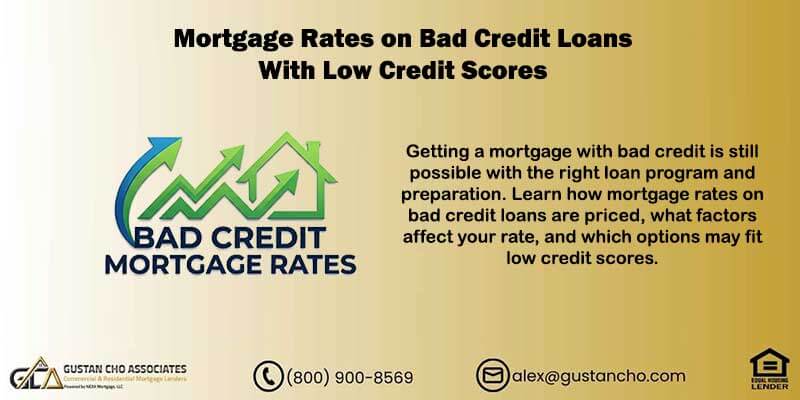
Securing a mortgage with bad credit or a low credit score may be difficult, but it is still achievable. While traditional lenders may hesitate to approve borrowers with credit issues, specialized loan programs are designed for those with less-than-perfect credit.
This guide explains how mortgage rates for bad-credit loans are set, how pricing is determined, and how low-credit-score borrowers can increase their chances of approval and reduce the cost of borrowing.
However, the mortgage interest rate plays a crucial role in determining affordability. In this article, we will talk about mortgage rates on bad credit loans for borrowers with bad credit, what loan options are available, and strategies to secure the best possible rate. In the following paragraphs, we will cover mortgage rates on bad credit loans with low credit scores.
Mortgage Rates on Bad Credit Loans With Low Credit Scores
Many borrowers with low credit scores think they will not qualify for a home loan, or that mortgage rates on bad-credit loans will always be too high. This is a more nuanced issue. Credit scores directly affect mortgage pricing, but for borrowers with bad credit, interest rates are determined by more than just a three-digit score. The loan program, down payment, debt-to-income ratio, type of property, occupancy, reserves, and whether the file is automated-approved or manual-underwritten all impact rates and the total cost of the loan.
What Bad Credit Home Loans Have for Mortgage Rates
Many homebuyers are particularly interested in understanding how mortgage rates are set for bad-credit loans and what actions they can take to improve terms, rather than the more straightforward question of whether they can qualify with bad credit. Government-backed loans, for example, remain an option for some borrowers with low credit. Other borrowers may find that traditional agency financing is not a good alternative and must use alternative documentation or non-QM programs.
What Else Affects Mortgage Rates on Bad Credit Loans Besides Credit Scores?
Before submitting an application, one must comprehend how lenders assess risk. For example, a borrower with a low credit score may still possess a high income, minimal debt, significant cash reserves, or be able to provide a large down payment. All of these may improve the odds of both approval and a better interest rate. When borrowers understand the factors that drive interest rates, they can approach financing with confidence.
What Determines Mortgage Rates on Bad Credit Loans?

- Credit Scores
- Debt-To-Income Ratio
- Manual versus automated underwriting system
- Type of property
- Occupancy: Owner Occupant, Second Homes, Investment Homes
- Loan-to-Value
- Loan Size
- City, County, or State
Given this, a loan with a lower interest rate may have a lower upfront cost, while another loan with a higher rate may require a larger cash payment at closing. Therefore, it is important to analyze the overall scenario, not just the interest rate. Having prior bad credit such as collections, late payments, bankruptcy, foreclosure, and deed-in-lieu of foreclosure, a short sale does not impact mortgage interest rates.
What Are Bad Credit Loans?
Bad credit loans are those extended to potential borrowers with low credit scores or more recent credit events that increase the lender’s risk. From this standpoint, bad credit loans carry a higher interest rate than loans extended to candidates with better credit because there is a greater risk that the borrower will fail to meet payment or loan obligations. Higher interest rates are neither unnatural nor, for that matter, impossible, but rather a reflection of the higher overall risk associated with the loan.
How Low Credit Scores Affect Mortgage Interest Rates
When it comes to mortgages, bad credit will affect the interest rate offered on the loan and the specific loan program chosen. People with lower credit scores typically have a better chance with government-backed services, such as the Federal Housing Administration (FHA) loan program, than with conventional services.
Veterans and active-duty service members may also have this opportunity through Department of Veterans Affairs (VA) loans, which do not require a minimum credit score.
Furthermore, United States Department of Agriculture (USDA) loans are available to eligible individuals for rural areas, as well as non-qualified mortgage loans (non-QM loans) for those who do not qualify under conventional guidelines. Keep in mind that interest rates are not the only prices to be paid when it comes to mortgages. Borrowers would also have to consider lender fees, discount points, mortgage insurance, and closing costs.
Low Credit Score? Find Out What Mortgage Options Are Available for You Now
Apply for a Bad Credit Loan NowAffects in Mortgage Rates on Bad Credit Loans
Lenders assess credit scores to determine the risk of lending to a borrower. A lower credit score suggest a higher risk for the lender, which leads to higher interest rates, stricter loan terms, and limited loan options. Lenders compensate for the increased risk by charging higher mortgage rates. Some lenders may require a larger down payment, additional reserves, or stricter income verification. And lastly, borrowers with bad credit may not qualify for conventional loans and may need to explore government-backed or non-QM loans.
Does Prior Bankruptcy Affect Mortgage Rates On Bad Credit Loans?
Prior bankruptcies and foreclosures do not affect mortgage rates on government and conventional loans. Borrowers who filed Chapter 7 bankruptcy have a mandatory 2-year waiting period before qualifying for an FHA-insured mortgage loan. This 2-year waiting period clock starts ticking from the date of the discharge of the Chapter 13 bankruptcy and not the filing date. For borrowers who have a foreclosure, there is a 3-year waiting period from the date of the sheriff’s sale or the date the deed foreclosed home is transferred out of their name. The date the deed is transferred from the homeowner’s name is crucial. Most lenders take their time in transferring a homeowner’s name out of the deed and transferring it into theirs.
Credit Score Ranges and Mortgage Rates on Bad Credit Loans
| Credit Score Range | Loan Qualification | Typical Mortgage Rates |
|---|---|---|
| 740+ | Best loan terms, lowest interest rates | 6% – 7% (as of 2024) |
| 680 – 739 | Good loan terms, competitive rates | 7% – 8% |
| 620 – 679 | Higher rates, stricter requirements | 8% – 9% |
| 580 – 619 | Subprime rates, limited options | 9% – 11% |
| Below 580 | Hard money/non-QM loans required | 10% – 15%+ |
Note: Rates are for illustrative purposes and vary by lender, market conditions, and loan type.
Mortgage Rates on Bad Credit Loans Depend on Lenders
Mortgage rates are not necessarily higher for bad credit borrowers than those with good credit. FHA-insured mortgage rates on bad credit loans depend mainly on borrowers’ credit scores. Late payments, collections, judgments, charge-offs, tax liens, or high debt-to-income ratios do not impact mortgage interest rates on FHA Loans. Borrowers with 580 FICO or higher credit scores can qualify for 3.5% down payment FHA loans. A borrower with a 580 credit score will have higher mortgage rates than a 700 credit score borrower.
How Low Credit Scores Affect Mortgage Interest Rates
A low credit score typically indicates a higher risk to the lender, which translates into a higher mortgage interest rate for the borrower. There are different risk factors in mortgage lending, and while a person’s credit score is the most important dimension of risk, it is not the only component. Lenders have to take this into consideration in their processes, and, as scores have a narrower range, there will be more limitations on a person’s score.
Why Credit Score Is Only One Piece of Mortgage Pricing
With a lower credit score, a borrower has demonstrated inconsistent payments, lower projected payments, few assets saved, or a payment history that includes accounts in collections or charged-off accounts. This is part of the reason a borrower with low credit scores is likely to receive a less favorable interest rate, if they are offered one at all. Obviously, if the applicant has low credit scores and many other factors negatively affect the underwriting process, the impact will be greater.
Should You Wait To Improve Your Credit Before Buying a Home?
On the other hand, many other factors are considered, which is why they affect the overall impact of the low score. For two borrowers with the same credit score, they may offer two different sets of mortgage pricing or two different mortgage rates. There might be instances in which the applicant has a credit obligation that is greater than what one has, and the other may be especially creditworthy with a firm credit obligation that is extremely good, with a high income, low obligations, and savings.
Why Credit Score Is Only One Piece of Mortgage Pricing
Although a credit score is almost a minimum, a lender will consider many other factors in the underwriting process. There are many other factors that are determined in a process. For example, a factor in determining a borrower’s risk is whether the owner-occupied home is considered. In other words, a strong borrower has a high credit score, while a low-score borrower is a less significant borrower. A borrower with a lower credit score may also qualify for more favorable pricing, provided they have strong compensating factors. For instance, increased equity from a larger down payment means a lower lender risk. A lower debt-to-income ratio also indicates that the monthly payment may be more manageable. Cash reserves after closing may further strengthen the application.
Why Two Borrowers With Bad Credit Have Different Mortgage Rates
A borrower with lower credit than others receives the same mortgage rate as others. This is untrue in pricing a mortgage, as it’s a transaction.
A borrower has steady employment and net savings, while the other is more financially leveraged and has a second property. The two represent different categories of risk.
Even with the same mortgage program, credit scores, and mortgage insurance rules, pricing can vary. It is common for borrowers with lower credit scores to assume they’ll receive the same terms and pricing, but that’s not true.
Loan Options for Bad Credit Borrowers
Despite having a low credit score, several mortgage programs are designed to accommodate borrowers with poor credit.
FHA Loans (Government-Backed)
- Minimum Credit Score: 500 (with 10% down) or 580 (with 3.5% down)
- Typical Interest Rates: Slightly higher than conventional loans but lower than subprime options
- Benefits: Low down payment, flexible credit requirements, and competitive rates
- Considerations: Mortgage Insurance Premium (MIP) is required for the life of the loan
VA Loans (For Eligible Veterans)
- Benefits: Minimum Credit Score: No set minimum (lenders may require 580+) Typical Interest Rates: Lower than conventional loans, even with bad credit Benefits: No down payment, no private mortgage insurance (PMI), flexible credit guidelines Considerations: Must meet military service eligibility requirements
USDA Loans (For Rural Homebuyers)
- Minimum Credit Score: Typically 640, but some lenders allow lower scores
- Typical Interest Rates: Comparable to FHA/VA loans
- Benefits: No down payment required, low mortgage insurance
- Considerations: Property must be in a USDA-eligible rural area
Non-QM Loans (Alternative Loan Programs)
- Minimum Credit Score: Varies (500+ may qualify)
- Typical Interest Rates: Higher than government-backed loans (9% – 15%)
- Benefits: Bank statement loans, asset-based lending, and DSCR loans are available
- Considerations: Higher down payment (often 20%+), more flexible documentation
Hard Money Loans (Short-Term Solution)
- Minimum Credit Score: No strict requirement
- Typical Interest Rates: 10% – 15%+ (or higher)
- Benefits: Fast approval, asset-based lending (based on home equity)
- Considerations: High interest rates and fees; best for temporary financing
Best Loan Programs for Borrowers Seeking Mortgage Rates on Bad Credit Loans
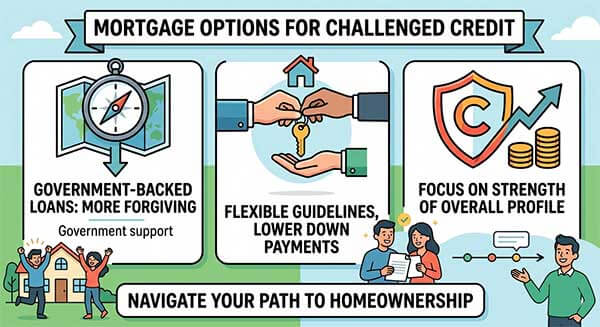
Not every mortgage program treats bad credit the same way. Some are more flexible for borrowers with lower credit scores, limited savings, or previous financial hardship. The right loan program in your hand can improve your financial struggles.
When borrowers are looking for a bad-credit mortgage rate, government-backed loans are usually the first stop. And, for good reason! These loans are typically much more forgiving than regular financing.
Government-backed loans, in some cases, enable a borrower to make a lower initial payment, have different qualification requirements, and accept a poor credit history as long as the rest of the file is strong.
Bad Credit & FHA Mortgage Rates
A lower credit score is likely to qualify a first-time buyer for an FHA Loan. Not only is the FHA loan cheaper than most government loans, but it also offers the most flexible income qualification and allows a lower initial payment. The FHA has successfully broadened the scope of eligible borrowers by adopting certain flexible credit policies. Mortgage rates for these borrowers are also very competitive.
FHA loans are really built for those who have never had the opportunity to secure a loan, and therefore make it possible for many borrowers who otherwise may not have had that opportunity because they could not qualify for a conventional loan.
However, it is worth mentioning that FHA loans also have a mortgage insurance premium in addition to the interest rate, and for those who need the most flexibility, FHA loans are a good option as long as the true total cost of the loan is analyzed beyond just the interest rate.
VA Mortgage Rates for Borrowers with Lower Credit Scores
VA loans are arguably among the best mortgage products for qualifying veterans, certain surviving spouses, and active-duty service members.
While the Department of VA guidelines themselves do not preclude by credit score or minimum requirements, most mortgage companies do.
And given that a VA loan is government-backed and requires no monthly mortgage insurance, this is likely a good loan product for a borrower with a lower credit score than many other loan options. For eligible borrowers, VA rates can be more affordable than alternative financing, particularly when paired with zero-down-payment requirements in certain cases.
Rural Homebuyers with Bad Credit – USDA Running Mortgage Rates
For eligible rural or suburban locations, USDA loans are another excellent option. These loans are intended to facilitate homeownership in designated areas and to provide financing with little or no equity requirements for most borrowers. For USDA, even borrowers with lower credit scores may be eligible, provided the overall file is solid, and the property qualifies. Where USDA loans are applicable, pricing is usually competitive, but there are location and total household eligibility factors. For buyers in the less urban areas, the USDA loan is often a viable option.
Bad Credit Loans and Conventional Mortgage Rates
With a declining credit score, conventional loans become increasingly difficult to obtain. In contrast to government-backed loans, conventional loans are more affected by scoring, risk, and pricing. For borrowers with low scores, the consequences include higher interest rates, more expensive mortgage insurance, and greater difficulty obtaining loan approval. This, however, does not mean conventional financing is impossible. With good income, assets, or a larger down payment, some borrowers with lower but qualifying credit scores may still qualify for a conventional loan. Even so, it is generally the loan category in which a lower credit score has the greatest impact on pricing.
Non-QM Mortgage Rates for Credit-Impaired Borrowers
Non-QM loans offer alternative options for borrowers who do not meet the standard requirements set by governing agencies. This includes self-employed individuals, those who can only provide bank statements, people who have recently experienced adverse credit events, and those with alternative income documentation. Non-QM loans are more expensive than agency loans because they are more flexible and have more associated risks. In some cases, non-QM financing may not be a last resort; rather, it may be seen as a more natural solution bridge, as it allows the possibility of homeownership and, later, the opportunity to refinance if credit documents, income documentation, or the borrower’s financial picture become more favorable.
What Else Affects Mortgage Rates on Bad Credit Loans Besides Credit Scores?
Most borrowers focus on their credit score; however, lenders have other considerations. A comprehensive underwriting review assesses the loan’s overall risk. The more risk layers, the higher the borrower’s risk, and the fewer the options available to him.
Better pricing is possible, and risk can be mitigated with larger down payments. low debt-to-income ratio, indicating minimal monthly payments. The borrower is seen as more secure if they have strong financial reserves after closing.
The home’s purpose is also important. A primary residence occupancy is likely to be less risky than a second home or investment property. The property type also affects the risk in multi-unit dwellings and unique housing structures. Negatives on a person’s credit report, such as late payments, open collections, charge-offs, or derogatory reports, can negatively impact their loan approval status as well as their interest rate. If there are no recent delinquencies, a person’s credit history may be judged differently when recent delinquencies are considered.
Down Payment and Loan-to-Value Ratio
A down payment is the amount the borrower pays at the start. A larger down payment reduces the total loan amount and the borrower’s loan-to-value ratio. It also provides the borrower with greater equity, reducing the lender’s risk. Improving the down payment can also improve the interest rate or strengthen the overall loan application. Bad credit borrowers may have more affordable options to improve their approval and pricing by increasing their down payment.
Debt-to-Income Ratio and Payment Stress
A borrower’s debt-to-income ratio (DTI) shows the proportion of a person’s gross income allotted to their monthly debt obligations. If a person’s DTI is extremely high, the loan is perceived as riskier, especially with low credit scores.
A borrower can disqualify themselves even if they technically meet the qualifications. A high DTI is especially common among those with lower credit scores.
Decreasing credit card debt, paying off an installment loan, and/or increasing income can help lower one’s DTI and improve their eligibility before applying.
Cash Reserves and Financial Strength
Cash reserves are the funds a borrower has available after a transaction, such as a loan closing, to help absorb potential income disruptions or cover unplanned expenses. Having sufficient cash reserves is especially helpful for lower credit scores, since a lack of cash reserves may justify them.
Buying a Home with Bad Credit?
Talk to a Loan Expert & Explore Your OptionsCan You Get a Low Mortgage Rate With Bad Credit?
Definitely, keep in mind that the word ‘low’ is relative based on the time of application and the borrower’s profile. A borrower with bad credit, which is why the pricing is different, can burg a better mortgage rate when assisted with a solid overall and manageable profile. Paying down some balances may help your score and debt-to-income ratio.
Targeting areas with potential for improvement is the most effective approach. Improving a score, even slightly, before the application can be very beneficial.
Revolving debt can be paid down to reduce debt. New credit inquiries should be avoided, reporting errors corrected, and a positive payment history should be built. Some borrowers are better off applying now because they already meet the guidelines for a practical loan program. Others may benefit from waiting a little longer to clean up balances, save more for closing, or allow recent derogatory items to age. It all comes down to the borrower, their goals, and the strength of the other parts of the file.
How To Improve Mortgage Rates on Bad Credit Loans Before You Apply
Many borrowers with low credit scores believe there is nothing they can do before applying. In truth, even a short time in preparation can yield significant improvement. A mortgage rate for bad credit loans is often determined by assessing risk factors rather than simply boosting the credit score to perfection.
Begin by examining all three credit reports. Look for misreported late payments, duplicated accounts, or incorrect balances. Spend extra time on revolving accounts, as credit card utilization can impact scores.
Generally, do not incur new debt before applying for the mortgage. New auto loans, financing furniture, and multiple new credit accounts will weaken the credit file. Keeping perfect accounts is also important – a single late payment can undo all the progress made. If possible, it is best for borrowers to build reserves and save for a larger down payment. While not all borrowers can wait, with some planning, it can make a big difference in what loans are available and in the rates they receive.
Pay Down Credit Cards Before Shopping for Rates
Particularly high credit card balances are one of the most important issues to address before you start looking for a mortgage. They can hurt your score and increase your debt-to-income ratio all at the same time. Reducing these balances, even partially, can significantly improve your situation.
Avoid New Debt During the Mortgage Process
Obtaining new credit before or during the mortgage process can be a substantial issue. This can change the borrower’s score, increase debt, and create new payment obligations, ultimately making the situation more expensive. Stability is essential during the mortgage process.
Check Credit Reports for Mistakes and Outdated Information
Many assume credit reporting is flawless. Not only is this a mistake, but it can cost money. Mortgage qualification and pricing can be negatively affected by outdated, high collection reporting, duplicates, and inaccurate balances.
Mortgage Rates on Bad Credit Loans Are Higher
Borrowers with credit scores below 580 FICO will have higher mortgage rates. Mortgage rates on bad credit loans with lower credit scores are higher because lenders associate lower credit scores with higher risk. Mortgage rate-sensitive borrowers should optimize their credit scores before applying for a mortgage.
Improve Your Credit Score Before Applying
Dispute inaccuracies on your credit report that may be hurting your score. Pay on time to build a positive payment history. Avoiding new credit inquiries before applying for a mortgage can also work in your favor.
Save For A Larger Down Payment
A higher down payment (10% – 20%) reduces lender risk and may qualify you for better terms. Government-backed loans like FHA allow as little as 3.5% down, but putting more down can reduce mortgage insurance costs.
Consider a Co-Signer or Joint Applicant
A co-signer with good credit can help ensure a lower rate. Adding a spouse or family member with a higher credit score may improve your approval odds.
Shop Around for Lenders
You can compare rates from multiple lenders, including mortgage brokers, credit unions, and non-QM lenders. Some lenders specialize in bad credit mortgage programs and may offer better terms.
Work With a Mortgage Broker
Mortgage brokers can access various loan programs and connect you with a lender that aligns with your credit profile. They may also negotiate better terms than you’d get along.
Consider a Temporary Buydown
Some lenders offer 2-1 or 3-2-1 buydowns, allowing you to start with a lower interest rate that gradually increases. This can be helpful if you plan to refinance once your credit improves.
Pricing Adjustments of Mortgage Rates With Low Credit Scores
Different loan programs may have varying requirements for credit scores. For example, government-backed loans like FHA and VA loans may be more lenient with lower credit scores than conventional loans. However, even with these programs, lower credit scores may still result in higher interest rates. While your credit score significantly determines your mortgage rate, it’s not the only factor.
Mortgage Rates on Conventional Loans
The higher the credit score, the lower the interest rate on conventional mortgage loans. Those who have just filed for bankruptcy two years ago or had a foreclosure three years ago can qualify for FHA loans. Gustan Cho Associates offers non-QM loans. NON-QM Loans do not have any waiting period requirements after bankruptcy or foreclosure. Most conventional loan programs have a long waiting period. 4-year waiting period after Chapter 7 Bankruptcy, recorded date of deed in lieu, and short sale to qualify for Conventional loans. 7-year waiting period after the recorded foreclosure date to qualify for conventional loans.
Mortgage Insurance and Closing Costs on Bad Credit Home Loans
FHA loans include mortgage insurance, which should be considered along with the note rate. Conventional loans may also require private mortgage insurance depending on down payment and equity position, and that cost can be heavily affected by credit score.
VA loans do not require monthly mortgage insurance, but other costs, such as the funding fee, may apply unless the borrower is exempt. USDA loans also include program-specific fees.
This is why comparing the annual percentage rate, lender fees, mortgage insurance, and cash-to-close matters just as much as comparing interest rates. Borrowers with low credit should review the total cost, not just the headline number. On the other hand, if the borrower is only a small step away from a stronger score band, delaying may improve affordability enough to justify the wait. The key is running the numbers practically rather than relying on assumptions.
Should You Wait To Improve Your Credit Before Buying a Home?
There is no one-size-fits-all answer. Some borrowers should move forward now because they qualify for a loan program that fits their needs and budget. Others may benefit from waiting if a few months of credit improvement could open significantly better terms.
Mortgage rates on bad credit loans are only part of the affordability picture. Borrowers should also understand mortgage insurance and closing costs. A loan with a lower rate may still cost more overall if fees are higher.
Likewise, a slightly higher rate may reduce out-of-pocket expenses if lender credits are used. The decision depends on urgency, rent costs, housing goals, cash reserves, and the realistically achievable level of improvement. If home prices in a target area are rising quickly, waiting may not always save money even if the borrower later qualifies for a somewhat better rate.
How To Shop Mortgage Rates on Bad Credit Loans the Smart Way
Rate shopping should be focused and organized. Borrowers should compare loans of the same type, with similar lock periods and fee structures. Comparing one FHA quote to one conventional quote without adjusting for mortgage insurance and closing costs does not provide a true apples-to-apples comparison.
What Are Mortgage Rates on Bad Credit Loans?
It is also important to ask whether the quote includes discount points, lender credits, or special assumptions. Some offers look lower at first glance because they require more cash upfront. Others may appear higher, but reduce cash-to-close. Borrowers with bad credit need clarity on both the monthly payment and total upfront cost. Shopping with lenders that understand lower-credit borrowers can also matter. Some lenders have stricter overlays than others, which can affect both approval and pricing. The right lender fit can make a real difference when the file is not straightforward.
Compare the Same Loan Type Across Multiple Lenders
When comparing offers, make sure each quote is based on the same program, occupancy, loan amount, and assumptions. This helps prevent misleading comparisons and makes it easier to identify the best true offer.
Ask About Rate Locks, Points, and Lender Credits
A quoted rate is only meaningful if the borrower understands whether it is locked, whether it includes points, and what lender fees are involved. Borrowers should ask direct questions so they can compare offers on equal footing.
Final Thoughts on Mortgage Rates on Bad Credit Loans
Mortgage rates for bad-credit loans are not based solely on credit scores. They reflect the full risk profile of the borrower and the loan itself. While lower scores often lead to higher rates, many borrowers still have viable paths to homeownership through FHA, VA, USDA, conventional, or non-QM financing, depending on their circumstances.
Borrowers who focus on strengthening the parts of the application they can control often put themselves in a better position to qualify and to secure more manageable financing.
The most important step is understanding how lenders evaluate risk and what actions may improve the file before applying. For borrowers with lower credit scores, the right mortgage strategy is not always about finding the absolute lowest advertised rate. It is about finding the best realistic loan option for current circumstances while keeping long-term affordability in focus.
Frequently Asked Questions: Mortgage Rates on Bad Credit Loans With Low Credit Scores
What Credit Score Is Considered Bad Credit For A Mortgage?
In mortgage lending, bad credit typically refers to credit scores below the range most lenders prefer for conventional financing. However, there is no single cutoff that applies to every loan program. Some government-backed programs are more flexible than conventional loans, and lenders may consider the full file rather than just the score.
Are Mortgage Rates Always Higher For Borrowers With Bad Credit?
Usually, yes, but not always by the same amount. Mortgage rates for bad-credit loans depend on the full risk profile, including down payment, debt-to-income ratio, reserves, occupancy, and loan program. A borrower with a lower score but strong compensating factors may still receive manageable terms.
Which Loan Program Is Usually Best For Bad Credit Borrowers?
That depends on the borrower’s eligibility and overall financial picture. FHA loans are often a common fit for low-credit borrowers. VA loans can be excellent for eligible veterans and service members. USDA may help rural buyers, while non-QM loans may suit borrowers who need more flexible documentation or have recent credit issues.
Should I Wait To Buy A Home Until My Credit Improves?
That depends on your goals, timeline, and current financial situation. Some borrowers benefit from waiting to improve their credit and reduce borrowing costs. Others may already qualify for a practical loan option now. The right decision depends on whether the savings from waiting outweigh market conditions, rent costs, and timing needs.
How Does My Credit Score Affect My Mortgage Rates On Bad Credit Loans?
A lower credit score signals higher risk to lenders, resulting in higher interest rates. Improving your score can help you secure better terms.
Are There Ways To Lower My Mortgage Rates On Bad Credit Loans?
Yes, you can improve your chances by increasing your down payment, improving your credit score, shopping around for lenders, or considering a co-signer.
How Much Higher Are Mortgage Rates On Bad Credit Loans?
Mortgage rates on bad credit loans can be 1%–5% higher than prime mortgage rates, depending on your credit score, loan type, and lender.