
FHA flipping guidelines affect buyers who want to purchase a recently resold property with an FHA loan. If the seller has owned the home for a short period, FHA may require a waiting period, additional documentation, or a second appraisal before the loan can close.
FHA Flipping Guidelines for Homebuyers and Investors
FHA flipping guidelines determine whether a homebuyer may utilize an FHA loan to purchase a recently renovated property. These regulations are particularly relevant for first-time buyers, real estate agents, investors, wholesalers, and sellers participating in FHA-backed transactions.
FHA loans are widely utilized due to their low-down payment requirements, flexible credit standards, and higher allowable debt-to-income ratios compared to many other loan types.
HUD’s FHA Single Family Housing Policy Handbook 4000.1 is the main FHA policy source for lenders, underwriting, property requirements, and endorsement guidance. FHA property flipping restrictions are also addressed in federal regulation 24 CFR 203.37a, which states that certain resales within 90 days are not eligible for FHA insurance, and that resales between 91 and 180 days may require additional documentation.
The Booming Housing Market Has Many Investors Buying and Selling Property Flips
HUD, the parent of FHA, has come up with new FHA flipping guidelines for home buyers and real estate investors. New FHA flipping guidelines were created after the 2008 Real Estate and Financial Meltdown. Days, where properties get flipped multiple times by investors prior to selling it to the end homeowner, have long been gone.
Explore FHA flipping guidelines for buyers and investors, including the 90-day rule, second appraisal requirements, and contract considerations.
The government put every possible measure into place to avoid another real estate crash like the one we had in 2008. Homebuyers with FHA loans can buy property flips from real estate investors. However, they need to follow and abide by FHA flipping guidelines.
How FHA Flipping Guidelines Work
The real estate market has recovered. Many home builders on the brink of bankruptcy are now enjoying stellar record profits. Home prices have skyrocketed throughout the country. FHFA has increased conforming loan limits for the past five years in a row. Conforming Loan Limits for 2024 is capped at $766,550. HUD has increased FHA Loan Limits for the past eight years in a row.
Rising Home Prices Make Property Flips Lucrative For Real Estate Investors
HUD has been increasing FHA loan limits for the past five years due to skyrocketing home prices due to housing shortages. FHA loan limits are updated annually and vary by county. Buyers should confirm the current FHA loan limit for the property county before making an offer. The reason for FHFA and HUD increasing loan limits is due to rising home prices. Many pre-approved home buyers are having a difficult time finding homes within their price range. Property flippers can offer great deals on homes they renovated and are flipping. There are two types of investors. Long-term real estate investors. The second type is short-term property flippers.
How FHA Flipping Guidelines Affect Real Estate Investors
Real estate property flippers are investors who purchase homes at a discount. They buy homes in need of repairs, do renovations to them, and then sell it for a profit. The key to making the most profit for property flippers is to sell it as fast as possible. Many flippers use hard money loans.
The longer borrowers have the hard money loan out, it means high interest and less profit. However, there are mortgage guidelines when it comes to home buyers buying property flips.
FHA flipping guidelines restrict real estate investors from selling flips fast. Lenders consider property flips as a property that has been purchased and flipped at a premium in a short period of time. Some property flippers can make over 100% return on their investment. Nothing is wrong with investors making double, triple, or more their investments. But HUD does have strict FHA Flipping Guidelines when it comes to FHA borrowers buying flips.
What FHA Flipping Guidelines Mean
FHA flipping guidelines regulate the minimum time interval before a property can be purchased and resold to an FHA buyer. These rules do not prohibit legitimate renovations. Their primary objective is to prevent rapid resales that lead to substantial price increases.
FHA requires a minimum of a 90-day waiting period. There are FHA flipping guidelines on homes that are sold between 91 to 180 days.
A typical property flip occurs when an investor acquires a home, renovates it, and subsequently sells it for profit. Although many flipped homes appear improved after renovations, the timing of the resale is critical. FHA lenders must verify that the seller has maintained ownership for a sufficient period and that the new sale price is justified by repairs, property condition, comparable sales, and a thorough appraisal.
Why FHA Has Property Flipping Rules
FHA flipping rules are designed to protect both homebuyers and the FHA insurance fund. Quick resales can be risky if prices go up sharply without real improvements. For instance, a seller might only make cosmetic changes and then list the home at a much higher price. If the price jump isn’t supported by real upgrades or market data, buyers might end up overpaying. FHA rules require lenders to review ownership history, resale timing, title records, appraisal results, and repair documents if needed.
FHA 90-Day Flipping Rule Explained
The most important FHA flipping rule is the 90-day rule. If the seller bought the property 90 days or less before the FHA buyer’s contract date, the property usually can’t get FHA financing. Federal rules say that if the resale happens within 90 days of purchase, the home isn’t eligible for an FHA-backed mortgage.
This requirement may necessitate that the buyer wait until the property becomes eligible for FHA financing, consider alternative loan options, postpone closing, or seek a different property.
The contract date is critical; even if closing occurs more than 90 days after the seller’s acquisition, the property remains ineligible if the contract was executed before day 91. Homebuyers and agents should always find out when the seller bought the home before making an FHA offer on a renovated property. Investors should also double-check this date before accepting offers backed by FHA loans.
Why Day 91 Matters for FHA Buyers
Many FHA transactions involving flipped homes may proceed on day 91, provided the property satisfies all other FHA requirements. However, merely reaching the 90-day threshold does not ensure loan approval. If the resale price has increased substantially, the lender may require supplementary documentation or a second appraisal.
FHA Rules for Properties Resold Between 91 And 180 Days
If a property is sold between 91 and 180 days after it was bought, it may qualify for FHA financing. But if the new price is much higher than what the seller paid, the lender will likely take a closer look at the value. According to 24 CFR 203.37a, if the resale happens between 91 and 180 days after purchase, the property usually qualifies for FHA insurance. But HUD requires extra paperwork when the resale price is 100 percent or more above what the seller paid, including a second appraisal.
When A Second FHA Appraisal May Be Required
A second appraisal may be required if the seller flips the home within 91 to 180 days and the new price is at least double what they paid. For example, if the seller bought the home for $120,000 and sells it to an FHA buyer for $240,000 or more within that period, the lender will probably do a detailed review. The lender may ask for a second appraisal and proof of why the price increased.
Renovation Documentation Can Help Support the New Value
Investors are encouraged to maintain comprehensive records of all repairs and improvements. Relevant documentation includes paid invoices, contractor receipts, before-and-after photographs, permits, material receipts, inspection reports, and a detailed list of completed work. Although such documentation does not guarantee loan approval, it assists the lender and appraiser in determining whether the increased price is substantiated by actual improvements and current market value.
FHA Rules for Resales After 180 Days
Once the seller has owned the property for more than 180 days, FHA flipping reviews are generally less stringent. Nevertheless, the lender will continue to examine the title history, appraisal, property condition, and overall eligibility. Selling after 180 days does not eliminate all associated risks. FHA buyers must ensure that the property meets minimum standards. The appraisal must support the sale price, the seller must have legal ownership, and the transaction must satisfy both lender and investor requirements.
FHA Resales Within 12 Months May Still Get Extra Review
Federal rules allow HUD to request additional proof of value for resales after 90 days but before 12 months if the resale price is 5 percent or more above the lowest sale price during that period. Even after 90 days, lenders may still request more details. If the property recently changed owners, had a significant price increase, or needs additional proof of repairs, extra conditions may arise during the loan process.
FHA Owner of Record Requirement
The seller must be the official owner, meaning they legally own the property and have the right to sell it. FHA lenders check the deed, title documents, purchase history, and related papers. This rule is especially important in assignments, wholesaling, double closings, estate sales, and investor deals. If the seller isn’t clearly listed as the owner, the FHA loan may run into title or approval issues.
FHA Flipping Rule Exceptions
Some transactions may be exempt from the FHA flipping time limits. Common examples include HUD-owned properties, certain government agency sales, inherited homes, employer relocation sales, some approved nonprofit sales, and certain disaster-area exceptions allowed by HUD. Even when an exception applies, the lender must submit the required documentation. Buyers should not assume that an exception will be granted without a comprehensive review by the lender.
FHA Flipping Guidelines for Homebuyers
Homebuyers using FHA loans should be cautious when looking at a recently renovated home. A flipped home can be a good purchase, but timing and keeping good records are very important. Before signing a contract, find out when the seller bought the home and if they have owned it for more than 90 days. Also, check whether the price has increased significantly, whether permits are required, and whether major systems such as the roof,
Renovation Documentation Can Help Support the New Value
A nice-looking home is not always a fully repaired home. Fresh paint, flooring, cabinets, and lighting can hide bigger issues. FHA buyers should still consider a professional home inspection, even when the appraisal is completed.
Contract Tips for FHA Buyers
The purchase contract should give enough time for appraisal review, title review, and underwriting. Buyers may also want protective language if FHA flipping rules delay or block the loan. A strong pre-approval is important, but the property must also qualify. FHA approval is not only about the borrower. It is also about the home.
Thinking of Buying a Flipped Home? Understand FHA Flipping Guidelines First!
Contact us today to learn about FHA flipping guidelines and how they affect your home buying process.Are Cosmetic Updates Enough to Support a Much Higher Resale Price?
FHA Flipping Guidelines for Investors
Documentation Investors Should Keep
Investors are advised to maintain a comprehensive file documenting renovations, including the scope of work performed, responsible parties, permits obtained, inspections passed, and justification for the final sale price. Good documentation can help prevent loan approval delays, especially when lenders ask about the resale price.
FHA Flipping Guidelines on Homes That Were Owned For 91 To 180 Days
For resales between 91 and 180 days after the seller acquired the property, FHA may require a second appraisal if the resale price is 100% or more above the seller’s acquisition price. The second appraisal must be completed by a different appraiser, and the borrower cannot be charged for the second appraisal. If the above conditions apply, a second home appraisal needs to be ordered. Under FHA Flipping Guidelines, the home buyer cannot pay for the second home appraisal.
Case Scenario of FHA Flipping Guidelines
Example: An investor buys a home for $100,000 and signs a resale contract with an FHA buyer for $200,000. If the resale contract is dated between 91 and 180 days after the seller acquired the property, FHA may require a second appraisal because the resale price is 100% or more above the seller’s acquisition price. The buyer cannot pay for the second appraisal.
FHA Appraisal Issues on Flipped Homes
FHA appraisers evaluate the property’s market value and condition, as well as its safety, security, and structural soundness. Even if a flipped home appears newly renovated, the appraiser may identify issues such as peeling paint, missing handrails, roof defects, broken windows, exposed wiring, plumbing deficiencies, trip hazards, or other necessary repairs. It is important to note that the appraiser does not serve as a home inspector. FHA buyers should not rely solely on the appraisal; obtaining an independent home inspection is recommended to identify potential issues not addressed in the appraisal report.
Common Problems That Delay FHA Flip Transactions
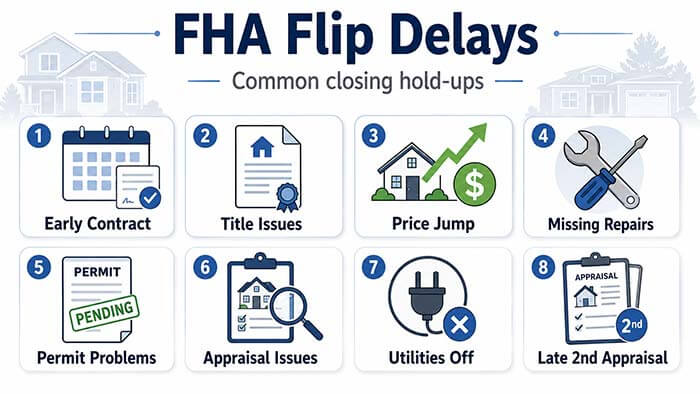 FHA flip deals often get delayed if the resale contract is signed too early, the seller’s purchase date isn’t checked, the title history is unclear, the price increase isn’t justified, repair records are missing, or the appraisal finds problems. Additional delays may occur if required permits are absent, repairs are undocumented, utilities are disconnected during the appraisal, or a second appraisal is requested late in the process.
Exceptions To FHA Flipping Guidelines
There are certain exemptions to FHA flipping guidelines. The following conditions are exempt from FHA flipping guidelines: A home that is purchased by employers or relocation companies. Common FHA flipping-rule exceptions may include HUD-owned properties, certain government-owned properties, homes acquired through inheritance, properties sold by employers or relocation companies, and homes in federally declared disaster areas. Buyers should confirm the exception with the lender before relying on it.
Homes purchased by non-for-profit agencies of HUD-owned single-family properties at a discount with resale restrictions. Homes acquired by the home seller through inheritance.
Financial and government-sponsored institutions and agencies. Local and state government organizations. Homes in Federal Declared Disaster Area. If an investor buys the above properties and decides to sell right away, then FHA flipping guidelines applies.
Buying Flips with Other Loan Programs
FHA has specific property-flipping restrictions. Other loan programs may not use the same FHA 90-day rule, but lenders can still review title history, prior sales, appraisal support, and investor overlays before approving a recently flipped property.
For more information on property flips, feel free to contact us at Gustan Cho Associates at 800-900-8569 or text us for a faster response.
Or email us at gcho@gustancho.com. We are experts in helping homebuyers buying house flips and getting them approved and closed on their FHA loan. The team at Gustan Cho Associates is available 7 days a week, evenings, weekends, and holidays.
FHA Flipping Guidelines and Lender Overlays
While FHA sets the basic rules, some lenders add extra requirements called overlays. This means one lender might turn down a loan that another would approve, even if it meets FHA and investor standards. This consideration is particularly significant for borrowers with lower credit scores, elevated debt-to-income ratios, recent credit challenges, manual underwriting needs, or complex property concerns. Flipped homes frequently require additional review, making lender selection a critical factor.
FHA Flipping Guidelines are Not the Same as Conventional Loan Rules
FHA flipping rules only apply to FHA-insured loans. Conventional, VA, USDA, and non-QM loans may have different rules. Some programs are more flexible about resale timing, while others require an appraisal or investment. If a buyer is ineligible for FHA financing due to the 90-day rule, alternative loan options remain available. The optimal loan selection depends on factors including credit history, down payment, income, property condition, occupancy, and loan amount.
Best Practices For Real Estate Agents
Real estate agents are advised to verify the ownership history and acquisition date at the outset when working with FHA buyers. If a property appears to be a recent flip, the seller’s purchase date should be confirmed prior to submitting an offer. It is advisable to obtain full pre-approval, verify the seller’s acquisition date, commission property inspections, review repair documentation, and collaborate with a lender experienced in FHA flipping regulations.
Reviewing listing history, previous sale prices, permit records (if available), and repair documentation can help prevent unnecessary inspection expenses, additional appraisal costs, closing delays, and client dissatisfaction.
Best Practices for FHA Borrowers: FHA borrowers should focus on three key factors: timing, condition, and value. Timing requires adherence to FHA resale rules; condition mandates that the property meets FHA standards; and value necessitates that the appraisal supports the purchase price.
FHA Flipping Guidelines For Homebuyers and Investors: Final Thoughts
FHA flipping regulations significantly affect transactions involving properties that have been recently acquired, renovated, and resold. The primary rule is the 90-day requirement: if the seller has owned the property for 90 days or less, FHA financing is generally unavailable. For resales occurring between 91 and 180 days with a price increase of 100 percent or more, a second appraisal and additional documentation are typically required. Buyers should verify the seller’s acquisition date before executing the contract. Investors must plan resale timing and maintain comprehensive renovation records. Agents should identify potential FHA flipping concerns before the loan approval process begins.
FAQs: FHA Flipping Guidelines for Homebuyers and Investors
How Do the FHA Flipping Guidelines Affect Real Estate Investors?
These guidelines restrict investors from quickly selling flipped properties, requiring a minimum waiting period before the property can be resold to a homebuyer using an FHA loan.
What are the Guidelines for Properties Sold between 91 to 180 Days?
If a property is sold between 91 and 180 days and the resale price is 100% or more of the acquisition cost, or if the price is more than 20% over the seller’s purchase price, a second appraisal is required.
Are There Any Exceptions to the FHA Flipping Guidelines?
Yes, exceptions include homes purchased by employers or relocation companies. HUD foreclosure homes, government-owned homes, properties acquired through inheritance, and homes in federally declared Disaster Areas.
Do Other Loan Programs Have Similar Flipping Guidelines?
Only FHA has specific property flip waiting period guidelines. Other loan programs, such as VA, USDA, and Conventional Loans, do not have these restrictions.
Why Have FHA and Conventional Loan Limits Increased Recently?
The limits have been raised due to skyrocketing home prices and a high demand for homes that exceeds the supply, making it difficult for pre-approved buyers to find homes within their price range.
How Can FHA Flipping Guidelines Impact My Ability to Buy a Flipped Property?
These guidelines may delay your purchase if the property has been owned by the seller for less than 91 days or requires a second appraisal due to a significant price increase.