FHA Bankruptcy Waiting Period: Chapter 7 and Chapter 13 Guidelines
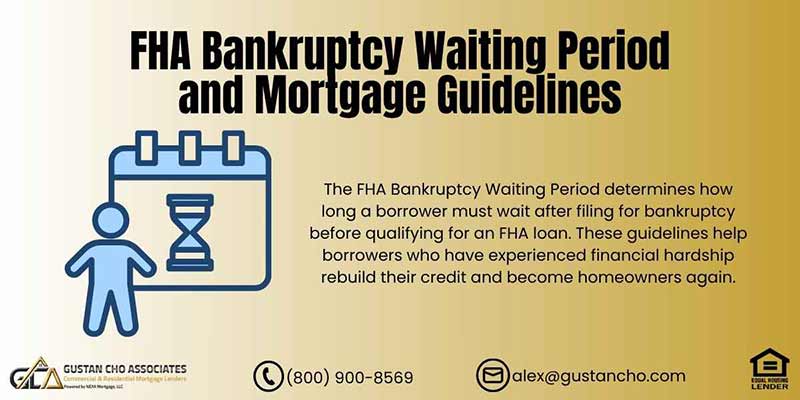
The waiting period for an FHA loan after bankruptcy depends on the type of bankruptcy filed, the case’s resolution, and the timing of the lender’s request for the FHA case number. For Chapter 7 bankruptcy, applicants must wait two years after discharge before applying for an FHA loan.
For Chapter 13, eligibility may be possible after 12 months of the repayment plan, provided there is a satisfactory payment record and court approval for the mortgage.
Filing for bankruptcy does not automatically preclude eligibility for an FHA loan. Eligibility is determined by several factors, including the waiting period, income, employment status, credit score, debts, assets, payment history, property characteristics, and lender-specific guidelines.
FHA Bankruptcy Waiting Period
Following a Chapter 7 bankruptcy discharge, the two-year waiting period begins on the discharge date. In certain cases, consideration may be possible after 12 months if the applicant can demonstrate extenuating circumstances and responsible financial management since the bankruptcy. For Chapter 13 bankruptcy, FHA financing may be available 12 months after the repayment plan begins, provided all payments have been made and court approval has been obtained. If the Chapter 13 discharge occurred less than two years ago, the loan may require manual underwriting rather than the standard process.
What You Need To Know About The FHA Bankruptcy Waiting Period
The date of bankruptcy filing is not the sole factor influencing the FHA waiting period. The key date for your FHA waiting period depends on the type of bankruptcy and underwriting. For Chapter 7, the discharge date matters most. For an active Chapter 13, lenders look at how much of your payment plan you’ve completed and if you’ve made all payments on time.
Eligibility for an FHA loan is typically determined by the date the FHA case number is assigned. This consideration is particularly important for applicants nearing the end of the required waiting period.
For example, a Chapter 7 discharge that occurred 23 months prior may appear to satisfy the two-year rule. However, the lender must verify that the FHA case number has been assigned and that all requirements are met at the time of assignment.
Chapter 7 Bankruptcy
Chapter 7 bankruptcy is the liquidation chapter. A bankruptcy may discharge a borrower from certain unsecured debts, but a bankruptcy does not remove liens that are not discharged in the bankruptcy proceeding. For FHA loans, the waiting period following a Chapter 7 bankruptcy is generally straightforward.
The FHA Chapter 7 Bankruptcy 2-Year Waiting Period
HUD’s manual underwriting guidelines states that a Chapter 7 bankruptcy will not disqualify a borrower from an FHA-insured mortgage after two years from the bankruptcy discharge, as of the FHA case number assignment. Maintaining good credit and avoiding new debts for at least two years after discharge is often a primary consideration for lenders. Meeting the two-year waiting period does not guarantee mortgage approval. Applicants must also satisfy all other requirements related to credit, income, assets, debts, and property eligibility itself.
Han Two Years After Chapter 7?
There is a limited exception for FHA loans if your Chapter 7 bankruptcy was discharged less than two years ago. A desire to purchase a home alone is insufficient to qualify for this exception.
HUD may permit application after 12 months but before two years if the applicant can demonstrate that the bankruptcy resulted from circumstances beyond their control and that finances have been managed responsibly since that time.
This represents an exception to the standard FHA waiting period. Lenders will evaluate the cause of the bankruptcy, whether it was genuinely beyond the applicant’s control, whether the situation has been resolved, and how finances have been managed since the event.
What Are Extenuating Circumstances
Extenuating circumstances are typically significant events beyond the borrower’s control that made it difficult to meet financial obligations. The lender must be convinced that cause is unlikely to recur. High levels of debt, frequent job changes, or excessive spending are not considered extenuating circumstances. The lender will make a determination based on the documentation provided.
How Borrowers Are Qualified for an FHA Loan During Chapter 13 Bankruptcy
Traditionally, in Chapter 13, a court will approve a payment plan that requires the person to pay some or all of their qualifying debt within three to five years. Upon completion of the payment plan, FHA provides a pathway for mortgage eligibility. FHA may allow eligibility even before the bankruptcy is officially discharged, provided at least 12 months of the payment plan have been completed and a case number is assigned. Lenders will review the most recent 12 months of payments to ensure all obligations have been met on time. A court order from the bankruptcy court is also required to proceed with the mortgage application.
The Importance of Trustee Approval During Chapter 13 Bankruptcy
This requirement is unique to FHA loans. Unlike conventional loans, FHA lets you buy a house while still in Chapter 13, as long as you meet the conditions.
According to HUD, you must have written approval from the court before you can get a mortgage. The Chapter 13 trustee may also participate in the approval process, and local rules may vary.
Approval from the trustee alone is insufficient for FHA; ongoing court approval is required throughout the home purchase or refinance process during Chapter 13.ining court orders.
FHA Manual Underwriting During Chapter 13 Bankruptcy
Applicants seeking an FHA loan during Chapter 13 bankruptcy should anticipate a more detailed review of finances, including credit reports and credit decisions, rather than reliance on the automated underwriting system.
With manual underwriting, the lender reviews your credit report, payment history on your mortgage and other debts, your Chapter 13 payments, your income and assets, how your debts compare to your income, and any other FHA requirements.
The need for manual underwriting does not automatically result in loan denial. Applications must still satisfy FHA’s manual underwriting requirements. There is still some confusion about what happens after a Chapter 13 bankruptcy is discharged and how it affects the FHA waiting period.
What is the Difference Between Manual vs Automated Underwriting System Approval
The FHA manual doesn’t require a two-year wait after bankruptcy is completed. However, the FHA’s automated system usually sets a two-year waiting period from your discharge date.
If your bankruptcy was discharged less than two years before your FHA case number is assigned, your loan will need manual underwriting instead of the automated process.
This primarily affects the manner in which the loan is reviewed and approved. Generally, waiting two years after a Chapter 13 discharge facilitates FHA approval. If the discharge occurred less than two years ago, a more detailed manual review should be anticipated. Discharge from Chapter 13 bankruptcy does not guarantee loan approval.
What Happens After the Discharge of Chapter 13 Bankruptcy?
A Chapter 13 bankruptcy dismissal is an entirely different scenario from a Chapter 13 bankruptcy discharge. A discharge resolves the requirements of a court-ordered plan and extinguishes the debtor’s obligation to the qualifying debts.
A bankruptcy case is dismissed, preventing a discharge, even if a plan’s requirement is fulfilled. Unlike conventional mortgages, FHA loans don’t have a post-dismissal waiting-period formula.
Lenders must investigate how the bankruptcy debts were resolved, the borrower’s payment history, and their current obligations and credit. Given the nature of bankruptcy dismissals, it is advisable to review the bankruptcy and credit report rather than rely solely on waiting periods. FHA’s underwriting guidelines consist of an automated scoring system. For bankruptcy, both systems must be addressed.
Ready to Apply for an FHA Loan After Bankruptcy?
Complete a quick application or send your bankruptcy details. We’ll confirm your FHA waiting period, credit readiness, DTI, income, and best path toward approval.HUD FHA Total Mortgage Guidelines on FHA Loans
To comply with FHA’s TOTAL credit reporting requirements, the lender must confirm that 2 years have passed since the bankruptcy discharge.
One lender may consider only FHA loan applications that receive an automated “approve” recommendation, while others may be more lenient and process requests for manual underwriting for otherwise qualified FHA applicants.
If bankruptcy discharges occurred within the last two years, the mortgage must be downgraded to Refer and processed through manual underwriting. HUD instructs lenders to refer to their manual underwriting guidelines for processing loans that require this treatment. This explains the variations in responses borrowers receive from loan officers.
Waiting Period for FHA Bankruptcy When the Mortgage Was in Bankruptcy
This subject can be challenging for borrowers to understand. If a mortgage is part of a bankruptcy filing, it doesn’t mean the mortgage ceases to exist, and the property is eliminated as part of the bankruptcy discharge. A bankruptcy discharge means only that the obligation on the debt is eliminated; bankruptcy does not eliminate a lien, and therefore, can survive bankruptcy. For this reason, lenders need to know how the property was disposed of after bankruptcy.
Bankruptcy Followed By Foreclosure
If the property was foreclosed, FHA’s foreclosure rules receive priority over the bankruptcy rules. A borrower is ineligible for a new FHA-backed mortgage if a foreclosure, or a deed-in-lieu of foreclosure, was done within the previous 3 years from the date of the FHA Case Number Assignment.
Regarding the property transfer, the relevant time frame is the date the property title is transferred from the borrower to the foreclosing entity or its agent.
It is erroneous to conclude that bankruptcy filings under Chapter 7 automatically impose a 3-year waiting period after discharge. When a bankruptcy case is closed, a lender must determine whether a foreclosure, deed in lieu, short sale, or another transfer of the property was completed. The lender must also determine the appropriate date to consider the transfer complete.
The Date of Property Transfer
A borrower can receive a Chapter 7 discharge and maintain legal title to the property. The FHA Foreclosure waiting period can restart if the lender forecloses later, even if the bankruptcy discharge occurred first. Borrowers should provide their loan officer with bankruptcy case documents and supporting materials that indicate the date and method of property sale or transfer. This enables the lender to accurately calculate the waiting period for FHA foreclosure eligibility.
FHA Loans after Bankruptcy and Foreclosure
Bankruptcy and foreclosure represent major setbacks in your credit history. After bankruptcy concludes, you must wait the required period before applying for a loan. If your home was foreclosed, you must also meet the FHA’s separate foreclosure waiting period.
FHA usually requires a three-year waiting period after a foreclosure or Deed in Lieu, starting from the date the property changes ownership. In rare cases, HUD may grant exceptions; however, you should not expect approval.
Treat each event as a distinct component of your housing history. A bankruptcy discharge, foreclosure, deed in lieu, or short sale will each affect your eligibility differently. Filing for bankruptcy does not impose additional FHA credit score requirements. You must still meet both your lender’s and the FHA’s credit score standards. To get an FHA loan with 96.5% financing, HUD requires a minimum credit score of 580. This means you need to make at least a 3.5% down payment.
HUD Minimum Credit Score Requirements on FHA Loans
If your credit score is between 500 and 579, you can get up to 90% financing and must put down at least 10% of the home’s value. Borrowers with credit scores below 500 are ineligible for standard FHA-insured financing.
Some lenders might require higher credit scores than the FHA’s minimum guidelines. Therefore, even if you meet HUD’s criteria, different lenders may reach different decisions regarding your application.
Rebuilding your credit after bankruptcy requires time and should be approached as a gradual, consistent process rather than a rapid effort to achieve a specific score. Important steps include paying your bills on time, avoiding new debt, checking your credit reports, keeping credit card balances low, and saving money.
How Much House Can You Afford: The Ability to Repay
Lenders want to see that you are willing and able to pay your debts after bankruptcy. This is especially important if your FHA loan is reviewed manually. If you have many recent late payments, you might face more challenges getting approved than someone with a recent bankruptcy but a good payment history. Underwriters review your entire credit report, not just a few dates, when deciding on your application.
Post Bankruptcy Housing Payment History
Your housing payment history is very important during a manual review for an FHA loan. Lenders may check your payments using your credit report, a landlord form, mortgage records, or bank statements. You may not need to complete a Verification of Rent form after bankruptcy.
The type of review and your payment history will determine which documents are required. After bankruptcy, the FHA does not have a special debt-to-income ratio credit rule.
You don’t need to open a lot of secured cards after bankruptcy. These habits show you are managing your credit well now. Still, your score might not reach 700 in a year, since credit scores can be unpredictable. Negative marks on your credit during the FHA bankruptcy waiting time do not automatically stop you from qualifying.
How Do Mortgage Underwriters Review Manual Underwriting Borrowers
For manual reviews, lenders look at your bankruptcy, debts, the mortgage you want, and your overall financial situation. In an active Chapter 13 plan, lenders will review your proposed mortgage, bankruptcy commitments, and your full financial situation. Don’t assume you know your buying power. Get the facts before you start shopping. You will need to gather several documents for an FHA loan after bankruptcy.
Getting a mortgage after bankruptcy usually means collecting more paperwork than you did for the bankruptcy itself. You will need your bankruptcy petition, discharge schedules, order of discharge, and proof of discharge date.
For Chapter 13, you will also need documentation of your payment plan and a court order allowing you to avoid paying the Chapter 13 bankruptcy. You will also need paperwork for any other major financial events that happened during your bankruptcy. If your bankruptcy involved real estate, your lender may request foreclosure papers, deeds, closing documents, or mortgage records to verify the property transfer. Gathering these early can help avoid delays.
Lender Overlays After Bankruptcy
While the FHA sets the basic mortgage insurance rules, lenders and investors can add their own extra requirements. These extra requirements are called lender overlays. For example, the FHA might allow a manual review for someone whose Chapter 13 bankruptcy ended less than two years ago, but the lender could still decide not to approve the loan. This usually means the lender has stricter rules than the FHA requires. Ask your lender if their waiting period is longer than the FHA’s, as this could be an extra lender rule.
The Period and the FHA Case Number
The FHA bankruptcy waiting period officially starts when your case number is assigned. Borrowers nearing the two-year anniversary of a Chapter 7 or similar bankruptcy. For example, if a Chapter 7 discharge was on September 15, 2024, the case number processing date would be September 15, 2026, using the general two-year rule. You can start preparing, but your case number and loan review must follow the FHA’s timing rules. Rust estimated waiting times—check the exact dates and rules.
FHA Loan After Multiple Bankruptcies
Having more than one bankruptcy does not always mean a longer wait, but underwriters will look more closely at your file. The discharge or disposition date must be documented to assess the bankruptcy and the borrower’s financial management. If you’ve filed for bankruptcy more than once, underwriters will check to see if you have truly resolved your financial issues.
Simply waiting the required time does not guarantee you will be seen as a good credit risk. I’ll review your bankruptcy papers, not just the dates on your credit report, when deciding if you qualify.
Considerations include whether the bankruptcy was filed under Chapter 7 or Chapter 13, the filing, discharge, or dismissal date, and, for Chapter 13, the start date of the payment plan and whether the most recent 12 months of payments were made on time. It is also important to determine if the case involved real property and, if so, whether there was a foreclosure, deed in lieu, short sale, or other transfer of ownership. Based on these dates, the lender can decide whether the bankruptcy case is eligible under an FHA rule or requires manual underwriting.
Why Do Different FHA Lenders Give Different Answers After Bankruptcy?
 People have similar bankruptcies, but they might get different answers because FHA eligibility is just one part of the mortgage process. One lender might require a higher credit score, another might skip manual underwriting, and some could ask you to wait longer after bankruptcy or other setbacks. Being denied by one FHA lender does not mean all FHA lenders will deny your application. Be sure to find out if your denial was due to a HUD rule or the lender’s own policies.
Analysis of Gustan Cho Associates Processing FHA Loans for Bankruptcy Clients
Gustan Cho Associates assists clients with bankruptcy, foreclosure, collections, charge-offs, late payments, and other credit issues. The firm verifies FHA eligibility independently rather than relying solely on the previous lender’s date to ensure accurate calculations. For Chapter 7 clients, the discharge date and any subsequent housing events are verified. For Chapter 13 clients, the credit report, bankruptcy status, case history, court orders, income, and debts are reviewed to determine if manual underwriting is necessary. This process ensures the mortgage file is complete and anticipates any lender-specific requirements that may affect financing.
FHA vs. Conventional Bankruptcy Waiting Period Summary
| Loan Type | Chapter 7 Waiting Period | Chapter 13 Waiting Period (Discharge) | Mortgage Included in Bankruptcy |
| FHA Loan | 2 years from discharge | No waiting period (manual underwrite if <2 yrs) | 3 years from deed transfer date |
| Conventional Loan | 4 years from discharge | 2 years from discharge | 4 years from discharge date |
Final Thoughts
Bankruptcy, like other credit setbacks, will not keep you from getting an FHA loan forever. For Chapter 7, you are usually eligible two years after discharge, though sometimes you can apply after just one year. With Chapter 13, you may qualify if you have an approved court plan.
After a Chapter 13 discharge, make sure you understand how it affects your FHA eligibility and whether you will need manual underwriting. Most FHA loans discharged within two years require manual review, even if you qualify otherwise.
Also, check whether you had a foreclosure, deed in lieu, or short sale, since each has its own waiting period. How long you will wait for an FHA loan after bankruptcy depends on your bankruptcy type, discharge status, property and credit history, and what the underwriter requires. After a Chapter 7 bankruptcy, the waiting period is generally two years after discharge. During this time, you should maintain good credit and avoid new debt. In some cases, the period may be shortened if you demonstrate financial responsibility under special circumstances. For Chapter 13 bankruptcy, the FHA will consider financing after 12 months, as long as you have a satisfactory payment history. ment history.
Frequently Asked Questions About FHA Bankruptcy Waiting Period:
How Long After a Chapter 7 Bankruptcy Can I Get an FHA Loan?
Most borrowers can qualify for an FHA loan 2 years after the Chapter 7 discharge date (not the filing date). The key is showing you’ve re-established credit and paid everything on time since discharge.
How Long Do I Have to Wait Before Applying for an FHA Loan After a Foreclosure?
Generally, the FHA requires at least 3 years to have passed after a foreclosure or deed in lieu. The waiting period starts from the date the property is transferred to the foreclosing entity. Exceptions may apply.
What Credit Score Do I Need to Apply for an FHA Loan After Foreclosure?
Bankruptcy does not change the credit score needed for FHA loans. HUD requires a score of 580 for maximum financing. Scores between 500 and 579 qualify for up to 90% financing. Some lenders may set higher requirements.
After Bankruptcy, Will My FHA Loan Application Need Manual Underwriting?
This is not always required. If the foreclosure happened more than two years before the FHA assigned the loan number, standard underwriting applies. If it were within two years, manual underwriting and a downgrade to Refer are necessary. While there are dissimilarities, bankruptcy and mortgage underwriting do have some common actors.
The U.S. Courts website includes forms to verify Chapter 7 and 13 bankruptcies, bankruptcy discharges, bankruptcy liens, bankruptcy reclamation plans, and bankruptcy procedures. Potential borrowers should speak to bankruptcy lawyers for bankruptcy matters.
Mortgage guidelines can change, and individual lenders may add extra requirements beyond FHA minimums. Credit review and standard underwriting determine eligibility.
FHA TOTAL now requires a manual downgrade for bankruptcy discharge within two years, while manual Chapter 13 review is allowed after at least twelve months of satisfactory payments and written court approval.