Becoming an authorized credit card user can be one way to rebuild credit before applying for a mortgage. This strategy may help borrowers with low credit scores, limited credit history, or past credit problems improve their credit profile when the account is handled correctly.
An authorized credit card user is added to another person’s credit card account, often by a spouse, parent, relative, or trusted friend. If that credit card has a strong payment history, low balance, high credit limit, and reports to the credit bureaus, the account may appear on the authorized user’s credit report. This can help improve credit scores over time.
However, becoming an authorized credit card user is not a guaranteed credit fix. It can help or hurt depending on the main cardholder’s payment history, credit limit, balance, and whether the credit card company reports authorized user accounts to Equifax, Experian, and TransUnion. A maxed-out card or a late payment can damage the authorized user’s credit rather than help it. For mortgage borrowers, credit scores matter because they can affect loan approval, interest rate pricing, mortgage insurance, and available loan programs. FHA, VA, USDA, conventional, and Non-QM lenders may all review credit differently. Some lenders may count authorized credit card user accounts, while others may give them less weight if the borrower does not have enough credit history of their own. Gustan Cho Associates works with borrowers who are rebuilding credit, recovering from bankruptcy, dealing with collections, or trying to qualify after being turned down by other lenders. In this guide, we will explain how becoming an authorized credit card user works, when it can help with mortgage approval, when it can hurt, and what borrowers should do before applying for a home loan.
What Is an Authorized User on a Credit Card?
An authorized user is someone, such as a credit card account holder, usually a parent, spouse, or trusted friend, who adds to their credit card account. This person can use the card to make purchases, but they are not legally responsible for the bill. The main account holder is still on the hook for any money spent. However, the card’s payment history, credit usage, and other details usually appear on the authorized user’s credit report.
The authorized credit card user can see a credit score boost if the main cardholder pays on time and keeps the balance low. The authorized user’s score can drop if the holder misses payments or runs up a high balance.
If you want to boost your credit score, becoming an authorized user on someone else’s credit card can work wonders. You inherit that good behavior when the primary cardholder keeps their account in good standing. This can lift your score, especially if you’re ready to apply for a mortgage.
Do Authorized User Accounts Still Help Credit Scores?

Rebuild Your Credit as an Authorized User on a Credit Card
Improve your credit score faster by becoming an authorized user on someone else’s credit card.How Authorized User Credit Cards Can Help You Qualify For A Mortgage
Becoming an authorized credit card user may help some borrowers improve their credit profile before applying for a mortgage. This can be useful for homebuyers with limited credit history, lower credit scores, or past credit issues who need stronger credit before getting pre-approved. When a borrower is added as an authorized credit card user, the credit card account may appear on their credit report. If the primary cardholder has a strong payment history, low balance, and long account history, that positive credit activity may help the borrower’s credit score. A higher credit score can make it easier to qualify for certain mortgage programs and may help improve loan pricing.
This strategy is most helpful when the credit card account is in excellent standing. The best authorized user accounts usually have no late payments, a low balance compared to the credit limit, and several years of positive history. The credit card company must notify the major credit bureaus about accounts with authorized users.
However, using an authorized user credit account should not be the only credit-building strategy before applying for a mortgage. Mortgage lenders usually check out a few key things when considering a borrower. They’ll want to see whether the person has their own credit accounts, how they handle payments, their income, how much debt they have relative to their income, and whether they can actually pay back the loan. Some lenders may give less weight to authorized user accounts because the borrower is not legally responsible for making the payments. For borrowers trying to qualify for FHA, VA, USDA, conventional, or Non-QM loans, becoming an authorized credit card user can be a helpful step when used correctly. It can support a stronger credit profile, but it should be combined with on-time payments, low personal debt, stable income, and careful preparation before mortgage pre-approval.
How Being An Authorized Credit Card User Helps Your Mortgage Approval
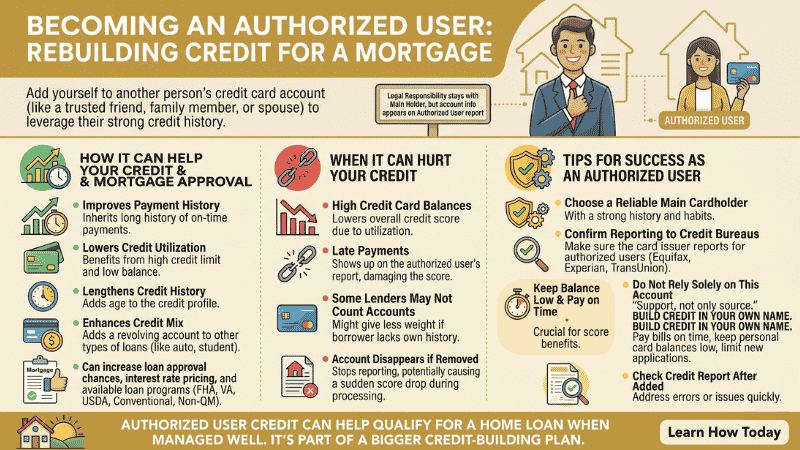 Being added as an authorized credit card user can help your credit profile when the account is managed well. For mortgage approval, lenders do not just look at the score. They also review payment history, credit balances, credit depth, debt-to-income ratio, and whether the borrower has shown responsible credit habits.
Payment History Can Help Show On-Time Credit Behavior
Payment history is one of the biggest factors in a credit score. If the primary cardholder has made on-time payments for several years, that positive history may appear on the authorized user’s credit report. For mortgage borrowers, this can help if they have thin credit, limited credit history, or need a stronger score before pre-approval. A clean payment history may support the borrower’s overall credit profile, especially when combined with their own on-time accounts.
Low Credit Utilization Can Help Raise Credit Scores
Credit utilization is the percentage of a credit limit that is being used. If the credit card has a high limit and a low balance, it may help lower the authorized user’s overall credit utilization. This matters for mortgage approval because lower utilization can help improve credit scores. A stronger score may help borrowers qualify for FHA, VA, USDA, conventional, or Non-QM loan options. It also helps with better pricing, depending on the loan program and lender guidelines.
Older Credit History Can Strengthen A Borrower’s Profile
The age of the credit card account can also help. If the primary cardholder has had the card open for many years, the authorized user may benefit from that longer credit history if the account reports properly. For mortgage borrowers, this can be helpful when their own credit history is newer or limited. A longer credit history may make the credit profile look more established before applying for a home loan.
Credit Mix Can Support A Stronger Credit File
Mortgage lenders like to see that borrowers can manage different types of credit responsibly. If the borrower only has installment loans, student loans, auto loans, or very little active credit, being added as an authorized credit card user may add revolving credit to the report. This can help create a more balanced credit file. However, borrowers should not rely only on authorized user accounts. Lenders may still want to see the borrower manage their own credit accounts before approving a mortgage.
Authorized User Credit Works Best With The Right Account
Not every authorized user account helps. The best account usually has a long history, a perfect payment record, a low balance, a high credit limit, and regular reporting to Equifax, Experian, and TransUnion. A poor account can hurt instead of help. If the primary cardholder misses payments, maxes out the card, or carries a high balance, the authorized credit card user may see their credit score drop. Before using this strategy to secure mortgage approval, borrowers should ensure the account truly strengthens their credit profile.
When Authorized User Credit Can Hurt Your Mortgage Approval
Becoming an authorized credit card user can help some borrowers improve their credit profile, but it can also backfire if the account is not managed well. Mortgage borrowers need to be careful, because lenders review more than just a credit score. They also look at payment history, credit balances, credit depth, debt-to-income ratio, and the borrower’s ability to manage credit responsibly.
High Credit Card Balances Lower Your Score
A high balance on the primary cardholder’s account can hurt the authorized user’s credit score. Credit scoring models look at credit utilization, which means how much of the credit limit is being used. If the credit card is close to the limit or maxed out, the authorized credit card user may see their score drop, even if the account has never had a late payment. This can create problems for mortgage approval, especially if the borrower is trying to reach a minimum score for FHA, conventional, VA, USDA, or Non-QM financing.
Late Payments Can Damage Your Credit
Late payments on the primary cardholder’s credit card can also appear on the authorized user’s credit report. A single late payment can damage credit scores and raise concerns during mortgage underwriting. Before becoming an authorized credit card user, borrowers should ensure the primary cardholder has a strong history of on-time payments. If the account has recent late payments, it may hurt the mortgage application rather than help it.
Some Lenders May Not Count Authorized User Accounts
Some mortgage lenders may give less weight to authorized user accounts because the borrower is not the person legally responsible for making the payments. Lenders may want to see that the borrower can manage credit accounts in their own name. This does not mean authorized user credit is useless. It means borrowers should not rely on it as their only credit-building strategy. Authorized user credit may support the file, but lenders still review income, employment, debt-to-income ratio, assets, reserves, and the borrower’s own credit history.
The Account Can Disappear If You Are Removed
If the primary cardholder removes you from the account, the authorized user account may stop reporting on your credit report. When that happens, the positive history may no longer help your credit score. This can be a problem if you are in the middle of the mortgage process. A sudden drop in credit score before closing may trigger new underwriting conditions or affect loan approval. Borrowers should avoid making changes to authorized user accounts during the mortgage process without first speaking with their loan officer.
You Still Need Your Own Credit History
Authorized user credit can help strengthen a credit profile, but it should not replace building credit in your own name. Mortgage lenders want to see that you have your own accounts, your own payment history, and your own ability to manage debt. Borrowers should focus on paying bills on time, keeping personal credit card balances low, avoiding new debt, and maintaining stable credit before applying for a mortgage. Becoming an authorized credit card user can be helpful, but it works best when it supports a complete credit-building plan.
Why Credit Scores Matter For Mortgage Approval
Credit scores play an important role in the mortgage approval process. Lenders use credit scores, payment history, credit depth, debt-to-income ratio, income, assets, and overall risk factors when reviewing a mortgage application.
Becoming an authorized credit card user may help some borrowers improve their credit score before applying for a home loan. Having a better credit score can make it easier for borrowers to snag better deals, save on mortgage insurance, and have more loan options.
The exact difference in mortgage pricing depends on market conditions, loan type, down payment, property type, credit profile, occupancy type, and lender pricing. Because mortgage rates change often, borrowers should avoid relying on outdated rate examples and instead focus on improving the credit factors they can control. For homebuyers trying to qualify for FHA, VA, USDA, conventional, or Non-QM loans, credit improvement can make a major difference. Even a small score increase may help a borrower meet minimum credit score requirements, receive an automated underwriting approval, or qualify with fewer lender restrictions.
Mortgage Credit Score Requirements After Rebuilding Credit
After becoming an authorized credit card user, the next step is understanding which mortgage programs may fit your credit profile. A higher credit score can help, but a credit score alone does not guarantee mortgage approval. Lenders also review income, employment history, debt-to-income ratio, assets, credit history, recent late payments, collections, bankruptcy, foreclosure, and automated underwriting findings. Authorized user credit may help some borrowers raise their scores, but lenders may still want to see that the borrower can manage credit in their own name. This is why borrowers should use authorized user accounts as one part of a larger credit-building plan before applying for a mortgage.
FHA Loans And Authorized User Credit
FHA loans are often a good option for borrowers rebuilding credit. FHA guidelines allow borrowers with a 580 credit score or higher to qualify with a 3.5% down payment. Borrowers with credit scores between 500 and 579 may still be eligible, but they generally need a 10% down payment.
Becoming an authorized credit card user may help a borrower reach the credit score needed for FHA loan approval. This can be helpful for borrowers who are close to the 580 credit score mark but need a stronger credit profile before applying.
However, lender overlays can still be a problem. Some lenders require higher credit scores than the FHA minimum guidelines. For example, a lender may require a 620 or 640 score even though FHA allows lower scores. Gustan Cho Associates works with borrowers who meet FHA agency guidelines but were turned down due to stricter lender overlays.
Conventional Loans And Authorized User Credit
Conventional loans generally require a minimum credit score of 620. However, meeting the minimum score does not automatically mean the borrower will be approved. Conventional mortgage approval often depends on automated underwriting through Fannie Mae’s Desktop Underwriter or Freddie Mac’s Loan Product Advisor. Authorized user credit may help borrowers improve their score enough to meet conventional loan requirements. However, automated underwriting approval is still important. The AUS findings will review the full borrower profile, including credit history, debt-to-income ratio, reserves, down payment, and overall risk. For borrowers trying to qualify for a conventional loan, being added as an authorized credit card user may help if the account reports properly and improves the overall credit profile. But borrowers should also build their own credit accounts, keep balances low, and avoid new debt before mortgage pre-approval.
VA Loans And Authorized User Credit
VA loans are available to eligible veterans, active-duty service members, and qualifying surviving spouses. The VA does not set a hard minimum credit score in its official guidelines. However, many lenders add their own VA lender overlays and may require a credit score of 620, 640, or higher.
This is where becoming an authorized credit card user may help. If a veteran is close to a lender’s minimum credit score requirement, a strong authorized user account may be enough to improve the score and qualify. The account should have no late payments, low utilization, and a long positive payment history.
Borrowers should also understand that VA loan approval is not based only on credit score. VA lenders review residual income, debt-to-income ratio, payment history, employment, assets, and overall ability to repay. Gustan Cho Associates helps eligible veterans who meet VA guidelines but were denied by other lenders due to overlays.
USDA Loans And Authorized User Credit
USDA loans are designed for eligible rural and suburban homebuyers who meet income and property eligibility rules. Many lenders prefer a credit score of 640 or higher for USDA loans because automated underwriting is often easier at that level. Borrowers with scores below 640 may still need a stronger overall file, manual underwriting, or additional compensating factors, depending on the lender and underwriting findings. Becoming an authorized credit card user may help borrowers improve their credit scores and strengthen their chances of USDA loan approval. As with FHA, VA, and conventional loans, the authorized user account must be in good standing. A high-balance card, late payment, or account that does not report to the credit bureaus may not help. USDA borrowers should also focus on stable income, low debt, clean recent payment history, and meeting USDA property and income eligibility requirements.
How To Build Your Credit As An Authorized Credit Card User
Becoming an authorized credit card user can help rebuild credit, but only if the account is strong and managed responsibly. Not every authorized user account improves credit. Some accounts can lower your score and hurt your chances of getting approved for a mortgage.
Before being added to someone else’s credit card, make sure the account has a strong history. A good authorized user account should have a long account history, no late payments, a low balance, a high credit limit, and regular reporting to Equifax, Experian, and TransUnion.
A bad authorized user account may have late payments, high credit utilization, a maxed-out balance, a recently opened account, or no reporting to the credit bureaus. If the primary cardholder has poor payment habits or a high balance, becoming an authorized credit card user can hurt your credit rather than help it.
Choose A Reliable Primary Cardholder
You should pick someone you really trust to be the primary cardholder, such as a spouse, parent, family member, or close friend. More importantly, they should have strong credit habits. They need to pay their bills on time, keep balances low, and understand that their account activity may affect their credit report. Do not become an authorized credit card user on an account just because the card has a high limit. The payment history, balance, account age, and reporting history are all important.
Make Sure The Account Reports To The Credit Bureaus
Not every credit card company reports authorized user accounts to all three major credit bureaus. Before adding, ask the primary cardholder to call the credit card company to confirm that authorized users are reported to Equifax, Experian, and TransUnion. If the account does not report, it may not help your credit score. For mortgage borrowers, this is important because lenders rely on credit reports and credit scores when reviewing loan applications.
Keep The Balance Low
Credit utilization is one of the most important parts of this strategy. The lower the balance is compared to the credit limit, the better it may be for the authorized user’s credit profile. For example, an account with a high credit limit and a very low balance may help lower overall credit utilization. But an account that is close to maxed out can hurt the authorized credit card user’s score, even if the payment history is perfect.
Make Sure Payments Are Always On Time
Late payments on the primary cardholder’s account may show up on the authorized user’s credit report. This can lower credit scores and create problems during mortgage underwriting. Before being added as an authorized credit card user, make sure the primary cardholder has a clean payment history and a strong habit of paying on time. One late payment can erase the benefit of the account.
Avoid Using The Card Unless There Is A Clear Agreement
An authorized credit card user may receive a card in their name, but using it is not always necessary. In many cases, the goal is to benefit from the positive account history, not to create new charges. If the authorized user spends on the card without a clear agreement, it can increase the balance, hurt credit utilization, and create tension with the primary cardholder. For mortgage approval, keeping the account stable and low-risk is usually the better strategy.
Monitor Your Credit Report After Being Added
After being added as an authorized credit card user, check your credit report to make sure the account is reporting correctly. Review the balance, payment history, credit limit, and account age. If the account reports late payments, high utilization, or incorrect information, address the issue quickly. If that account is dragging your score down, you should chat with the main cardholder to see if they can remove you from the account.
Keep Building Credit In Your Own Name
Authorized user credit should not be your only credit-building strategy. Mortgage lenders may want to see that you can manage credit accounts in your own name. Borrowers should also focus on paying all bills on time, keeping personal credit card balances low, avoiding unnecessary new debt, and building a clean recent credit history. Becoming an authorized credit card user can help, but it works best when combined with your own responsible credit habits.
Boost Your Credit with Extra Steps
Being an authorized user is a good start, but you’ll want a few more tricks to build your score:
- Secured Credit Card: You can get a secured card by making a small deposit.
- Using it wisely will grow your credit history.
- Pay Bills on Time: Make sure personal bills like rent or utilities get paid on time.
- Some companies report these to the credit bureaus.
- Cut Down Debt: Work on paying off any existing debt.
- This will lower your overall credit utilization and improve your Debt-to-Income (DTI) ratio, making it easier to get a mortgage.
Boost Your Credit by Becoming an Authorized User
Find out how being an authorized user can help you build a better credit history.Limit New Credit Applications
To protect your credit score, limit the number of new credit applications. Each time you apply, a hard inquiry appears on your report and can lower your score quickly.
Benefits Of Being An Authorized Credit Card User For Mortgage Qualification
Becoming an authorized credit card user can help some borrowers strengthen their credit profile before applying for a mortgage. However, authorized user accounts should not be the only credit-building strategy before applying for a home loan. Mortgage lenders may still want to see that the borrower can manage credit accounts in their own name.
Authorized User Credit May Help Improve Credit Scores
A strong authorized user account may help improve credit scores if the primary cardholder has a long history of on-time payments, a low balance, and a high credit limit. This can help borrowers who are close to meeting minimum credit score requirements for FHA, VA, USDA, conventional, or Non-QM loans.
Authorized User Credit May Help Borrowers With Thin Credit
Some borrowers have limited credit history, even if they pay their bills on time. Being added as an authorized credit card user may help build a positive revolving credit history on the borrower’s credit report. This can be helpful for borrowers who do not have enough active credit accounts. However, lenders may still want to see additional credit history in the borrower’s own name.
Authorized User Credit May Help With Mortgage Options
A better credit score can help borrowers access more mortgage options, secure better interest rates, or pay lower mortgage insurance costs. The exact benefit depends on the borrower’s full credit profile, loan type, down payment, debt-to-income ratio, and lender guidelines. Authorized user credit can help support the file, but it does not replace income, employment, assets, reserves, or the borrower’s ability to repay the mortgage.
Authorized User Credit Does Not Make The Borrower Responsible For The Debt
Usually, if you’re an authorized user on someone else’s credit card, you’re not on the hook for paying off the balance. The primary cardholder remains responsible for the debt. This is one reason authorized user credit can be appealing. The borrower may benefit from the account’s positive history without being the primary account holder. However, if the primary cardholder misses payments or maxes out the card, the authorized user’s credit score can still be damaged.
Authorized User Credit Works Best As Part Of A Bigger Plan
Authorized user accounts can help some borrowers, but they should not be treated as a quick fix or guaranteed mortgage approval strategy. The safest approach is to combine authorized user credit with strong personal credit habits. Borrowers should keep their own accounts current, lower personal credit card balances, avoid new debt before applying, save for the down payment and closing costs, and work with a mortgage professional who understands credit rebuilding and lender overlays.
Will Mortgage Lenders Count Authorized User Accounts?
Mortgage lenders may count authorized user accounts, but they do not always treat them the same as credit accounts opened in the borrower’s own name. This is because an authorized credit card user is usually not legally responsible for making the monthly payment. The main cardholder is the one responsible for the debt.
This does not mean authorized user accounts are worthless. A strong authorized user account may help improve credit scores if it has a clean payment history, a low balance, a high credit limit, a long account history, and reports to the credit bureaus. That stronger score may help some borrowers meet mortgage credit score requirements.
However, lenders and automated underwriting systems may review the full credit profile. They may look at whether the borrower has their own credit accounts, recent payment history, debt levels, income, employment, assets, and debt-to-income ratio. If most of the borrower’s credit score comes from authorized user accounts, the lender may ask for more explanation or may give those accounts less weight. For mortgage approval, the safest approach is to use authorized user credit as support, not as the foundation of the entire credit profile. Borrowers should also build credit in their own name, keep balances low, avoid late payments, and speak with a mortgage loan officer before applying. This helps determine whether the authorized user account is helping the file or creating underwriting concerns.
How Long Does It Take an Authorized User Credit To Help?
Becoming an authorized credit card user may help some borrowers improve their credit score, but the timeline is not guaranteed. Some borrowers may see a credit score change after the account reports, often within one or two credit reporting cycles. However, results vary depending on the borrower’s full credit profile, derogatory accounts, credit utilization, payment history, and whether the account reports correctly. The account also needs to be strong enough to help. An authorized user account with a long history, no late payments, low balance, and high credit limit may be more helpful than a newer account or a card with a high balance. If the primary cardholder misses payments or carries a large balance, the authorized credit card user may see little improvement or even a lower credit score. Mortgage borrowers should not wait until the last minute to use this strategy. It is better to review your credit several months before applying for a home loan. This gives the borrower time to confirm the account is reporting, check for credit report errors, lower personal debt, and build credit in their own name. For borrowers trying to qualify for FHA, VA, USDA, conventional, or Non-QM loans, the best approach is to speak with a mortgage professional before applying. A loan officer can review the credit report, explain whether the authorized user account is helping, and create a plan to strengthen the file before pre-approval.
What To Do After Your Credit Score Improves
After becoming an authorized credit card user and seeing your credit score improve, the next step is to prepare for mortgage approval. A higher credit score can help, but lenders still review the full application, including income, employment, debt-to-income ratio, assets, down payment, reserves, and recent credit activity.
Get A Mortgage Credit Review
Before shopping for a home, have a mortgage loan officer review your credit report. This helps determine whether the authorized user account is helping your file and whether you meet the credit requirements for FHA, VA, USDA, conventional, or Non-QM loans. A credit review can also show if you need to pay down balances, remove errors, build more credit in your own name, or wait for another reporting cycle before applying.
Avoid New Debt Before Applying
Do not open new credit cards, finance furniture, buy a car, co-sign a loan, or take out personal loans before mortgage pre-approval. Taking on new debt can ding your credit score, bump up your debt-to-income ratio, and mess with approval processes. Even after pre-approval, borrowers should avoid new debt until after closing. Lenders may refresh credit before issuing the clear-to-close.
Keep Credit Card Balances Low
Low credit card balances can help protect the score improvement you gained as an authorized credit card user. Having high balances can drag down your score and make your mortgage application seem more risky. Keep both personal credit cards and authorized user accounts as low as possible. If a card reports a high balance right before a mortgage application, it may affect your qualifying score.
Save For Down Payment, Closing Costs, And Reserves
Credit score improvement is only one part of mortgage readiness. Borrowers also need funds for the down payment, closing costs, prepaid expenses, and possible reserves. Lenders want to verify that funds are seasoned, sourced, and documented. Avoid large unexplained deposits, cash deposits, or moving money between accounts without a clear paper trail.
Get Pre-Approved Before Shopping For A Home
Once your credit profile is stronger, get pre-approved before looking at homes. A mortgage pre-approval helps you understand your budget, loan options, estimated payment, and any remaining conditions before making an offer. For borrowers who recently improved their score by becoming an authorized credit card user, pre-approval is especially important. It confirms whether the improved credit profile is strong enough for mortgage underwriting before you start house hunting.
Tips for Success as an Authorized User
- Set Clear Expectations: Talk openly with the primary cardholder about how the card will be used.
- Ensure they know how key it is to pay the bill on time.
- Diversify Credit-Building Efforts: Treat your authorized user status as just one piece of your credit roadmap.
- Pay your other bills on time and monitor low credit card balances to show lenders they can trust you.
- Track Progress: Check your credit score with free Credit Karma or Experian tools.
- These services can show if the authorized user account is helping your score climb.
- Plan for Mortgage Timing: Begin your credit boost journey 6 to 12 months before you want to apply for a mortgage.
- This will give your score time to rise and give you a better loan offer.
Final Thoughts On Becoming An Authorized Credit Card User Before Applying For A Mortgage
Becoming an authorized credit card user can be a helpful credit-building step, but it should be used carefully. The right account may help improve credit scores, strengthen a thin credit profile, and support mortgage qualification. The wrong account can lower scores and create underwriting problems.
Before you dive into the mortgage application, take a moment to check your credit report and make sure the authorized user account is showing up correctly.
Make sure the account has no late payments, a low balance, a strong credit limit, and a long positive history. Borrowers should also continue building credit in their own name, keep personal balances low, and avoid new debt before pre-approval. Authorized user credit should support your mortgage application, not replace a complete credit profile. FHA, VA, USDA, conventional, and Non-QM lenders may all review authorized user accounts differently. Speaking with a mortgage professional before applying can help you understand whether the account is helping your file and what steps are needed before moving forward with a home loan.
FAQs About Becoming An Authorized Credit Card User
Can Becoming An Authorized Credit Card User Help My Credit Score?
Becoming an authorized user on someone else’s credit card can boost your credit score, especially if the main account holder has good credit habits. The account should have a long history, no late payments, low credit utilization, and regular reporting to the credit bureaus. However, it can also hurt your score if the account has late payments or high balances.
Does Being An Authorized Credit Card User Help With Mortgage Approval?
Being an authorized credit card user may help with mortgage approval if it improves your credit score and strengthens your credit profile. However, mortgage lenders may not give authorized user accounts the same weight as accounts opened in your own name because you are not legally responsible for the debt. Lenders still review income, debt-to-income ratio, payment history, assets, and overall credit depth.
How Long Does It Take for an Authorized User Account To Show On My Credit Report?
Some borrowers may see an authorized user account appear after one or two credit reporting cycles, but the timeline is not guaranteed. It depends on when the credit card company reports, whether it reports authorized users, and whether your personal information is listed correctly on the account. Always check your credit report after being added.
Can An Authorized Credit Card User Hurt My Credit?
Yes. Having an authorized user account can mess with your credit if the main cardholder misses payments, has a high balance, maxes out the card, or doesn’t handle the account well. Even though the authorized credit card user is usually not responsible for paying the debt, the account activity may still appear on the authorized user’s credit report.
Do I Need to Use The Credit Card To Get Credit Score Benefits?
Usually, no. In many cases, the authorized credit card user does not need to make purchases to benefit from the account’s positive history. The main factors are whether the credit card company reports the account to the credit bureaus and whether the account remains in good standing.
Should I Rely Solely On An Authorized User’s Credit Before Applying For A Mortgage?
No. Authorized user accounts can help some borrowers, but they should not be the only credit-building strategy before applying for a mortgage. Borrowers should also build credit in their own name, keep balances low, pay every account on time, avoid new debt, and speak with a mortgage professional before applying for FHA, VA, USDA, conventional, or Non-QM loans.
This article about “Rebuilding Credit Being an Authorized Credit Card User” was updated on April 27th, 2026.