The Federal Housing Administration (FHA), a segment of the United States Department of Housing and Urban Development, was established in 1934. Its primary mission is to foster homeownership among Americans, particularly those with moderate incomes, less-than-perfect credit, and minimal down payments. The FHA plays a vital role not as a lender but as a government-sponsored entity that provides insurance for home loans offered by private lenders.
This insurance protects lenders if a borrower defaults and the subsequent foreclosure, helping mitigate the financial loss lenders incur.
Lenders who wish to be eligible for this insurance must obtain approval from the Department of Housing and Urban Development (HUD). These HUD-approved lenders must adhere strictly to the underwriting guidelines outlined in the HUD 4000.1 FHA Handbook, also known as the FHA TOTAL Scorecard. A key requirement imposed by the FHA on lenders is that all necessary parties involved in the real estate transaction complete and sign the FHA amendatory clause. This clause is essential for the buyer’s protection, ensuring they are not legally bound to purchase a home if its appraised value exceeds the sale price. This article explains the FHA amendatory clause and its obligations on parties involved in FHA-backed real estate transactions.
When Is The Amendatory Clause Required During The Home Purchase Process
Amendatory Clause, attached to the real estate purchase contract to minimize risks for FHA buyers needs to be signed by the following people:
- Buyers
- Sellers
- Buyers Real Estate Agent
- Sellers Real Estate Agent
The FHA Amendatory Clause was created to help protect the home buyers interests in a real estate transaction.
Roles and Responsibilities in the FHA Amendatory Clause
The FHA amendatory clause is a critical element in home buying processes involving FHA loans, delineating specific roles and responsibilities for the parties involved. Here’s a detailed explanation of who needs to sign the clause and the responsibilities assigned to each participant:
Buyers
- Signing Requirement: The buyer must sign the FHA amendatory clause. This confirms that they understand the terms and are only obligated to complete the purchase if the appraisal supports the agreed-upon price.
- Responsibility: Buyers are responsible for ensuring that they are fully informed about the implications of the clause. They must understand that they can withdraw from the purchase without losing their earnest money if the appraisal is lower than the price.
Sellers
- Signing Requirement: Sellers are also required to sign the amendatory clause. Their signature confirms acknowledgment that the sale is contingent upon the appraisal matching or exceeding the sale price.
- Responsibility: Sellers need to recognize that the transaction could be renegotiated or even nullified if the appraisal comes in lower than expected. They should also be prepared for the possibility of returning the buyer’s earnest money if the buyer chooses to withdraw based on the clause.
Real Estate Agents
- Signing Requirement: While real estate agents are not required to sign the FHA amendatory clause themselves, they play a crucial role.
- Responsibility: Real estate agents representing buyers and sellers should ensure that their clients understand the implications of the amendatory clause. They should facilitate the signing process before proceeding with the appraisal and ensure all parties are informed about the potential outcomes based on the appraisal results.
Lenders
- Signing Requirement: Lenders do not sign the amendatory clause but are integral to the process.
- Responsibility: Lenders are responsible for ordering the property appraisal and ensuring it is conducted fairly and impartially.
- They must also ensure that the clause is included in the contract documentation and is signed by the required parties before loan processing proceeds.
Escrow Officers
- Signing Requirement: Escrow officers do not sign the clause but are involved in the transaction process.
- Responsibility: They are responsible for holding and, if necessary, returning the earnest money deposit based on the outcomes dictated by the FHA amendatory clause.
- They also ensure that funds are disbursed according to the contract terms and the appraisal results.
The amendatory clause of the FHA establishes a safeguarding framework for real estate transactions that include FHA financing, benefiting both buyers and sellers. Its purpose is to establish the responsibilities and obligations of each party, ensuring that the sale of the property goes forward only if the financial aspects are solid, thus protecting the interests of everyone involved. This clause is a testament to the structured approach of FHA loans designed to minimize risks and promote fair dealings in the housing market.
Role And Function Of FHA
HUD, the parent of FHA, promotes lenders to originate and fund FHA Home Loans to home buyers, first time home buyers, and buyers with less than perfect credit. The function and role of FHA are to insure residential mortgage loans that have been originated and funded by FHA approved lenders. FHA will reimburse these FHA approved lenders against borrowers who fail to repay their mortgage loan and go into default. Due to this guarantee and government insurance by HUD, lenders can offer home loans with very little down payment at very low-interest rates.
- FHA charges mortgage insurance premiums on every loan they insure
- There is an upfront one-time mortgage insurance premium
- There is also an ongoing lifetime annual FHA mortgage insurance premium on 30 year fixed rate mortgages
- The FHA mortgage insurance premium goes into a special FHA fund
- This fund is used to pay out default by borrowers who default on their loan
- FHA loans are extremely popular
Over a third of home loans originated in the United States are FHA Home Loans.
Importance Of FHA Amendatory Clause
Many FHA buyers lose homes because the lender did not properly review the file up front. Gustan Cho Associates focuses on issuing accurate pre-approvals and helping borrowers avoid last-minute surprises.
Additionally, it addresses conditions where the buyer might be penalized or required to provide additional funds to close the deal if the property’s appraisal does not match the originally agreed-upon sales price. This ensures buyers are safeguarded against unexpected financial burdens if the property valuation exceeds expectations.
What Is The FHA Amendatory Clause And How It Works
The FHA amendatory clause is a key form that protects buyers in an FHA home purchase. Many first-time buyers sign it without really knowing what it means. Simply put, this clause protects you if the home’s appraised value is less than the agreed purchase price. If you use an FHA loan, the Federal Housing Administration wants to make sure you are not required to pay more than the home’s appraised value.
The FHA amendatory clause lets you cancel the contract and keep your earnest money if the appraisal is too low. This clause does not mean the seller must lower the price. It does not mean the FHA automatically denies the loan.
It simply gives the buyer legal protection if the FHA appraisal comes in below the sales price and the buyer decides not to proceed. Gustan Cho Associates helps FHA borrowers nationwide understand the mortgage process, including FHA appraisals, purchase contracts, seller disclosures, and underwriting requirements. FHA loans are excellent mortgage options for homebuyers with lower credit scores, higher debt-to-income ratios, limited down payment funds, and past credit challenges.
What Is The FHA Amendatory Clause?
The FHA amendatory clause is a required add-on for many FHA home purchases. It says you do not have to finish the purchase or forfeit your earnest money unless you get a written statement showing that the home has been appraised for at least the purchase price. HUD guidance explains that an amendatory clause must be included when the borrower has not already been informed of the appraised value through Form HUD-92800.5B before signing the sales contract.
HUD also states that the amendatory clause protects the purchaser from being forced to complete the purchase or forfeit earnest money if the property does not meet the required appraised value.
To put it simply, the FHA amendatory clause means: If the home does not appraise for the contract price, the buyer cannot be forced to buy the home with an FHA loan, and the buyer should not lose the earnest money deposit solely because of the low FHA appraisal.
Why The FHA Amendatory Clause Matters
The FHA amendatory clause matters because FHA loans are backed by the federal government. FHA wants to reduce the risk of buyers overpaying for homes, especially those using low-down-payment financing.
With an FHA loan, you might only need a 3.5% down payment if you meet the credit score requirement. Since you have less equity at closing, the FHA appraisal is crucial. It confirms the home’s value matches the loan amount.
The FHA amendatory clause gives you a way out if the appraisal is too low. Without it, you might have to bring extra money to closing, renegotiate under pressure, or risk losing your earnest money.
How The FHA Amendatory Clause Works
The FHA amendatory clause is usually signed early in the transaction, often at the time the purchase contract is signed or shortly after the buyer changes to FHA financing.
After you apply for an FHA mortgage, your lender will order an FHA appraisal. An approved appraiser checks the property and gives an opinion of value.
If the value is at least the purchase price, the deal usually moves forward, as long as the property meets FHA standards and you qualify. If the FHA appraisal is lower than the purchase price, the amendatory clause is crucial. You have options: ask the seller to lower the price, pay the difference in cash, renegotiate, dispute the appraisal with your lender, or cancel the contract if you cannot agree.
FHA Amendatory Clause: Know Before You Sign
Buying a home with an FHA loan? The amendatory clause protects you as a buyer. Apply Now And Get recommendations From Loan ExpertsFHA Amendatory Clause Example
Here’s A Simple Example:
- A buyer signs a purchase contract to buy a home for $300,000 using an FHA loan.
- The buyer puts down earnest money.
- The FHA appraisal comes back at $290,000.
- Because of the FHA amendatory clause, the buyer is not forced to complete.
- Thanks to the FHA amendatory clause, the buyer does not have to pay $300,000 for the home.
- The buyer can ask the seller to lower the price to $290,000.
- The seller can agree, refuse, or propose an alternative solution.
- If the buyer pays the $10,000 difference out of pocket, the FHA amendatory clause may allow the buyer to cancel the contract without losing the earnest money deposit, depending on the contract terms and state law.
Does The FHA Amendatory Clause Mean The Seller Must Lower The Price?
No, the FHA amendatory clause does not require the seller to lower the sales price.
- Many people misunderstand the FHA amendatory clause.
- It protects the buyer from having to move forward if the home appraises low, but it does not force the seller to accept the appraised value.
- If the FHA appraisal is lower than the purchase price, the seller has options.
- They can lower the price, negotiate a compromise, keep the price the same, or cancel the deal if the buyer cannot meet the contract terms.
Does The FHA Amendatory Clause Protect The Buyer’s Earnest Money?
The main purpose of the FHA amendatory clause is to protect buyers from losing their earnest money just because the property does not appraise for the purchase price. However, buyers should understand that earnest money rules can also depend on the full contract, state law, deadlines, and how cancellation is handled. The FHA amendatory clause is strong protection, but you should still work closely with your agent, lender, and attorney if needed. automatically receive earnest money back. The clause is specifically tied to the FHA appraised value issue.
When Is The FHA Amendatory Clause Required?
The FHA amendatory clause is generally required on FHA purchase transactions when the buyer has not received the FHA appraised value before signing the sales contract.
HUD’s guidance states that the amendatory clause must be included when the borrower was not informed of the appraised value by receiving Form HUD-92800.5B before signing the sales contract.
HUD also lists certain transactions in which an amendatory clause is not required, including HUD REO sales, FHA 203(k) loans, and certain sales involving government agencies or lender-owned REO properties. In most standard FHA purchase transactions involving a buyer, seller, and real estate agents, the FHA amendatory clause is signed as part of the FHA loan paperwork.
Who Signs The FHA Amendatory Clause?
The FHA amendatory clause is typically signed by the buyer and seller. HUD guidance also requires the lender to confirm that sales contracts, addenda, and the amendatory clause are signed by all borrowers and sellers when required. In many transactions, the FHA amendatory clause is paired with the FHA real estate certification. The real estate certification may also need signatures from the buyer, seller, and real estate agents if the required language is not already included in the purchase agreement. HUD guidance notes that real estate certification is required when the signatures are not already contained in the purchase agreement.
FHA Amendatory Clause Versus FHA Real Estate Certification
The FHA amendatory clause and the FHA real estate certification are often discussed together, but they are not the same thing. The FHA amendatory clause protects the buyer if the home does not appraise for at least the purchase price. It focuses on the FHA appraised value and the buyer’s right not to proceed if the value is too low.
The FHA real estate certification confirms that the purchase agreement and any related agreements are true, complete, and reflect the actual terms of the transaction.
It helps prevent side agreements, undisclosed concessions, or hidden terms that could affect the loan approval. Both forms are important because FHA lenders must document that the transaction is legitimate, properly disclosed, and supported by the property value.
What Happens If The FHA Appraisal Comes In Low?
A low FHA appraisal does not always kill the deal. It does create a problem that must be solved before closing.
The Seller Can Lower The Price
The cleanest solution is for the seller to reduce the price to the FHA appraised value. If the buyer agreed to pay $300,000 and the FHA appraisal comes in at $290,000, the seller may agree to lower the price to $290,000. This keeps the transaction moving and avoids requiring the buyer to bring extra cash to closing.
The Buyer Can Pay The Difference
The buyer may choose to pay the difference between the purchase price and the appraised value. However, the buyer must have verified funds, and the loan must still meet FHA requirements. For example, if the purchase price is $300,000 and the FHA appraisal is $290,000, FHA financing is based on the lower appraised value. The buyer would need to cover the gap if the seller does not reduce the price.
The Buyer And Seller Can Renegotiate
Sometimes the buyer and seller meet in the middle. The seller may reduce the price, and the buyer may agree to bring additional funds. This depends on the buyer’s financial ability, the seller’s motivation, the local housing market, and how badly both sides want the transaction to close.
The Buyer Can Cancel The Contract
If the parties cannot agree and the buyer does not want to pay above the FHA appraised value, the buyer may use the FHA amendatory clause to cancel the contract without being obligated to complete the purchase because of the low appraisal.
Can A Buyer Waive The FHA Amendatory Clause?
The FHA amendatory clause is required when applicable. Buyers should not treat it like an ordinary optional contract term. In competitive housing markets, some buyers are willing to waive appraisal protections to strengthen their offers. However, with an FHA loan, the FHA amendatory clause is designed to protect the buyer and the FHA-insured loan process. A buyer may still choose to pay more than the appraised value if they have the funds and want to proceed, but they should not be forced to do so under the FHA amendatory clause.
Does The FHA Amendatory Clause Apply To Conventional Loans?
No. The FHA amendatory clause is specific to FHA mortgage transactions. Conventional loans do not use the FHA amendatory clause. However, conventional loans may still include appraisal contingencies, depending on the purchase contract. A conventional loan buyer may have similar protection if the contract includes an appraisal contingency, financing contingency, or other language that allows the buyer to cancel if the property does not appraise. The difference is that the FHA amendatory clause is required in many FHA purchase transactions, while conventional appraisal protection comes from the purchase contract itself.
Does The FHA Amendatory Clause Apply To VA Loans?
VA loans have their own appraisal and property approval process. VA transactions may use VA-specific language and protections, not the FHA amendatory clause. HUD’s older guidance references VA valuation documentation in connection with whether a borrower was informed of the value before signing the contract, but FHA and VA loans are separate mortgage programs with different forms and procedures. Borrowers using VA loans should work with a lender experienced in VA appraisal requirements, VA minimum property requirements, and VA contract protections.
Is the FHA Amendatory Clause Required on FHA 203(k) Loans?
The FHA amendatory clause is generally not required on FHA 203(k) loans. HUD guidance specifically lists FHA’s 203(k) loan program among the exceptions where the amendatory clause is not required. This is important because FHA 203(k) loans involve renovation financing, repair costs, and after-improved value considerations. The structure is different from a standard FHA purchase loan.
Is The FHA Amendatory Clause Required On HUD REO Sales?
The FHA amendatory clause is generally not required on HUD REO sales. HUD guidance lists HUD REO sales as an exception. REO means real estate owned. These are properties owned by lenders, government agencies, or other institutions after foreclosure. FHA rules treat certain REO transactions differently from standard seller-owned purchase transactions.
Why Sellers Should Understand The FHA Amendatory Clause
Sellers sometimes become nervous when they see the FHA amendatory clause. They may think it gives the buyer an easy way to cancel the deal for any reason. That is not the purpose of the clause.
The FHA amendatory clause is tied to the FHA appraised value. It does not automatically cancel the contract. It does not require the seller to accept a lower price.
It simply states that the buyer is not required to complete the purchase if the property does not appraise high enough. Sellers should understand this before accepting an FHA offer. FHA buyers can be strong buyers, especially when they are fully pre-approved, have verified income, and work with an experienced FHA lender.
Why FHA Buyers Should Understand The Clause Before Making An Offer
FHA buyers should understand the FHA amendatory clause before making an offer because it affects negotiation strategy. If the buyer offers above the likely appraised value, there may be a higher risk of a low appraisal. Before making an aggressive offer, buyers should discuss the following with their real estate agent and loan officer:
- How likely is the home to appraise for the purchase price?
- How much cash does the buyer have if there is an appraisal gap?
- Will the seller renegotiate if the appraisal comes in low?
- Does the contract include other protections besides the FHA amendatory clause?
- Is the buyer comfortable walking away if the value does not support the price?
The FHA amendatory clause is not a substitute for a smart offer strategy. It is a protection, not a pricing tool.
FHA Appraisal Requirements And Property Standards
The FHA appraisal does more than estimate value. FHA appraisers also review the property for basic safety, security, and soundness. A property must meet the FHA minimum property standards.
If the appraiser identifies required repairs, those issues may need to be corrected before closing or handled through an approved repair escrow when allowed.
Common FHA appraisal concerns may include peeling paint on older homes, missing handrails, broken windows, roof issues, exposed wiring, water damage, safety hazards, or non-functioning utilities. This is separate from the FHA amendatory clause. The clause deals with value protection. FHA property standards address whether a property is acceptable for FHA financing.
Implications of Not Signing the FHA Amendatory Clause
Improperly signing the FHA amendatory clause has serious legal and financial repercussions for real estate deals.
Buyer Consequences
- Financial Risk: If the purchaser fails to sign the FHA amendatory clause and the property’s appraised value is less than the negotiated purchase price, they might be legally obligated to buy the property at a higher price.
- Loss of Earnest Money: In cases where the buyer wishes to withdraw from the transaction due to the appraisal shortfall but still needs to sign the amendatory clause, they may forfeit their earnest money deposit.
- This could result in a significant financial loss.
Seller Consequences
- Legal Exposure: If the seller fails to sign the FHA amendatory clause and the transaction proceeds without it, they may face legal challenges from the buyer if the appraisal is lower than the sales price.
- The buyer could seek damages or pursue legal action to rescind the contract.
- Market Perception: Sellers may face reputational damage if perceived as unwilling to adhere to standard real estate procedures.
- This could impact their ability to attract future buyers and negotiate favorable terms.
Loan Processing Issues
- Loan Approval Delays: Lenders typically require the FHA amendatory clause to be signed before processing the loan application.
- Provide this documentation promptly to ensure loan approval and subsequent closing, causing inconvenience to both parties.
- Loan Denial: In extreme cases, lenders may deny financing altogether if the documentation, including the FHA amendatory clause, is not provided.
- This would force the buyer to seek alternative financing or abandon the purchase altogether.
Escrow Challenges
- Disputed Funds: If the transaction proceeds without the FHA amendatory clause and disputes arise regarding the earnest money deposit, escrow officers may face challenges in determining the appropriate course of action.
- Resolving such disputes can prolong the closing process and may require legal intervention.
The FHA amendatory clause is a formality and a crucial component of real estate transactions involving FHA loans. Failure to properly sign this document can lead to legal, financial, and procedural challenges for buyers and sellers. All parties must understand the implications of non-compliance and ensure the necessary documentation is in place to protect their interests and facilitate a smooth transaction process.
Who Signs the FHA Amendatory Clause—and Why It Matters
Don’t close on your home without understanding this required form. Get a Quick Breakdown of What You Need to SignInteraction with Appraisals: The Role of the FHA Amendatory Clause
The FHA amendatory clause is essential in real estate deals with FHA loans. Its primary purpose is to ensure that the amount lent by the FHA does not exceed the property’s market value, which is determined through an appraisal. The appraisal also assesses the property’s condition to meet FHA safety and soundness standards.
Lenders must include the FHA amendatory clause in the sales contract to protect the buyer and maintain the integrity of the FHA’s lending practices. It ensures compliance with FHA lending limits and safeguards the buyer’s financial interests.
The FHA amendatory clause allows buyers to withdraw from a contract without penalty if the appraisal is lower than the purchase price. This protects buyers from overpaying and aligns the loan amount with the property’s market value. Sellers may need to renegotiate the sale price based on the appraisal, which can cause delays in closing.
FHA Loan Requirements
The FHA Amendatory Clause is important when using an FHA loan to purchase a property. It ensures that the loan amount does not exceed 96.5% of the property’s sales price and requires its appraised value to match the sales price. This protects the lender and borrower and ensures sufficient collateral in case of default.
FHA Amendatory Clause And Low Appraisals
In cases where the property’s appraised value is lower than the sales price, the contract must be adjusted to reflect this lower value. Subsequently, lenders will provide financing for 96.5% of this new, amended price. The FHA Amendatory Clause also provides a safety net for home buyers, allowing them to withdraw from the transaction without penalty if the purchase contract price exceeds the home’s appraised value.
FHA Amendatory Clause Explained For Homebuyers
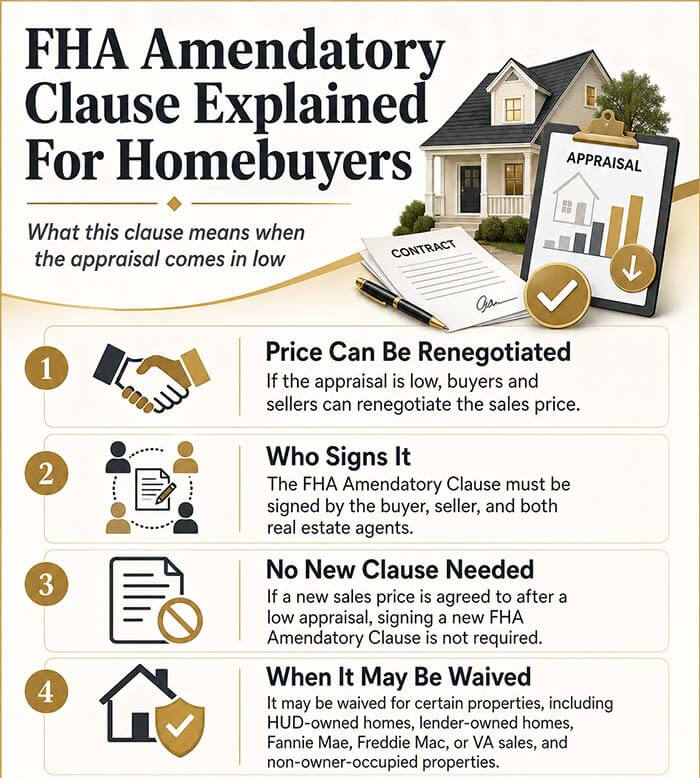
Both buyers and sellers have the option to renegotiate the sales price in light of the appraisal findings. This clause must be signed by all parties involved in the transaction, including buyers, sellers, and their respective real estate agents.
Signing a new FHA Amendatory Clause or any other amendatory clause is unnecessary if a new sales price is negotiated following a low appraisal.
The requirement for the FHA Amendatory Clause is waived for properties owned by specific entities, such as the United States Department of Housing and Urban Development (HUD), mortgage lenders, in-home sales managed by Fannie Mae, Freddie Mac, or VA, or those that are not primary residences.
Exceptions and Special Cases to the FHA Amendatory Clause
While the FHA amendatory clause is a standard requirement in most real estate transactions involving FHA loans, there are exceptions and special cases where the clause may not apply. Understanding these exceptions can help buyers, sellers, and professionals navigate the specifics of their real estate transactions more effectively.
Government Entities as Sellers
The FHA amendatory clause is often waived when a government entity sells property, such as HUD (Housing and Urban Development) foreclosures. This is because these entities typically sell properties “as-is” and have processes and conditions that supersede typical FHA requirements.
Foreclosures
Like government entity sales, homes purchased as foreclosures, particularly those owned by banks or acquired through sheriff sales, might not require the FHA amendatory clause. This is because such properties are usually sold without any warranties regarding the condition, and the buyer often accepts the risks associated with purchasing under these circumstances.
Direct Sales by Builders
In some instances, properties purchased directly from builders where the buyer uses FHA financing may not require an FHA amendatory clause. Builders often have purchase agreements that provide similar protections or may have pre-negotiated terms that do not include the clause.
Sales Involving Non-Traditional Financing
Transactions not involving FHA loans typically do not require an FHA amendatory clause. This includes conventional loans, VA loans, or any other non-FHA financing methods where the specific protections of the FHA amendatory clause are not stipulated.
Refinancing Scenarios
In refinancing scenarios where the original purchase used an FHA loan but the current refinancing does not, the FHA amendatory clause would not apply. The clause is irrelevant since the transaction does not involve a new sale or purchase price but rather a renegotiation of existing terms.
Streamlined FHA Refinancing
The FHA amendatory clause is generally optional for FHA streamlined refinancing, which allows lower documentation and easier qualification processes. This refinancing option is intended for existing FHA loans. It focuses on reducing rates or changing loan terms, not property valuation.
What If The Seller Refuses To Sign The FHA Amendatory Clause?
If the FHA amendatory clause is required and the seller refuses to sign it, the FHA loan may not close. A seller who accepts an FHA offer should expect FHA-related forms. If the seller does not want to sign the FHA documents, the buyer may need to renegotiate, switch to a different loan program if possible, or find another property. This is why real estate agents should confirm early whether the seller is willing to accept FHA financing and sign the required FHA addenda.
Common Mistakes With The FHA Amendatory Clause
Signing It Too Late
The FHA amendatory clause should be handled early in the process. Waiting until the last minute can delay underwriting, closing, and final loan approval.
Thinking Forces The Seller To Reduce The Price
The seller is not forced to lower the price. The clause protects the buyer’s right not to proceed if the FHA appraisal is too low.
Confusing It With A Home Inspection
The FHA amendatory clause is not a home inspection clause. FHA appraisals are not the same as full home inspections. Buyers should still consider getting a professional home inspection.
Assuming It Protects Every Deposit Issue
The clause is designed to protect the buyer from losing the earnest money due to an appraisal issue. Other deposit disputes may depend on the contract, deadlines, contingencies, and state law.
Not Reviewing The Purchase Contract
The FHA amendatory clause works together with the purchase contract. Buyers should understand all financing, appraisal, inspection, and cancellation deadlines.
FHA Amendatory Clause And No Lender Overlays
Gustan Cho Associates specializes in helping borrowers who need FHA financing without unnecessary lender overlays. FHA has agency guidelines, but many lenders add stricter internal rules called lender overlays.
A borrower may meet HUD guidelines but still be denied by a lender due to overlays. Lenders can have overlays with FICO, debt-to-income ratio, late payments, manual underwriting,, collections, charge-offs, or disputed accounts.
Gustan Cho Associates works with borrowers who may have been told no by other lenders. The goal is to match borrowers with FHA, VA, USDA, conventional, or non-QM loan options based on the borrower’s full credit and income profile.
How Gustan Cho Associates Helps FHA Buyers
Gustan Cho Associates helps FHA buyers from pre-approval through closing. This includes reviewing credit, income, assets, debt-to-income ratios, FHA appraisal concerns, contract terms, and underwriting conditions.
The FHA amendatory clause is only one part of the FHA mortgage process. Buyers also need a strong pre-approval, accurate income calculation, clean documentation, and a lender who understands FHA guidelines.
The FHA amendatory clause provides critical buyer protections in typical FHA loan scenarios. Still, its requirements can vary based on the nature of the sale and the type of financing involved. Recognizing when the clause does or does not apply is essential for all parties to ensure compliance with FHA regulations and to protect their interests in different real estate transaction scenarios.
Conclusion: The FHA Amendatory Clause
The FHA amendatory clause serves as a critical protection for homebuyers utilizing FHA financing. It ensures that buyers are not obligated to complete a purchase or forfeit earnest money if the property appraises below the agreed purchase price.
The clause does not obligate the seller to reduce the price, replace a home inspection, or guarantee loan approval. It provides FHA buyers with significant leverage and protection if the appraisal is lower than the purchase price.
Homebuyers using FHA financing should review the amendatory clause before signing the purchase contract, collaborate with an experienced real estate agent, and select a mortgage lender familiar with FHA guidelines and requirements. Gustan Cho Associates assists homebuyers in qualifying for FHA loans, including those with lower credit scores, higher debt-to-income ratios, previous credit challenges, and complex underwriting scenarios. If you have any questions about the FHA Amendatory Close or you need to qualify for loans with a lender with no overlays on government or conforming loans, please contact us at 800-900-8569. Text us for a faster response. Or email us at alex@gustancho.com. The team at Gustan Cho Associates is available 7 days a week, on evenings, weekends, and holidays.
Frequently Asked Questions Regarding the FHA Amendatory Clause
What Is The FHA Amendatory Clause?
The FHA amendatory clause is a mandatory addendum to the contract in many FHA purchase transactions. It protects the buyer if the property does not appraise for at least the purchase price. If the FHA appraisal is lower than the agreed price, the buyer is not required to proceed with the purchase under the original terms.
Why Does FHA Require The Amendatory Clause?
The FHA mandates the amendatory clause to protect homebuyers from being compelled to purchase a property at a price above its appraised value. Because FHA loans typically permit low down payments, the agency seeks to ensure that the property value adequately supports the insured mortgage. ed mortgage.
Who Signs The FHA Amendatory Clause?
Both the buyer and seller are generally required to sign the FHA amendatory clause. According to HUD guidance, lenders must verify that the sales contract, all addenda, and the amendatory clause are signed by all borrowers and sellers when applicable.
What Happens If The FHA Appraisal Is Lower Than The Purchase Price?
If the FHA appraisal is lower than the purchase price, the buyer and seller may renegotiate the terms. The seller may reduce the price, the buyer may pay the difference, both parties may reach a compromise, or the buyer may cancel the contract if no agreement is achieved.
Does The FHA Amendatory Clause Mean The Seller Must Lower The Price?
No. The FHA amendatory clause does not require the seller to lower the price. It protects the buyer from being obligated to complete the purchase if the FHA appraisal is below the agreed purchase price.
Is The FHA Amendatory Clause Required On Every FHA Loan?
No. The FHA amendatory clause is not mandatory for every FHA transaction. HUD guidance specifies exceptions, such as HUD Real Estate Owned (REO) sales and FHA 203(k) loans.
Can A Buyer Still Buy The home If The Appraisal Comes in Low?
Yes. A buyer may proceed with the purchase even if the FHA appraisal is low, but may need to provide additional funds at closing or renegotiate with the seller. The lender will base FHA financing on the lower appraised value. the lower appraised value.
Is The FHA Amendatory Clause The Same As An Appraisal Contingency?
No. The FHA Amendatory Clause is a required protection specific to the FHA appraised value. An appraisal contingency is a contractual term that may apply to various loan types, depending on the purchase agreement.
Does The FHA Amendatory Clause Replace A Home
No. The FHA amendatory clause does not substitute for a home inspection. The FHA appraisal assesses value and basic property standards, but buyers are advised to obtain a professional home inspection.
What Should Buyers Do Before Signing On FHA Purchase Contract?
Prospective buyers should review the FHA amendatory clause, assess appraisal-related risks, confirm financing terms, consult with their real estate agent regarding the offer price, and collaborate with an experienced FHA lender prior to signing the contract.
What is the FHA Amendatory Clause?
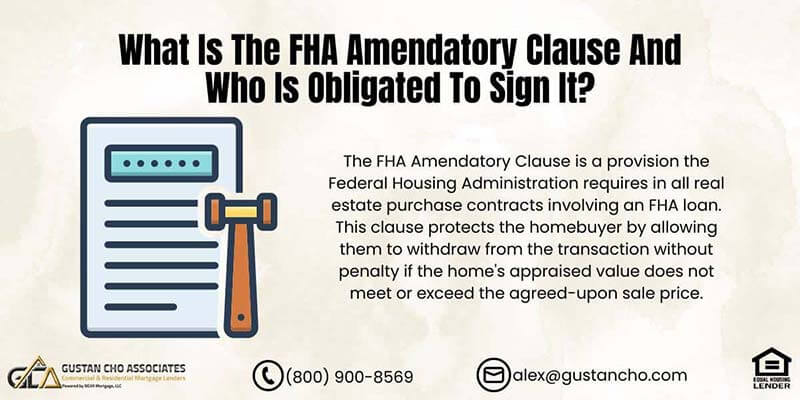
The FHA Amendatory Clause is a provision the Federal Housing Administration requires in all real estate purchase contracts involving an FHA loan. This clause protects the homebuyer by allowing them to withdraw from the transaction without penalty if the home’s appraised value does not meet or exceed the agreed-upon sale price.
Why Was The FHA Amendatory Clause Created?
It was created to minimize risks for buyers and to ensure that they do not forfeit their earnest money deposit or incur additional costs to close the deal if the appraisal value is less than the purchase price.
Who Needs To Sign The FHA Amendatory Clause?
The contract must be signed by the buyer, seller, and the buyer’s and seller’s real estate agents involved in the transaction. This ensures that all parties are aware of and agree to the potential implications of the appraisal results.
What Happens If The FHA Amendatory Clause Is Not Signed?
Not signing the clause can lead to significant legal and financial repercussions. Buyers may be compelled to purchase the property at a higher price than its appraised value, potentially losing their earnest money if they withdraw. Sellers might face legal challenges or reputational damage, and lenders could experience delays in loan processing or even deny the loan.
How Does The FHA Amendatory Clause Interact With Property Appraisals?
The clause is closely tied to the appraisal process. Suppose an appraisal reveals the property’s market value is less than the sale price. In that case, the clause allows the buyer to exit the transaction without financial penalty. This prevents the buyer from overpaying for a property and aligns the loan amount with the appraised value.
Are There Any Exceptions To The FHA Amendatory Clause Requirement?
Yes, exceptions include properties being sold by government entities like HUD, direct sales by builders, foreclosure sales, and transactions not involving FHA loans. Also, the clause is generally not required in FHA streamline refinancing situations.
What Role Do Lenders Play Regarding The FHA Amendatory Clause?
While lenders do not sign the clause, they are responsible for ensuring that it is included in the contract documentation and signed by the required parties before loan processing can proceed. They must also order a fair and impartial property appraisal.
What Is The Importance Of The FHA Amendatory Clause In FHA-Backed Real Estate Transactions?
The clause establishes a safeguarding framework that benefits both buyers and sellers by ensuring the property sale will proceed only if the financial aspects are verified to be solid through an appraisal, thus protecting the interests of all involved.
By understanding these aspects of the FHA Amendatory Clause, participants in FHA-backed real estate transactions can better navigate the complexities of home buying and selling, ensuring their interests are protected. This Guide About What Is The FHA Amendatory Clause And Who Is Obligated To Sign It Was Updated On April 29, 2026.