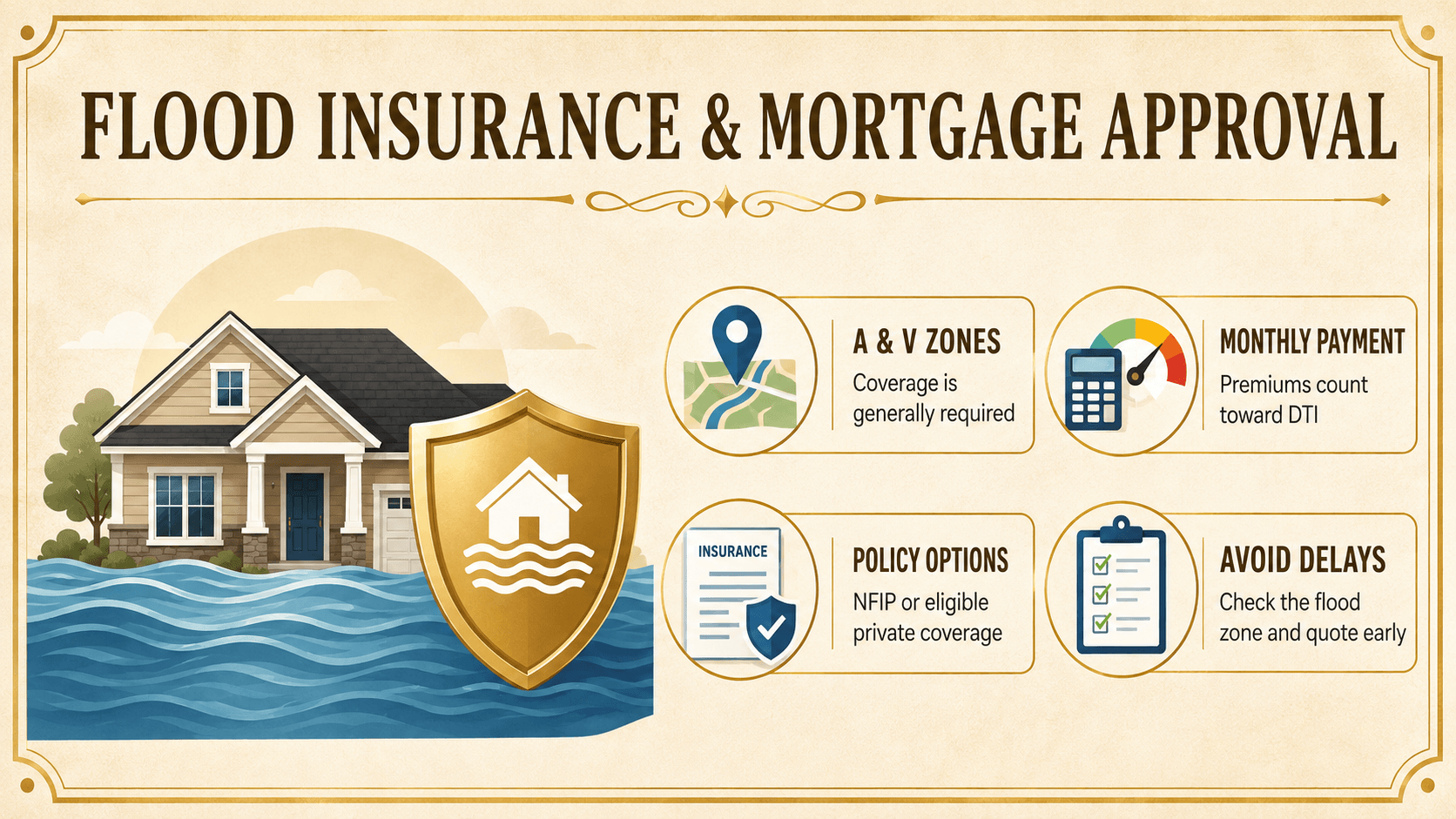
Flood insurance mortgage guidelines generally require coverage when a building securing a federally regulated, insured, or guaranteed mortgage is located in a FEMA Special Flood Hazard Area, usually an A or V zone. The lender orders the official flood determination, verifies acceptable coverage, and includes the premium in the borrower’s housing expense. The property may still qualify, but the flood zone, community participation, policy, deductible, coverage amount, and loan program must be acceptable.
What Are Flood Insurance Mortgage Guidelines
Flood Insurance Mortgage Guidelines dictate whether a mortgage requires flood coverage. Lenders examine the mortgage program and the properties’ designations from the Federal Emergency Management Agency (FEMA) and the collateral securing the loan. Lenders require flood insurance to be in effect before the mortgage closing. Underwriting allows costs associated with flood insurance to be included as part of the borrower’s monthly qualifying expenses for the mortgage.
Which FEMA Flood Zones Require Flood Insurance?
Special Flood Hazard Areas are indicated by flood zones beginning with A or V on Flood Insurance Rate Maps published by FEMA. Areas considered Special Flood Hazard Areas include AE, AO, AH, VE, A99, and AR zones.
Flood insurance is typically required when the mortgage collateral is in a Special Flood Hazard Area.
In general, B, C, and X zones are at low risk for flooding and do not require mandatory flood insurance based on their flood zone designation. Lenders may still require flood insurance if they deem the property’s risk to be too high.
What Is a Special Flood Hazard Area
A Special Flood Hazard Area (SFHA) is a location with a 1% annual flood risk. FEMA flood maps display these areas in zones that start with ‘A’ or ‘V’. Being in an SFHA doesn’t mean that a home can’t get a mortgage. It means the lender must determine whether flood insurance is required and confirm that the property meets the loan and insurance criteria.
How Mortgage Lenders Determine Flood Insurance Is Required
Mortgage lenders do not make a final determination using flood zone data provided in property listings or insurance quotes. They order a flood determination based on the latest FEMA flood maps to finalize the Special Flood Hazard Area (SFHA) designation. For Fannie Mae loans, lenders typically use FEMA’s Standard Flood Hazard Determination form.
For Fannie Mae mortgages, flood insurance is mandatory if any part of the principal structure is located in an SFHA. Different rules are applicable if only a structure is located in the flood zone.
Once coverage is required, the lender will confirm that the insurance meets the mortgage approval requirements for the policy, coverage amount, deductible, and insurance company. Different criteria apply for conventional, FHA, VA, USDA, and Non-QM loans.
Buying a Home in a Flood Zone? Check Eligibility Early
Flood determinations, elevation certificates, condo master policies, detached structures, and required coverage can create closing delays. We’ll help identify issues before they become problems.Flood Insurance Requirements By Mortgage Programs
Different mortgage programs have their own unique flood insurance requirements. Lenders are responsible for the agency or investor requirements as well as the federal government flood insurance mandates.
Conventional Loans
For Fannie Mae and Freddie Mac loans, the lender orders a Standard Flood Hazard Determination to determine whether an insurable structure securing the mortgage is located in a Special Flood Hazard Area. An appraisal, property listing, insurance quote, or consumer flood map may identify a possible risk, but it does not replace the lender’s official flood determination. Fannie Mae generally requires flood insurance when any portion of the principal residential structure is in an SFHA. Coverage may also be required for a detached residential structure located in an SFHA if it is part of the mortgage collateral. Different rules apply when only the land or a detached nonresidential structure is in the flood zone. Freddie Mac requires flood insurance when the flood determination identifies insurable improvements in an A- or V-designated SFHA. The coverage must remain in effect for the term of the mortgage. Both Fannie Mae and Freddie Mac permit qualifying private flood insurance as an alternative to an NFIP policy. The lender must confirm that the insurer, coverage, policy terms, deductible, and documentation satisfy the applicable conventional loan requirements before closing.
FHA Loans
FHA also mandates flood insurance when a property is located in a flood insurance area that requires it. FHA permits either NFIP coverage or a private flood insurance policy that satisfies HUD requirements. Private coverage is an alternative to NFIP coverage, but it does not necessarily make a property eligible when federal law or FHA rules otherwise prohibit financing in a nonparticipating community. Before closing, lenders must confirm that the property and the flood insurance policy comply with FHA requirements.
VA Loans
VA loans mandate flood insurance coverage when the proposed property is located in a Special Flood Hazard Area and flood insurance is available. In the absence of a community’s participation in the National Flood Insurance Program, VA will not issue a loan guarantee. The veteran’s estimated housing expense includes the cost of required flood insurance.
USDA Loans
USDA requires the lender to order a Standard Flood Hazard Determination. A home in a Special Flood Hazard Area can qualify for USDA financing if the community is part of the National Flood Insurance Program and you secure acceptable flood insurance before closing. Flood insurance is required when any portion of the primary residential structure is in an SFHA. Attached improvements, including decks and carports, are considered part of the residential structure and can trigger the coverage requirement. Detached nonresidential structures, such as sheds and detached garages, generally do not trigger USDA’s mandatory flood insurance requirement when they do not serve as residences. However, the lender may require coverage if it determines that an improvement remains vulnerable to flooding. New or proposed construction in an SFHA is subject to additional eligibility and elevation requirements. Depending on the property, the lender may need a final FEMA Letter of Map Amendment or Letter of Map Revision, an acceptable Elevation Certificate showing that the lowest floor meets the required elevation, or other documentation permitted under USDA environmental rules. The lender must verify that the property, community, policy, coverage amount, and deductible comply with the current USDA Single Family Housing Guaranteed Loan Program Handbook.
Non-QM Loans
Non-QM loans do not have one agency guide comparable to FHA, VA, USDA, Fannie Mae, or Freddie Mac. However, federal mandatory-purchase requirements may still apply depending on the lender, collateral, and transaction. The investor may also impose flood insurance requirements beyond the federal minimum. A property in a Special Flood Hazard Area may still qualify for Non-QM financing when acceptable coverage is available. Depending on the investor, the borrower may be able to use an NFIP policy or qualifying private flood insurance. The lender will review the flood determination, property type, community participation, policy amount, deductible, insurer, and investor guidelines. The flood insurance premium must also be included in the qualifying housing expense and may affect the borrower’s debt-to-income ratio.
How Much Flood Insurance Do Mortgage Lenders Require?
 For a Fannie Mae first mortgage secured by a one- to four-unit property, the minimum required flood insurance coverage is the lesser of:
- The full replacement cost value of the enhancements is covered at 100%.
- The maximum coverage available through the National Flood Insurance Program
- The outstanding principal balance of the mortgage, or the initial loan amount at the time it was issued.
Flood insurance applies to the insurable buildings and improvements securing the mortgage. The value of the land is not included in the coverage calculation. These are minimum requirements. A lender or loan agreement may require more coverage, subject to applicable law. Before closing, the lender will verify that the policy amount, deductible, insurer, effective date, and documentation meet the applicable mortgage requirements.
NFIP vs Private Flood Insurance
Borrowers may have more than one option when obtaining flood insurance. Depending on the loan program and policy, coverage may come from the National Flood Insurance Program (NFIP) or from an eligible private insurer.
NFIP Flood Insurance
The NFIP, which is run by FEMA, provides federally backed flood insurance for qualifying communities. The NFIP provides coverage for residential buildings for up to $250,000. The mortgage requirement generally concerns building coverage protecting the structure that secures the loan. NFIP contents coverage is optional borrower protection and does not replace required building coverage.
Private Flood Insurance
Private flood insurance, like most insurance policies, provides varying levels of coverage, premiums, and deductibles. Although a policy may be private and less expensive, it still may not meet the requirements for a mortgage. Fannie Mae approves private flood insurance as long as the policy provides adequate coverage and the insurance company meets their requirements. The FHA also allows private flood insurance policies that meet HUD’s requirements. Borrowers are expected to have the private policy evaluated by the lender prior to relying on it for closing.
How Flood Insurance Affects Your Mortgage Payment and DTI
Flood insurance will impact mortgage qualification because the Insurance premium is added to housing expenses, increasing the monthly payments to the lender and raising the debt-to-income (DTI) ratio.
If the annual premium for flood insurance is $3,600, the lender will include a $300 monthly expense when determining the borrower’s total housing costs.
Flood Insurance Mortgage Guidelines should be researched early when purchasing a flood-prone property to help avoid last-minute issues before closing. An affordable property rate may be difficult to achieve if the insurance quote is obtained after the contract is signed.
Flood Insurance and DTI Example
The following example is for illustration only and does not guarantee mortgage approval. Assume a borrower has:
- Gross monthly income: $8,000
- Existing monthly debts: $1,200
- Proposed qualifying housing expense before flood insurance: $2,450
- Annual flood insurance premium: $3,600, or $300 per month
The $2,450 proposed housing expense includes applicable principal, interest, property taxes, homeowners’ insurance, mortgage insurance, and association dues. Flood insurance is shown separately to demonstrate its effect on qualification. Before adding flood insurance: $1,200 + $2,450 = $3,650 in total monthly obligations $3,650 ÷ $8,000 = 45.6% DTI After adding the $300 monthly flood insurance expense: $1,200 + $2,450 + $300 = $3,950 in total monthly obligations $3,950 ÷ $8,000 = 49.4% DTI The flood insurance premium increases the borrower’s DTI from approximately 45.6% to 49.4%. This difference could affect the loan amount or underwriting decision, which is why buyers should obtain a flood insurance quote early. A DTI of 49.4% does not automatically approve or deny the loan. The outcome depends on the loan program, automated underwriting findings, compensating factors, lender requirements, credit, income, assets, and property eligibility.
Flood Insurance Requirements for Condos
Flood insurance requirements for a condominium may involve the association’s master policy, an individual unit policy, or both. For a Fannie Mae loan on an attached condo in a Special Flood Hazard Area, the lender generally must verify that the homeowners’ association maintains an acceptable Residential Condominium Building Association Policy or an equivalent private master flood insurance policy. The policy must cover the subject unit’s building, common elements, and applicable building machinery and equipment. Fannie Mae permits an individual flood policy in place of evidence of a master policy only in limited situations, including:
- Detached condo properties
- Units in two- to four-unit condo projects
- Certain high-LTV refinance loans
If the association’s master policy does not provide sufficient coverage, the unit owner may need a supplemental flood insurance policy to make up the shortage. The lender must also verify that the coverage amount, deductible, insurer, and policy documentation comply with Fannie Mae’s condo flood insurance requirements. FHA and other mortgage programs have their own condominium flood insurance requirements. Buyers should have the lender review the association’s policy early because insufficient master coverage can delay or prevent mortgage approval.
What If Only Part of the Property Is in a Flood Zone?
A portion of the land being in a flood zone does not automatically mean the home requires flood insurance. The location and use of each structure are more important than the lot’s overall flood-zone designation. Under Fannie Mae guidelines:
- Flood insurance is required if any portion of the principal residential structure is in a Special Flood Hazard Area.
- If the principal structure is outside the SFHA but a detached residential structure securing the mortgage is in the SFHA, coverage is required for that detached structure.
- If the principal structure is outside the SFHA and only a detached nonresidential structure, such as a shed or detached garage, is in the SFHA, Fannie Mae generally does not require flood insurance for either structure.
- If only vacant land is in the SFHA and no insurable structure is affected, the land’s location alone generally does not trigger the coverage requirement.
Other loan programs may apply different rules to attached improvements, detached buildings, new construction, and other property features. The lender’s official flood determination, the location and use of each structure, the collateral included in the mortgage, and the applicable loan-program requirements determine whether coverage is required.
What If You Disagree With the Flood-Zone Determination?
A buyer or homeowner who believes a structure has been incorrectly classified within a Special Flood Hazard Area may request a map change from FEMA. A licensed surveyor or engineer may need to prepare an Elevation Certificate or provide other supporting information. An Elevation Certificate documents the structure’s elevation, but it does not automatically remove the federal flood insurance requirement. FEMA generally must issue an applicable map-change document, such as:
- A Letter of Map Amendment
- A Letter of Map Revision
- A Letter of Map Revision Based on Fill
A LOMA may apply when the structure or property is naturally at or above the Base Flood Elevation. A LOMR-F may apply when fill was used to elevate the land or structure. The appropriate request depends on the property and the reason for the disputed designation. After FEMA issues its determination, the borrower must provide it to the lender or mortgage servicer for review and processing. An approved LOMA or LOMR-F generally removes the federal mandatory purchase requirement, but the mortgage agreement or the lender may still require flood insurance. Do not cancel an existing policy until the lender or servicer confirms in writing that coverage is no longer required. Borrowers can review the process through FEMA’s LOMA and LOMR-F guidance.
How Much Does Flood Insurance Cost?
There is no general price. For most NFIP policies, FEMA bases prices on the property’s flood risk rather than the FEMA flood zone. The distance from a water source, how frequently it floods, building characteristics, foundation type, and the estimated cost to rebuild the structure (replacement cost) are factors that may affect the price. Because the costs can vary greatly, homebuyers should obtain a flood insurance cost estimate and plan accordingly.
Ways to Save on Flood Insurance
Depending on the property and policy, borrowers may have several ways to reduce the cost of flood insurance.
Compare NFIP and Private Flood Insurance
If a mortgage program permits private flood insurance and the NFIP, compare the two options. The lender must review the private policy before the borrower can rely on it at closing.
Check Your Community’s CRS Rating
Check your community’s classification in FEMA’s Community Rating System (CRS). Communities that exceed the program’s minimum standards may be eligible for a CRS designation. NFIP policyholders in these communities may qualify for a discount of 5 percent to 45 percent.
Review Property Information
There are many factors that flood insurance underwriters use to determine a rate for a particular property. The insurance company must have all of the information for the property to ensure an accurate quote. Before making property changes solely to lower the premium, ask the insurance agent how the proposed mitigation may affect pricing. The lender must still approve the policy amount and deductible, though the deductible must still adhere to the Flood Insurance Mortgage Guidelines and associated loan program criteria.
What Happens If Flood Insurance is Cancelled After Closing?
Generally, required flood insurance must be maintained throughout the period during which the mortgage and the Federal flood insurance requirements are applicable.
If a lender or servicer determines that required flood insurance has lapsed or is inadequate, it must notify the borrower. If the borrower does not obtain adequate coverage within forty-five days of the notice, the lender or servicer is obligated to procure the coverage in accordance with the federal flood insurance program.
The borrower may be required to pay the premium and any associated fee for the coverage, which will begin on the date the required insurance lapses or becomes insufficient. Homeowners should act expeditiously to address any expiring or inadequate flood coverage notices and avoid the lender procuring coverage.
Common Flood Insurance Problems That Delay Mortgage Closings
Our mortgage team commonly finds that the flood zone itself is not the only problem. Closing delays often happen because the flood determination, insurance policy, property structures, or qualifying payment was not reviewed early enough. The flood determination conflicts with the listing. A real estate listing may say that a home is outside a flood zone, while the lender’s Standard Flood Hazard Determination shows that an insurable structure is in a Special Flood Hazard Area. The lender must rely on the official flood determination rather than the listing description. The flood insurance quote arrives too late. A borrower may qualify based on the estimated mortgage payment and then discover that flood insurance adds several hundred dollars per month. Because the premium is included in the qualifying housing expense, a late quote can increase the DTI and reduce the approved loan amount. A private policy does not meet the loan requirements. Private flood insurance may cost less or provide more coverage than an NFIP policy. However, the lender must verify that the insurer, policy terms, coverage amount, deductible, and documentation meet the applicable agency or investor requirements. The condo master policy is insufficient. A condominium association may have flood insurance but still fail the mortgage review because the policy does not provide enough coverage for the subject building and common elements. The unit owner may need supplemental coverage, or the association may need to correct the master policy. A detached residential structure is overlooked. The main home may be outside the SFHA, while a detached guesthouse or other residential structure securing the mortgage is inside it. Depending on the loan program, that detached structure may require separate flood insurance. The policy deductible is too high. A policy can provide sufficient total coverage yet still be unacceptable if the deductible exceeds the applicable loan program or investor limit. The lender should review both the coverage amount and the deductible before the borrower pays the premium. FEMA changes the map during the mortgage term. A home that did not require flood insurance at closing may later be placed in an SFHA. If the servicer receives an updated flood determination, the homeowner may be required to obtain coverage even though the original mortgage closed without it. The borrower purchases contents coverage instead of sufficient building coverage. NFIP and private policies may provide protection for personal belongings, but contents coverage does not satisfy a lender’s building coverage requirement. The structure securing the mortgage must have the required amount of building coverage. These problems are easier to address before the appraisal, insurance review, and final underwriting stages. Buyers considering a property in or near a flood zone should ask the lender to review the flood determination and insurance quote as early as possible.
Steps to Take Before Making an Offer on a Home in a Flood Zone
Before considering buying a home in or near a flood zone, buyers need to do the following:
- Make sure the lender confirms the FEMA flood zone designation.
- Get a quote for flood insurance as soon as possible.
- Find out if either the National Flood Insurance Program (NFIP) or private flood insurance is an option.
- Include the estimated flood insurance premium when calculating the entire estimated monthly cost of owning the home.
- Review condo association coverage if purchasing a condo.
- Discuss a higher-than-expected premium with the loan officer before finalizing the purchase offer.
Budget concerns can be addressed by completing the actions listed above before finalizing the purchase offer.
Final Thoughts on Flood Insurance Mortgage Guidelines
Having a home in a flood zone doesn’t necessarily mean the end of mortgage approval, but the insurance requirement will affect the DTI and the underwriting process.
Flood insurance mortgage guidelines depend on many factors, including the specifics of the loan, the property type, the flood zone determination, and the insurance policy. Because it’s a good idea to get a reasonable estimate, it’s best not to wait until the last minute to deal with these things.
Dealing with a lender experienced with flood zone properties should help the buyer identify any issues in the mortgage process.
Frequently Asked Questions About Flood Insurance and Mortgages
Is Flood Insurance Included in the Mortgage Escrow Account?
Generally, yes. Many lenders are required by federal law to establish an escrow account to pay flood insurance premiums on residential mortgages when a required flood insurance policy is mandated. Some loans and lenders are granted exemptions to this requirement. When a policy is escrowed, a portion of the premium is collected with the monthly mortgage payment.
Can a Seller Transfer an Existing NFIP Flood Insurance Policy to the Buyer?
An existing flood insurance policy can be transferred to the new owner upon completion of the sale of the insured property. The insurance company or agent should affect the assignment and confirm the new owner’s interest in adequate flood insurance coverage.
Will the NFIP 30-Day Waiting Period Delay a Mortgage Closing?
Not necessarily. The 30-day waiting period on NFIP policies is waived when a flood insurance policy is purchased to satisfy a requirement to obtain or increase the level of a mortgage. In that case, the buyer should purchase the policy as early as possible to allow the lender to review the policy before the scheduled close.
Is Flood Insurance Reviewed Again When Refinancing a Mortgage?
Yes. A refinance is a new mortgage transaction, and the lender will evaluate whether flood insurance is needed based on the property’s current flood status. FEMA’s Standard Flood Hazard Determination Form is used by a lender for a federally backed mortgage to assess the property’s location in a Special Flood Hazard Area.
What Happens if FEMA Places My Home in a Flood Zone After I Already have a Mortgage?
Within the lifetime of a mortgage, flood zones can change. In such a case, if the lender or servicer determines that a mortgaged property has moved into a Special Flood Hazard Area, the borrower is required to obtain flood insurance, even though it was not required when the loan was closed.
Do Second Homes and Investment Properties have Flood Insurance Requirements?
Yes, a second home or an investment property is not exempt from the requirement when the property securing the mortgage is in a Special Flood Hazard Area, and the loan is subject to mandatory flood insurance. The lender would still have to confirm that the required insurance is adequate as per the mortgage and investor guidelines.
This article about “Flood Insurance Mortgage Guidelines by Loan Type and Flood Zone” was updated on August 27th, 2026.