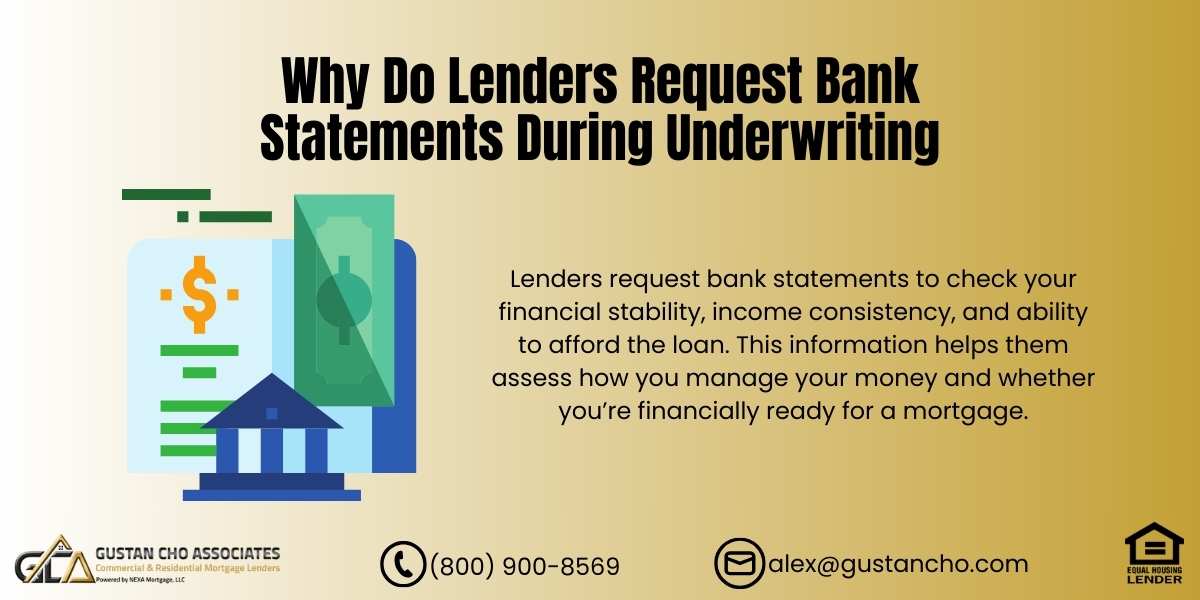
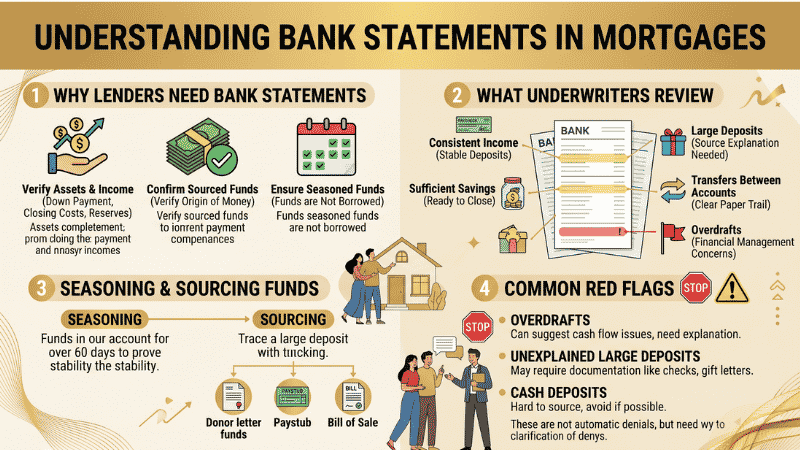
If you are buying a home or refinancing, you might wonder why mortgage lenders request bank statements throughout the loan process. Many borrowers feel anxious when underwriters request these documents, unsure what the lender is looking for or whether certain transactions might negatively affect their approval. Mortgage lenders request bank statements primarily to verify your income, confirm the source of your funds, and ensure you have sufficient cash for the down payment, closing costs, and required reserves. These statements also allow underwriters to examine large deposits, gift funds, transfers, overdrafts, and any other transactions that may need clarification before closing. In essence, understanding why mortgage lenders request bank statements boils down to their need
to ascertain that the funds used for your mortgage are legitimate, properly sourced, seasoned, and permissible under the loan program. A bank statement can reveal more than just your account balance; it offers insight into your financial management, the stability of your funds, and any potential issues that might require additional documentation. The good news is that questions regarding bank statements do not automatically indicate that your loan is in jeopardy. Many concerns, like large deposits or transfers between accounts, can often be resolved with the correct documentation. By grasping why mortgage lenders request bank statements, you can better prepare yourself, avoid delays, and navigate underwriting with greater confidence.
Why Bank Statements Matter In The Mortgage Process

Underwriters also review bank statements for activity that may need an explanation. This can include large deposits, gift funds, transfers between accounts, overdrafts, nonsufficient funds, and the source of your earnest money deposit. If a deposit cannot be documented, the lender may not be able to count it as an acceptable verified asset for your mortgage approval.
For self-employed borrowers, bank statements may also help demonstrate business cash flow, especially when applying for a bank statement loan or another non-QM mortgage program. In these cases, lenders may review deposits over a longer period to help determine qualifying income. Understanding why mortgage lenders request bank statements is crucial, as these documents help them determine whether you have the verified, readily available funds needed to close the mortgage. By preparing your bank statements in advance, you can prevent underwriting delays, minimize documentation problems, and streamline the overall mortgage process.
What Are Lenders Looking for in Bank Statements?
When a lender requests your bank statements, they typically review the following:
- Consistent Income: Lenders want to see steady deposits, like your paycheck or business revenue. If you’re self-employed, this is even more crucial. Irregular income might raise questions, so it’s important to document all sources of funds.
- Sufficient Savings: Having enough money in the bank to cover the down payment, closing costs, and reserves (typically two months of mortgage payments) is critical. This shows lenders that you’re financially prepared.
- Irregular Deposits: Deposits outside your normal paychecks—like gifts, bonuses, or side income—will be flagged. For anything over $200 (or a similar threshold), lenders will ask for an explanation and documentation, such as a letter from the donor for gift funds.
- Overdrafts: Overdrafts are a red flag. They suggest poor financial management, which could impact your approval. Some lenders are stricter about overdrafts than others, so avoiding them is ideal.
- Large Withdrawals: Significant withdrawals may raise concerns about your ability to manage future mortgage payments. Lenders want to ensure that your spending doesn’t jeopardize your financial stability.
Why Mortgage Lenders Request Bank Statements For 60 Days?
Most lenders only ask for the most recent two months (60 days) of bank statements. Here’s why:
- Seasoning Requirements: Funds used for your down payment and closing costs must typically be in your account for at least 60 days. This “seasoning” proves the money isn’t borrowed or from an unverifiable source.
- Up-to-date Snapshot: A couple of months of statements provide underwriters with a clear view of your financial status without extensively exploring historical details.
What Does It Mean When Funds Must Be Sourced And Seasoned?
When mortgage lenders review your bank statements, they are looking to ensure that the money used for your mortgage is properly sourced and seasoned. This is critical for your down payment, closing costs, cash reserves, and any substantial deposits that appear during the mortgage process. Understanding why mortgage lenders request bank statements is essential for borrowers. Sourced funds are funds the lender can trace back to their origin. Acceptable sources include income from your paycheck, documented savings accounts, gifts from eligible donors, proceeds from the sale of assets, or transfers from accounts you own, provided they are supported by the appropriate documentation.
Seasoned funds are those that have been in your account long enough that the lender may not need to trace them back further. Most mortgage lenders typically examine the most recent 60 days of bank statements. If the funds were already in your account before this review period, they may be deemed seasoned because they won’t appear as recent large deposits.
This verification process is crucial because mortgage lenders want to confirm that your down payment and closing costs did not originate from undisclosed loans, cash advances, personal loans, borrowed funds, or any unverifiable sources. If a lender cannot ascertain the origin of the money, the underwriter may not permit those funds to be included in your mortgage approval. Large deposits often prompt lenders to request additional documentation, which raises the question of why mortgage lenders require bank statements. If a sizable deposit appears on your bank statement, the lender may ask for evidence of its origin, such as a copy of the check, a gift letter, transaction records, a bill of sale, a deposit receipt, or statements from a verified account. To avoid delays, borrowers should maintain their mortgage funds in a single account, avoid cash deposits, clearly document any transfers, and discuss any large transfers with their loan officer. This is important because it addresses why mortgage lenders request bank statements. Providing clear and accurate bank statements helps underwriters verify your assets and confirm your cash-to-close requirements.
Can Overdrafts On Bank Statements Hurt Mortgage Approval?
Overdrafts on bank statements can hurt mortgage approval, but they do not automatically mean every borrower will be denied. An overdraft may raise concern because it can suggest the borrower is having trouble managing cash flow or keeping enough money in the account to cover expenses.
Mortgage underwriters review overdrafts to determine if they are singular occurrences or indicative of a recurring issue. This is why mortgage lenders request bank statements: a minor overdraft from months prior may be treated differently than several recent overdrafts during the mortgage application process.
The impact of overdrafts depends on several factors, including the loan program, AUS findings, the age of the most recent overdraft, the number of overdrafts, and whether the account is now stable. It can also depend on whether the lender has internal overlays that are stricter than the minimum agency guidelines. Some lenders may deny a loan due to recent or recurring overdrafts, even if the borrower otherwise meets FHA, VA, USDA, or conventional mortgage guidelines. This is often a lender overlay issue, not always a hard agency rule. If your bank statements show overdrafts or nonsufficient funds, be upfront with your loan officer. The lender may request a letter of explanation, updated bank statements, proof that the issue has been resolved, or documentation showing that the overdraft was caused by an isolated event. Borrowers should avoid overdrafts before and during the mortgage process whenever possible. Keeping your account stable, avoiding unnecessary large withdrawals, and maintaining sufficient funds for your cash to close can help reduce underwriting questions. At Gustan Cho Associates, individuals who have been denied by another lender due to overdrafts may still have viable options. Understanding why mortgage lenders request bank statements is important, as it involves a thorough review of the entire file, including credit, income, assets, AUS findings, loan program guidelines, and whether the previous denial stemmed from lender overlays.
What To Do If Your Bank Statement Shows Overdrafts
If your bank statement shows overdrafts or nonsufficient funds, do not try to hide them from your mortgage lender. It is better to tell your loan officer upfront so the issue can be reviewed before the file goes to underwriting.
An overdraft does not always mean your mortgage loan will be denied. The lender will usually look at the full picture, including how recent the overdraft was, how many overdrafts appear on the statements, whether the account is now current, and whether the borrower has enough verified funds for the down payment, closing costs, and reserves.
The underwriter may request a written explanation detailing the reasons for the overdraft, including whether it was a one-time occurrence and the measures taken to prevent its recurrence. Additionally, it’s important to understand why mortgage lenders request bank statements, as they may seek updated records, verification that the account is current, or documentation confirming that the overdraft issue has been resolved. Some mortgage lenders have stricter rules, called lender overlays, when reviewing overdrafts. One lender may deny a borrower due to recent overdrafts, while another lender may approve the same borrower if the file meets FHA, VA, USDA, conventional, or non-QM guidelines. To understand why mortgage lenders request bank statements, it’s important to review them with your loan officer early in the process. If you spot overdrafts, insufficient funds, or any unusual activity in your account, your loan officer can guide you on the necessary documentation to present before underwriting. This proactive approach can help prevent delays, lessen surprises, and enhance your chances of a smoother mortgage approval process.
Why Large Deposits Need To Be Documented
One of the most common reasons why mortgage lenders request bank statements is due to large deposits made by borrowers. While a sizable deposit doesn’t necessarily lead to a denial of your loan, the lender may need to verify the source of those funds before they can be applied to your down payment, closing costs, or cash reserves.
Not every unusual deposit creates a problem. Underwriters are usually more concerned when a deposit is large, recent, or unusual for your account history, or when it is needed to qualify for the mortgage. If the money is not needed for your cash-to-close or reserves, the lender may not need to document it as closely.
Mortgage lenders review large deposits to ensure the funds are from an acceptable source. The concern is that the funds may have come from an undisclosed loan, cash advance, personal loan, borrowed money, or another source that could affect your debt-to-income ratio or mortgage approval. Depending on the loan program, AUS findings, and lender overlays, the underwriter may ask for documentation such as:
- A copy of the deposited check
- Proof of wire transfer
- A gift letter
- A bill of sale
- A deposit receipt
- A bank statement from another verified account
- Proof of sale of an asset
- A letter of explanation
For FHA loans, older HUD guidance required documenting recent large deposits exceeding 2% of the property’s sale price. However, lenders may still request additional documentation based on the full file, automated underwriting findings, and internal lender overlays. The safest rule for borrowers is simple: avoid cash deposits and keep a paper trail for any large deposit before or during the mortgage process. If you receive gift funds, sell an asset, transfer money between accounts, or deposit money from another source, tell your loan officer early so the funds can be properly sourced and documented before underwriting. This transparency helps explain why mortgage lenders request bank statements, allowing for proper sourcing and documentation of the funds before the underwriting stage.
Take First Step Toward Making Your Dream A Reality
Apply Online And Get recommendations From Loan ExpertsWhy Lenders Check Your Earnest Money Deposit
During the underwriting process, mortgage lenders often take a close look at your earnest money deposit. This deposit, which you provide after your purchase contract is accepted, demonstrates your commitment to buying the home. Understanding why mortgage lenders request bank statements clarifies the need to demonstrate your financial stability alongside your earnest money.
If you have already paid earnest money to a title company, escrow company, attorney, or real estate broker, the lender may need to verify the source of that money. This is because earnest money is part of your total cash used in the transaction. The underwriter wants to make sure those funds are properly sourced, documented, and allowed under the mortgage program.
Borrowers should avoid paying earnest money in cash. Cash can be difficult to verify because there may be no clear paper trail showing its origin. If the lender cannot document the source of the earnest money, it may create underwriting delays or require additional explanations. When it comes to verifying funds, a check, wire transfer, cashier’s check, or traceable electronic transfer is typically more straightforward. This is why mortgage lenders request bank statements: they might ask for a copy of the canceled check, a wire receipt, or a bank statement showing the funds leaving your account. Additionally, you may need to provide a receipt from the title company or real estate broker. The safest option is to use money from a verified bank account and keep proof of the transaction. Before moving funds or giving earnest money, ask your loan officer what documentation will be needed so your deposit does not create problems later in mortgage underwriting.
How Gift Funds Show Up On Mortgage Bank Statements
Gift funds can be used for many mortgage loan programs, but they must be properly documented. When gift money appears on your bank statement, the mortgage lender must verify its source and confirm that it is a true gift, not a loan that must be repaid.
The rules governing gift funds may vary by loan program. FHA, VA, USDA, and conventional loans may have different requirements for who can give gift funds and how the transfer must be documented. In most cases, the donor must be an acceptable source, such as a family member, close relative, or another eligible donor allowed by the loan program.
Gift funds cannot be disguised as a loan. The underwriter typically wants a signed gift letter stating that the money is a gift and doesn’t need to be repaid. If the borrower is expected to repay the money, it may be treated as debt and affect the borrower’s debt-to-income ratio. When transferring gift funds, it’s important to maintain a clear paper trail. This is why mortgage lenders request bank statements. They may ask for a copy of the gift letter, evidence of the donor’s financial capacity to provide the gift, a bank statement from the donor, a wire receipt, a copy of the check, or the borrower’s bank statement to confirm that the gift funds have been deposited. Borrowers and donors should avoid large cash deposits before giving gift funds. If the donor deposits a large amount of cash into their account right before sending the gift, the lender may question where that money came from. This can cause delays if the donor needs to provide additional documentation. The safest approach is to talk with your loan officer before moving gift funds. Your lender can explain the correct process for your loan program so the gift money is properly sourced, documented, and accepted by underwriting.
Why Lenders Question Transfers Between Bank Accounts
Mortgage lenders may question transfers between bank accounts because they need to verify where the money came from before counting it toward your down payment, closing costs, or cash reserves. A transfer is not usually a problem if both accounts belong to the borrower and both accounts can be documented. For instance, when you move funds from your savings account to your checking account, it’s important to understand why mortgage lenders request bank statements for both accounts. This allows the underwriter to verify that the money originated from your own confirmed assets rather than being borrowed from an undisclosed source.
Transfers can create problems when the money comes from an account that was not disclosed on the mortgage application, another person’s account, a business account, a cash app, a cryptocurrency sale, or another source that is difficult to verify. In these cases, the lender may request additional documentation to verify that the funds meet mortgage guidelines.
Borrowers should also be careful when moving money between personal and business accounts. For self-employed borrowers, business funds may require extra review because the lender may need to confirm that using those funds will not hurt the business’s ability to operate. The safest approach is to keep a clear paper trail. Save copies of bank statements, transfer receipts, wire confirmations, and account histories showing where the money came from and where it went. Before moving large amounts of money during the mortgage process, ask your loan officer what documentation will be needed. Transfers between accounts do not have to delay your mortgage approval. The key is ensuring every transfer can be properly sourced, documented, and linked to an acceptable account.
Common Mistakes to Avoid When Submitting Bank Statements
- Hiding Accounts: Never try to withhold bank accounts from your lender. If they discover an undisclosed account, it could delay or derail your approval.
- Opening or Closing Accounts: Avoid opening or closing new accounts during the mortgage process. This can complicate underwriting.
- Unexplained Transfers: If you move money between accounts, document and explain the transaction to your lender.
Digital Bank Verification And Online Asset Checks
Many mortgage lenders now use secure digital tools to verify bank statements and assets. Instead of manually uploading PDF bank statements, borrowers may be able to connect their bank accounts via an online verification system. This can help the lender confirm account balances, deposits, and recent transaction history more quickly.
Digital asset verification can speed up the mortgage process, but it does not eliminate underwriting questions. If the system shows large deposits, overdrafts, nonsufficient funds, transfers between accounts, or account inconsistencies, the lender may still ask for additional documentation.
Borrowers may still need to provide PDF bank statements, transaction histories, gift letters, transfer receipts, letters of explanation, or proof of the source of certain deposits. The underwriter’s job is still to make sure the funds are properly sourced, seasoned, verified, and acceptable under the loan program. Before submitting any documents, it’s important to ask your loan officer about the specific requirements and the preferred method of delivery for the information. Understanding why mortgage lenders request bank statements is important, as it helps in providing accurate documentation. After you’ve submitted bank statements or completed digital verification, confirm with the lender that they received everything. This proactive step can help prevent delays, requests for missing documents, and unexpected underwriting conditions before closing.
What to Do If You Have a Financial Red Flag
If you know your bank statements include issues like overdrafts, large withdrawals, or irregular deposits, take these steps:
- Be Honest: Disclose the issue to your loan officer upfront.
- Provide Documentation: Offer proof to explain the situation, such as receipts or letters of explanation.
- Work With Flexible Lenders: Not all lenders have the same policies. For instance, non-QM loans (non-qualified mortgages) may allow more flexibility with financial hiccups.
Regular Mortgage Bank Statements Versus Bank Statement Loans
There is a big difference between a mortgage lender asking for bank statements and a bank statement loan. Many borrowers confuse the two, but they are not the same thing. In traditional mortgage programs like FHA, VA, USDA, and conventional loans, understanding why mortgage lenders request bank statements is important. Lenders examine these statements to verify your assets, ensuring you have sufficient cash to close, down payment funds, closing costs, cash reserves, large deposits, gift funds, and transfers between accounts.
In a traditional mortgage, your income is usually verified with documents such as pay stubs, W-2s, tax returns, written verification of employment, or other approved income documentation. Bank statements are not usually used as the primary basis for calculating your qualifying income.
A bank statement loan is different. Bank statement loans are commonly used by self-employed borrowers, business owners, independent contractors, and 1099 workers who may not qualify using traditional income documents. With this kind of non-QM mortgage, the lender may review your personal or business bank statements from the previous 12 to 24 months to determine the amount of income for which you qualify. This means two borrowers may both be asked for bank statements, but for different reasons. One borrower may be getting a traditional FHA, VA, USDA, or conventional loan, where the lender is verifying assets. Another borrower may be applying for a non-QM bank statement loan where the lender uses bank deposits to help calculate income. Understanding this difference can prevent confusion during the mortgage process. If your lender asks for two months of bank statements, that does not automatically mean you are applying for a bank statement loan. In most cases, the lender is simply verifying that your funds are sourced, seasoned, documented, and available for closing.
Why AUS Findings And Lender Overlays Matter With Bank Statements
Mortgage approval is not based only on your bank statements. Bank statements are one part of the full underwriting review. The lender also reviews your credit, income, assets, debts, property type, loan program, and automated underwriting system findings. The automated underwriting system (AUS) plays a crucial role in evaluating whether a loan file aligns with mortgage program guidelines. Depending on the specific loan program, the file may be processed through systems such as DU, LPA, TOTAL Scorecard, or GUS. These assessments help lenders determine which documentation may be necessary for loan approval, which is why mortgage lenders request bank statements to verify the borrower’s financial stability. Bank statement issues, such as overdrafts, large deposits, transfers, gift funds, and cash deposits, do not always mean the borrower cannot qualify. Many of these issues can be cleared if the funds are properly sourced, seasoned, and documented.
However, not every lender reviews bank statements the same way. Some lenders have stricter internal rules called lender overlays. A lender overlay is when a mortgage company adds requirements that are tougher than the minimum FHA, VA, USDA, conventional, or non-QM guidelines.
For example, one lender may deny a borrower due to recent overdrafts, large deposits, or strict asset documentation requirements. Another lender may be able to approve the same borrower if the file meets agency guidelines, AUS findings are acceptable, and the bank statement issue can be properly explained. This is why borrowers should not assume one denial means they cannot qualify for a mortgage. The key is understanding whether the issue came from actual mortgage guidelines, automated underwriting findings, or the lender’s own overlays. At Gustan Cho Associates, borrowers who have been denied because of bank statement issues may still have options. The full file needs to be reviewed, including income, assets, credit, debt-to-income ratio, AUS findings, and the reason the prior lender denied the loan.
Key Takeaways: Preparing Your Bank Statements for a Mortgage
To avoid delays or denials, here’s how you can prepare your bank statements for submission:
- Review Your Statements: Check for overdrafts, large withdrawals, or irregular deposits before submitting them.
- Document Everything: Have proof of any unusual transactions.
- Avoid Big Changes: Keep your finances stable during the mortgage process—no new accounts, no large purchases.
- Ask Questions: If you’re unsure about what your lender is looking for, ask your loan officer for guidance.
Final Thoughts On Why Mortgage Lenders Request Bank Statements
Mortgage lenders request bank statements to verify your cash-to-close, reserves, income deposits, large deposits, transfers, gift funds, and overall financial stability. Underwriters want to know that the funds used for your mortgage are properly sourced, seasoned, documented, and permitted under the loan program.
If your bank statements show overdrafts, unusual deposits, cash deposits, or transfers, do not panic. These issues do not always mean your mortgage will be denied. Many bank statement questions can be resolved with the right documentation, such as a letter of explanation, proof of transfer, a gift letter, a deposit receipt, or an updated bank statement.
The best step is to review your bank statements before applying for a mortgage. Look for large deposits, overdrafts, nonsufficient funds, transfers between accounts, and any money that may be difficult to document. Addressing these issues early can help reduce underwriting delays and avoid last-minute conditions before closing. Because every loan file is different, borrowers should work with a mortgage lender who understands agency guidelines, AUS findings, manual underwriting, and lender overlays. One lender’s denial does not always mean you cannot qualify. It may simply mean the file needs to be reviewed by a lender that understands how to document bank statement issues correctly. Related> Overdrafts In Bank Statements
FAQs About Why Mortgage Lenders Request Bank Statements
Can Mortgage Lenders See All Of My Bank Accounts?
Mortgage lenders can only review the bank accounts you disclose or submit during the mortgage process. However, if money is transferred from another account, the lender may ask for statements from that account to verify the source of funds. Any account being used for down payment, closing costs, reserves, or income support should be disclosed upfront.
Do Mortgage Lenders Look At Every Transaction On Bank Statements?
Mortgage lenders may review transactions that affect your mortgage approval, especially large deposits, transfers, overdrafts, nonsufficient funds, recurring payments, and unusual activity. Underwriters are mainly trying to confirm that your funds are acceptable, verified, and available for closing.
Can I Use Cash Deposits For My Down Payment?
Cash deposits can create problems because they are difficult to source. Mortgage lenders usually need a clear paper trail showing the source of the funds. If cash was deposited before applying, speak with your loan officer before using those funds for down payment, closing costs, or reserves.
What Happens If I Move Money Before Closing?
Moving money before closing can lead to additional documentation requests. If you transfer funds between accounts, the lender may ask for statements from both accounts, transfer receipts, or proof of the source of the funds. It is best to ask your loan officer before moving large amounts of money during the mortgage process.
Why Does My Lender Keep Asking For More Bank Statements?
A lender may request additional bank statements if the original statements show large deposits, transfers, missing pages, overdrafts, or funds from another account. Additional statements may also be needed if the first statements become outdated before closing.
Can Bank Statements Show Undisclosed Debt?
Yes, bank statements may show recurring payments that do not appear on your credit report. This could include private loans, business debts, payment plans, child support, alimony, or other obligations. If the lender finds recurring payments, they may ask for an explanation or include the debt in your mortgage qualification review.
This article about “Why Mortgage Lenders Request Bank Statements & Red Flags” was updated on May 21st, 2026