A credit score does not have to be perfect to get approved for a home loan, but it can change the path to approval. Your score can affect the loan programs available to you, the down payment required, the interest rate offered, the mortgage insurance, the discount points, and the level of underwriting review. Many borrowers are surprised when the score they see online differs from the one a mortgage lender uses. Others find out too late that high credit card balances, recent late payments, new accounts, or credit disputes can create problems during the mortgage process. Even a small score change can matter when it moves a borrower into a different pricing tier or affects automated underwriting findings. The good news is that securing a home purchase or refinancing is still possible even with a low credit score. Loan options like FHA, VA, conventional, USDA, and non-QM assess credit differently. While some individuals might qualify with lower scores if their overall application is strong, others may need to settle some debts, wait for their accounts to reflect updates, or refrain from applying for new credit beforehand. Knowing the importance of credit scores for home loans allows you to make adjustments that positively affect your chances of approval.
Why Credit Scores Matter When Getting a Mortgage

Mortgage lenders use credit scores to measure risk. A credit score helps the lender see how you have handled debt in the past, including credit cards, auto loans, student loans, personal loans, and other accounts.
Lenders also review your full credit history, not just the number. Recent late payments, high credit card balances, collections, charge-offs, or new accounts can all affect how strong the file looks. Credit scores matter because different loan programs have different requirements. FHA loans can accept lower scores, while conventional loans typically need higher scores, especially for better rates or lower mortgage insurance. VA loans don’t have a specific minimum score, but lenders may set their own rules. This means that two people with the same income and down payment could get different loan terms just because of their credit scores. A mortgage approval takes into account the entire file, not just the credit score. Factors such as income, debts, assets, employment history, down payment, property type, and automated underwriting results are all significant. However, the importance of credit scores for home loans cannot be overlooked, as they are among the first factors lenders assess. Before starting the mortgage application process, borrowers should be aware of their credit score, understand any factors that may negatively impact it, and identify potential improvements they can make.
What Credit Score Do You Need To Buy a House?
The credit score you need to get a house depends on the type of loan, the lender you’re working with, how much money you can put down, and how solid the rest of your mortgage application looks. No one credit score works for every borrower. A buyer with high income, low debt, and savings may have more options than a buyer with the same score but higher debt and limited savings. The importance of credit scores for home loans goes beyond meeting the minimum guidelines. Your score can affect approval, interest rate, mortgage insurance, discount points, and the level of underwriting scrutiny. A lower score does not always mean you cannot buy a home, but it may affect which loan programs are available to you.
FHA Credit Score Requirements
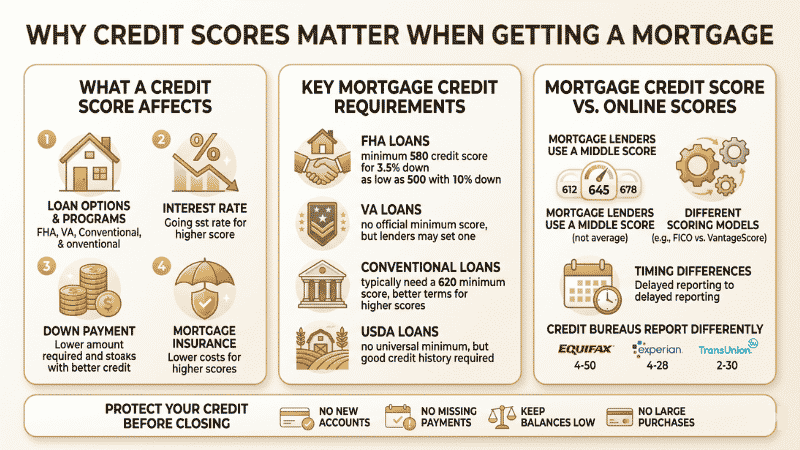
For FHA loans, borrowers may qualify with a 580 credit score or higher with a 3.5% down payment. FHA may allow scores as low as 500 if the borrower has at least 10% down, but not every lender offers FHA loans at those lower score levels. Some lenders add their own credit score rules, known as lender overlays.
VA Credit Score Guidelines
For VA loans, the Department of Veterans Affairs does not set a minimum credit score. However, VA lenders still review credit history, payment history, debts, income, and residual income. Many lenders set their own minimum score requirement, even though VA guidelines do not require one. This highlights the importance of credit scores for home loans, as one lender might deny an application while another assesses it differently.
Conventional Loan Credit Score Requirements
For conventional loans, borrowers usually need a credit score of at least 620. A higher score can help with better interest rates, lower private mortgage insurance, and stronger automated underwriting findings. Conventional loans are often more sensitive to credit score changes than government-backed loans, especially when the borrower has a smaller down payment.
USDA Credit Score Guidelines
USDA loans also do not have a universal minimum credit score set by the program. However, lenders still review whether the borrower has a strong history of managing debt. Many USDA lenders prefer higher scores because USDA loans are zero-down-payment loans that require borrowers to meet income and property eligibility requirements. The importance of credit scores for home loans goes beyond meeting the minimum. A borrower with a lower score may still qualify, but the loan may require more documentation, stronger compensating factors, a larger down payment, or a different loan program. Before shopping for a home, it is best to have a mortgage professional review your credit, income, debts, and down payment together so you know which loan options are realistic.
How Mortgage Lenders Use Your Middle Credit Score
Mortgage lenders typically evaluate credit scores from three primary credit bureaus: Equifax, Experian, and TransUnion. The importance of credit scores for home loans is evident, as each bureau may present a different score because not all lenders report to every bureau simultaneously. A credit card, auto loan, collection, or late payment might show up on one credit bureau before it does on another. This is why borrowers often have three distinct credit scores when applying for a mortgage.
When a borrower has three credit scores, lenders usually use the middle score to decide on a mortgage. This is not the average score. For example, if your scores are 612, 645, and 678, the lender will likely choose 645 as your qualifying score.
This score affects your loan program, interest rate, mortgage insurance, down payment, and automated underwriting results. When it comes to the importance of credit scores for home loans, lenders typically use the lower of two credit scores. If there is only one usable credit score, the loan may be reviewed differently based on the loan program and the lender’s rules. Borrowers with limited credit history, a thin credit profile, or no traditional credit may need to provide alternative documents. These can include records such as rent history, utility payments, insurance payments, and other verified monthly expenses. When two or more people apply for a loan together, lenders usually use the lowest middle credit score among all applicants. For example, if one borrower has a middle score of 720 and the other has a middle score of 610, the loan will be based on the 610 score. This means that one person’s credit score can affect the loan approval, even if another borrower has a very good score. The importance of credit scores for home loans becomes clear when a small score difference changes the loan terms. A few points can move a borrower into a different pricing level, change the mortgage insurance cost, or affect whether the file receives automated approval. Before applying, borrowers should know which score a mortgage lender will use, rather than relying solely on free credit scores from phone apps or credit card websites.
Your Credit Score Can Make or Break Your Home Loan Approval
Credit scores affect your loan options, interest rate, mortgage insurance, and down payment requirements. Get a quick review and see where you stand before you apply.Why Your Mortgage Credit Score May Be Different Online
Many borrowers check their credit score online before applying for a mortgage. They may use a banking app, a credit card app, Credit Karma, Experian, or another free credit score tool. Then the lender pulls credit, and the mortgage score is different. This can be frustrating, but it is common. The reason is that not all credit scores are the same. Free credit score websites may use a different scoring system than mortgage lenders use. A score used for a credit card, car loan, or personal loan may not match the score used for a home loan. Mortgage lenders often use mortgage-specific credit scoring models, so the number can be higher or lower than what you see online. Another reason scores can be different is timing. Credit card companies, auto lenders, student loan servicers, and other creditors do not all report updates on the same day. Your online score may show one balance, while the mortgage credit report may show another. If a credit card balance was high on the day it was reported, your mortgage score may be lower, even if you paid the card down later. Different credit bureaus can present differing information, highlighting the importance of credit scores for home loans. Equifax, Experian, and TransUnion do not update their information simultaneously. As a result, one bureau may show a paid balance while another still lists the old balance. Additionally, one bureau might report a collection or late payment that the others do not. This can lead to your mortgage lender seeing three different credit scores. This is also why borrowers should not rely solely on free online scores when preparing to buy a home. Online scores can help you watch your credit, but they may not tell the full story for mortgage approval. Before making major credit moves, such as paying collections, opening a new card, closing an account, or filing a dispute, it is better to ask a loan officer how that move may affect your mortgage credit score.
How Credit Scores Affect Mortgage Rates and Loan Pricing
The importance of credit scores for home loans extends beyond approval; they can also influence your mortgage rate, closing costs, monthly payments, and mortgage insurance. Typically, a higher credit score results in more favorable pricing for the borrower. While a lower score might not automatically lead to denial, it often makes the loan more costly.
Higher Scores Can Mean Better Pricing
Mortgage lenders price loans based on risk. A stronger credit score can show that you have handled debt well. That may help you qualify for a lower rate, lower costs, or more loan options.
Lower Scores Can Cost More
Having a lower credit score can mean you’ll face higher interest rates, pay more for mortgage insurance, or even have to buy discount points. Discount points are basically upfront costs to snag a lower rate. That’s why your credit score is super important for home loans—it’s not just about getting approved.
A Small Score Change Can Matter
A few things can bump up or drag down a borrower’s pricing level. For example, if your credit card balance goes up, a new account pops up, a late payment shows up, or a new credit check happens right before closing, it can hurt your score.
Example
Two borrowers apply for the same loan amount on the same type of home. One has a 740 score. The other has a 620 score. Both may qualify, but they may not receive the same rate, monthly payment, or closing costs. The borrower with the higher score will usually have better pricing.
Protect Your Credit Before Closing
Do not open new accounts, run up credit cards, finance furniture, miss payments, or make major credit changes during the mortgage process. Even after pre-approval, lenders may refresh credit before closing. A lower score or new debt can change the approval rate or the monthly payment.
Can a Lower Credit Score Mean More Discount Points?
Yes, a lower credit score can sometimes mean more discount points, but it depends on the loan program, lender, down payment, and full mortgage file. Discount points are fees you pay upfront at closing to secure a lower interest rate. One discount point is about 1% of the total loan amount.
People with higher credit scores usually get better loan terms. Borrowers with lower credit scores may be offered a higher rate. In some cases, they may have the option to pay discount points to lower the rate. This does not mean every borrower with a lower score must pay points, but it can happen when the loan is riskier.
The importance of credit scores for home loans is highlighted by the fact that a borrower with a 740 credit score is likely to receive more favorable pricing compared to someone with a 620 credit score. While the borrower with the lower score may still be eligible for a loan, they might face higher interest rates or closing costs. Additionally, opting to pay points can reduce the monthly payment, but it also increases the cash required at closing. Discount points do not always make sense. If you plan to keep the home and the loan for many years, paying points may help you save money over time. If you plan to sell or refinance soon, paying points may not be worth it. It really comes down to how quickly your monthly savings will add up to cover the initial cost. Before paying discount points, ask your loan officer to show the numbers with and without points. Look at the rate, monthly payment, closing costs, and break-even point. A lower rate may look good, but it should make sense for your budget and long-term plans.
How Credit Scores Affect Mortgage Insurance
Your credit score can also affect mortgage insurance. Mortgage insurance protects the lender if the borrower defaults on the loan. It is usually required when a borrower buys a home with a small down payment. On conventional loans, credit scores can significantly affect the cost of private mortgage insurance (PMI). A borrower with a higher credit score may pay less each month for PMI. A borrower with a lower credit score may pay more. This can change the total monthly mortgage payment, even if both borrowers are buying homes at the same price. For example, two borrowers may both put 5% down on a conventional loan. One borrower has a 760 credit score. The other borrower has a 640 credit score. The borrower with the higher score may get a lower PMI payment. The borrower with the lower score may still qualify, but the monthly mortgage insurance may cost more. FHA mortgage insurance works differently. FHA does not price mortgage insurance the same way conventional loans do. FHA mortgage insurance is based more on the loan amount, down payment, and loan term. This is one reason FHA loans may be a better fit for some borrowers with lower credit scores. However, FHA mortgage insurance can last a long time, and borrowers should compare the full cost before choosing a loan. The importance of credit scores for home loans goes beyond the interest rate. Your score can affect mortgage insurance, closing costs, and the monthly payment. Before choosing between FHA and conventional financing, borrowers should compare the total payment, not just the rate.
Should You Open New Credit Before Applying for a Mortgage?
In most cases, it is better not to open a new credit right before applying for a mortgage. A new credit card, personal loan, auto loan, furniture account, or store card can change your credit score and your debt-to-income ratio. Even if the new account seems small, it can still affect your mortgage approval.
When you apply for new credit, the creditor usually pulls your credit report. This is called a hard inquiry. A hard inquiry can lower your credit score by a few points. While it may seem minor, even a slight decrease can affect you if you’re close to a crucial score threshold or seeking a better interest rate.
New credit can also add a new monthly payment. Mortgage lenders count monthly debt payments when they review your debt-to-income ratio. If you finance a car, furniture, appliances, or other items before closing, your new payment may reduce how much house you can qualify for. In some cases, it can turn an approval into a denial. Getting a new credit card might not be the best move if you charge a large amount right away. A high balance can affect your credit score, even if you plan to pay it off soon. The reported amount is usually what mortgage lenders will see. There are times when opening credit may help, such as when a borrower is rebuilding credit early and is not planning to apply for a mortgage soon. A secured credit card, used carefully, may help build payment history over time. But if you are getting ready to apply, are already pre-approved, are under contract, or are close to closing, do not open new credit without speaking to your loan officer first. The importance of credit scores for home loans also helps protect your approval. Before applying for new credit, ask how it may affect your score, monthly payment, debt-to-income ratio, and closing timeline. It is usually safer to keep your credit stable until after the mortgage closes.
Final Thoughts on the Importance of Credit Scores for Home Loans
Your credit score does not have to be perfect to buy a home, but it does matter. It can affect your loan options, interest rate, mortgage insurance, discount points, down payment, and how the lender reviews your file. A few points may not seem like much, but in mortgage lending, a small score change can sometimes affect the loan cost or the approval path. The importance of credit scores for home loans goes beyond meeting a minimum threshold. Lenders also look at your payment history, credit card balances, collections, charge-offs, recent inquiries, new accounts, income, debts, assets, and employment history. A lower score may still work if the rest of the file is strong, but the loan may need the right program and the right lender. Before applying for a mortgage, check your credit, keep payments on time, avoid new debt, and keep credit card balances as low as possible. Do not open new accounts, close old accounts, pay off collections, or dispute credit items without first asking a loan officer how it may affect your mortgage approval. The goal is not just to raise your score. The goal is to protect your approval and secure the best loan option for your situation.
FAQs About the Importance of Credit Scores for Home Loans
Can I Get A Mortgage If I Have No Credit Score?
It is indeed possible to secure a mortgage without a credit score, but doing so may require a different evaluation process. While the importance of credit scores for home loans is well recognized, some loan programs accept alternative forms of credit, including payment histories for rent, utilities, insurance, phone bills, and other regular expenses. Lenders will typically look for a proven track record of timely bill payments, even in the absence of traditional credit cards or loans.
Does Checking My Own Credit Hurt My Mortgage Score?
No, checking your own credit usually does not hurt your score. This is called a soft inquiry. A soft inquiry is not the same as a hard inquiry, which is what happens when you go for new credit. Borrowers should check their credit before applying for a mortgage to spot errors, review balances, and understand what a lender may see.
How Far Back Do Mortgage Lenders Look At Credit History?
Mortgage lenders review the full credit report, but recent activity usually matters the most. Late payments, collections, charge-offs, and new debt in the past 12 to 24 months may get more attention than older issues. Older credit problems may still matter, but a strong recent payment history can help show the lender that the borrower is back on track.
Can Paying Off Debt Before Applying For A Mortgage Help?
Paying off debt can help, but it depends on the type of debt and how it reports to the credit bureaus. Paying down credit card balances often helps because it lowers credit utilization. Paying off an installment loan may not always raise the score and could have little impact. Before paying off collections, charge-offs, or old accounts, ask a loan officer how it may affect your mortgage approval.
Do Collections Have To Be Paid Before Getting A Mortgage?
Not always. Some loan programs may allow unpaid collections, depending on the amount, type of collection, and overall strength of the file. Medical collections, non-medical collections, charge-offs, and disputed accounts may be treated differently. A lender may not require every collection to be paid. However, the underwriter may still review how the account affects the borrower’s credit risk.
Can Credit Disputes Cause Problems With Mortgage Approval?
Yes, credit disputes can cause problems during the mortgage process. Some disputed accounts may need to be removed from dispute before the loan can move forward, especially if they affect the credit score or automated underwriting findings. Removing a dispute can sometimes change the score, so borrowers should not dispute accounts right before or during a mortgage application without first asking their loan officer.
How Soon Should I Start Working On My Credit Before Buying A House?
It is best to start reviewing your credit at least three to six months before applying for a mortgage. You get a chance to fix mistakes, pay down what you owe, stay away from new debt, and let the credit bureaus catch up with your updated account info. Borrowers with recent late payments, collections, or very high credit card balances may need more time before they are ready to apply.
This article about “The Importance of Credit Scores For Home Loans” was updated on June 10th, 2026.