FHA-insured mortgage loans are home loans made by private mortgage lenders and insured by the Federal Housing Administration. FHA does not lend money directly to homebuyers. Instead, FHA protects approved lenders if a borrower defaults, which allows lenders to offer more flexible credit, down payment, and debt-to-income guidelines than many conventional loan programs.
For many first-time homebuyers, renters, and borrowers with less-than-perfect credit, FHA-insured mortgage loans can make homeownership possible with a lower down payment and more forgiving qualification standards. Borrowers with a 580 credit score may qualify with a 3.5% down payment.
In contrast, borrowers with scores between 500 and 579 may still be eligible with a 10% down payment, dependi
ng on lender requirements and overall underwriting approval. The main benefit of FHA-insured mortgage loans is flexibility. FHA loans may help borrowers with higher debt-to-income ratios, limited savings, prior credit issues, or a need for a non-occupying co-borrower. However, FHA loans also come with mortgage insurance premiums, property requirements, and county loan limits. That is why homebuyers should compare FHA loans with conventional, VA, USDA, and non-QM mortgage options before choosing the best loan program. In this guide, we will explain how FHA-insured mortgage loans work, what “FHA-insured” means, who may benefit from an FHA loan, and how FHA loans compare with other mortgage programs.
What Does FHA Insured Mean?
FHA insured means the mortgage loan is backed by the Federal Housing Administration. The FHA doesn’t lend money straight to people buying homes. Instead, private mortgage lenders handle the loans, with FHA stepping in to insure the lender if the borrower can’t keep up with payments and the house ends up in foreclosure.
This insurance is one reason FHA insured mortgage loans can offer more flexible credit, down payment, and debt-to-income guidelines than many conventional loan programs. FHA-approved lenders can help borrowers with lower credit scores, smaller down payments, or past credit problems because they offer government-backed protection.
However, FHA insurance protects the lender, not the borrower. Borrowers pay for this insurance through FHA mortgage insurance premiums. Most FHA-insured mortgage loans include an upfront mortgage insurance premium (often called UFMIP) and an annual mortgage insurance premium, which is often paid monthly as part of the mortgage payment. FHA mortgage insurance helps keep the FHA loan program available to more homebuyers, but it also increases the loan’s total cost. That is why borrowers should compare the full monthly payment and long-term costs of FHA-insured mortgage loans with those of conventional, VA, USDA, and non-QM loan options before choosing a mortgage program.
FHA Insured Mortgage Loans vs Other Mortgage Programs
FHA-insured mortgage loans are often compared with conventional, VA, USDA, and non-QM loans. Each loan program has different credit, down payment, income, property, and mortgage insurance rules. The best choice depends on the borrower’s credit profile, income, debt-to-income ratio, savings, military eligibility, property location, and long-term financial goals.
FHA Insured Mortgage Loans
FHA-insured mortgage loans are often a strong option for first-time homebuyers, borrowers with lower credit scores, and buyers with limited funds for a down payment. FHA loans allow a 3.5% down payment for borrowers with a credit score of 580 or higher. Borrowers with credit scores between 500 and 579 may still qualify with a 10% down payment, depending on lender requirements. FHA loans can also allow higher debt-to-income ratios than many conventional loans when the borrower receives automated underwriting approval. The tradeoff is that FHA borrowers must pay upfront and monthly mortgage insurance premiums. FHA also has property condition requirements and county loan limits.
Conventional Loans
Conventional loans are not insured by FHA, VA, or USDA. They are backed by private lenders and usually follow Fannie Mae or Freddie Mac guidelines. Conventional loans may be a better fit for borrowers with stronger credit, stable income, and enough equity or down payment to reduce or remove private mortgage insurance. One of the best things about conventional loans is that you can often get rid of private mortgage insurance once you’ve built up enough equity in your home. FHA mortgage insurance may last longer, depending on the loan term, down payment, and loan-to-value ratio. For borrowers with higher credit scores and larger down payments, conventional loans may cost less over time.
VA Loans
VA loans are backed by the U.S. Department of Veterans Affairs. They are available to eligible veterans, active-duty service members, and certain surviving spouses. VA loans can be one of the best mortgage options for eligible borrowers because they usually allow zero down payment and do not require monthly mortgage insurance. VA loans do have a VA funding fee unless the borrower is exempt. While VA does not set a universal minimum credit score, many lenders do. Eligible military borrowers should usually compare VA loans with FHA-insured mortgage loans before choosing, because VA loans may offer lower upfront costs and lower monthly payments.
USDA Loans
USDA loans are backed by the U.S. Department of Agriculture. They are designed for eligible homes in approved rural and suburban areas. USDA loans can allow zero down payment for borrowers who meet income and property location requirements. USDA loans may be a strong option for buyers who want no down payment and are purchasing in a USDA-eligible area. However, not every property qualifies, and household income limits apply. FHA-insured mortgage loans may be a better option for buyers purchasing outside USDA-eligible areas or whose income exceeds USDA limits.
Non-QM Loans
Non-QM loans are not government-insured loans and do not follow standard FHA, VA, USDA, Fannie Mae, or Freddie Mac guidelines. These loans may help borrowers who cannot qualify with traditional income documentation, including self-employed borrowers, real estate investors, bank statement borrowers, DSCR loan borrowers, or borrowers with recent credit events. Non-QM loans may offer more flexible documentation options, but they often require larger down payments, higher credit standards, higher interest rates, or greater reserves than FHA-insured mortgage loans. FHA is usually the better first option for owner-occupied borrowers who can document income and meet FHA guidelines.
Advantages and Disadvantages of FHA Insured Mortgage Loans
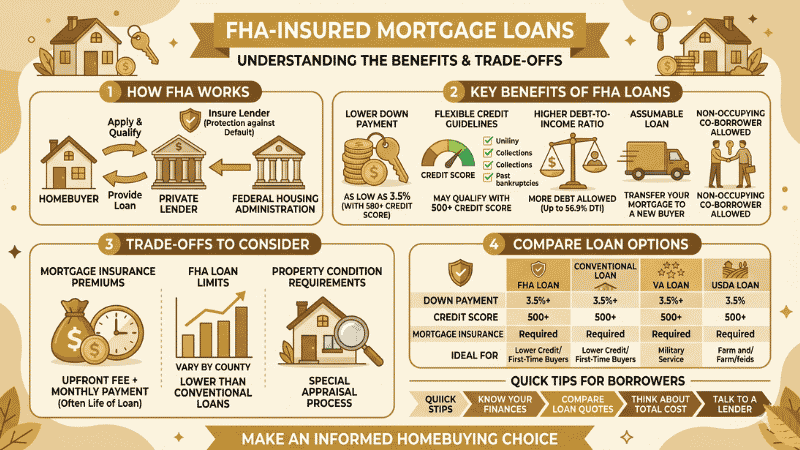
FHA loans have several advantages, making them a popular choice for many buyers. A down payment of just 3.5 percent costs much less upfront than the typical 20 percent required for conventional loans. Borrowers with credit scores beginning at 500 can still get approved, so folks with a few credit bumps still have an option. Plus, FHA loans are assumable, meaning a future buyer can take over the mortgage, making the home more appealing when it’s time to sell. Finally, most lenders offer them, so it’s easy to find.
Still, FHA loans have some trade-offs. Borrowers must pay an upfront mortgage insurance premium (UFMIP) and an ongoing monthly mortgage insurance premium (MIP) that adds to the total cost.
Unlike the private mortgage insurance (PMI) on conventional loans, the annual MIP often can’t be dropped. FHA loan limits are also lower than conventional options, which can be problematic in pricey neighborhoods. Any home with an FHA loan must pass a special appraisal process that can leave some houses off the table. Finally, if someone can qualify for a conventional loan, they may pay less over the long haul.
Choosing the Right Loan Program
Picking the right mortgage loan is about matching your finances, home-buying wishes, and qualifications. If you’re a first-time buyer with a credit score below 680 or little saved for a down payment, the FHA loan is a great option. A conventional loan works best if you have strong credit, can put down a bigger payment, or want to skip lifelong mortgage insurance. Veterans and active-duty service members can benefit from a VA loan without a down payment or mortgage insurance. Meanwhile, USDA loans serve moderate-income rural buyers who meet location and income rules.
Know What You’ll Pay During the Mortgage Process
From closing costs to down payments, we’ll help you understand your out-of-pocket expenses.Tips for Selecting a Mortgage
To find the mortgage that suits you, start by looking at your finances—credit score, income, debt-to-income ratio, and how much cash you have for a down payment. Get loan quotes from several lenders, because rates, fees, and terms can differ greatly. Think about the full cost over time— mortgage insurance, interest rates, and how long the loan lasts. Talk to a mortgage broker or lender for advice that fits your situation. And always double-check that you meet the special rules for loans like VA or USDA before you apply.
FHA-insured mortgage loans are a great choice for many buyers. They let you buy a home with a small down payment and few credit hurdles. Still, a conventional, VA, or USDA loan could offer better terms or lower monthly payments, depending on your financial picture and homeownership goals.
The key is to weigh your situation and compare all your loan choices. Doing so will help you pick the mortgage that fits your journey to owning your home. Talk to a reliable lender or mortgage advisor to dive deeper into your choices and take the next confident step toward that dream home. This keeps the same information and keywords as your original content, while simplifying the wording. Let me know if you need more adjustments or a different angle!
FHA Insured Mortgage Loans are the Most Popular Loan Program in The United States
HUD currently insures more than one trillion in home loans in the United States and makes homeownership possible for those with less than perfect credit and those who are first time home buyers. The FHA loan programs has insured more than 36 million homes since its inception in 1934. FHA is the largest home mortgage insurance company in this world and is still going strong.
Benefits of FHA-Insured Mortgage Loans
FHA-insured mortgage loans are popular because they give homebuyers more flexibility than many traditional mortgage programs. They can be especially helpful for first-time homebuyers, borrowers with limited savings, buyers with lower credit scores, and borrowers who need more room with their debt-to-income ratio.
Lower Down Payment Requirements
One of the best things about FHA loans is that you don’t need to put down a huge amount of money to get started. Borrowers with a credit score of 580 or higher may qualify with as little as 3.5% down. Borrowers with credit scores between 500 and 579 may still be eligible with a 10% down payment, depending on lender requirements and the overall strength of the loan file. This makes FHA loans helpful for buyers with steady income who have not saved a large down payment. Gift funds from an eligible donor may also be allowed, which can help buyers cover part or all of the required down payment and closing costs.
Flexible Credit Score Guidelines
FHA-insured mortgage loans are known for more flexible credit guidelines. You don’t need to have flawless credit to get approved for a loan. FHA loans may be available to buyers with past credit challenges, including lower credit scores, collections, prior bankruptcy, foreclosure, short sale, or late payments. Approval still depends on the full borrower profile, automated underwriting findings, lender requirements, and whether the borrower meets HUD FHA guidelines. However, FHA loans are often one of the first mortgage options borrowers review when they have less-than-perfect credit.
Higher Debt-To-Income Ratio Flexibility
FHA-insured mortgage loans may allow higher debt-to-income ratios than many conventional loan programs. Debt-to-income ratio, also called DTI, compares your monthly debt payments to your gross monthly income. A higher DTI does not automatically mean a borrower will be approved, but FHA guidelines can be more flexible when the borrower receives automated underwriting approval and has compensating factors. This can help buyers who have stable income but also carry monthly debts such as car payments, student loans, credit cards, or other obligations.
Non-Occupying Co-Borrower Options
Another major benefit of FHA-insured mortgage loans is the ability to use a non-occupying co-borrower. A non-occupying co-borrower is someone who applies for the loan with the main borrower but does not live in the property. This can help when the main borrower has enough credit and down payment, but does not have enough qualifying income. For example, a parent, family member, or eligible co-borrower can help strengthen the loan application. All income, credit, debt, and documentation must still meet FHA and lender requirements.
Competitive FHA Mortgage Rates
FHA-insured mortgage loans often have competitive mortgage rates because they are insured by the federal government. This government insurance helps reduce lenders’ risk, which can make FHA rates more attractive to borrowers with lower credit scores or smaller down payments. However, borrowers should compare the full cost of the loan, not just the interest rate. FHA loans come with both upfront and monthly mortgage insurance costs, which can significantly change your monthly payment and overall expenses over time. On the flip side, a conventional loan might have a slightly higher interest rate but could end up being cheaper for some people if the mortgage insurance is lower or can be dropped later on.
Assumable Loan Feature
FHA-insured mortgage loans are assumable, meaning a qualified future buyer can take over the existing FHA loan instead of getting a brand-new mortgage. This can be a valuable feature if the home is sold when current mortgage rates are higher than the seller’s existing FHA interest rate. The buyer must still qualify with the lender, and the assumption must follow FHA and lender rules. An assumable FHA loan can make a property more appealing to buyers, especially when interest rates are high.
Non-Occupied Co-Borrowers
There are many instances where mortgage underwriters will not take into account income that is not sourced or documented such as cash income. There are many instances where self-employed or 1099 workers have sufficient income to qualify for a mortgage loan. The mortgage underwriter will not take that income for qualifying purposes because it is not sourced or it is not documented. John Strange, a senior mortgage loan originator at Gustan Cho Associates says the following about FHA insured mortgage loans:
Cash is worthless in the mortgage business and cannot be used whatsoever. No exceptions. HUD allows for those who do not qualify for a mortgage loan due to lack of income to get a non-occupied co-borrower. The actual borrower can have zero income but will qualify as long as he or she has a non-occupied co-borrower.
FHA will allow debt to income ratios as high as 56.9%.
Bottom Line on FHA-Insured Mortgage Loans
FHA-insured mortgage loans can be a strong option for homebuyers who need more flexible mortgage guidelines. They are especially helpful for first-time homebuyers, borrowers with lower credit scores, buyers with limited savings for a down payment, and borrowers who need greater flexibility with their debt-to-income ratio. The key benefit of FHA-insured mortgage loans is that they make homeownership possible for borrowers who may not fit conventional loan guidelines. FHA loans allow low down payments, flexible credit standards, non-occupying co-borrowers, and competitive mortgage rates. However, borrowers also need to understand the cost of FHA mortgage insurance, FHA loan limits, and FHA property condition requirements.
Before choosing an FHA loan, compare it with conventional, VA, USDA, and non-QM mortgage options. The best loan program depends on your credit score, income, debts, down payment, property type, military eligibility, location, and long-term financial goals.
Gustan Cho Associates helps borrowers review FHA-insured mortgage loans and other mortgage programs with no lender overlays on government and conventional loans. If you have been denied by another lender, have lower credit scores, higher debt-to-income ratios, or past credit challenges, you may still have options. A licensed mortgage professional can review your file and help you find the loan program that best fits your situation.
Frequently Asked Questions About FHA-Insured Mortgage Loans:
What Are FHA-Insured Mortgage Loans?
FHA-insured mortgage loans are home loans made by private mortgage lenders and insured by the Federal Housing Administration. FHA does not lend money directly to borrowers. Instead, FHA protects approved lenders if the borrower defaults, which helps lenders offer more flexible credit, down payment, and debt-to-income guidelines.
Who Qualifies For FHA-Insured Mortgage Loans?
Borrowers may qualify for FHA-insured mortgage loans if they meet the FHA credit, income, debt-to-income, down payment, and property requirements. To get a loan, the home must be the borrower’s primary residence, and the borrower must show they can repay the loan. Different lenders may have their own extra requirements, so approval can differ from one lender to another.
What Credit Score Do You Need For An FHA Loan?
FHA guidelines allow borrowers with a 580 credit score or higher to qualify with a 3.5% down payment. Borrowers with credit scores between 500 and 579 may still be eligible with a 10% down payment, depending on lender requirements and overall underwriting approval.
Do FHA-Insured Mortgage Loans Require Mortgage Insurance?
Yes. FHA loans require mortgage insurance, which you have to pay. Most people who get an FHA loan pay an upfront fee and a monthly insurance fee. This insurance is meant to protect the lender, not the borrower, in case the borrower fails to repay the loan.
Are FHA Loans Better Than Conventional Loans?
FHA loans may be better for borrowers with lower credit scores, limited savings, higher debt-to-income ratios, or past credit challenges. Conventional loans may be better for borrowers with stronger credit, larger down payments, and the ability to remove private mortgage insurance later. The best choice depends on credit score, income, debt, down payment, property type, and long-term mortgage costs.
What Is the Downside Of FHA-Insured Mortgage Loans?
The main downside of FHA-insured mortgage loans is the cost of FHA mortgage insurance. Borrowers also need to meet FHA property requirements and county loan limits. In some cases, a conventional, VA, USDA, or non-QM loan may offer better long-term savings, depending on the borrower’s qualifications and financial goals.
This article about “FHA-Insured Mortgage Loans Made Simple” was updated on April 24th, 2026.