Can you buy a house while in Chapter 13 bankruptcy?
Yes, buying a house while in Chapter 13 bankruptcy is possible with an FHA or VA loan while the repayment plan is ongoing. Borrowers usually need to have made at least 12 months of on-time payments and get written approval from the bankruptcy court or trustee, depending on the loan program and local rules. They must also meet the loan program’s income, credit, debt, reserve, occupancy, and property requirements. While meeting the Chapter 13 conditions makes you eligible, it doesn’t guarantee approval for a mortgage.
Mortgage Eligibility While in an Active Chapter 13 Bankruptcy
Mortgage eligibility depends partly on the status of the bankruptcy. An active Chapter 13 repayment plan has different requirements from a bankruptcy that has been discharged or dismissed. A discharge generally means the borrower has completed the plan, and the eligible debts have been discharged. A dismissal ends the case without a discharge and may leave debts outstanding. Borrowers with an active plan may be considered for FHA or VA financing after meeting the applicable payment history and court approval requirements.
Buying a home while in Chapter 13 bankruptcy requires a consistent and verifiable source of income that is anticipated to continue. The lender must document employment or other qualifying income and determine that the borrower can afford both the required Chapter 13 plan payment and the proposed housing expense.
The complete mortgage payment includes principal, interest, property taxes, homeowners’ insurance, mortgage insurance when applicable, and HOA dues. The home must meet the loan program’s occupancy, property, appraisal, and loan-limit requirements. FHA and VA loans require borrowers to use the property as their primary residence. The purchase price and loan amount must be supported by the appraisal, the borrower’s qualifications, and applicable FHA loan limits or VA entitlement considerations. Meeting agency guidelines does not require every lender to approve the loan. Some lenders impose overlays, such as higher minimum credit scores, lower debt-to-income ratios, additional reserves, or a policy against financing borrowers who are in an active Chapter 13 plan. A basic prequalification is not enough to confirm approval. Prequalification may rely on unverified information and may not include a complete review of the bankruptcy documents, trustee payment history, income, assets, credit, proposed mortgage payment, or court authorization. Borrowers should obtain a fully documented preapproval from a lender experienced with active Chapter 13 cases before making an offer. Final approval remains subject to underwriting, the appraisal, title review, required bankruptcy authorization, and satisfaction of all closing conditions.
Required Chapter 13 Payment History
Payment history is critical when buying a house while in Chapter 13 bankruptcy. The main requirements include:
- FHA loans: At least 12 months of the Chapter 13 payout period must have elapsed, and all required payments must have been made on time.
- VA loans: The borrower should have at least 12 months of satisfactory plan payments to be considered favorably.
- Verification: Lenders typically obtain the payment history directly from the Chapter 13 trustee.
- Important timing: The bankruptcy filing date and the payout period start date may differ.
- Recent credit: New late payments, collections, judgments, or excessive debt can affect approval.
One late payment on a plan does not create a universal “12-month reset” across all programs and lenders. Its effect depends on the circumstances, subsequent payment history, agency rules, and lender overlays.
Court and Trustee Approval for a Mortgage
Buying a house during Chapter 13 bankruptcy means taking on new mortgage debt while under the bankruptcy court’s supervision. The transaction, therefore, requires written authorization from the court, trustee, or both, depending on the loan program and local bankruptcy procedures. The borrower should work with their bankruptcy attorney, who may need to file a motion to incur debt. The attorney or trustee may request proposed loan terms showing:
- Purchase price and loan amount
- Interest rate and loan term
- Estimated principal and interest payment
- Property taxes and homeowners insurance
- Mortgage insurance, when applicable
- HOA dues or assessments
- Estimated cash required at closing
Processing time varies by bankruptcy district, trustee, court schedule, and whether a hearing is necessary. Borrowers should begin the authorization process early and avoid scheduling an unrealistic closing date. When buying a house during Chapter 13 bankruptcy, keep the mortgage preapproval conditional until the lender receives the required written authorization. Remember that trustee consent, court approval, and mortgage underwriting are separate processes, and approval of one does not guarantee approval of the others.
Ready to Buy a House While in Chapter 13 Bankruptcy?
Complete a quick application or send your scenario. We’ll review your trustee approval, payment history, income, debts, credit, and mortgage options.FHA Guidelines for Buying a House During Chapter 13
Buying a home during Chapter 13 bankruptcy may be feasible with an FHA loan, provided specific criteria are met:
- At least 12 months of the Chapter 13 payout period have elapsed by the FHA case-number assignment.
- All required plan payments were made on time and in full.
- The borrower has written permission from the bankruptcy court to obtain the mortgage.
- The loan is manually underwritten.
- The borrower meets FHA income, credit, DTI, reserve, occupancy, and property requirements.
FHA generally permits a 3.5% down payment with a credit score of 580 or higher. Scores from 500 to 579 generally require at least 10% down. These are FHA minimums; lenders may require higher scores or additional conditions. For manual underwriting, the standard FHA DTI limits are generally 31% for housing and 43% for total debt. Borrowers with a score of at least 580 and qualifying compensating factors may be considered for higher limits, such as 37%/47% or 40%/50%. Compensating factors may include verified reserves, minimal payment shock, residual income, or additional documented income not used in the qualification process. FHA loans require upfront and annual mortgage insurance. How long you pay annual mortgage insurance depends on the loan term and the original loan-to-value ratio. Meeting HUD requirements does not guarantee approval. Some lenders impose overlays that exclude active Chapter 13 cases or require stronger credit, lower DTI, or additional reserves.
VA Guidelines for Buying a House During Chapter 13
Veterans considering buying a house while in Chapter 13 bankruptcy must first establish VA eligibility and obtain a Certificate of Eligibility. The COE confirms eligible service and available entitlement, but it does not guarantee mortgage approval. VA consideration generally requires:
- At least 12 months of satisfactory Chapter 13 plan payments
- Approval of the new mortgage debt by the trustee or bankruptcy judge
- Sufficient VA entitlement
- Intent to live in the property as my main residence
- Acceptable credit, income, property, and loan terms
The lender must determine that the veteran remains a satisfactory credit risk. VA uses a 41% total debt-to-income ratio as a benchmark, but exceeding 41% does not automatically result in denial. The underwriter also evaluates residual income, which is the money remaining after taxes, housing expenses, debts, and other obligations. A substantial increase in the current housing payment may be subject to additional scrutiny. Strong residual income, stable employment, limited consumer debt, liquid assets, and a satisfactory housing history may serve as compensating factors. The VA does not set a minimum credit score, but individual lenders can set their own requirements and may refuse applications from borrowers with active Chapter 13 cases.
How Manual Underwriting Works During Chapter 13
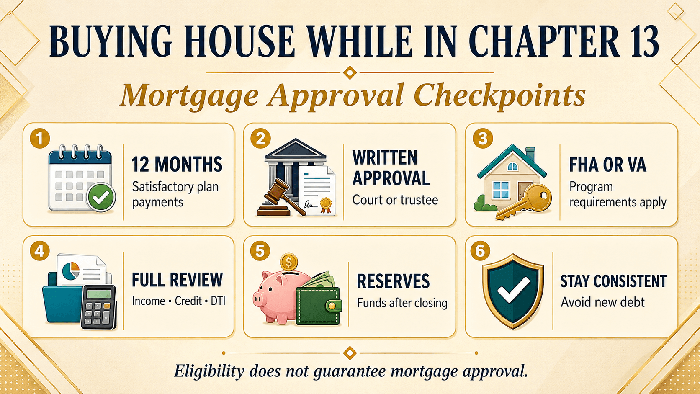
Manual underwriting allows a human underwriter to review the borrower’s complete financial history instead of relying only on an automated decision. For borrowers buying a house while in Chapter 13 bankruptcy, the review generally includes:
- Why the bankruptcy occurred
- Whether the financial hardship has been resolved
- Chapter 13 and housing-payment history
- Income and employment stability
- New late payments, collections, or other derogatory credit
- DTI, reserves, and proposed payment shock
- Use of credit since filing for bankruptcy
Stable employment, verified reserves, limited consumer debt, minimal payment shock, and additional documented income may strengthen the application. These are known as compensating factors. However, compensating factors cannot replace mandatory requirements. They cannot overcome insufficient Chapter 13 payment history, missing court authorization, unacceptable income, inadequate residual income, or failure to meet the loan program’s credit, occupancy, or property requirements.
Credit, DTI, Reserves, and Payment History
Qualifying to buy a house while in Chapter 13 bankruptcy depends on the complete financial profile—not on a single credit score or underwriting factor.
Credit After Filing Chapter 13
Underwriters review how the borrower has managed credit since filing for bankruptcy. Recent late payments, collections, overdrafts, excessive new debt, or unresolved disputed accounts may affect approval. Responsible credit use and timely payments can help demonstrate that the financial problems leading to bankruptcy are unlikely to recur.
Debt-to-Income Ratio
For FHA manual underwriting, the standard ratios are generally 31% for housing and 43% for total debt. Borrowers with qualifying compensating factors may be considered for higher ratios, including 37%/47% or 40%/50%. VA uses a 41% total DTI benchmark but places significant emphasis on residual income. A ratio above 41% is not an automatic denial when the complete file supports approval. The Chapter 13 plan payment must be included in the analysis when required by the applicable underwriting treatment.
Cash Reserves
FHA manual underwriting generally requires at least one monthly mortgage payment in reserves for a one- or two-unit property, and three monthly mortgage payments in reserves for a three- or four-unit property. Using reserves as a compensating factor generally requires at least three or six payments, respectively. VA does not impose one universal reserve requirement for every purchase. However, verified liquid assets can strengthen the file and help demonstrate financial stability.
Housing Payment History
Lenders may verify housing payments through a credit report, landlord verification, canceled checks, bank statements, or mortgage records. Borrowers living rent-free may need a signed statement from the property owner. The exact documentation period depends on the loan program, underwriting findings, and lender requirements.
Documents Required for Mortgage Approval During Chapter 13
If you’re in Chapter 13 bankruptcy and want to buy a house, gather these documents before filling out your mortgage application.
Identification, Income, and Assets
- Government-issued identification
- Social Security number and credit authorization
- Most recent pay stubs
- W-2s or applicable tax returns
- Verification of employment
- Bank, investment, and retirement-account statements
- Gift-fund documentation, when applicable
Chapter 13 Documents
- Bankruptcy petition and schedules
- Confirmed Chapter 13 repayment plan
- Official trustee payment history
- Current plan balance and monthly payment
- Written trustee or court authorization
- Court order approving the mortgage, when required
- Explanation of what caused the bankruptcy
- Documents showing that the financial problem has been resolved
Credit and Legal Documents
- Rent or mortgage payment verification
- Explanations for credit inquiries, late payments, collections, overdrafts, or disputed accounts
- Divorce decrees, child-support orders, or other applicable court documents
Loan and Property Documents
- Purchase contract
- Property address and listing information
- Homeowners insurance estimate
- HOA information, when applicable
- VA Certificate of Eligibility for a VA loan
Additional documentation may be required based on the borrower’s employment, income type, credit history, property, bankruptcy district, and lender requirements.
Steps to Get Approved While in Chapter 13
Follow these steps when buying a house while in Chapter 13 bankruptcy:
- Find an experienced lender. Work with a lender familiar with active Chapter 13 cases and FHA or VA guidelines.
- Verify your payment history. Confirm that you have completed at least 12 months of satisfactory plan payments.
- Complete a full preapproval. Provide income, asset, credit, housing, and bankruptcy documents.
- Obtain proposed loan terms. The lender should prepare the purchase price, loan amount, interest rate, payment amount, and estimated housing expenses.
- Contact your bankruptcy attorney. Give the proposed financing terms to the attorney for review.
- Secure written authorization. Obtain the required trustee consent, court order, or both.
- Complete the loan process. Satisfy underwriting, appraisal, title, insurance, and final closing conditions.
- Protect the approval. Avoid new debt, large purchases, job changes, missed payments, or unexplained bank deposits before closing.
FHA Approval Example During Chapter 13 Bankruptcy
The following hypothetical example shows how buying a house while in Chapter 13 bankruptcy could be evaluated through FHA manual underwriting.
- Purchase price: $250,000
- Loan program: FHA
- Down payment: $8,750, or 3.5%
- Base loan amount: $241,250
- Gross qualifying income: $7,500 per month
- Chapter 13 plan payment: $450 per month
- Other monthly debts: $500
- Proposed housing payment: $2,000, including principal, interest, taxes, insurance, and FHA mortgage insurance
- Front-end DTI: 26.7%
- Total DTI: 39.3%
- Verified reserves after closing: $6,500
- Trustee history: 12 satisfactory monthly payments
- Court approval: Written authorization received
The front-end DTI is calculated by dividing the $2,000 housing payment by $7,500 in gross income. The total DTI includes the housing payment, $500 in other debts, and the $450 Chapter 13 payment. Underwriting result: The loan receives conditional manual underwriting approval, subject to an acceptable appraisal, title review, final credit verification, and all remaining conditions. This example is for illustration only. Identical income, debts, reserves, or payment history will not guarantee approval for another borrower.
Final Thoughts on Buying a House While in Chapter 13 Bankruptcy
It is possible to purchase a home during Chapter 13 bankruptcy without waiting for the completion of your repayment plan. However, completing 12 months of satisfactory plan payments and obtaining court or trustee authorization are only part of the approval process. The lender must still evaluate income, credit, debts, reserves, housing history, payment shock, and the proposed property. Because lender overlays and bankruptcy procedures vary, borrowers should work with an FHA- or VA-approved lender experienced in Chapter 13 financing and coordinate closely with their bankruptcy attorney. A complete file prepared early can help prevent avoidable delays, but final approval is never guaranteed.
Frequently Asked Questions About Buying a House While in Chapter 13
Can I Use a USDA Loan During an Active Chapter 13 Bankruptcy?
Possibly. USDA guidelines may permit financing after at least 12 months of the repayment plan have elapsed, all required payments have been made on time, and the borrower has written permission from a court or trustee. USDA income, location, property, and lender requirements still apply.
Can I Get a Conventional Loan While My Chapter 13 Is Active?
Conventional financing generally requires the Chapter 13 case to be discharged or dismissed. Fannie Mae’s standard waiting period is two years after discharge or four years after dismissal. However, a shorter dismissal period may apply in cases of documented extenuating circumstances.
Can I Use Down Payment Assistance During Chapter 13?
Possibly, but eligibility depends on the assistance program. Some programs do not permit active bankruptcies or manually underwritten loans. The assistance, any second mortgage, and its monthly payment must satisfy the requirements of the first-mortgage program, the lender, and the bankruptcy court.
Can FHA Gift Funds Be Used for the Down Payment?
FHA may allow eligible gift funds from an acceptable donor for the down payment or closing costs. The lender must document the donor, source, and transfer of the money. Gift funds cannot be used to satisfy FHA reserves when the borrower must show their own qualifying assets.
Can My Spouse Get a Mortgage if I Am in Chapter 13?
A non-filing spouse may qualify independently if they meet the lender’s requirements. However, joint debts, community-property laws, household obligations, title ownership, and the bankruptcy estate may affect the transaction. The lender and bankruptcy attorney should review the complete situation.
Will Purchasing a Home Change My Chapter 13 Plan Payment?
Not automatically, but the trustee or court may review the household’s updated income and expenses to confirm that the new mortgage will not interfere with the repayment plan. Whether a plan modification is required depends on the case and local bankruptcy procedures.
How Long Does Chapter 13 Remain on a Credit Report?
A Chapter 13 bankruptcy generally remains on a credit report for up to seven years from the filing date. Borrowers may still qualify for a mortgage before the bankruptcy disappears from their reports if they meet the applicable program requirements.
What Happens if My Chapter 13 Is Dismissed Before Mortgage Closing?
The borrower should immediately notify the lender and bankruptcy attorney. The lender must reevaluate the loan because active-plan eligibility and court authorization may no longer apply. A dismissal can trigger different waiting-period and credit-review requirements, and the existing approval may no longer be valid.
This article about “Buying a House While in Chapter 13 Bankruptcy: 2026 Mortgage Guidelines” was updated on August 20th, 2026.