Learning how to get Refer to Approve-Eligible per AUS starts with reviewing the complete findings report and verifying that the loan application was submitted accurately. The lender may correct documented errors, add qualifying information that was previously omitted, or restructure the loan when permitted. However, no adjustment guarantees an Approve/Eligible finding. If the accurate file remains Refer, the lender must determine whether manual underwriting or another eligible loan program is available.
How an Automated Underwriting System Reviews a Mortgage
An automated underwriting system, commonly called an AUS, helps lenders evaluate a mortgage application against the applicable loan program’s eligibility and credit-risk requirements. The lender submits information from the borrower’s loan application, credit report, and supporting documents. Depending on the loan program, the AUS may evaluate factors such as:
- Credit scores and payment history
- Monthly debts and housing expenses
- Income and employment
- Funds needed to close
- Verified assets and cash reserves
- Debt-to-income ratio
- Loan amount and loan-to-value ratio
- Down payment or equity
- Occupancy and property type
- Bankruptcy, foreclosure, and other significant credit events
The AUS evaluates these factors together. A borrower usually does not receive a Refer finding based on a single number. High DTI, limited reserves, recent late payments, a high loan-to-value ratio, or incomplete application data may become more significant when several risk factors appear in the same file. The information submitted must be complete, accurate, and supported by documentation. If the lender changes the income, debts, assets, loan amount, property information, or other qualifying data, the AUS recommendation may also change. An AUS recommendation is not final loan approval. The lender remains responsible for verifying the information, reviewing the credit and supporting documents, satisfying the findings, and confirming that the borrower and property meet the applicable program requirements.
What the Different AUS Findings Mean
AUS terminology varies by loan program and underwriting platform. Fannie Mae Desktop Underwriter, Freddie Mac Loan Product Advisor, FHA TOTAL Mortgage Scorecard, USDA Guaranteed Underwriting System, and systems used for VA loans do not all issue the same findings. Borrowers should review the exact wording of the findings with their loan officer instead of assuming that every AUS result has the same meaning.
Approve/Eligible or Accept
An Approve/Eligible or Accept finding is a favorable automated recommendation. It generally means that the application meets the system’s credit risk and eligibility requirements based on the information submitted. It does not guarantee final approval or closing. The lender must verify that the application data is accurate, collect the required documents, review the property, and satisfy every applicable underwriting condition.
Approve/Ineligible
An Approve/Ineligible finding may indicate that the file received a favorable credit-risk assessment but does not meet one or more eligibility requirements for the loan as submitted. The lender must review the AUS messages to identify the source of the eligibility problem. Depending on the issue, the file may need to be corrected, restructured, submitted under another eligible program, or declined.
Refer/Eligible or Refer
A Refer or Refer/Eligible finding means the AUS did not provide an automated approval. Borrowers sometimes describe this result as “Refer-Eligible per Automated Underwriting System.” A Refer finding is not automatically a final denial of the mortgage. The lender should review the findings and confirm that the credit, income, debts, assets, housing expenses, and loan terms were entered correctly. If the submitted information is accurate, the next step depends on the loan program and transaction. The file may be eligible for manual underwriting, require additional documentation, or need to be evaluated under another eligible loan program.
Refer With Caution or Caution
A Refer with Caution or Caution finding generally identifies a higher level of underwriting risk or means the file did not receive the system’s favorable risk classification. This finding should be reviewed carefully rather than treated as interchangeable across all loan programs. Some loans may be eligible for manual underwriting, while other loan products or transactions may not permit manual underwriting. For example, Fannie Mae may permit certain loans receiving a Refer with Caution recommendation to be manually underwritten when the loan product and transaction allow it. Freddie Mac uses an Accept or Caution risk classification and provides feedback messages that may identify factors requiring review.
FHA TOTAL Findings
FHA TOTAL Mortgage Scorecard generally returns an Accept or Refer classification. An Accept permits the lender to continue under the applicable automated underwriting requirements unless the FHA requires a manual downgrade. A Refer requires the lender to have the mortgage reviewed under FHA’s manual underwriting requirements. HUD states that a lender may not approve or deny an FHA-insured mortgage based solely on the TOTAL assessment.
USDA GUS Findings
USDA’s Guaranteed Underwriting System may return Accept, Refer, or Refer with Caution. USDA loans receiving “Refer” or “Refer with Caution” generally require a manual underwriting evaluation under USDA guidelines.
VA AUS Findings
VA loans may be evaluated through an approved AUS, but the system does not make the final credit decision. The lender and authorized underwriter remain responsible for determining whether the Veteran is an acceptable credit risk and meets VA requirements, including applicable residual-income standards. The correct response to any AUS finding is to review the complete findings report, verify the submitted information, and follow the requirements of the specific loan program. Borrowers should not pay debts, move money, dispute credit accounts, add a co-borrower, or make other financial changes solely to obtain a different AUS result without first discussing the consequences with their loan officer.
Conventional Refer With Caution Findings
With Fannie Mae Desktop Underwriter (DU), a Refer with Caution recommendation may be given for a conventional loan.
A Fannie Mae loan with this recommendation cannot be submitted to DU for loan delivery. This does not mean the loan has been denied. Fannie Mae permits the lender, when the loan and transaction are eligible for manual underwriting, to process them through manual underwriting.
Freddie Mac Loan Product Advisor uses the terms “Accept” and “Caution.” A loan that receives a Caution indication means that the automated risk classification for an Accept recommendation was not made. Freddie Mac provides feedback to the loan originator documenting factors that may be addressed, but are not specific to causing an Accept indication. Changing any given factor to an Accept indication is not guaranteed.
Common Reasons for a Refer Finding
There is no singular reason a borrower receives a Refer-Eligible per Automated Underwriting System finding. As AUS evaluates the loan file holistically, so may multiple factors. These factors may include, but are not limited to:
- High DTI
- Limited reserves, assets
- Recent derogatory credit or late payments
- High LTV
- Insufficient credit history, established credit.
- Recent bankruptcy or foreclosure
- Mortgage or rental payment history
- Incomplete, incorrect data input to AUS
- Multiple risk factors in a single loan file
Prior to making any changes, the AUS findings should be reviewed. Increasing income or paying down debt does not lead to approval. Adding reserves or changing the down payment does not guarantee approval.
Common Problems Our Mortgage Team Finds in Refer/Eligible Files
Our mortgage team has reviewed Refer/Eligible files in which the problem was not immediately clear from the borrower’s credit score or DTI. The team compares the AUS findings with the loan application, credit report, income documents, asset statements, and property information before recommending the next step. Correcting a problem does not guarantee Approve/Eligible. Depending on the findings and loan program, the appropriate result may be an accurate AUS resubmission, manual underwriting, a different loan program, additional documentation, or more time before the borrower can qualify.
An Incorrect Liability or Monthly Payment
A debt may be entered twice, assigned to the wrong borrower, or reported with an incorrect monthly payment. Student loans, installment accounts, co-signed obligations, and debts assigned through a divorce decree may require additional review. The team compares the AUS data with the credit report and supporting documents. If the payment was entered incorrectly, the lender may update the application using the payment required by the applicable loan program. A payment cannot be changed merely to improve the DTI.
Property Taxes, Insurance, or HOA Dues Change the DTI
The proposed housing payment includes more than principal and interest. Property taxes, homeowners’ insurance, flood insurance, mortgage insurance, and HOA dues can materially affect the qualifying DTI. The team reviews the most reliable available figures and updates the application when the original estimates are no longer accurate. A higher property tax or insurance amount can cause a previously acceptable file to receive a different recommendation. Lower figures may only be used when supported by current documentation.
Gift Funds are Entered as Available Reserves
Gift funds may be permitted for the down payment or closing costs, but the lender must distinguish funds needed to close from assets that qualify as post-closing reserves. The team reviews the loan program, gift letter, donor documentation, evidence of transfer, borrower contribution requirements, and the amount remaining after closing. Gift funds should not be entered as reserves unless their treatment is permitted and fully documented. Correcting the entry may or may not change the AUS recommendation.
Housing Payment History is Missing or Incomplete
A borrower may have a strong explanation for past credit problems but lack documentation showing how recent rent or mortgage payments were made. The team may review a rent verification, canceled checks, bank statements, money order records, landlord documentation, or mortgage payment history. The required evidence depends on the loan program, AUS findings, and whether the file must be manually underwritten. Missing housing history does not always mean the borrower is ineligible, but it can affect the underwriting path and the documentation required.
A Disputed Derogatory Account Requires Additional Review
Credit disputes can affect the way an account and credit score are evaluated. The proper treatment depends on the type of account, balance, payment history, loan program, and AUS findings. The team reviews the credit report before telling a borrower to add or remove a dispute. Borrowers should not automatically dispute derogatory accounts or withdraw existing disputes solely to obtain a different AUS result. Any change should be based on accurate credit information and the applicable program requirements.
Recent Late Payments Prevent an Automated Approval
A borrower may meet the minimum credit score requirement but still receive a Refer finding due to recent late payments or multiple credit risk factors. The team reviews the dates, severity, and circumstances of the late payments. It also evaluates the borrower’s housing history, income stability, reserves, payment shock, and other applicable compensating factors. If the loan program permits manual underwriting, late payments may be evaluated by an underwriter in accordance with the program’s manual underwriting requirements. Manual underwriting provides an additional review path, but it does not erase late payments or guarantee approval.
Bankruptcy or Foreclosure Information does not Match the Documents
Credit reports do not always show complete or consistent information about a bankruptcy, foreclosure, short sale, deed in lieu of foreclosure, or a mortgage included in bankruptcy. The team compares the credit report with bankruptcy schedules, discharge or dismissal documents, foreclosure records, and other supporting evidence. Filing dates, discharge dates, dismissal dates, and property-transfer dates can affect waiting periods differently. The application should be updated when the documented history does not match the information submitted to AUS. Switching lenders does not eliminate an agency waiting period or other program requirement.
The Loan Program or Property does not Permit the Intended Underwriting Path
Not every loan receiving a Refer or Caution finding can be manually underwritten. Eligibility may depend on the loan program, transaction type, occupancy, property type, and investor requirements. The team reviews whether manual underwriting is permitted for the specific transaction. Condominiums, manufactured homes, investment properties, certain refinance transactions, and specialized loan products may have additional restrictions. If the intended underwriting path is unavailable, the team determines whether another eligible program exists. If no compliant option is available, the borrower must resolve the underlying issue before reapplying. These reviews focus on identifying the accurate and permissible next step, not finding a shortcut around underwriting requirements. Every correction, resubmission, or program change must be supported by the borrower’s documents and the applicable mortgage guidelines.
Got a Refer AUS Finding? It May Not Be the End
A Refer finding does not automatically mean mortgage denial. We’ll review your credit, income, debts, assets, and loan structure to see what may improve the AUS result.How To Get Refer To Approve/Eligible Per AUS
There is no single adjustment that will convert every Refer finding into Approve/Eligible. Learning how to get Refer to Approve-Eligible per AUS begins with reviewing the complete findings report and confirming that the mortgage application was submitted accurately. The loan officer should compare the AUS data with the borrower’s credit report, loan application, income documents, asset statements, and estimated housing expenses. The purpose of this review is to identify incorrect information, missing qualifying information, eligibility problems, and risk factors that may be affecting the recommendation.
Review the Complete AUS Findings
The findings report may identify eligibility issues, documentation requirements, credit concerns, or application data that needs to be verified. A Refer finding should not be addressed by randomly changing information and repeatedly resubmitting the loan. The lender should determine:
- Which AUS recommendation and eligibility messages were returned
- Whether the finding concerns credit risk, program eligibility, or both
- Whether all income, debts, assets, and housing expenses were entered correctly
- Whether the loan program permits manual underwriting
- Whether a lender overlay is preventing approval
- Whether an eligible alternative loan program is available
For conventional loans, the lender should also distinguish between the credit-risk recommendation and the eligibility component of the findings.
Correct Inaccurate or Incomplete Information
An AUS can only evaluate the information submitted. A debt entered twice, an incorrect monthly payment, omitted qualifying income, or inaccurate property expenses can affect the result. Legitimate corrections may include:
- Removing a duplicate liability
- Correcting a monthly debt payment that does not match the credit report or documentation
- Adding eligible income that was previously omitted and can be fully documented
- Updating verified assets or reserves
- Correcting property taxes, homeowners’ insurance, flood insurance, or HOA dues
- Documenting an allowable debt exclusion
- Correcting the property type, occupancy, loan purpose, or loan amount
- Updating bankruptcy, foreclosure, or other credit-event information
Fannie Mae instructs lenders to confirm that the information submitted to Desktop Underwriter is accurate and complete. A lender may correct documented errors and resubmit the case file, but the revised submission must continue to reflect the borrower’s actual financial circumstances.
Consider Documented Changes to the Loan Structure
When all submitted information is accurate, the lender may evaluate whether a legitimate change to the loan structure could improve the overall risk profile. Depending on the loan program and borrower’s circumstances, possible changes may include:
- Reducing the loan amount
- Increasing the down payment with verified eligible funds
- Paying off or reducing an eligible debt
- Lowering the debt-to-income ratio
- Documenting additional eligible reserves
- Selecting a property with lower taxes, insurance, or HOA dues
- Adding an eligible co-borrower whose income, credit, debts, and assets strengthen the complete application
- Choosing another loan program for which the borrower and property qualify
No individual change guarantees Approve/Eligible. The AUS evaluates the cumulative risk of the complete loan file. For certain Freddie Mac loans that receive a Caution risk class, Loan Product Advisor Choice messages may include information on DTI, loan-to-value ratios, or reserves. Addressing those messages may improve the likelihood of an Accept result, but Freddie Mac does not guarantee that any specific change will produce an Accept recommendation.
Resubmit Only Supported Changes
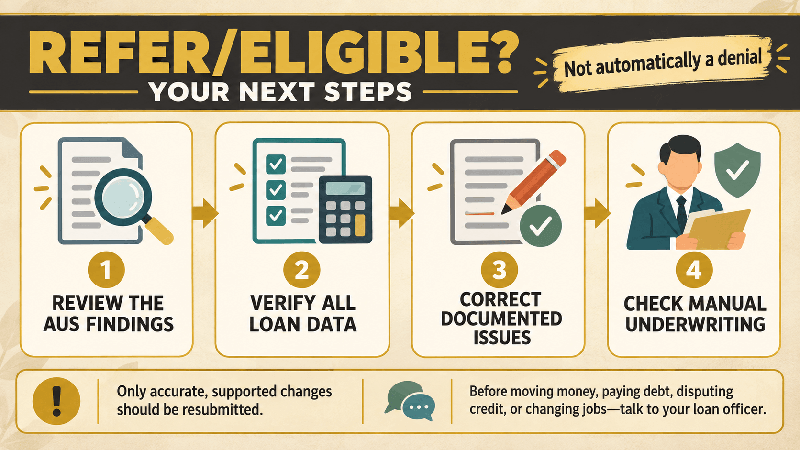
After correcting an error or documenting a legitimate change, the lender may update the application and request new AUS findings. Loan officers should not enter unsupported income, assets, reserves, or other information to obtain a different result. They should also avoid repeatedly resubmitting an unchanged file in the hope that the system will eventually return Approve/Eligible. Borrowers should speak with their loan officer before:
- Paying off or closing credit accounts
- Moving money between accounts
- Changing the source of the down payment
- Disputing credit accounts
- Adding or removing a co-borrower
- Changing jobs
- Increasing the loan amount
- Entering a new purchase contract
These actions may affect credit scores, available funds, income qualification, DTI, or the documentation required for approval.
Determine Whether Manual Underwriting Is Available
If the accurate and fully documented file continues to receive a Refer finding, the lender should determine whether the loan program and transaction permit manual underwriting. FHA, VA, USDA, and certain conventional loans may offer a manual underwriting option. However, each program has separate credit, DTI, reserve, housing history, and documentation requirements. The lender may also impose overlays or decline to offer manual underwriting. For FHA loans, a Refer classification requires evaluation under FHA’s manual underwriting requirements. HUD states that a lender may not approve or deny an FHA-insured mortgage based solely on the TOTAL Mortgage Scorecard assessment. Manual underwriting does not guarantee approval. It allows a qualified underwriter to evaluate the complete file in accordance with the applicable program guidelines, including the borrower’s payment history, income, debts, assets, housing history, compensating factors, and documented circumstances. The appropriate goal is not to manipulate the AUS. It is to submit an accurate loan file, address legitimate findings, and identify the underwriting path that the borrower is qualified to use.
Borrower Checklist After a Refer/Eligible Finding
A Refer/Eligible finding is a reason to review the loan file—not to assume the mortgage has been denied. Borrowers should take the following steps:
- Ask for the exact AUS recommendation and an explanation of the findings.
- Confirm that income, debts, assets, employment, housing expenses, and loan terms were entered correctly.
- Provide any missing documents requested by the loan officer or underwriter.
- Ask whether the issue involves an agency guideline, an AUS risk assessment, or a lender overlay.
- Find out whether the loan is eligible for manual underwriting.
- Ask whether another eligible loan program may be more appropriate.
- Do not pay debts, move money, dispute credit accounts, change jobs, or add a co-borrower without first discussing the potential effect with the loan officer.
- Ask whether additional underwriting will affect the scheduled closing date.
Correcting documented errors or providing missing information may change the AUS recommendation, but no adjustment guarantees Approve/Eligible. Every resubmission must accurately reflect the borrower’s financial circumstances.
Can Refer/Eligible Change to Approve/Eligible?
A Refer/Eligible finding can change for legitimate reasons, and loan updates are submitted, but there is no guarantee this will happen.
Correcting a liability, reporting qualifying income, verifying additional assets, changing the loan amount, addressing other findings in the underwriting report, etc., may result in the finding being changed.
Freddie Mac has stated that some conventional loan Caution risk loans may receive LPA Choice messages, indicating that if income, down payment, or reserves improve, there is a higher likelihood of an Accept finding. Freddie Mac clearly states that improving any of these factors does not guarantee an Accept finding, as other risk factors influence the overall assessment. If the information provided to AUS is already complete and accurate, resubmitting the loan multiple times is unlikely to resolve the problem. In that situation, the lender must review whether manual underwriting or another eligible form of financing is possible.
Gift Funds, Reserves, DTI, and Other AUS Factors
AUS reviews a broad range of credit factors and does not review single attributes in isolation. Credit reports and individual attributes (debt-to-income ratio, available funds and assets, loan-to-value ratio, employment stability, etc.) are reviewed together.
Gift Funds
The requirements of the FHA loan program (along with others) allow for gift funds to be used as a source for the down payment. The use of gift fund(s) does not result in a Refer finding. The gift funds must be properly documented by the lender and entered into the AUS system. The loan must contain borrower funds, gift funds, reserves, and the cash necessary to close.
Cash Reserves
Having cash left over after closing is a positive fit factor in a loan file, especially when other risk factors exist. There is no set reserve threshold that will result in an AUS approval for a file with a Refer finding. Reserve requirements and underwriting treatment are dictated by the loan program and the file.
Debt-to-Income Ratio
Higher DTI ratios can sometimes result in an AUS Refer finding. There are many factors that contribute to a Refer. DTI is just one factor. Different loan programs have different guidelines for manual underwriting and the maximum allowable DTI. FHA, VA, USDA, Fannie Mae, and Freddie Mac do not use the same standard DTI for all manual underwriting for the mortgage loans. FHA loans utilize Chapter IV of the HUD Handbook 4000.1, and the current version of the Handbook is effective as of August 12, 2026.
Lender Overlays vs. Agency Guidelines
Meeting the requirements of FHA, VA, USDA, Fannie Mae, or Freddie Mac may not be enough for a borrower at every lending institution. In accordance with agency guidelines, a lending institution may impose its own requirements on borrower eligibility, sometimes referred to as lender overlays.
Case in point, a lending institution may set more stringent minimum credit scores, maximum debt-to-income ratios, reserve requirements, or constraints on the extent of manual underwriting.
Different lending institutions may use different criteria to evaluate a borrower’s mortgage eligibility. After obtaining a Refer-Eligible per the Automated Underwriting System report, a loan application may be ineligible at one lending institution but eligible at another. Borrowers must understand the distinctions among:
- Agency or program requirements
- Recommendations from an AUS
- Lending institution underwriting requirements
These differ and should not be conflated.
Hypothetical Refer/Eligible Mortgage Scenario
This is for illustrative purposes only. A borrower is purchasing a primary residence using an FHA loan at $275,000.
- Credit score: 610
- Stable W-2 employment
- Documented rental history
- Debt-to-income ratio: 43%
- Verified funds for closing and reserves
The AUS result generates a Refer. The lender reviews the application. The lending institution confirms that the borrower’s information was input correctly. The lending institution also reviews the application. The outcome of AUS is the same. Instead of denying the application based on the referral from AUS, the lending institution reviews the application for FHA manual underwriting. The underwriter evaluates the complete borrower profile against the FHA manual underwriting guidelines. Approval occurs when the borrower meets all applicable FHA and lender requirements. HUD advises members to utilize the manual underwriting provisions of Handbook 4000.1 for situations in which FHA loans require manual underwriting.
Documents Needed for Manual Underwriting
Manual underwriting often requires a more comprehensive evaluation of the borrower’s credit history and requires more documentation than an automated approval. Based on the loan program and AUS findings, the lender may require the following:
- Recent pay stubs and W-2s
- Tax returns that are needed or requested
- Bank and asset statements
- Verification of rent or payment history for housing
- Documentation for large deposit credit events
- Letters explaining credit events
- Bankruptcy and foreclosure documentation
- Documentation supporting debt exemptions
- Gift funds documentation
- Additional employment or income verification
VA manual underwriting places a lot of emphasis on residual income, like FHA and other underwriting branches. Early submission of complete documents may help avoid delays caused by missing underwriting materials.
Final Thoughts on How to Turn Refer to Approve-Eligible in AUS
A Refer finding should be reviewed before a borrower assumes the mortgage has been denied. It should never be assumed that a mortgage was approved based on an Eligible AUS finding. The reason is that completing the required forms for submission to AUS for approval should be the first step.
If the dispute is resolved in favor of Refer, the lender must confirm the specific loan program’s provisions. There are options for manual underwriting for FHA, VA, USDA, and certain types of conventional loans where the conditions are appropriate.
Borrowers must appreciate that agency directives and lender overlays are distinct. A lender’s internal requirement is likely to be more stringent than the minimum guidelines for the mortgage program. The most effective response to a Refer finding that is not repeated is to avoid AUS submissions with unsupported changes. This is achieved by a review of the findings, an assessment of the borrower’s qualifications, and an examination of the underwriting alternatives available for the loan program. A more appropriate eligible loan program is available.
FAQs About How to Turn Refer to Approve-Eligible in AUS
How Long Does It Take to Receive an AUS Finding?
Once the lender has entered the required application and credit information, an automated underwriting system can generally return its initial findings within minutes. That quick response is not final mortgage approval. The lender must still verify the submitted information, collect supporting documents, review the property, and satisfy the underwriting conditions. A manually underwritten file may take longer because a human underwriter must evaluate the complete borrower profile.
Can a Lender Run AUS Before I Find a House?
Yes, a lender may be able to submit a prequalification without a property address. Freddie Mac, for example, allows certain Loan Product Advisor prequalification submissions with or without an address. Once the borrower selects a home, the lender must add the property, purchase price, taxes, insurance, HOA dues, and other transaction details before obtaining updated findings.
Does Running AUS Lower My Credit Score?
Submitting or resubmitting a loan to AUS does not, by itself, create a new credit inquiry. However, the lender may need to obtain or refresh the borrower’s credit report, and a hard inquiry for a mortgage can have a small effect on credit scores. The Consumer Financial Protection Bureau states that multiple mortgage credit checks completed within a 45-day shopping window are generally recorded as a single inquiry.
Can a Borrower Run Desktop Underwriter or Loan Product Advisor?
Borrowers generally cannot submit their own applications directly to Fannie Mae Desktop Underwriter or Freddie Mac Loan Product Advisor. These systems are used by authorized lenders, mortgage brokers, and loan originators. Borrowers can ask their loan officer to explain the recommendation, eligibility status, and important conditions listed in the findings report. The lender remains responsible for interpreting the findings and determining the appropriate underwriting path.
Do AUS Findings Expire Before the Mortgage Closes?
An AUS finding should not be treated as permanent approval. Credit reports, income verifications, asset reports, and other documents have expiration periods. The loan must also continue to match the information used for the most recent AUS submission. The lender may need to obtain updated documents and resubmit the file when information expires or materially changes. Fannie Mae’s updated DU Findings report identifies important expiration-related closing dates for the lender.
Can a Mortgage Rate Change Affect the AUS Result?
Yes. A different interest rate can change the proposed mortgage payment and debt-to-income ratio. If the updated loan terms no longer match the information previously evaluated, the lender may need to resubmit the file. Some changes may fall within the AUS platform’s permitted tolerances, while others require a new recommendation. A lower rate may improve the qualifying payment, but it does not guarantee Approve/Eligible.
This article about “How to Turn Refer Into Approve-Eligible in AUS” was updated on September 15th, 2026.