One of the challenges people who want to buy a house have is having a high debt-to-income ratio. If you have ever been told that your debt-to-income ratio is too high to get a loan, you are not the one.
There is news. Removing some debts from the debt-, to-income calculation can make it easier for you to get the home loan you need. This can be helpful whether you are buying a house or changing your current mortgage.
In this guide, we’ll explain how excluding debts from DTI calculations works, which debts can be excluded, and the specific guidelines for popular loan programs like FHA loans. This updated guide simplifies everything so you can learn how to increase your chances of qualifying for a home loan, even if you have a high DTI ratio.
Excluding Debts from DTI Calculations: 2026 Mortgage Guidelines
Meta Description: Find out when mortgage lenders will permit debts to be excluded from DTI calculations, such as debts paid by someone else, co-signed loans, business debts, and short-term loans.
- If your debt-to-income ratio seems too high for mortgage approval, consider more than just asking, “How much debt can I pay off?”
- A better question is, “Does every debt on my credit report actually need to be counted against me?”
Some mortgage rules allow lenders to exclude certain monthly debts from your DTI if you provide the right documents. This can include debts paid by others, co-signed loans, business debts, debts assigned by divorce, and short-term installment loans. Leaving out debts from your DTI is not up to the lender’s choice; it must follow the specific rules of each mortgage program.
How Do You Know When a Debt Can Be Excluded from Your DTI?
A debt can be excluded from your mortgage DTI if the loan rules state that the borrower does not have to make the payment, or if the debt meets a specific exclusion.
Common Examples Include:
- A qualifying debt that another person has documented paying for the required period
- Certain co-signed obligations
- Debt assigned to another person by a court order
- Some business debts are paid directly by a borrower’s business
- Certain installment debts with only a few payments remaining
- Some loans secured by the borrower’s own financial assets
- Revolving accounts paid off before or at closing when permitted by the applicable program
- The documents needed and rules for eligibility differ between FHA loans, Fannie Mae and Freddie Mac loans, VA loans, USDA loans, and non-QM loans.
- A debt that can be left out under one program might still have to be counted under another.
What is the Meaning of Excluding Debts When Calculating the DTI?
The debt‑to‑income ratio shows how your monthly mortgage payments compare to your qualifying income. For example if your qualifying gross monthly income is $8,000. The lender says your total monthly obligations are $4,000. Your DTI would be: $4,000 ÷ $8,000 = 50%. Suppose that $600 of your debt is a qualifying payment that someone else has been making and the mortgage rules allow the lender to ignore it. The remaining monthly obligations: $3,400 ÷ $8,000 = 42.5%. This adjustment can significantly impact your loan approval. The debt will still appear on your credit report, and the underwriter will record the reason the payment is not taken into account for mortgage qualification.
Debts Paid by Someone Else May Be Excluded From DTI
For many borrowers, this is one of the most helpful DTI rules. If some debt is in your name but a parent, spouse, child, business partner, or someone else is paying the monthly bills, your lender might be able to leave out those payments when figuring your debt-to-income ratio.
Fannie Mae Debts Paid by Others
Fannie Mae allows qualifying non-mortgage debts to be excluded when another party has actually been paying them. It is not necessary.
It may be applied to obligations including installment loans, student loans, revolving debts, lease payments, alimony, child support, and separate maintenance, provided that the relevant requirements are met.
The other person does not have to be legally responsible for the non-mortgage debt, but the lender usually needs proof that they have made all payments on time for the past 12 months makes the payments must not have an interest in the transaction involving the purchase of the home. For example, the seller or the real estate agent. If you have been told your DTI is too high, review this section of your file before assuming you are ineligible.
What Documents are Needed When Someone Else Pays Your Debt?
Complete documentation is necessary. A borrower’s letter saying, “My father makes the payments,” is usually not enough. For standard exclusions, underwriters may need to get payment records directly from the person or company making the payments.
Useful Documentation May Include:
- Twelve months of bank statements from the person making the payments
- Twelve months of canceled checks
- Evidence of electronic payments from the other party’s account
- Creditor statements showing the payment history
- Business bank statements when a business is responsible for the obligation
- Divorce decrees, separation agreements, or other court orders.
- Do not move money through your own account just to create a payment record.
- The documents must clearly show who really made the payments.
- It is a usual issue for people taking out mortgages to have co-signed debt.
- A parent might have agreed to co-sign their child’s car loan.
- One sibling could have assisted the other in getting financing.
- A person can still be legally responsible for a debt even if someone else has been making the payments.
- When underwriters consider your credit report, they look beyond just the names.
- In the case of conventional loans, the other party’s recorded payment history can be used to exclude some jointly agreed debts from the DTI calculation.
Since FHA and VA have their own rules regarding contingent liabilities, borrowers cannot assume that documentation accepted for a Fannie Mae loan will work the same way for an FHA or VA loan. People who would like to learn more about this case may also read our article on the exclusion of co-signed loan debt when applying for a mortgage.
Can a Mortgage, Which is Paid for by Someone Other Than the Owner, be Excluded?
Mortgage payments are subject to closer scrutiny since they typically include principal, interest, property taxes, insurance, and possibly association fees or mortgage insurance. So long as the specified conditions are met, the full amount of the housing expense can be excluded if another party is making the payments.
In addition to other requirements, the person making the payments must be liable on the mortgage debt, there must be no delinquencies in the most recent 12 months, and the borrower must not use the rental income from that property to qualify.
The property could still be counted as one of the borrower’s financed properties even if the amount paid on the home is not included in the DTI. Freddie Mac also provides guidelines on situations in which a mortgage obligation that qualifies for exclusion is paid by a third party, and the required documentation should be reviewed prior to structuring the loan. This is why mortgage debt is treated differently from car loans or credit cards, even if another person is making the payments.
A Debt Can Be Transferred to an Ex-Spouse as a Result of a Divorce Decree
Divorce creates a set of challenges. Divorce often brings its debt‑to‑income problems. I have seen people still tied to a car loan, a mortgage, a personal loan or other accounts when the divorce decree or court order says the former spouse must pay.
Fannie Mae guidelines say that a debt assigned to another person by a court order is usually treated as a contingent liability. Therefore it does not have to be counted in the borrower’s recurring debt obligations.
Freddie Mac also allows qualifying obligations assigned by the court to be excluded, provided that the necessary court documents are included in the mortgage file. The VA guidance also states that debts owed to an ex-spouse under a divorce decree are usually not deducted from the Veteran borrower’s assets. The most important document is usually the official divorce decree, the separation agreement, or the court order—not just an informal agreement between ex-spouses.
Can Business Debt Be Excluded From a Self-Employed Borrower?
A common example is a self-employed person who has personally guaranteed a loan for a business vehicle, equipment, credit card, or Small Business Administration loan. Since the debt shows on the borrower’s personal credit report, it might look like a personal monthly payment. But that does not mean it will count toward your personal DTI.
Debt in the borrower’s name can be left out if the lender can prove the business has been paying it and the payment is properly included in the business’s financial review. The account should usually have no late payments, and the lender needs proper proof that payments were made.
This is important because if you remove the payment from the borrower’s DTI without including it in the business’s cash flow, the benefit would be counted twice. Before becoming self-employed, review your Before becoming self-employed, check your debts because all accounts on your credit report might be seen as personal debts remaining be excluded? It’s possible, but the rules vary by loan program.
Fannie Mae Short-Term Installment Debt
In general, Fannie Mae requires that installment debts with more than 10 monthly payments left be included. A debt with fewer payments left does not always have to be included, but the underwriter might still count it if the payment is big enough to affect the borrower’s ability to pay other bills. A $1,200 car payment with six months remaining is treated very differently from a $70 payment with the same term left.
Freddie Mac Short-Term Installment Debt
Freddie Mac also allows installment debt with 10 or fewer payments left to be excluded if the mortgage documents show the remaining term.
FHA Short-Term Closed-End Debt
FHA uses a more specific test. Closed-end debts that have been paid off within ten months of the closing date can be excluded, provided that the total of the monthly payments for those debts does not exceed 5 percent of the borrower’s gross monthly income. FHA also makes it clear that the borrower cannot just pay down the balance to lower the remaining term to 10 months. If you are considering paying off a car loan or a personal loan solely to qualify for FHA financing, then this difference is important.
Car Leases Are Different From Car Loans
It is wrong to think your DTI goes down when you lease a car just because only a few payments are left. For example, Fannie Mae treats lease payments as ongoing debts no matter how many months are left. This is because the borrower will usually need transportation after the lease ends and might get a new lease or buy a car. That is why an underwriter must find out if a car payment is a loan or a lease before deciding if a short remaining term helps the borrower.
Is it Possible to Pay Off Credit Card Debt to Reduce Your DTI?
That is not the same as having somebody else make the payments. If you use conventional financing, you can pay off revolving accounts at or before closing once the conditions are met. Fannie Mae lets you leave out a revolving account from the DTI if it is paid off by closing, even if you don’t close the account. Do not start paying off accounts without a plan during the mortgage process.
The Loan Officer and Underwriter Should First Determine:
- What debt is in fact causing the DTI problem?
- By how much will the payoff increase the qualifying ratio?
- It is also necessary to use the payoff amount.
- You also need to use the payoff amount for the down payment, closing costs, or reserves.
- Whether the source of the payoff funds will need to be documented.
Paying Off the Wrong Account Can Use Valuable Cash Without Materially Changing the Mortgage Approval
What About 30-Day Charge Accounts?
- A true 30-day charge account is different from an ordinary revolving credit card because the balance is expected to be paid in full each month.
- Fannie Mae does not require qualifying open 30-day charge accounts to be included in DTI, although sufficient verified funds may be necessary to cover the outstanding balance in addition to funds needed for closing and reserves.
- HUD also has separate treatment for qualifying 30-day accounts and reviews whether the borrower has historically paid the balance as required.
- Do not confuse a 30-day charge account with a credit card that merely has a monthly minimum payment.
Can a 401(k) Loan Be Excluded from the DTI?
Some financial assets can have loans backed by them treated differently from regular consumer debt. According to the guidelines of Fannie Mae, a loan backed by assets such as a qualifying 401(k), IRA, certificate of deposit, stocks, bonds, or the cash value of a life insurance policy need not be regarded as a recurring monthly debt, provided that the lender records the fact that the financial asset is used to secure the loan. If the asset is used to meet reserve requirements, the reserve amount may need to be lowered by the loan amount and fees. The main point is that taking money from retirement accounts is not always treated the same as regular personal loans.
What Is the Debt-to-Income Ratio (DTI)?

- Front-end DTI: This is the percentage of your income that goes to housing costs, such as mortgage payments, property taxes and homeowners insurance.
- Back-end DTI: This includes all housing costs plus every other monthly debt payment, such as credit card balances, student loans, car loans or personal loans.
For example if your monthly income is $6,000 and your total monthly debts, including your housing payment, amount, to $3,000 then your back-end DTI equals fifty percent ($3,000 ÷ $6,000 = 0.50 or 50%).
What Is a Good DTI Ratio?
Borrowers with a lower DTI ratio are usually preferred by lenders. This limit changes based on the kind of loan. If the person taking the loan has other good qualities, like a very good credit score or a large down payment.
- Conventional Loans: The highest back-end debt-to-income ratio is generally between 43% and 50%.
- FHA Loans: FHA loans are famous, for being more flexible. They allow a front-end debt-to-income ratio of up to 46.9% and a back-end debt-to-income ratio high as 56.9% for borrowers approved through automated underwriting.
- But what happens if your DTI is too high?
- That’s where excluding debts from DTI calculations can come into play.
Student Loans Need Special Attention
Student loans should not be classified together. Student loans should not be grouped with regular installment loans unless you check the specific mortgage program. Exempt debts include debts the main borrower is responsible for, may be eligible for the debts-paid-by-others clause, provided that the necessary documentation is given.
Fannie Mae also has separate rules for calculating the payment when the borrower is liable for the student loan, including situations involving documented income-driven repayment plans.
FHA uses a different method. Usually, FHA counts outstanding student loans in the review, even if no payments are being made. If the credit report shows no monthly payment, FHA usually uses 0.5 percent of the loan’s balance, unless another FHA rule applies.
Want to Buy a Home but Worried About Your DTI? Let’s Exclude Some Debts to Help You Qualify!
Contact us today to find out how we can help you exclude debts and secure your mortgage.FHA Guidelines for Excluding Debts From DTI Calculations
FHA underwriting should be viewed on its own, separate from conventional underwriting. A student loan payment can be removed from your debt calculation if documents show the balance was forgiven, canceled, discharged or fully paid. Rules vary depending on the program. Borrowers with student loans should compare their options. Don’t assume all lenders treat these payments the way.A more detailed explanation of the separate student loan mortgage guidelines is provided in that document; the rules are not repeated here.
FHA Contingent Liabilities
FHA defines a contingent liability as an obligation that may become the borrower’s responsibility if another legally obligated party fails to pay. HUD generally requires the payment to be counted unless documentation establishes that the borrower cannot be pursued for the obligation or the other legally obligated party has made the required history of timely payments. A court-ordered debt assignment can receive different treatment.
FHA Authorized-User Accounts
An authorized-user credit account may not necessarily have to remain in the borrower’s DTI. FHA permits an exclusion when the lender documents that the primary account holder made the required payments for the previous 12 months. Special treatment applies when the account has not required enough payments to establish that history.
FHA Debts With Fewer Than 10 Months Remaining
As discussed earlier, qualifying closed-end obligations due to be paid off within 10 months can potentially be omitted when the cumulative monthly payments do not exceed FHA’s specified percentage of gross monthly income. These FHA provisions make it especially important to have the loan officer review the actual credit report instead of relying only on a consumer’s estimate of monthly debt.
VA Guidelines on Debts and Obligations
VA underwriting does not rely solely on a DTI percentage. The lender also analyzes residual income and the Veteran’s overall ability to meet financial obligations. VA generally considers debts with a remaining term of 10 months or more significant.
A debt with fewer than 10 months remaining can still matter when the monthly payment is large enough to have a substantial effect on the household’s resources.
For a borrower who is a co-obligor or co-signer, VA permits the lender to consider excluding the obligation when there is evidence that another person is making the payments, the obligation is current, and there is no reason to believe the Veteran will have to participate in repayment. VA also provides separate treatment for debts assigned to a former spouse under a divorce decree. Veterans with higher DTI ratios should therefore have both the debt calculation and residual-income calculation reviewed instead of focusing on DTI alone.
Fannie Mae and Freddie Mac Guidelines on Conventional Loans
Conventional loans from Fannie Mae and Freddie Mac have similar features, such as debts paid by others, debts assigned by court, business debts, short-term installment debts, and debts backed by financial assets. But the documents and wording of the rules differ. For borrowers who’re close to the DTI limit these differences can make the difference between approval and denial. One automated system might reject an application. Another could approve it. Even if one automated system rejects an application, another might approve it. So do not accept a rejection without checking all options under the chosen program.
USDA Guaranteed Loans
USDA Guaranteed loans follow rules in the Single Family Housing Guaranteed Loan Program and HB-1-3555. Do not assume a debt exclusion from Fannie Mae, Freddie Mac, FHA, or VA loans applies to USDA loans. USDA lenders must follow USDA handbook rules and the Guaranteed Underwriting System for each file. This is especially important if a borrower is close to USDA’s qualifying ratio limits.
Just because a debt makes it harder to qualify does not mean it can be left out. For example, an underwriter cannot remove a $700 car payment just because the borrower says a relative will start paying it next month.
The same applies to a loan the borrower plans to refinance after closing or a credit card the borrower plans to stop using. The exclusion must be backed by the agency’s rule and proper documents. That is why you should be careful if someone says, “Don’t worry, we won’t count that debt,” without showing the rule that allows it.
Example of Excluding a Debt From DTI
Let’s say a borrower earns $7,500 per month.
- The proposed housing payment is $2,600.
- Other monthly debts total $1,600.
- Total obligations come to $4,200.
The initial DTI is: $4,200 ÷ $7,500 = 56% In the $1,600 of debt there is a $500 auto loan.. The borrower’s adult child has been paying that loan from their own bank account for more than one year.
If the Selected Loan Program Permits That Obligation to be Excluded and the Payment History Satisfies the Underwriting Requirements, the Lender Could Calculate the Debt Using $3,700 Instead:
- $3,700 ÷ $7,500 = 49.3%
- Nothing about the borrower’s income changed.
- Nothing was hidden from the lender.
- The underwriter simply applied the correct guideline to a documented obligation.
Common Mistakes When Trying to Leave Out Debt From DTI
The biggest mistake is assuming an account can be removed just because someone says another person pays it. In certain circumstances, the documentation may not clearly show who made the payments.
Borrowers Can Also Run Into Problems When:
- Payments were late during the documentation period
- Payments came from the borrower’s own account
- The documentation does not cover the required period
- A mortgage payer is not legally obligated when the applicable program requires it
- The borrower is trying to use rental income from the same property
- A business debt was not properly reflected in the business cash-flow analysis
- A car lease is incorrectly treated like a short-term installment loan
- A student loan is handled under the wrong agency’s rules
- The borrower pays down an account without first checking whether the strategy is permitted
- A lender overlay is more restrictive than the underlying agency guideline
Common Mistakes When Trying to Exclude Debt From DTI
 The best time to fix these issues is during pre-approval, not just before closing. Not all debts are treated equal when excluding them from DTI calculations.
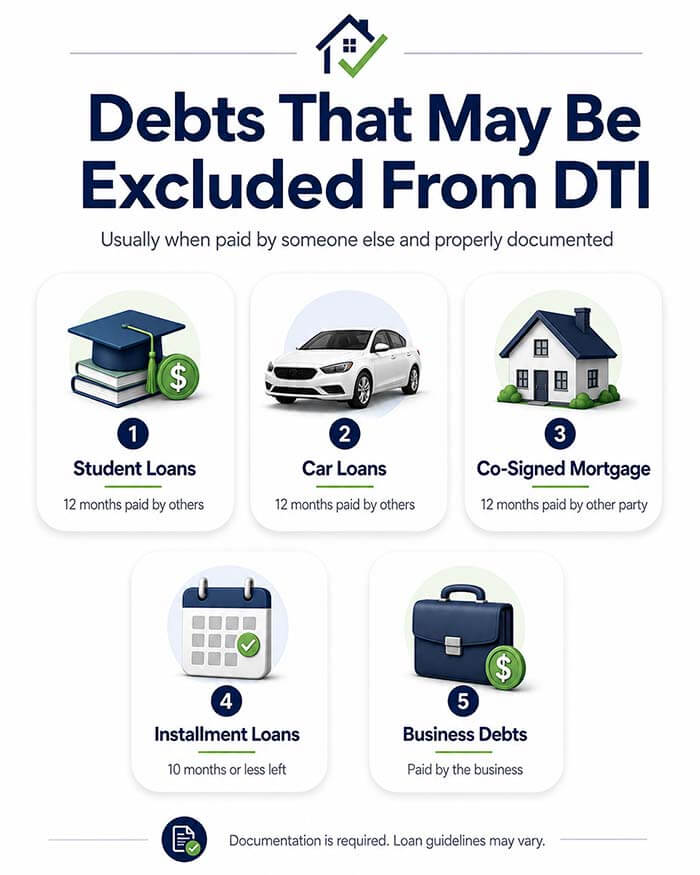
The Following are Some Common Types of Debts That May Be Excluded if Someone Else Makes the Payments:
The following are some types of debts that may be excluded if someone else makes the payments:
- Student Loans: If a parent or another person has been paying your student loans for at least 12 months those payments can be left out of your debt-to-income ratio.
- Car Loans: If someone else has been paying your car loan and you can prove it with 12 months of payment records that car loan can be excluded from your DTI.
- Mortgages: If you co-signed a mortgage but don’t make the payments that mortgage might be excluded from your DTI if the other person has made payments for at least 12 months.
- Installment Loans: Loans that are expected to be paid off within 10 months or less may not count in your DTI. This especially applies to -mortgage debts such as personal loans or unpaid credit card balances.
- Business Debts: If you have a loan, for a business and the business itself is making the payments, not you personally that debt may be excluded from your DTI. You will need to provide documents proving the business owns the debt.
How Excluding Debts Can Help You Qualify for a Mortgage
By excluding certain debts from your DTI calculation, you lower the total debt the lender considers. This could assist you in meeting the criteria for a bigger home loan or a home loan in general if your DTI was previously too elevated. Let us look at a real-life examples of how this can work: Example 1: Sarah is applying for an FHA loan but her back-end DTI is 58 percent, which is higher than the maximum allowed 56.9 percent. Sarah’s parents have paid her student loans for the two years. By excluding her student loans from her DTI Sarah’s DTI drops to 54 percent and Sarah qualifies for the mortgage. Example 2: John wants to buy a home. He co-signed a car loan for his brother. His brother has been making the payments. By excluding the car loan, from John’s DTI John’s DTI goes down. John qualifies for a higher loan amount.
Talk to a Loan Officer to Find Out if You Qualify
Excluding debts from DTI calculations is a strategy for borrowers with high debt-to-income ratios who want to buy a home or refinance. Understanding how this works and having the documents can help you qualify for a larger loan or get approved when you thought it wasn’t possible.
Contact us today for more information on how excluding debts from DTI calculations can help you. We’re available 7 days a week, evenings, weekends, and holidays to assist with your mortgage needs.
Want to know if excluding debts from DTI calculations can help you qualify for a mortgage? Our knowledgeable loan officers at Gustan Cho Associates are available to assist you throughout the entire process. We specialize in helping borrowers with DTI ratios find the right loan options. Whether you are looking to buy a home or refinance your current mortgage we are here to help. Let us help you find the mortgage solution that fits your needs.
Frequently Asked Questions About Excluding Debts From DTI Calculations:
What Does Excluding Debts from DTI Calculations Mean?
Excluding debts from DTI calculations means that certain debts, which someone else is paying on your behalf, may not be included when calculating your debt-to-income ratio. This can lower your DTI and help you qualify for a mortgage.
How can Excluding Debts from DTI Calculations Help me Get a Mortgage?
If someone else has been making payments on certain debts, excluding those from your DTI can lower the total debt amount the lender considers. This may help you qualify for a loan or even allow you to borrow more money.
Which Debts Can Be Excluded from DTI Calculations?
If someone else has been making payments on debts like student loans, car loans or mortgages for least 12 months those debts can be excluded from DTI calculations. You must provide documents like canceled checks or bank statements to prove this.
Can Co-Signed Loans be Excluded from My DTI?
Yes co-signed loans can be excluded from your DTI if the primary borrower has been making payments for least 12 months. You need to provide proof of those payments.
Do All Lenders Allow Excluding Debts from DTI Calculations?
Not all lenders allow this. Each lender has its rules. It’s important to speak with your loan officer to see if excluding debts from DTI calculations is an option for your situation.
What Documentation is Required to Exclude Debts from DTI Calculations?
To exclude debt from DTI calculations, you must show 12 months of canceled checks or bank statements proving that someone else has been making the payments.
Can Student Loans Be Excluded from My DTI if Someone Else Pays Them?
Yes. If someone like a parent has been paying your student loans for least 12 months those payments can be excluded from your DTI with proper documentation.
How Do FHA Loans Handle Excluding Debts from DTI Calculations?
Flexibility is offered by FHA loans in excluding debts from DTI calculations. If someone else has been making the payments for 12 months, debts like student or car loans can be excluded, as long as you can provide proof of payment.
Can Business Debts Be Excluded from DTI Calculations?
Yes. If the business is responsible for the debt and you can show proof that it belongs to the business it can be excluded from your DTI calculations.
How Much Can Excluding Debts from DTI Calculations Improve My Chances of Getting a Mortgage?
Excluding debts from DTI calculations can lower your DTI ratio. That makes it easier to qualify for a mortgage. In some cases it could mean the difference, between being approved and denied.. It could help you qualify for a larger loan amount.