Using a 401(k) to buy a house can be a smart move for some people. It can help cover the down payment, closing costs, or the cash reserves needed to qualify for a mortgage. For many homebuyers, the monthly mortgage payment isn’t the biggest hurdle; rather, it’s gathering sufficient cash to close the deal.
When considering using a 401(k) to buy a house, it’s important to understand the distinction between taking a loan against the account and making a withdrawal.
A 401(k) loan typically requires repayment through payroll deductions, whereas a withdrawal may result in taxes, penalties, and potential long-term implications for retirement savings. Additionally, the specific rules can vary depending on the employer’s retirement plan, the loan program, and the borrower’s mortgage application. Before tapping into retirement funds for home purchasing, borrowers must explore all available options. Possible alternatives might include gift funds, seller concessions, lender credits, down payment assistance programs, FHA loans, VA loans, USDA loans, conventional low-down-payment loans, or non-QM mortgage options. This guide explains how using a 401(k) to buy a house works, when lenders may permit it, the required documents, and the risks and alternatives to consider before accessing retirement savings.
Mortgage Guidelines On Using a 401(k) To Buy A House
Lenders may allow borrowers to use 401(k) funds to buy a house, but the money must be properly documented. A borrower cannot simply move a large amount of money into a bank account without showing where it came from. A 401(k) may be used for the down payment, closing costs, or cash reserves, depending on the loan program and lender guidelines. The lender will want to verify that the funds belong to the borrower and that the borrower is allowed to access them.
Borrowers may need to provide a recent 401(k) statement showing the vested balance. If the money comes from a 401(k) loan, the lender may request loan approval, repayment terms, the payment amount, the interest rate, and proof that the funds were deposited into the borrower’s bank account.
If the money comes from a 401(k) withdrawal, the lender may ask for withdrawal documentation, deposit records, and bank statements showing the transfer. Borrowers should also speak with a tax professional, as withdrawals may result in tax or penalty obligations. The debt-to-income impact can depend on the loan program, automated underwriting findings, and lender guidelines. Some 401(k) loan payments may be treated differently from regular consumer debt because the borrower is borrowing against their own funds. However, borrowers should not assume the payment will always be ignored. Before using a 401(k) to buy a house, borrowers should inquire with the lender about how the funds will be documented, whether repayment will impact their qualification, and whether the 401(k) can still be considered as reserves after any funds are borrowed or withdrawn.
The Down Payment and Closing Costs on Home Purchases

Benefits of Using A 401(k) Loan For A Home Down Payment
A 401(k) loan may help some homebuyers purchase a house sooner when they do not have enough money saved outside of their retirement accounts. For borrowers who are short on funds, using a 401(k) to buy a house can provide access to money for the down payment, closing costs, or cash reserves needed for mortgage approval. One benefit of a 401(k) loan is that it usually does not require a credit check. The borrower is borrowing against their own vested retirement balance, not applying for a traditional personal loan from a bank. This may make it easier for some buyers to access funds without adding new unsecured debt or opening another credit account before closing. Another benefit is that the interest paid on a 401(k) loan typically goes back into the borrower’s own retirement account. A 401(k) loan can be cheaper than using a personal loan or a credit card. However, this does not mean using retirement money is automatically the best choice.
Borrowers should be cautious before using a 401(k) loan for a home down payment. The money removed from the account may lose future investment growth. The borrower must repay the loan under the plan’s rules. If the borrower changes jobs, loses their job, or cannot repay the loan, the unpaid balance may create tax and penalty issues.
Using a 401(k) to buy a house may make sense for some buyers, but it should be reviewed carefully. Before touching retirement funds, borrowers should compare other options such as gift funds, seller concessions, lender credits, down payment assistance, FHA loans, VA loans, USDA loans, and conventional low-down-payment programs.
401(k) Loan Versus 401(k) Withdrawal When Buying A House
When using a 401(k) to buy a house, borrowers need to know that a 401(k) loan and a 401(k) withdrawal are two different things. They don’t work the same way. A 401(k) loan means the borrower withdraws money from their vested retirement account and agrees to repay it under the retirement plan’s rules. The repayment is usually made through payroll deductions. Since the borrower is borrowing against their own retirement funds, a 401 (k) loan may be easier to access than a traditional personal loan. However, the loan must still be repaid, and the borrower must follow the plan’s repayment terms. A 401(k) withdrawal means the borrower permanently withdraws money from the retirement account. This can be more expensive than a loan because the money may be treated as taxable income. If the borrower is under age 59½, the withdrawal may also be subject to an additional early withdrawal penalty, depending on the type of distribution and IRS rules. A hardship withdrawal may sound helpful when a buyer needs money for a home purchase, but it can create long-term financial consequences. Unlike a 401(k) loan, a hardship withdrawal usually cannot be repaid into the retirement plan. Once the money is withdrawn, the borrower may lose future investment growth on those funds.
Why a 401(k) Withdrawal Can Be More Expensive Than a Loan
A 401(k) withdrawal can be more expensive than a 401(k) loan because the borrower is not just using cash. They may also be giving up retirement savings, future compound growth, and possibly creating a tax bill.
For example, if a borrower withdraws money from a 401 (k) before retirement age, the amount withdrawn may be added to taxable income. The borrower may also owe an early withdrawal penalty if they do not qualify for an exception. This can reduce the actual amount of money available for the home purchase.
A 401(k) loan may also involve risks, but the borrower is generally expected to repay the loan into the account. With a withdrawal, the money is usually gone permanently. That can make it harder to rebuild retirement savings later. Before considering using a 401(k) to buy a house, borrowers should consult a tax professional, a financial advisor, and a mortgage lender. In many instances, exploring alternative options may be more beneficial. These alternatives can include gift funds, seller concessions, lender credits, down payment assistance, FHA loans, VA loans, USDA loans, or conventional low-down-payment programs.
Down Payment Requirements on Home Purchase
The number one issue most home buyers face is coming up with the down payment. No matter how much income you make, it is often difficult to save money. This holds true for consumers with a large household. An average trip to the grocery store for a family of five can easily run $350.00 plus. Average car payments are $400.00 per month.
Using a 401(k) to purchase a home is a significant decision with long-term financial implications. Careful consideration and professional advice are recommended to ensure this aligns with your financial goals.
Everything is getting more expensive these days. It’s surprising to learn that many Americans earning over $100,000 have little to no savings. Some people manage to save by setting aside a portion of their paycheck regularly. Yet, with increasing home prices and higher interest rates, the down payment needed for a home purchase continues to grow. Therefore, using a 401(k) to buy a house is an option that lenders allow.
What Is The Maximum Amount You Can Take Out From A 401(k) To Purchase A Home?
Many 401(k) plans limit loans to the lesser of 50% of the borrower’s vested account balance or $50,000, although the exact amount depends on the employer’s retirement plan rules. Not every 401(k) plan allows participant loans, and some plans may have stricter limits than the IRS maximum. For example, if a borrower has a vested 401(k) balance of $80,000, the maximum loan may be $40,000. If the borrower has a vested balance of $120,000, the maximum loan may be capped at $50,000, not $60,000. Borrowers should be cautious about assuming they can borrow a specific percentage of their total 401(k) balance. When using a 401(k) to buy a house, the lender and plan administrator may consider your vested balance, any existing 401(k) loans, the plan’s rules, repayment terms, and whether the loan is for a primary home.
How Long Do You Have To Repay A 401(k) Loan For A Home Purchase?
Most 401(k) loans are repaid within five years. However, a 401(k) loan used to buy a primary residence may qualify for a longer repayment period if the retirement plan allows it.
This is important for homebuyers because a primary residence loan may be treated differently from a general-purpose 401(k) loan. The exact repayment term depends on the employer’s retirement plan, the plan administrator, and the loan agreement.
Borrowers should ask the plan administrator these questions before using a 401(k) to buy a house:
- How long do I have to repay the loan?
- What will my payment be?
- Will payments be taken from my paycheck?
- What interest rate will apply?
- Can I continue contributing to my 401(k) while repaying the loan?
- What happens if I leave my job before the loan is paid off?
Using a 401(k) to buy a house can assist with down payments, closing costs, or reserves, but it should not be seen as free money. If the borrower doesn’t repay the loan as agreed, they could face tax issues and penalties due to the unpaid balance. Before tapping into retirement funds, borrowers should assess their mortgage approval, monthly budget, job stability, and the long-term effects on their retirement savings.
What Happens If You Leave Your Job After Taking A 401(k) Loan?
Leaving your job before a 401(k) loan is fully repaid can create a serious financial risk. This is one of the most important things borrowers should understand before using a 401(k) to buy a house.
Depending on the employer’s retirement plan rules, the unpaid 401(k) loan balance may need to be repaid sooner after the borrower leaves the company. This can happen if the borrower quits, gets laid off, changes employers, becomes self-employed, or switches to a different income structure.
If the unpaid balance is not repaid properly, the remaining loan amount may be treated as a taxable distribution. If the borrower is under age 59½, the balance may also be subject to an early withdrawal penalty under IRS rules and the borrower’s circumstances. This can create a major problem for homebuyers. A borrower may use a 401(k) loan to buy a house, then later lose their job or change jobs, suddenly facing a tax issue they did not expect. Before using a 401(k) loan for a home purchase, borrowers should ask their plan administrator what happens if they leave their job before the loan is paid off. They should also review their job stability, income type, emergency savings, and retirement goals before borrowing against their 401(k).
Documents Lenders May Need When Using 401(k) Funds
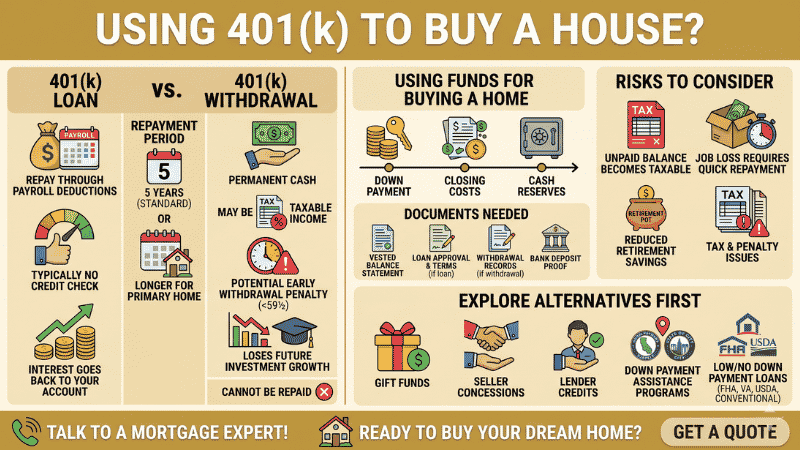
When using a 401(k) to buy a house, borrowers need to be prepared to document the source of the funds and how they were accessed. Lenders want a clear paper trail before allowing retirement funds to be used for the down payment, closing costs, or cash reserves. Borrowers may need to provide a recent 401(k) statement showing the vested account balance. The lender should want to see proof that the borrower can access the money in their 401(k), either through a loan or a withdrawal.
If the borrower takes a 401(k) loan, the lender may request the loan approval, repayment terms, payment amount, interest rate, and documentation from the plan administrator. If the borrower withdraws funds, the lender may request confirmation of the withdrawal and proof of the amount received.
The lender will also need to see the funds transferred into the borrower’s bank account. This may require bank statements showing the deposit, transfer records, and an explanation letter if the money was recently moved before or during the mortgage process. Borrowers may also want to speak with a tax professional before taking a hardship withdrawal. A withdrawal may create taxes, penalties, and long-term retirement consequences. Having the right documents ready early can help avoid underwriting delays before closing.
Option Other Than Using A 401(k) For A Home Down Payment
Before using a 401(k) to buy a house, it’s a good idea for borrowers to explore other options for covering the down payment, closing costs, and setting aside reserves. Retirement funds should not be the first option without reviewing the full mortgage file. One common alternative is using gift funds from a family member. Many loan programs allow eligible gift funds for the down payment or closing costs, provided the gift is properly documented and does not need to be repaid.
Borrowers may also use seller concessions to help cover closing costs. Seller concessions do not usually cover the down payment, but they can reduce the amount of cash the borrower needs to bring to closing.
Another option is a lender credit. With a lender credit, the lender may help cover part of the borrower’s closing costs in exchange for a higher interest rate. This can help buyers who are short on cash, but borrowers should also consider the long-term costs. Some buyers can get help with their down payment through programs offered by the state, county, city, nonprofits, or housing agencies. These programs may offer grants, forgivable loans, deferred-payment loans, or second mortgages to help eligible buyers purchase a home. Borrowers should also compare low-down-payment and no-down-payment mortgage programs. FHA loans may allow a low down payment for eligible borrowers. VA loans may offer no down payment for eligible veterans, active-duty service members, and qualifying surviving spouses. USDA loans may offer no down payment for eligible buyers purchasing qualified rural or suburban properties. Some conventional loan programs may allow as little as 3% down for qualified borrowers. Using a 401(k) for a home down payment makes sense for some borrowers, but it should be compared against these options first. A borrower may be able to buy a house without touching retirement savings by combining gift funds, seller concessions, lender credits, down payment assistance, or the right mortgage program.
Using 401(k) Funds By Mortgage Program
Using a 401(k) to buy a house may be allowed under several mortgage programs, but the funds must be properly documented. The rules can vary depending on the loan type, the borrower’s full file, automated underwriting findings, and lender overlays.
FHA Loans
FHA loans allow low down payment options for eligible borrowers. A 401(k) loan or documented retirement funds may be used to help cover the down payment, closing costs, or reserves. The lender must verify the source of the funds and ensure the borrower is authorized to use them. FHA borrowers should also understand that using 401(k) funds does not automatically guarantee approval. The borrower still needs to meet the FHA credit, income, debt-to-income, and property requirements.
VA Loans
VA loans do not require a down payment for eligible veterans, active-duty service members, and qualifying surviving spouses. However, some VA borrowers may still use 401(k) funds for closing costs, reserves, or paying off debts if needed. Because VA loans focus heavily on residual income and overall ability to repay, borrowers should ask the lender whether a 401(k) loan repayment affects the file. VA approval may also depend on AUS findings, manual underwriting, and lender overlays.
USDA Loans
USDA loans may offer 100% financing to eligible borrowers and properties in eligible rural or suburban areas. Even with no down payment, a borrower may still need funds for closing costs, reserves, inspections, moving expenses, or other costs connected to the purchase. A documented 401(k) loan or withdrawal may be used if allowed by the lender and properly sourced. USDA borrowers should also make sure the property, income, household size, and location meet USDA eligibility rules.
Conventional Loans
Conventional loans allow low down payment options for qualified borrowers, including some programs with as little as 3% down. Borrowers may be able to use 401(k) funds for down payment, closing costs, or reserves when properly documented. Conventional loan approval may depend on the borrower’s credit score, debt-to-income ratio, reserves, loan-to-value, and DU or LPA automated underwriting findings. If the 401(k) loan has a required repayment, the lender may review whether it must be counted for qualifying purposes.
Non-QM Loans
Non-QM loans may be an option for borrowers who do not fit traditional FHA, VA, USDA, or conventional guidelines. This may include some self-employed borrowers, bank statement borrowers, real estate investors, or borrowers with recent credit events. Non-QM lenders may treat retirement funds differently depending on the program. Some may focus on reserves, asset documentation, cash flow, or compensating factors. Because Non-QM guidelines vary by lender, borrowers should ask how 401(k) funds can be used and what documentation is required before moving money.
When Do I Need To Make Commitment
Borrowing from 401k to purchase homes does not take long. Gifted funds are allowed for the down payment and closing costs. If the home buyer was promised a gift by a family member but the family member later changed their minds, the buyer can tap into their 401k. It normally takes less than 7 days for the borrower from 401k.
Talk To A Mortgage Expert Before Using Your 401(k)
Using a 401(k) to buy a house may help some borrowers, but it is not the right move for everyone. A 401(k) loan can provide access to money for the down payment, closing costs, or reserves, but it can also affect retirement savings, monthly cash flow, and future financial security.
Before taking a 401k loan or withdrawal, borrowers should compare all available mortgage options. This may include down payment assistance, gift funds, seller concessions, lender credits, FHA, VA, and USDA loans, conventional low-down-payment loans, and Non-QM mortgage programs.
Borrowers should also review the tax impact, repayment terms, job-change risk, and long-term retirement consequences before using retirement funds. A 401(k) withdrawal may be especially costly because it may create taxes, penalties, and lost future investment growth. Gustan Cho Associates can review your credit, income, assets, debt-to-income ratio, down payment options, and mortgage program choices to help determine whether using 401(k) funds makes sense for your home purchase. A borrower may have more options than they think before touching retirement savings.
FAQs About Using a 401(k) to Buy A House
Can I Use My 401(k) To Pay Closing Costs?
Yes, a borrower may be able to use 401(k) funds to help pay closing costs if the funds are properly documented and allowed by the retirement plan. The lender may request a 401(k) statement, loan or withdrawal confirmation, deposit records, and bank statements showing funds entering the borrower’s account.
Can I Use My 401(k) As Mortgage Reserves?
Yes, some lenders may allow vested 401(k) funds to count as mortgage reserves, depending on the loan program and lender guidelines. Reserves are not the same as down payment funds. Reserves show the lender that the borrower has extra assets available after closing.
Can I Use a 401(k) Loan And Gift Funds Together?
Yes, many borrowers can use a 401(k) loan with gift funds, seller concessions, lender credits, or down payment assistance. The key is documentation. Each source of funds must be allowed by the loan program and clearly verified by the lender.
Will Taking Money From My 401(k) Delay My Mortgage Closing?
It can delay closing if the funds are not documented early. Borrowers should ask the 401(k) plan administrator how long the loan or withdrawal will take, then provide the lender with proof of the transaction, deposit records, and updated bank statements as soon as possible.
Can I Use My 401(k) To Buy An Investment Property?
Possibly, but it depends on the retirement plan rules, lender guidelines, and loan program. Some mortgage programs treat primary homes, second homes, and investment properties differently. Borrowers should confirm whether 401(k) funds can be used and how reserves will be documented before moving funds.
Is Using a 401(k) Better Than Waiting To Save More Money?
Not always. Using a 401(k) may help a buyer purchase sooner, but waiting may be safer if the borrower has unstable income, little emergency savings, high debt, or concerns about retirement. A mortgage lender and financial advisor can help compare both options before the borrower touches retirement funds.
This article about “Using a 401(k) to Buy a House? Read This First” was updated on May 21st, 2026.