Buying a house during a recession can feel scary. News headlines discuss job losses, high prices, and interest rate changes. At the same time, you may come across homes that fit your needs, and worry that you will miss your chance.
This guide is here to help you buy a house even when the economy’s taking a hit. We’ll break it down into plain and simple language so it’s easy to understand. We will discuss the pros, the risks, and a step-by-step plan so you can make an informed, smart decision for your family.
Key Takeaways About Buying a House During Recession
- Buying a house during recession can be a good move if your job is stable and you plan to stay for a while.
- A recession can bring less competition and more flexible sellers, but lending rules can get tighter.
- Your job security, savings, credit, and debt matter more than “timing the market.”
- You do not always need 20% down when buying a house during recession. There are low-down-payment and even zero-down options.
- Lender guidelines can tighten during recessions, so it helps to compare loan programs and approval requirements before you decide.
What Does a Recession Mean for Homebuyers?
Before considering buying a house during recession, it’s helpful to understand what a recession really is.
A recession is a time when:
- The economy slows down
- Some people lose jobs or work fewer hours
- Companies earn less money
- People spend less
During a recession:
- Some areas see home prices cool or dip
- In other areas, prices may still go up if there is very low inventory
- Interest rates may move up or down depending on what the Federal Reserve does
The key point is that the economy can be weak, but housing can still be strong in many markets. That is why buying a house during recession is not always a bad idea. It depends on your personal situation, not just the headlines.
Pros of Buying a House During Recession
There can be real benefits to buying a house during recession:
1. Less Buyer Competition in Some Areas
During slow periods, some buyers become cautious and stay on the sidelines. That means:
- Fewer bidding wars
- More room to negotiate
- More time to think before making an offer
If you are buying a house during recession with a strong pre-approval, you can stand out.
2. Sellers May be More Flexible
Some sellers need to move due to job changes, family reasons, or financial stress. They may be more open to:
- Lower prices
- Closing cost credits
- Repairs or home warranties
- Flexible closing dates
Buying a house during recession can give you more power at the negotiating table.
3. Builder and Lender Incentives
In some markets, builders and lenders offer:
- Rate buydowns
- Closing costs help
- Free upgrades
When buying a house during a recession, always ask about the incentives or credits that might be available.
Risks of Buying a House During Recession
There are real risks you must understand when buying a house during recession.
1. Job Loss or Income Cuts
The biggest risk is losing your job or having your hours cut. If your income is shaky, buying a house during recession can put serious stress on your budget.
Ask yourself:
- If I lost my job, how long could I make the payment?
- Do I have skills that are in demand?
- Is my company or industry stable?
2. Home Values Can Dip in the Short Term
Even if you buy a good home, prices in your area might:
- Stay flat for a while
- Go down a bit before they go up again
If you are buying a house during recession and plan to sell in one or two years, that can be risky. If you plan to stay 5–7+ years, short-term ups and downs matter less.
3. Lending Rules Can Tighten
During recessions, some lenders:
- Add more overlays (extra rules on top of FHA, VA, USDA, Fannie Mae, Freddie Mac)
- Raise their credit score requirements
- Ask for more reserves and paperwork
This is why buying a house during recession is easier with a lender that does not have overlays and is used to tough files.
Questions to Ask Before Buying a House During Recession
Before you decide to buy a house during a recession, ask yourself a few simple but powerful questions.
How Safe is My Job and Income?
- Have you been with your employer for at least 2 years?
- Is your industry growing or shrinking?
- Do you have a backup plan if your income changes?
If you feel good about your job and skills, buying a house during recession may make sense.
Scared To Buy a House During a Recession?
We’ll walk you through payment, rates, and risk so you can decide with confidence
Do I have Enough Savings?
Try to have:
- Your down payment
- Closing costs
- At least 3–6 months of full expenses in an emergency fund
If you don’t have any savings, buying a house during a recession might be too stressful right now.
Is My Credit Ready?
When buying a house during recession, credit matters:
- Recent late payments can hurt your approval
- High credit card balances can raise your DTI and lower scores
- Collections and charge-offs may need to be reviewed
Some loan programs may allow lower credit scores, but lender standards and loan options can vary. A lower score does not always mean you cannot qualify, especially if your income, payment history, and overall file are stronger in other areas.
Am I Planning to Stay Put?
Buying a house during recession works best if you:
- Plan to stay at least 5 years or more
- Are you ready for the costs of owning (repairs, taxes, insurance)
- Want to build long-term equity, not just flip
Money You Need When Buying a House During Recession
You don’t always need a 20% down payment when buying a house, especially during a recession. Here are some options:
- VA loans: Qualified veterans and active-duty service members are not required to make a down payment.
- USDA loans: No down payment in many rural and some suburban areas.
- FHA loans: Down payments as low as 3.5%, even for those with lower credit scores.
- Conventional loans: Down payments from 3% to 5% for many first-time buyers.
Also, keep these costs in mind:
- Closing costs: Typically, they range from 2% to 5% of the home’s value.
- Prepaids: Costs for taxes, insurance, and interest.
- Reserves: Some lenders may require 1 to 6 months of mortgage payments saved.
When buying a house during recession, your loan officer can help tailor a plan that fits your budget, rather than just focusing on what you qualify for.
Smart Ways to Save for Down Payment and Closing Costs
Saving money can feel hard, especially during a slowdown. Here are simple ideas that help many of our clients who are buying a house during recession:
- Separate savings account just for the home
- Set aside a portion of your paycheck in a dedicated “home fund” account.
- If you don’t see it, you’re less likely to spend it.
- Automatic transfers
- Set up a small automatic transfer each week or month.
- Even $25–$100 adds up fast over a year or two.
- Tax refunds and bonuses
- Treat refunds, bonuses, or side-gig income as “home money.”
- Don’t change your lifestyle; feed your savings instead.
- Retirement account options
- Some 401(k) plans let you borrow for a primary home.
- Always speak with a tax professional before using retirement funds.
- Gift funds
- Many loan programs allow gifted funds from family for your down payment and/or closing costs.
These simple habits can make buying a house during recession more realistic than it first seems.
Loan Options When Buying a House During a Recession
When buying a house during a recession, the best loan is not always the one with the lowest down payment or the most flexible credit rules. The right choice depends on your credit, savings, job stability, income type, and how long you plan to stay in the home. Here is a simpler way to think about your options.
Best Loan Option if Your Credit Is Bruised
FHA loans are often the first program many buyers look at when their credit is less than perfect. They are generally more flexible than conventional loans. They may work well for borrowers who have higher debt, past credit issues, or limited savings. The trade-off is that FHA loans include mortgage insurance, which can increase your monthly payment. During a recession, FHA can be a practical option for buyers with stable income who need more forgiving credit standards.
Best Loan Option if You Have No Down Payment
VA and USDA loans are the main low-down-payment options for qualified buyers. VA loans are for eligible veterans, active-duty service members, and some surviving spouses. USDA loans are for eligible properties in certain rural and suburban areas and have household income limits. In a recession, these programs can be especially valuable for buyers who want to preserve cash reserves rather than use all their savings for a down payment.
Best Loan Option if Your Income Is Strong and You Want Lower Long-Term Costs
Conventional loans may be a strong fit for buyers with steadier income, stronger credit, and the ability to qualify under tighter guidelines. They can offer lower long-term mortgage insurance costs and more flexibility once you build equity. During a recession, conventional financing may work best for borrowers with strong financial profiles who want to keep borrowing costs lower over time.
Best Loan Option if Your Income Is Nontraditional
Non-QM loans may help buyers who do not fit standard underwriting models. This can include self-employed borrowers, business owners, real estate investors, or individuals with strong cash flow but not in a traditional W-2 format. These loans can be useful during a recession if your income is real but harder to document in standard ways. The trade-off is that rates are often higher, and qualification standards can be more lender-specific.
How to Choose the Right Loan During a Recession
The best loan during a recession is usually the one that gives you a payment you can comfortably afford while protecting your cash reserves. Many buyers focus too much on getting approved and not enough on how the payment will feel if the economy weakens further. It is usually smarter to choose the loan that leaves room in your budget for repairs, job changes, and unexpected expenses.
First-Time Buyer Worried About the Word ‘Recession’?
Get a clear, step-by-step guide instead of scary headlines
How Credit Scores Affect Buying a House During a Recession
Your credit score affects:
- Approval chances
- Interest rates
- Mortgage insurance costs
- Borrowing limits
Tips if you are buying a house during recession:
- Make sure all payments are on time—no late payments in the last year, if possible.
- Keep credit card balances low—ideally under 30% of your limit.
- Avoid opening many new accounts just before applying for a mortgage.
- Check your credit reports for errors and dispute any mistakes.
At Gustan Cho Associates, we help borrowers with late payments, collections, charge-offs, and low credit scores. With the right credit strategy, buying a home during a recession is possible.
Example: When Buying During a Recession Can Still Work
Consider a buyer with a mid-500s credit score, limited savings, some credit card debt, and a stable full-time income. At first glance, that file may look risky, especially during a recession when some lenders become more cautious.
The main challenge is not always one single issue. It is often a combination of factors: lower scores, modest cash reserves, and concern that the borrower may be unable to make the payment if the economy weakens further.
In some cases, the file becomes stronger not because everything changes overnight, but because a few important details improve. Credit card balances may come down, on-time rent history may help show payment discipline, and a small emergency fund may make the overall picture more stable. Making regular on-time payments for a little while helps lower your risk.
That is often why a borrower who was not ready a few months ago may become more mortgage-ready later. The difference is not magic. It is usually better to have stronger files, better documentation, and a loan program that matches the borrower’s real profile more closely.
The takeaway for buyers is simple: a rejection does not always mean homeownership is out of reach. The timing, documentation, or loan structure needs to improve first. During a recession, buyers with lower credit scores usually have the best chance when they pair stable income with stronger payment habits, better cash management, and realistic budget expectations.
Why Lender Guidelines Can Differ During a Recession
During a recession, mortgage lending standards can become more cautious. Even when the basic rules for FHA, VA, USDA, conventional, or other loan programs have not changed, individual lenders may still apply stricter internal standards.
These added requirements are often called lender overlays. An overlay is an additional rule a lender adds to the standard program guidelines. For example, one lender may want higher credit scores, lower debt-to-income ratios, more cash reserves, or stronger documentation than another lender offering the same type of mortgage.
This matters because two borrowers with very similar financial profiles may get different answers from different lenders. One lender may view the file as too risky during a slower economy. At the same time, another may be more flexible within the same program’s broader rules.
For buyers, the key lesson is simple: do not assume one denial tells the full story. If you are financially close to qualifying, compare lenders, loan options, and underwriting approaches before deciding that homeownership is out of reach.
This does not mean every borrower should move forward in a recession. It means lender differences can matter more when the economy is uncertain, especially for buyers with lower credit scores, higher debt, variable income, or a shorter savings history.
Step-by-Step Plan for Buying a House During a Recession
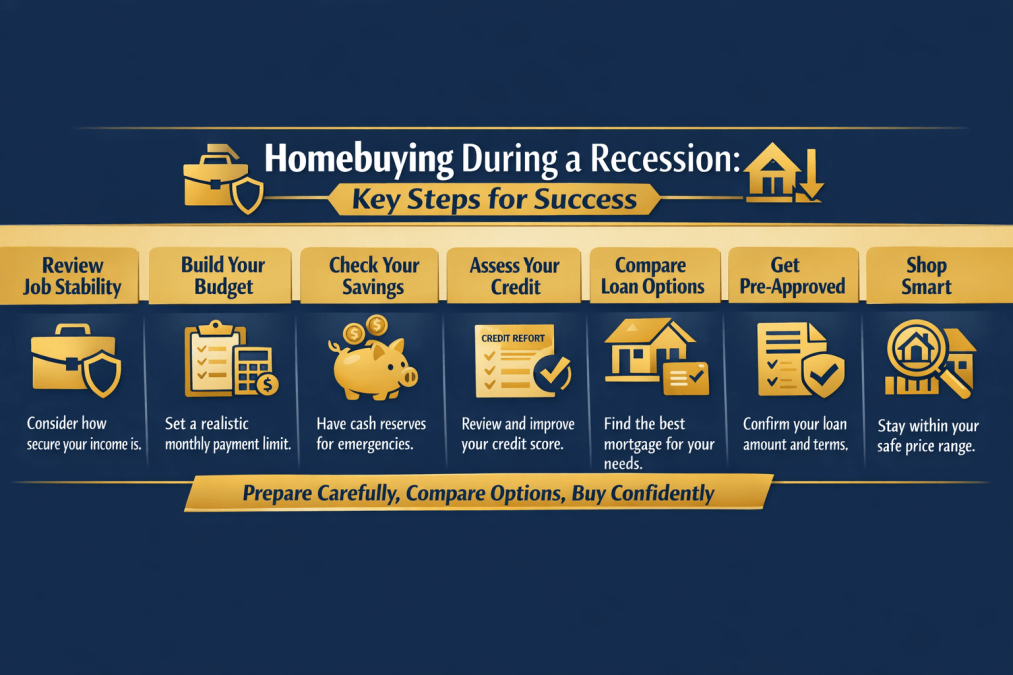
Buying during a recession is usually less about trying to time the market and more about knowing whether your finances are strong enough to handle homeownership if the economy stays uncertain. A simple step-by-step approach can make the decision much clearer.
1. Review Your Job Stability
Start with the most important question: how stable is your income right now? A recession can lead to layoffs, reduced hours, or slower business activity, so buyers should honestly assess how secure their job feels. If your income is steady and your field is resilient, you may be in a stronger position to move forward.
2. Build a Realistic Housing Budget
Before looking at homes, figure out what payment feels comfortable, not just what a lender may approve. Include principal, interest, property taxes, homeowners’ insurance, utilities, maintenance, and any HOA dues. In a recession, it is smart to leave more breathing room in your budget than you might in a stronger economy.
3. Check Savings and Emergency Reserves
Make sure you are not using every dollar for the purchase. A healthy plan usually includes your down payment, closing costs, and some emergency savings left over after closing. Cash reserves matter even more when the economy is uncertain because they give you a cushion for repairs, job changes, or unexpected bills.
4. Review Your Credit
Look at your credit reports, payment history, and overall debt. Bring any late payments current, avoid opening new accounts, and work on lowering high credit card balances. Even small improvements can strengthen your loan options and reduce financial stress.
5. Compare Loan Options
Once you understand your budget and credit profile, compare the mortgage programs that may fit your situation. Some buyers may need a lower down payment option, while others may care more about long-term cost, monthly payment flexibility, or qualifying with nontraditional income. The best loan is the one that supports both approval and stability.
6. Get Pre-Approved
After doing your own preparation, the next step is to get pre-approved. This gives you a clearer idea of your price range, helps you move faster if you find the right home, and shows sellers that you are serious. In a more cautious market, a strong pre-approval can also improve your negotiating position.
7. Shop With Discipline
Even if you qualify for more, stay within the payment range that feels safe. Do not let a lower asking price or a temporary rate incentive push you into buying a house you cannot comfortably afford. In a recession, discipline matters as much as approval.
8. Talk With the Right Professionals
Once you know your goals and limits, speak with a lender and a real estate agent who can help you evaluate your options clearly. This is the stage where professional guidance is most useful, as you are making decisions from a position of preparation rather than uncertainty.
When It May Be Better to Wait
Sometimes the smartest move is to wait on buying a house during a recession.
You may want to hold off if:
- Your job or hours are unstable
- You have no savings and are living paycheck to paycheck
- You had recent serious credit problems (multiple late payments, new collections)
- Your debt is already very high
- You would need to use all of your savings for the purchase
If this is you, we can still help by building a roadmap so you can buy a house after you fix a few key items.
What to Do Next if You Are Thinking About Buying During a Recession
If you are thinking about buying during a recession, focus on the basics first. Review your job stability, stress-test your budget, compare loan options, and make sure you have enough savings left after closing. The goal is not just to get approved. The goal is to buy in a way that still feels safe if the economy stays uncertain for a while.
Talking with a lender can help once you understand your budget and goals. A good lender should be able to explain your options clearly, compare payment scenarios, and show you what is realistic based on your full financial picture.
If you want help reviewing your options, you can speak with a mortgage professional and compare paths based on your credit, income, savings, and long-term plans.
Frequently Asked Questions About Buying a House During Recession:
Is it Smart to Buy a House During a Recession?
It can be smart to buy a house during a recession if your job is stable, your budget is solid, and you plan to stay in the home for several years. A recession can create less competition and more room to negotiate, but it can also lead to greater job uncertainty and tighter mortgage standards.
Do Home Prices Always Go Down During a Recession?
No. Home prices do not always fall during a recession. In some markets, prices may soften or level off, while in others they can stay high if inventory remains tight. Buyers should look at local market conditions, not just national headlines.
Do Mortgage Rates Drop During a Recession?
Not always. Recessions can put downward pressure on rates, but mortgage rates do not move in a straight line and are not controlled by a single factor. Buyers should focus on whether the payment works for their budget now rather than trying to perfectly time the lowest rate.
Is it Harder to Get Approved for a Mortgage During a Recession?
It can be. During weaker economic periods, some lenders may become more cautious and tighten their standards. That can mean closer review of credit, income, reserves, and debt-to-income ratios, even if the basic loan program remains in place.
Should I Wait to Buy a House Until After a Recession?
Waiting can make sense if your income is unstable, your savings are thin, or your credit needs work. But waiting is not always better if you are financially ready now and can comfortably afford a home. The better question is usually whether you are personally prepared, not whether the timing feels perfect.
What Matters Most When Buying a House During a Recession?
The biggest factors are job stability, emergency savings, manageable monthly payments, and a long enough time horizon to ride out short-term market swings. Financially prepared buyers tend to be in a much stronger position than buyers who are trying to guess exactly where the market will go next.
This article about “Buying a House During Recession: A Simple Guide for Buyers” was updated on March 11th, 2026.
Ready To Buy a House During a Recession—But Only the Smart Way?
Work with a lender that gives you a simple guide, not sales pressure