Filing for bankruptcy doesn’t completely eliminate the possibility of purchasing a home in the future. When considering an FHA versus conventional mortgage after bankruptcy, FHA loans provide a quicker path to homeownership for some borrowers, while a conventional loan is more suitable after a longer period of credit recovery. The best choice depends on several factors: the type of bankruptcy filed, whether it was discharged or dismissed, your history with mortgages, and your current credit situation, income, debts, and savings.
Before comparing loan programs, confirm the dates that control your eligibility. These may include the bankruptcy discharge or dismissal date, the date title was transferred after a foreclosure or deed in lieu, and your Chapter 13 payment history. Meeting a waiting-period rule is only one part of the mortgage approval process. You must still meet the lender’s credit, income, asset, property, and underwriting requirements.
Can You Get a Mortgage After Bankruptcy?
Yes, you can get a mortgage after bankruptcy, but you must meet the waiting-period rules for the loan program you are using. FHA loans are often more flexible after bankruptcy, while conventional loans usually require a longer wait and stronger credit. Getting past the waiting period does not automatically mean you are approved. Lenders will still review your credit score, income, debt-to-income ratio, payment history after bankruptcy, and whether you have rebuilt credit. If a foreclosure, short sale, deed in lieu, or mortgage included in bankruptcy was involved, the timeline may be different.
FHA Vs Conventional Mortgage After Chapter 7 Bankruptcy
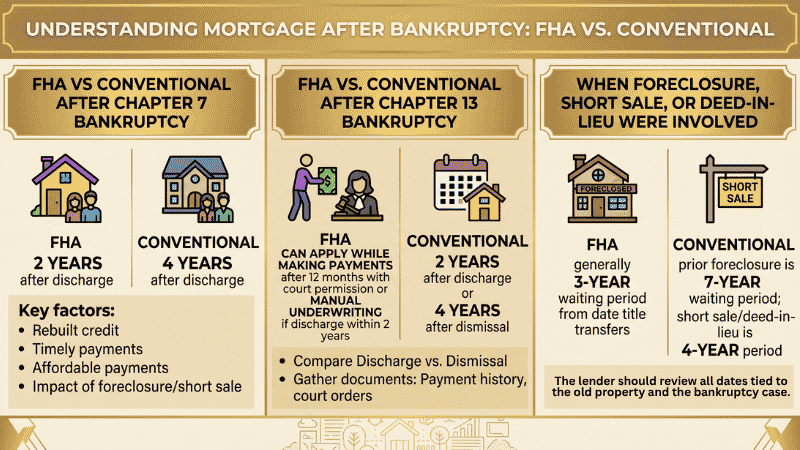
Many individuals wait two years after their Chapter 7 case closes before applying for an FHA loan. In contrast, it takes four years to qualify for a conventional mortgage following discharge. This time difference makes the FHA an attractive option immediately after bankruptcy concludes, especially when considering FHA versus conventional mortgage after bankruptcy. One piece of getting approved? That wait time. Lenders look beyond it, though. Rebuilt credit matters – proof you’ve been responsible since bankruptcy closed. Timely payments count too, month after month without slipups. Affording the new house bill? They check that just as closely. Had a foreclosure once? Or maybe a short sale took place. Deed handed back instead of defaulting? Each path changes how long you must wait. Bankruptcy didn’t cover every loan type the same way, either.
FHA vs. Conventional After Chapter 13 Bankruptcy
A Chapter 13 bankruptcy does not automatically prevent you from qualifying for an FHA mortgage. FHA may allow a borrower to apply while still making Chapter 13 plan payments, provided that at least 12 months of the repayment period have passed, all required payments have been made on time, and the bankruptcy court has given written permission to enter the mortgage transaction. These files generally require manual underwriting, so the lender reviews income, payment history, debt, assets, and the reason for the bankruptcy more closely.
A recent Chapter 13 discharge can also require manual underwriting for FHA financing. FHA’s automated underwriting rules require a downgrade to manual underwriting when the bankruptcy discharge date is within two years of case number assignment.
This does not mean the borrower is automatically ineligible, but the loan must meet the FHA manual underwriting requirements rather than relying solely on automated approval. Conventional financing typically has a longer, more defined waiting period after Chapter 13. Under Fannie Mae guidelines, borrowers generally must wait two years after a Chapter 13 discharge or four years after a Chapter 13 dismissal. A two-year waiting period may be possible after a dismissal if documented extenuating circumstances prevented the borrower from completing the repayment plan. Knowing the difference between a discharge and a dismissal is essential when looking at FHA versus conventional mortgages after bankruptcy. A discharge indicates that the borrower successfully completed the Chapter 13 repayment plan and received a court order to conclude the case. In contrast, a dismissal signifies that the case ended before the repayment plan was completed. Before applying, borrowers should present the bankruptcy discharge or dismissal order, evidence of their Chapter 13 payment history when available, and documentation showing stable income and credit improvement since the bankruptcy.
Get Your Mortgage Timeline After Bankruptcy
FHA and conventional loans have different waiting periods after Chapter 7, Chapter 13, foreclosure, short sale, or deed-in-lieu. Get a clear timeline based on your exact dates.
When a Foreclosure, Short Sale, or Deed-in-Lieu Was Also Involved
Bankruptcy is not the only event lenders review after a serious mortgage hardship. If you also had a foreclosure, short sale, or deed in lieu of foreclosure, that event may create a separate waiting period. This is where many borrowers get confused. You may be past the bankruptcy waiting period, but still not past the waiting period tied to the old property.
FHA Loans
For FHA loans, the timeline usually starts when ownership is transferred out of your name. A foreclosure or deed-in-lieu generally requires a three-year waiting period from the date the title is transferred before a new FHA case number can be assigned. A short sale can also require a three-year waiting period from the date the property is transferred through the short sale. Some exceptions may apply, but they require strong documentation and are reviewed carefully.
Conventional Loans
Conventional loans have specific rules. According to Fannie Mae, a prior foreclosure requires a 7-year waiting period from the completion date. A short sale, deed in lieu of foreclosure, or mortgage charge-off generally requires a 4-year waiting period from the completion date. Shorter waiting periods may be possible only when documented extenuating circumstances apply.
Why the Dates Matter
Borrowers should not rely only on the bankruptcy discharge date. The lender should review all dates tied to the old property and the bankruptcy case. Documents that may need to be reviewed include bankruptcy papers, credit reports, foreclosure records, short-sale closing documents, deed-in-lieu paperwork, and county title records, as needed. The goal is to confirm when the bankruptcy ended, when the property transferred, and which loan program gives the borrower the best path forward.
When a Mortgage Was Included in Bankruptcy
A mortgage included in bankruptcy can create confusion because the debt and the property are not always handled on the same date. The bankruptcy may discharge the borrower’s personal responsibility for the mortgage debt, but the lien on the property may remain until the home is sold, foreclosed, transferred through a deed-in-lieu, or otherwise removed from the borrower’s name.
Why the Bankruptcy Date May Not Be the Only Date
Some borrowers believe the waiting period starts and ends with the bankruptcy discharge date. That is not always true. If the old home was later foreclosed, sold through a short sale, or transferred by deed in lieu, the lender may also need to review the date the property left the borrower’s name. This is especially important when the borrower stayed on title after the bankruptcy was discharged. In that case, the bankruptcy may be over, but the property event may still create a separate waiting period for a mortgage.
FHA Loans
For FHA loans, having a mortgage in bankruptcy does not eliminate the waiting period after a foreclosure, short sale, or deed in lieu. The lender may still need to confirm the transfer of title from the borrower. A borrower may be past the Chapter 7 bankruptcy waiting period but still not past the FHA waiting period connected to the old property. This is why the recorded deed, foreclosure documents, short sale closing statement, or deed-in-lieu paperwork may be needed before the lender can confirm eligibility.
Conventional Loans
Conventional loans may treat a mortgage included in bankruptcy differently when the file meets agency documentation rules. Under Fannie Mae guidelines, if the mortgage debt was discharged through bankruptcy, the bankruptcy waiting period may be applied when the lender obtains proper documentation showing the mortgage obligation was discharged. If the lender cannot document that the mortgage debt was discharged in bankruptcy, the longer waiting period may apply. That could mean the file is reviewed under the foreclosure, short sale, deed-in-lieu, or mortgage charge-off timeline instead of only the bankruptcy timeline.
Documents Borrowers Should Gather
Borrowers should gather the bankruptcy discharge papers, bankruptcy schedules, foreclosure deed, sheriff’s deed, trustee’s deed, short sale closing disclosure, deed-in-lieu paperwork, and any county records showing when ownership transferred. The credit report alone may not show the correct dates. Before choosing FHA or conventional financing, the lender should review both timelines: the bankruptcy timeline and the property transfer timeline. The best loan option depends on which waiting period applies, how the debt was reported, and whether the borrower has rebuilt credit since the bankruptcy.
Credit, Down Payment, Mortgage Insurance, and Cost Differences
The best choice after bankruptcy is not always the loan with the shortest waiting period. Borrowers should compare credit requirements, down payment, mortgage insurance, monthly payment, closing costs, and long-term costs before choosing FHA or conventional financing.
Credit Score Differences
FHA loans are often more flexible for borrowers rebuilding credit after bankruptcy. FHA allows a 3.5% down payment with a credit score of 580 or higher. Borrowers with credit scores between 500 and 579 may need at least 10% down, and not every lender will accept scores that low. Conventional loans usually require stronger credit after bankruptcy. A borrower may be past the required waiting period but still need enough credit depth, payment history, and automated underwriting approval to qualify. Higher credit scores can also help improve conventional loan pricing and private mortgage insurance costs.
Down Payment Differences
FHA loans are often used by borrowers who need a lower down payment after bankruptcy. A borrower with a qualifying credit score may be able to buy with 3.5% down. Gift funds may also be allowed when they meet the FHA documentation rules. Conventional loans may also offer low down payment options for eligible borrowers. Some conventional programs allow as little as 3% down, but the borrower must meet program, income, credit, and underwriting requirements. A larger down payment can help lower the payment, reduce mortgage insurance, and strengthen the file.
Mortgage Insurance Differences
FHA loans require mortgage insurance on most loans. FHA mortgage insurance usually includes an upfront premium and an annual premium paid monthly. The cost allows FHA loans to be accessible to borrowers with low down payments or credit scores, but it raises the overall cost of the loan. Conventional loans use private mortgage insurance, often called PMI, when the down payment is less than 20%. PMI is usually affected by credit score, down payment, loan type, and other risk factors. A borrower with stronger credit and more money down may find conventional PMI less expensive than FHA mortgage insurance.
Monthly Payment and Long-Term Cost
A lower down payment does not always mean a cheaper loan. FHA may help a borrower qualify sooner after bankruptcy, but the mortgage insurance can increase the monthly payment. Conventional financing may cost less over time for borrowers who have rebuilt stronger credit, saved more money, and qualify for better pricing. The right comparison should include the full payment, not only the interest rate. Borrowers should review the principal and interest, property taxes, homeowners’ insurance, mortgage insurance, HOA dues (if applicable), closing costs, lender credits, discount points, and how long they expect to keep the loan.
Which Loan May Cost Less After Bankruptcy?
When considering FHA versus conventional mortgage after bankruptcy, FHA may be a more suitable short-term option for borrowers who require flexible credit guidelines, a lower down payment, or the possibility of manual underwriting. In contrast, conventional loans might be the better long-term choice for those with stronger credit, a larger down payment, and sufficient time elapsed since bankruptcy to meet agency qualifications. In the end, the most suitable choice will rely on the overall financial overview. Borrowers should carefully compare the two options before applying, especially if they are rebuilding their credit after bankruptcy or are unsure whether to buy now or wait.
Why Passing the Waiting Period Does Not Guarantee Approval
Passing the bankruptcy waiting period is only the first step. It means enough time has passed under the loan program rules, but it does not mean the mortgage will automatically be approved. Lenders still need to review the full file before issuing final approval.
Credit History After Bankruptcy
Lenders want to see that the borrower has rebuilt credit after bankruptcy. Recent late payments, maxed-out credit cards, unpaid collections, new charge-offs, or too many new accounts can create problems even if the waiting period has passed. A stronger file usually shows on-time payments, low credit card balances, and responsible use of credit after the bankruptcy.
Debt-to-Income Ratio
The debt-to-income ratio compares monthly debts to gross monthly income. A borrower may meet the bankruptcy timeline but still be denied if the new mortgage payment and other debts are too high for the income. Lenders review credit card, auto loan, student loan, personal loan, child support, alimony, and other required payments. A lower debt load can strengthen the file.
Income and Employment Stability
Lenders need to document stable and reliable income. This may include W-2 income, self-employment income, retirement income, disability income, or other eligible sources of income. Job gaps, recent employment changes, declining income, or hard-to-document income can make approval harder. The lender needs to make sure the borrower can afford the new mortgage payment.
Lender Overlays
Some lenders add their own rules on top of FHA, conventional, VA, or USDA guidelines. These extra rules are called lender overlays. A borrower can meet the agency waiting period but still be denied if the lender demands a higher credit score, lower debt-to-income ratio, a longer time since bankruptcy, or fewer recent credit problems. This is why one lender may say no while another lender may still have an option.
Credit Report Errors or Missing Dates
Bankruptcy, foreclosure, short sale, and deed-in-lieu dates must be reviewed carefully. A credit report may not always show the correct discharge date, dismissal date, foreclosure completion date, or property transfer date. If the wrong date is used, the lender may think the borrower is not eligible yet. Borrowers should be ready to provide bankruptcy papers, court records, foreclosure documents, short-sale paperwork, deed records, and other supporting documents as needed.
Automated Approval Is Not Guaranteed
Many mortgage files are reviewed through an automated underwriting system. The system looks at credit, income, debts, assets, payment history, and the full risk profile. Passing the waiting period does not guarantee an automated approval. Some borrowers may need manual underwriting, especially after a Chapter 13 bankruptcy or when the file has recent credit issues. Manual underwriting can still work, but it requires stronger documentation and a more careful review.
The Full File Matters
Mortgage approval after bankruptcy depends on more than one date. The lender reviews the waiting period, credit recovery, income stability, debt-to-income ratio, assets, property type, and current mortgage guidelines. The best step is to have the full file reviewed before house hunting. That gives the borrower a clear answer on whether they qualify now, need more documentation, or should wait and strengthen the file before applying.
Steps To Take Before Applying
Getting approved after bankruptcy is easier when the file is reviewed before the borrower starts house hunting. The goal is to confirm the correct waiting period, clean up credit issues, document income, and compare FHA versus conventional options before an offer is made.
Review the Bankruptcy Timeline
Start with the bankruptcy paperwork. The lender needs to know whether the case was Chapter 7 or Chapter 13, whether it was discharged or dismissed, and the exact date the court entered the order. For Chapter 13, borrowers may also need proof of trustee payments, court approval when required, and documentation showing the repayment plan was handled on time.
Confirm Any Property Transfer Dates
If a foreclosure, short sale, deed in lieu, or mortgage included in bankruptcy was involved, the lender should review the property timeline as well. The bankruptcy discharge date may not be the only date that matters. Borrowers may need a sheriff’s deed, trustee’s deed, recorded deed, short sale closing documents, deed-in-lieu paperwork, or county records showing when the property transferred out of their name.
Check Credit Reports Early
Borrowers should review all three credit reports before applying. Bankruptcy accounts, old mortgage accounts, collections, charge-offs, and late payments should be checked for accuracy. Credit report errors should be addressed before the mortgage process begins. An incorrect date, an incorrect balance, or an account that should show as discharged in bankruptcy can delay or hurt approval.
Rebuild Credit Carefully
After bankruptcy, lenders want to see responsible credit use. Borrowers should make every payment on time, maintain low credit card balances, and refrain from opening too many new accounts before applying for a mortgage. A secured credit card or small installment account may help some borrowers rebuild credit, but it must be managed carefully. The goal is to show stable payment habits, not to take on unnecessary debt.
Avoid New Debt Before Applying
New car loans, personal loans, credit cards, or high balances can raise the debt-to-income ratio and lower credit scores. Even if the borrower meets the bankruptcy waiting period, new debt can make approval harder. Before opening new credit or paying off old debts, borrowers should speak with a mortgage loan officer. Some accounts may not need to be paid, while others may affect approval or closing funds.
Gather Income and Asset Documents
Borrowers should prepare recent pay stubs, W-2 forms, tax returns if needed, bank statements, retirement or disability award letters, and documents for any other income used to qualify. The lender also needs to verify funds for the down payment, closing costs, reserves, and any gift funds. Large deposits should be documented before the file goes to underwriting.
Compare FHA and Conventional Options
When considering FHA versus conventional mortgage after bankruptcy, both options can be viable, but the best choice really depends on individual circumstances. FHA loans may offer more flexibility for those looking to buy sooner or rebuild their credit, while conventional loans might be more suitable for borrowers with stronger credit profiles, greater savings, and a longer time to recover. It’s essential to compare both options side by side. Borrowers should carefully review factors such as payment amounts, interest rates, mortgage insurance, closing costs, waiting-period rules, and underwriting requirements before deciding which loan to pursue.
Choosing Between FHA Versus Conventional Mortgage After Bankruptcy
Homeownership after bankruptcy is achievable, but the best loan option often depends on personal circumstances. When considering FHA versus conventional mortgage after bankruptcy, those looking to buy soon may find FHA loans offer more accessible terms. In contrast, conventional loans may be a better fit for individuals with higher credit scores, larger down payments, and longer recovery periods. Lenders evaluate more than just the time elapsed since discharge; several factors come into play. Most individuals need to rebuild their credit, make timely payments recently, and maintain a manageable debt-to-income ratio. If there are prior issues with the property, such as foreclosure, short sale, or bankruptcy, they can affect the purchase timeline. A mortgage professional can help by checking when certain events happened, looking at your current credit profile, reviewing your monthly income, and exploring different borrowing options. This can all be done before you start searching for a house.
FAQs About FHA Versus Conventional Mortgage After Bankruptcy
Does Bankruptcy have to be Removed from My Credit Report Before I Can Get a Mortgage?
No, bankruptcy does not need to disappear from your credit report before you can qualify for a mortgage. Lenders can approve borrowers after bankruptcy if the required waiting period has passed and the borrower meets the loan program’s credit, income, debt, and asset rules. What matters most is whether the bankruptcy is reported accurately and whether the borrower has rebuilt stable credit since the filing.
Can My Spouse Apply for the Mortgage if I Filed for Bankruptcy?
Yes, one spouse may be able to apply alone if only that spouse’s income, credit, debts, and assets are needed to qualify. This may help when the other spouse has recently filed for bankruptcy or has credit issues. However, state property laws, marital debt, title requirements, and household finances can affect the decision. A lender should review both options before deciding whether to apply jointly or separately.
Will I Need to Write a Letter of Explanation After Bankruptcy?
Many lenders may ask for a letter of explanation after bankruptcy. The letter should briefly explain what caused the bankruptcy, what has changed since then, and why the same problem is less likely to happen again. Borrowers should keep the explanation honest, simple, and, when possible, supported by documents such as divorce papers, medical records, job-loss documentation, or proof of restored income.
Can Rental History Help Me Qualify After Bankruptcy?
Rental history can help strengthen a mortgage file after bankruptcy, especially when the borrower has made on-time rent payments. Some lenders may ask for canceled checks, bank statements, a verification of rent, or payment records from a property management company. Strong rental history does not replace credit, income, or waiting-period rules, but it can help show that the borrower has handled housing payments responsibly.
Can I Refinance from an FHA to a Conventional Loan After Bankruptcy?
Yes, some borrowers start with an FHA loan after bankruptcy and later refinance into a conventional loan as their credit, equity, and waiting period improve. This may help reduce or remove mortgage insurance if the borrower qualifies. Refinancing should only be considered when the new loan creates a real benefit, such as a lower payment, better terms, or lower long-term cost after closing costs are included.
Can I Get Pre-Approved Before the Bankruptcy Waiting Period is Over?
A borrower may be able to speak with a lender before the waiting period ends, but a full mortgage approval usually cannot happen until the required timeline is met. An early review can still be useful because the lender can check credit, income, debts, bankruptcy dates, property transfer dates, and documents. This gives the borrower time to fix errors and prepare before becoming eligible.
Are VA or USDA Loans Different from FHA and Conventional Loans After Bankruptcy?
Yes, VA and USDA loans have their own bankruptcy rules and underwriting requirements. VA loans may offer flexible options for eligible veterans, service members, and surviving spouses, while USDA loans may help eligible borrowers buy in approved rural areas. These programs are not the same as FHA or conventional financing, so borrowers should compare all available options if they are eligible.
This article about “FHA Versus Conventional Mortgage After Bankruptcy” was updated on July 7th, 2026.
Denied After Bankruptcy? Get a Second Opinion
Some denials happen because of lender overlays or the wrong loan program. We’ll review your file and show FHA, conventional, or Non-QM options that may still work.