Is buying a home in the suburbs right for you?
Homebuyers buying homes in the suburbs may get more living space, a larger yard, and a quieter setting. However, the right choice depends on the full monthly cost, not just the home price. Compare property taxes, insurance, HOA fees, utilities, maintenance, and commuting expenses. Also consider your work location, nearby services, and long-term plans. Get pre-approved before shopping so you know which suburban homes fit your budget.
Why Buyers Consider Moving From Cities to Suburbs
Many buyers consider moving to the suburbs because they want more space, greater privacy, and a different pace of life. Suburban properties may offer larger floor plans, private yards, garages, and more storage than homes or condominiums in city centers.
Flexible work arrangements have also given some buyers more freedom to live farther from an office. Someone who works remotely or follows a hybrid schedule may accept a longer commute in exchange for a larger home. However, borrowers should confirm that their employment arrangement and work location can be documented to qualify for a mortgage.
Affordability is another common reason for homebuyers buying homes in the suburbs. A buyer may be able to find more square footage or a larger lot for the same purchase price. However, suburban homes are not automatically less expensive. Property taxes, homeowners’ insurance, HOA fees, utilities, maintenance, and transportation costs can change the true monthly expense. Lifestyle also plays an important role. Some buyers prefer quieter streets, less congestion, outdoor space, and easier access to parks or recreational activities. Others may value the restaurants, public transportation, entertainment, and walkability that a city offers. Neither choice is right for everyone. Before moving, buyers should compare the complete cost and daily routine of each location. The best decision is the one that fits the buyer’s budget, employment, transportation needs, preferred lifestyle, and long-term plans.
City Versus Suburbs: What Buyers Gain and Give Up
Choosing between the city and the suburbs often involves a tradeoff between space and convenience. The best choice depends on how buyers work, travel, spend their free time, and plan to use their homes.
What Buyers May Gain in the Suburbs
Homebuyers buying homes in the suburbs may find larger houses, private yards, garages, and more storage. Suburban properties may also provide extra bedrooms for children, guests, or a home office. Some buyers enjoy having more privacy and less noise than they experienced in a busy city. Others want space for pets, outdoor activities, gardening, or future household needs. A larger property may give a buyer room to grow without having to move again in a few years. A suburban location may also provide more single-family homes within the buyer’s price range. However, prices vary by market, and popular suburbs can cost as much as or more than nearby city neighborhoods.
What Buyers May Give Up
Moving farther from the city can mean a longer commute and greater dependence on a vehicle. Gas, maintenance, parking, tolls, and additional vehicles can reduce the savings gained from a lower home price. Buyers may also have fewer public transportation options and less access to walkable restaurants, stores, entertainment, and other services. Simple errands may require more driving and planning. Larger suburban homes can cost more to heat, cool, furnish, and maintain. Buyers may also become responsible for lawn care, snow removal, exterior repairs, and other expenses they did not have while renting or living in a condominium.
Compare the Complete Lifestyle
Buyers should not make the decision based on square footage or purchase price alone. They should consider the total monthly cost, commuting time, transportation needs, property upkeep, and how the location will affect their daily routine. A suburban home may be the right choice for someone who values space and privacy. A city home may work better for someone who values convenience, walkability, and a shorter commute. Understanding what will be gained and what will be given up can help buyers choose a home that fits both their finances and their lifestyle.
Compare the Total Cost of Suburban Homeownership
A suburban home may have a lower purchase price or provide more space for the money, but the price alone does not show whether the home is affordable. Homebuyers in the suburbs should compare the total monthly housing expenses with the costs of maintaining their new lifestyle.
Principal and Interest
Principal and interest make up the basic mortgage payment. The amount depends on the loan balance, interest rate, and repayment term. A larger suburban home may require a larger loan even when its price per square foot is lower.
Property Taxes
Property taxes can vary widely between cities, counties, school districts, and suburban communities. A home with a lower purchase price could still have a higher monthly payment if the property taxes are high. Buyers should review the most recent tax bill and ask whether the property may be reassessed after the sale. The lender will use estimated property taxes when calculating the housing payment and debt-to-income ratio.
Homeowners and Flood Insurance
Insurance expenses are influenced by factors such as the home’s location, age, state, size, building materials, and susceptibility to regional hazards. A larger house usually costs more to rebuild and may require more coverage. Some properties may also require separate flood, wind, earthquake, or other hazard coverage. Buyers should request an insurance quote before making a final decision because online estimates may not reflect the actual premium.
HOA Fees and Special Assessments
Some suburban homes belong to a homeowners’ association. HOA fees may pay for common areas, private roads, landscaping, community facilities, or other shared services. The lender generally counts required HOA dues as part of the borrower’s monthly housing obligation. Buyers should also review the association’s financial condition, rules, pending assessments, and planned fee increases.
Utilities and Property Maintenance
Larger homes can cost more to heat, cool, furnish, and maintain. Buyers may also become responsible for lawn care, snow removal, pest control, exterior repairs, and equipment such as a well or septic system. Utilities and routine maintenance are not normally included in the mortgage debt-to-income calculation, but they still affect how comfortable the payment will be after closing. Buyers should leave room in their budget for repairs and unexpected expenses.
Commuting and Transportation
A move to the suburbs may add mileage, tolls, fuel costs, vehicle maintenance, parking, or the need for another car. These expenses may offset part of the savings from a lower home price. Most ordinary commuting expenses are not included in the lender’s debt-to-income calculation. However, buyers should include them in their personal budget before deciding how much house they can comfortably afford.
Compare the Payment Before Making an Offer
Before making an offer, buyers should ask their loan officer to estimate the payment, including taxes, insurance, HOA dues, and other costs for that specific property. Two homes with the same price can produce very different monthly payments. Mortgage approval shows what a borrower may qualify for. A personal budget helps determine what the borrower can comfortably maintain. Looking at both numbers can prevent a suburban home from becoming more expensive than expected.
Ready to Buy a Home in the Suburbs?
Complete a quick application or send your scenario. We’ll review your credit, income, debts, budget, location, and loan options so you can buy with confidence.How Moving to the Suburbs May Affect Mortgage Approval
Moving to the suburbs does not automatically make a borrower easier or harder to approve. Mortgage approval still depends on income, credit, debts, assets, occupancy, and the property being financed. However, the move can change several numbers and documents reviewed during underwriting.
Property Taxes, Insurance, and HOA Fees Affect DTI
A lower-priced suburban home does not always produce a lower qualifying payment. Property taxes, homeowners’ insurance, flood insurance, mortgage insurance, HOA dues, special assessments, and subordinate financing can all be included in the monthly housing expense. Lenders use the complete qualifying payment when calculating the borrower’s debt-to-income ratio. Higher taxes or insurance can reduce buying power, even when the home’s purchase price is within the borrower’s original budget. Fannie Mae’s monthly housing expense guidelines identify these costs as components of PITIA.
Employment Location May Need an Explanation
Homebuyers buying homes in the suburbs may be moving farther from their employers. A longer commute does not automatically prevent mortgage approval, and there is no single distance limit that applies to every borrower, loan program, and lender. However, the lender may ask how the borrower will continue working from the new location. A remote or hybrid employee may need documentation showing that the work arrangement is permitted. An employer letter or verification of employment may help confirm where the borrower works and whether regular office attendance is required. The main underwriting issue is whether the qualifying income is stable, documented, and reasonably expected to continue. Fannie Mae’s general income guidelines require lenders to evaluate the stability and expected continuance of income.
Keeping the Current Home Can Affect Qualification
Buyers who already own a city home must decide whether to sell it, rent it, or keep it as another residence. The existing mortgage payment may need to be counted along with the proposed payment on the new suburban home. For conventional loans following Fannie Mae guidelines, the current and proposed PITIA may both be included when the existing principal residence will not be sold before the new purchase closes. An exception may apply when the lender has an executed sales contract and confirmation that financing contingencies have been cleared. Fannie Mae’s other real estate owned guidelines explain how an existing housing payment may affect qualification. Borrowers converting their current home into a rental should not assume that all proposed rent can be used as income. Rental documentation, vacancy adjustments, reserves, and program-specific requirements may apply.
The New Home Must Match the Stated Occupancy
If the suburban property is being financed as a primary residence, the borrower must genuinely intend to occupy it as the main home. Primary residences, second homes, and investment properties have different down payment, pricing, and qualification requirements. Fannie Mae defines a principal residence as a property the borrower occupies as a primary residence.
Update the Pre-Approval Before Making an Offer
A pre-approval based on one city or county may not reflect the taxes, insurance, HOA dues, or other costs of a suburban property. Buyers should ask their loan officer to update the estimated payment and debt-to-income ratio for each property they are seriously considering before making an offer. Reviewing employment, occupancy, the current residence, and property-specific expenses early can prevent unexpected underwriting conditions later.
Suburban Property Types and Financing Considerations

Suburban communities can include detached houses, townhomes, condominiums, manufactured homes, new construction, and properties with acreage. Each property type may have different appraisal, insurance, down payment, and loan-program requirements. Homebuyers buying homes in the suburbs should confirm that both the borrower and the property qualify for financing. A strong borrower may still face delays if the selected property does not meet the lender’s or the loan program’s requirements.
Detached Single-Family Homes
Detached single-family homes are common in suburban areas. These properties generally offer private yards, garages, and more separation from neighboring homes. The lender will review the appraisal, property condition, legal use, access, utilities, and marketability. Fannie Mae requires eligible properties to be residential, safe, structurally sound, accessible by acceptable roads, served by utilities that meet community standards, and suitable for year-round use.
Townhomes, Condominiums, and PUDs
A townhome’s appearance does not determine how it is financed. A townhome may be legally classified as a condominium, a planned unit development, or a fee-simple property. Buyers should ask their loan officer to confirm the legal classification early. When a property is part of a condominium, co-op, or planned unit development, the lender may need to review the entire project in addition to approving the borrower. The review may include the HOA budget, insurance, reserves, litigation, special assessments, ownership concentration, and property condition. Fannie Mae’s project standards explain why project eligibility is separate from the borrower’s credit approval. A buyer can be fully pre-approved and still have a loan delayed or denied because the project does not meet the selected program’s requirements. Project approval should be checked before the buyer spends money on an appraisal or inspection.
New-Construction Homes
New suburban developments may offer energy-efficient features, warranties, and the ability to choose finishes. However, buyers should understand the builder’s completion schedule, deposit requirements, property-tax estimates, HOA fees, and possible special assessments. Taxes shown on vacant land or an unfinished home may not represent the future tax bill after construction is complete. The lender may need to qualify the borrower using a reasonable estimate based on the completed property. Construction delays can also affect the interest-rate lock, appraisal, loan documents, and closing date. Buyers should avoid making major credit purchases for furniture, appliances, or vehicles before the mortgage closes.
Manufactured and Modular Homes
Manufactured and modular homes are not the same, even when they look similar. The construction method, title, foundation, HUD labels, property classification, and installation history can affect financing. Under Fannie Mae guidelines, an eligible manufactured home must meet specific requirements involving its permanent chassis, foundation, HUD Data Plate or certification labels, real-property classification, utilities, access, and structural condition. Buyers should provide the property address and listing information to their loan officer before making an offer. Not every lender offers every manufactured-home loan program.
Homes With Acreage or Rural Features
Some outer suburbs include larger lots, private roads, wells, septic systems, barns, workshops, or other outbuildings. These features do not automatically prevent financing, but they can require additional review. The property must remain primarily residential for many standard mortgage programs. A working farm, income-producing agricultural property, unusual land use, or property with limited comparable sales may require a different loan program. Some suburban or semi-rural properties may be eligible for USDA financing, but eligibility depends on the property location, household income, occupancy, and other program requirements. Buyers can check an address through the USDA property eligibility tool.
Review the Property Before Making an Offer
A mortgage pre-approval mainly evaluates the borrower. Final approval also depends on the property. Before making an offer, buyers should tell their loan officer whether the home is a condominium, manufactured home, new construction, multi-unit property, or a home with acreage or unusual features. An early property review can help identify program restrictions, additional documents, appraisal concerns, insurance requirements, and possible lender overlays before they delay the transaction.
Questions to Answer Before Leaving the City
Moving to the suburbs can provide more space and privacy, but it also changes a buyer’s budget and daily routine. Before making an offer, homebuyers buying homes in the suburbs should answer several important questions.
Can I Afford the Complete Monthly Cost?
Look beyond the purchase price, mortgage principal, and interest. Estimate property taxes, homeowners’ insurance, mortgage insurance, HOA dues, utilities, transportation, and routine maintenance. A larger suburban house may cost more to heat, cool, furnish, and repair. Buyers should also maintain savings for unexpected expenses after closing.
How Often Will I Need to Commute?
Remote and hybrid work arrangements can change. Buyers should consider what the commute would look like if their employer required more days in the office. Calculate the travel time during busy hours, not just the mileage shown on a map. Include fuel, tolls, parking, vehicle maintenance, and the possible need for an additional car.
Can My Employment Be Documented From the New Location?
A buyer moving far from an employer may need to explain how the job will continue. Remote workers should confirm that their arrangement is approved and can be documented. Buyers expecting a job transfer, new position, or change in pay should discuss it with their loan officer before moving or making an offer. Changes in employment or income can affect mortgage approval.
What Will Happen to My Current Home?
Current homeowners must decide whether to sell, rent, or keep their city property. The existing mortgage payment may have to be counted when qualifying for the new loan. Buyers planning to use rental income should ask what leases, rent estimates, reserves, and other documents their loan program requires. They should not assume that all expected rent will count as qualifying income.
Am I Ready to Maintain a Larger Property?
More space brings more responsibility. A suburban home may require lawn care, snow removal, exterior maintenance, pest control, and repairs to a driveway, fence, roof, well, or septic system. Buyers should consider whether they have the time, money, and ability to handle these responsibilities. Hiring others to complete the work should also be included in the budget.
Will the Home Still Fit My Needs in Several Years?
Think about household size, employment plans, aging parents, pets, accessibility, and future space needs. A home that works today should also support the buyer’s likely plans for the next several years. Buyers should also consider how easily they could sell the property if their work or family situation changed.
Have I Compared the Lifestyle, Not Just the House?
A larger home can be appealing, but buyers should consider what they may give up by leaving the city. This could include a shorter commute, public transportation, walkability, entertainment, or nearby services. The right suburban home should improve the buyer’s overall quality of life without creating financial stress or an unmanageable daily routine. Answering these questions before shopping can make the final decision clearer and more realistic.
Final Thoughts on Buying a Home in the Suburbs
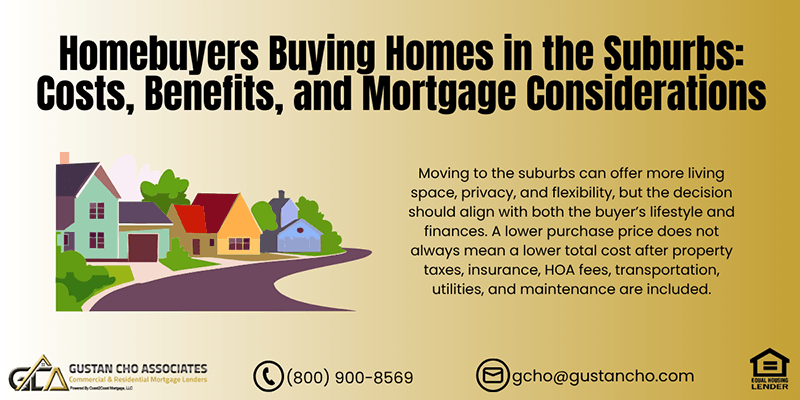
Moving to the suburbs can offer more living space, privacy, and flexibility, but the decision should align with both the buyer’s lifestyle and finances. A lower purchase price does not always mean a lower total cost after property taxes, insurance, HOA fees, transportation, utilities, and maintenance are included.
Homebuyers buying homes in the suburbs should also consider employment location, occupancy plans, property type, and what will happen to their current residence. These details can affect the qualifying payment, debt-to-income ratio, required documents, and final mortgage approval.
Before making an offer, ask a loan officer to review the specific property and estimate the complete monthly payment. A careful review can identify potential financing problems early and help buyers choose a suburban home they can comfortably afford for years to come.
Frequently Asked Questions About Homebuyers Buying Homes in the Suburbs
Do I Need a 20% Down Payment to Buy a Suburban Home?
No. A 20% down payment may help a conventional borrower avoid private mortgage insurance, but it is not required for every mortgage. Qualified buyers may have access to conventional, FHA, VA, USDA, or special loan programs with lower down payment requirements. Eligibility depends on the borrower, occupancy, property, loan amount, and program guidelines. The Consumer Financial Protection Bureau recommends comparing loan types because each option affects the required down payment and total borrowing cost.
Can First-Time Homebuyers Purchase Homes in the Suburbs?
Yes. First-time buyers can purchase suburban homes using many of the same mortgage programs available for properties elsewhere. Buyers may qualify for conventional, FHA, VA, USDA, or state and local housing programs. Some programs offer reduced down payments, closing-cost assistance, or more flexible qualification requirements. The buyer and property must still meet the selected program’s guidelines.
Can I Use Down Payment Assistance to Purchase a Home in the Suburbs?
Possibly. Down payment assistance may come from state housing agencies, local governments, nonprofit organizations, employers, or approved lenders. Programs may have income limits, purchase price limits, occupancy requirements, approved-lender rules, or homebuyer education requirements. Some are limited to first-time buyers, while others are not. Buyers can begin their search through HUD’s state homeownership resources and ask their loan officer which programs can be combined with their first mortgage.
Does a Suburban Address Affect the Mortgage Interest Rate?
The word “suburban” does not determine the mortgage rate. Rates are generally influenced by factors such as credit score, down payment, loan type, loan term, occupancy, property type, and current market conditions. Location can indirectly affect financing by changing the loan amount, property eligibility, insurance requirements, or available assistance programs. The CFPB mortgage-rate tool shows how credit, down payment, term, and loan type can change available rate offers.
Are Closing Costs Different for Homes in the Suburbs?
They can be. Closing costs may vary by state, county, lender, loan program, property type, and purchase contract. Local transfer taxes, recording fees, title charges, surveys, HOA transfer fees, inspections, and prepaid taxes or insurance can change the amount needed at closing. Buyers should review the official Loan Estimate and request property-specific quotes instead of relying on a general percentage.
Is It Better to Rent or Buy in the Suburbs?
The better option depends on the buyer’s finances and plans. Renting may provide greater flexibility and fewer repair responsibilities. Buying may provide stable housing, the opportunity to build equity, and more control over the property. Buyers should consider how long they expect to remain in the area, the cash needed at closing, future maintenance costs, local rents, and the total cost of ownership before deciding.
Do Suburban Homes Appreciate Faster Than City Homes?
Not necessarily. A suburban location does not guarantee faster appreciation. Future value depends on local supply and demand, employment growth, property condition, housing inventory, tax burden, transportation access, and future development. Some suburbs may outperform nearby cities, while others may grow more slowly. Buyers should treat appreciation as a possibility rather than a guaranteed return, and purchase a home that fits their current budget.
This article about “Homebuyers Buying Homes in the Suburbs: Costs, Benefits, and Mortgage Considerations” was updated on September 10th, 2026.