Understanding credit and DTI guidelines on conventional loans is one of the most important steps before applying for a mortgage. Conventional loans are not insured by the government, so lenders usually look closely at your credit score, monthly debts, income, down payment, and overall risk profile before issuing an approval. For most conventional loans, borrowers need a minimum credit score of 620. However, meeting the minimum does not always mean getting the best rate or easiest approval. Borrowers with higher credit scores, lower debt-to-income ratios, stable income, and cash reserves are more likely to be approved at better pricing.
Your debt-to-income ratio, also called DTI, measures how much of your gross monthly income goes toward paying monthly debt obligations. This includes the proposed mortgage payment, credit cards, auto loans, student loans, personal loans, and other monthly debts reported or required by underwriting.
Many conventional loan borrowers are strongest when their total DTI is 43% or lower. However, some borrowers may receive automated underwriting approval with DTI ratios up to 50%, depending on the full strength of the file. Credit score, down payment, reserves, property type, and payment history can all affect whether a higher-DTI conventional loan gets approved. The important thing to understand is that conventional loan approval is not based on a single number. If someone has a credit score of 620 and a high debt-to-income ratio, they might run into tougher approval conditions, higher rates, or extra requirements from lenders. A borrower with stronger credit, lower debt, and savings after closing may have more flexibility. In this guide, we will explain the credit and DTI guidelines on conventional loans, how Fannie Mae and Freddie Mac automated underwriting works, what compensating factors can help, and why one lender may deny a conventional loan that another lender can approve.
Credit and DTI Guidelines on Conventional Loans vs FHA Loans
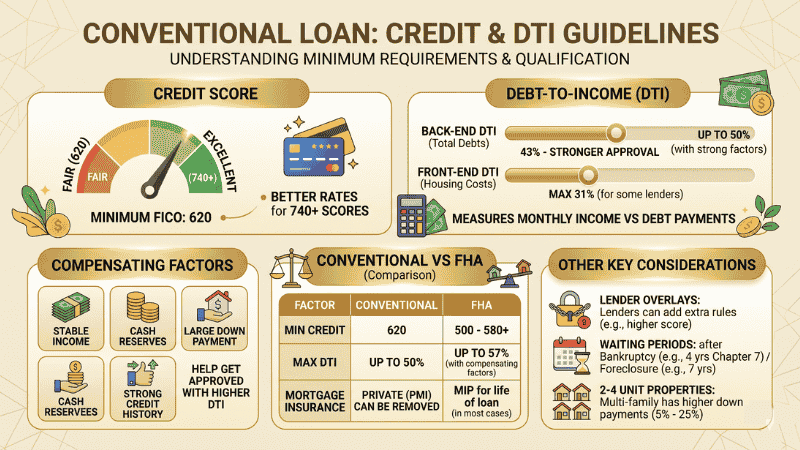
Most lenders like to see a credit score of at least 620. For a conventional loan, however, putting down a larger down payment or having a lower DTI can help a borrower with a lower score get approved. You can qualify for better interest rates if your score hits 740 or above. On the other hand, FHA loans can work with scores down to 580 for a 3.5% down payment. If your score is between 500 and 579, you can still qualify with a 10% down payment, but you’ll need to show a good track record of paying your bills.
Debt-to-Income Guidelines
Debt-to-Income, or DTI, is the percentage of your monthly income that goes to paying debts. For conventional loans, a DTI of 43% is the general limit. Still, lenders may allow a higher percentage for borrowers with stronger credit scores and more savings. FHA loans are more forgiving, with a cap of 31% for front-end DTI and a total DTI limit of 43% to 50%, depending on the borrower’s credit. Falling under these DTI caps shows lenders you can manage your monthly payments and other debts.
How Conventional Loan Guidelines Compare To FHA Loans
Conventional loans and FHA loans have different credit and DTI guidelines. Conventional loans are usually a better fit for borrowers with stronger credit, stable income, lower debt-to-income ratios, and enough down payment to qualify with Fannie Mae or Freddie Mac automated underwriting. FHA loans are usually easier for people with lower credit scores or higher debt-to-income ratios. FHA allows lower minimum credit scores than conventional loans and may be easier to qualify for when a borrower has past credit issues, limited savings, or a smaller down payment. The main difference is that conventional loans are based on their riskiness. Your credit score, DTI, down payment, property type, and reserves can affect your approval and mortgage pricing. FHA loans have more flexible qualifying standards, but they also require FHA mortgage insurance, which can increase the loan’s long-term cost. For borrowers who qualify for both programs, the better choice depends on the full mortgage profile. A borrower with higher credit scores and a lower DTI may benefit from a conventional loan. A borrower with lower credit scores, recent credit challenges, or a higher DTI may need to compare FHA as an alternative.
Credit and DTI Guidelines on Conventional Loans vs FHA Loans: Which Loan Fits You?
The right choice between a conventional loan and an FHA loan depends on your unique financial picture. If you have good credit, a stable income, and can make a reasonable down payment, a conventional loan might save you money on mortgage insurance and interest. However, your credit score is lower, or you have a smaller down payment. In that case, an FHA loan can help you step onto the property ladder with more affordable monthly payments right from the start. John Strange, a senior mortgage loan originator says the following about credit and DTI guidelines on conventional loans vs FHA loans:
Credit score standards vary quite a bit for conventional loans versus government-backed options. On a conventional loan, most lenders want you to score at least 620, but many of them start to prefer 640 or even higher.
Suppose your score hits 740 or above; you’re on track to get the most attractive rates and loan terms. If your score falls between 620 and 680, prepare for higher rates or extra hoops to jump through, such as a bigger down payment or more cash reserves in the bank. Conventional loans lean toward stronger scores because the higher the score, the more a lender trusts your ability to repay. If you’re below 620, getting approved for a conventional loan is tough. However, a low debt-to-income ratio or a hefty down payment can tip the scales in your favor.
When Conventional Loan Credit And DTI Guidelines May Be Harder To Meet
Conventional loan approval can be more difficult when a borrower has lower credit scores, higher debt-to-income ratios, limited savings, or recent credit issues. Even though many conventional loans allow a minimum credit score of 620, borrowers near the minimum may face higher mortgage rates, stricter automated underwriting results, or additional lender overlays. The debt-to-income ratio can also create challenges. Some conventional loan borrowers may receive automated underwriting approval with DTI ratios up to 50%, but that does not mean every borrower will qualify at that level. A higher DTI file usually needs stronger compensating factors, such as stable income, cash reserves, a larger down payment, or a strong credit history.
Conventional loan guidelines may also be harder to meet after bankruptcy, foreclosure, short sale, deed-in-lieu of foreclosure, recent late payments, or unresolved credit disputes. These issues can affect automated underwriting approval and may cause one lender to deny a file that another lender may be able to approve.
When a borrower cannot meet the credit and DTI guidelines on conventional loans, an FHA loan may be worth considering. FHA loans may offer more flexible credit scores and debt-to-income requirements for borrowers who do not qualify for conventional financing. The best loan option depends on the borrower’s credit profile, income, debts, down payment, property type, and long-term mortgage goals.
Understand Credit and DTI Guidelines for FHA vs. Conventional Loans
Find out which loan option has the best requirements for your financial situation and get approved.Credit and DTI Guidelines on Conventional Loans: Front-End and Back-End Debt-to-Income Ratio
Conventional loans do not have a front-end debt-to-income ratio. The maximum debt-to-income ratio cap on conventional loans is 50%. However most lenders have lender overlays on debt-to-income ratio on conventional loans. Alex Carlucci explains the front-end and back-end debt-to-income ratio many lenders impose on conventional loans as follows:
Conventional loans break down the DTI into two parts. The front-end ratio only counts your housing costs. This includes the mortgage payment, property taxes, and homeowners insurance, and it usually shouldn’t be more than 31% of your income. The back-end ratio includes all monthly debt, like car loans, credit cards, and student loans, and it also needs to stay at or below 43%. If your DTI is above 43%, you’ll usually have to show that you have solid financial reserves to get approved.
FHA loans give borrowers some leeway regarding debt-to-income (DTI) ratios, which is helpful for people carrying larger amounts of debt. The standard rule is that the total DTI should stay below 43%. Still, lenders can sometimes extend that ceiling to 50% or even 57% when borrowers show extra strengths—like a good credit score, a steady job history, or a decent pile of cash reserves. The front-end DTI, which looks only at housing costs, usually has a 31% cap on gross income. The back-end DTI, which includes all monthly obligations, can still surpass 43% if the compensating points are solid. This approach acknowledges that some borrowers can handle a mortgage even at higher DTI levels if they plan their finances carefully.
Fannie Mae And Freddie Mac Guidelines vs Lender Overlays
 Fannie Mae and Freddie Mac set the baseline rules for most conventional loans. These rules cover credit scores, debt-to-income ratios, down payment requirements, property types, mortgage insurance, reserves, and waiting periods after major credit events. However, meeting the basic conventional loan guidelines does not always guarantee approval.
Most conventional loan approvals are first reviewed through automated underwriting. Fannie Mae uses Desktop Underwriter, often called DU. Freddie Mac uses Loan Product Advisor, often referred to as LP. These systems review the borrower’s full loan profile, including credit score, income, debts, assets, down payment, occupancy type, and property risk.
When automated underwriting issues an approve/eligible finding, it means the loan may meet Fannie Mae or Freddie Mac guidelines if all information can be verified and documented. However, some lenders add their own extra rules on top of agency guidelines. These extra rules are called lender overlays. A lender overlay may require a higher credit score, a lower debt-to-income ratio, more cash reserves, or stricter rules on recent late payments, collections, credit disputes, or bankruptcy history. This is why a borrower may be denied by one lender even though the file could meet Fannie Mae or Freddie Mac guidelines through automated underwriting. For borrowers trying to meet credit and DTI guidelines on conventional loans, lender overlays can make a big difference. A borrower with a 620 credit score, higher DTI, limited reserves, or past credit issues may be told by one lender that they do not qualify. Another lender with no overlays may be able to approve the same borrower if the file receives eligible automated underwriting findings and meets agency requirements. Gustan Cho Associates works with borrowers who may have been denied elsewhere because of lender overlays. The goal is to review the full file in accordance with actual conventional loan guidelines, automated underwriting findings, and documented compensating factors, rather than applying unnecessary extra restrictions.
Conventional Loan DTI Guidelines
Conventional loan DTI guidelines focus mostly on the borrower’s total back-end debt-to-income ratio. The back-end DTI includes the new mortgage payment plus other monthly debt obligations, such as credit cards, auto loans, student loans, personal loans, child support, and other debts counted by underwriting. Many conventional loan borrowers are strongest when their total DTI is 43% or lower. A lower DTI shows the lender that the borrower has more room in the monthly budget after paying the mortgage and other debts. Borrowers with lower DTI ratios may have an easier time getting approved and may receive better loan terms.
Some conventional loan files may receive automated underwriting approval with DTI ratios up to 50%. However, a 50% DTI does not guarantee automatic approval. Fannie Mae Desktop Underwriter and Freddie Mac Loan Product Advisor review the full borrower profile before issuing an approval recommendation.
A higher-DTI conventional loan usually needs stronger compensating factors. These may include a higher credit score, stable income, money left over after closing, a larger down payment, strong payment history, or a property type with less risk. The stronger the file, the better the chance of receiving an approve/eligible finding through automated underwriting. Lender overlays can also affect conventional loan DTI limits. Fannie Mae or Freddie Mac may allow a higher DTI through automated underwriting, but an individual lender may cap the borrower’s DTI at a lower number, such as 43%, 45%, or another internal limit. This is why a borrower may be denied by one lender and approved by another lender with no overlays. For borrowers with higher debt-to-income ratios, the key is not only the DTI number. The full file matters. Credit score, reserves, down payment, property type, income stability, and automated underwriting findings all help determine whether the borrower can meet credit and DTI guidelines on conventional loans.
Overview of the Mortgage Process
Don’t forget about mortgage insurance, loan limits, and property rules. With a conventional loan, you first pay private mortgage insurance (PMI), but you can drop it later. FHA loans have mortgage insurance premiums (MIP) that stick around for the life of the loan. FHA loan limits are usually lower than conventional loans, especially in pricey areas. So, checking your local limits with HUD or Fannie Mae is smart. FHA loans also have tighter home rules, ensuring the property is safe and livable. This can narrow your options compared to a conventional loan.
To max out your chances at either type of loan, start by boosting your credit score. Pay down credit card balances, steer clear of new debts, and always make your payments on time.
Lowering your debt-to-income (DTI) ratio helps, too. You can do this by knocking out smaller debts or earning extra income. Saving up for a bigger down payment can calm worries over a lower credit score or a higher DTI. Touching base with a mortgage lender is a smart next step, letting you dig into your finances and find the loan that fits you best. Ultimately, choosing between a conventional loan and an FHA loan comes down to your credit score, DTI ratio, and homeownership plans. Conventional loans are great for those with solid credit and a low DTI, giving competitive rates and flexible terms. On the other hand, FHA loans welcome those with lower credit scores or higher DTI, making homeownership more within reach. Knowing the rules lets you confidently decide and approach your new front door. Talk to a mortgage lender about your choices for extra help that’s just right for you.
2 To 4 Unit Home Purchases
Cases, where home buyers should benefit from FHA loans and NOT conventional loans, is when they are purchasing a multi-unit home as their primary residence. For example, multi-family homes up to 4 units are considered residential homes. Multi-unit mortgage loan applicants can qualify for residential mortgage loans.
HUD allows 3.5% minimum down payments for multi-family units up to 4 units. Conventional loans, a 5% down payment is required for single-family homes as well on two to four-unit properties. Fannie Mae and Freddie Mac now requires a 5% down payment on two-unit owner occupant homes.
15% down payment is required for 3 to 4 unit owner occupant units on conventional loans. This is a case where a home buyer with excellent credit and income will benefit from FHA loans and NOT conventional loans.
Credit Issues That Can Affect Conventional Loan Approval
Credit and DTI guidelines on conventional loans are not limited to credit scores and monthly debt ratios. Underwriters also review the borrower’s credit history, payment patterns, disputed accounts, collections, charge-offs, and recent credit activity. Even when a borrower meets the minimum credit score and DTI requirements, unresolved credit issues can still delay or weaken conventional loan approval.
Collections And Charge-Offs
Collections and charge-offs can affect conventional loan approval if they change the borrower’s risk profile or increase the debt-to-income ratio. Some collection accounts may not need to be paid before closing. However, underwriters still review the account type, balance, reporting date, and whether a payment agreement exists. If a borrower has large unpaid collections, the lender may need to count a monthly payment toward DTI or require documentation showing how the account will be handled. Medical collections are often treated differently from non-medical collections, but borrowers should not assume all collections will be ignored. The safest step is to review collection accounts with a loan officer before applying. Paying off or disputing accounts without guidance can sometimes lower credit scores or create new underwriting problems.
Credit Disputes During The Mortgage Process
Credit disputes can create problems during conventional loan underwriting. A disputed account may cause automated underwriting to disregard certain credit history, making approval less reliable. In some cases, the borrower may need to remove the dispute before the loan can move forward. This matters because resolving a dispute can improve a credit score. If the score drops below the required level, the borrower may lose the conventional loan approval or need a different loan strategy. Borrowers should not open new disputes during the mortgage process unless their loan officer advises them to do so. If there are already disputed accounts on the credit report, they should be reviewed early to avoid surprises before closing.
Late Payments Before Closing
Recent late payments can be a serious issue on conventional loans. A borrower may receive an initial approval, but the lender can still re-check credit before closing. If a new late payment appears, the file may need to be re-underwritten. Late payments on mortgages, auto loans, credit cards, or other debts can weaken the borrower’s credit profile and may affect automated underwriting findings. A late payment before closing can also raise concerns about the borrower’s ability to manage the new mortgage payment. The best rule is simple: keep every account current from application through closing. Do not miss payments, open new accounts, increase credit card balances, or make major financial changes while the loan is in process.
Which Loan Works for You? Conventional vs. FHA Credit and DTI Guidelines
We’ll help you understand the key differences in credit and DTI requirements for FHA and conventional loans.Mortgage Guidelines on Credit Disputes
There are strict mortgage guidelines on credit disputes during mortgage process. Credit disputes: Credit disputes applies to both FHA loans, USDA Loans, VA Loans, and Conventional loans.
- Borrowers cannot have any credit disputes with open credit balances (certain rules applies) in general
- For example, if someone has a derogatory credit item that is five years old with a $5,000 balance, they cannot try to delete that item by disputing it to the credit bureaus
- Stating and disputing that the derogatory item does not belong to them in hopes of the creditor not responding back and hoping in getting that derogatory credit item removed will not work
- If it is an active pending dispute, mortgage application process will come to an immediate halt
- Before it can proceed again, mortgage borrower needs to retract the credit disputes
- Unfortunately, if borrower retract the credit dispute, credit scores will likely drop
- Medical credit disputes with open credit balances are exempt from this rule
- Non-medical credit disputes with zero balances are exempt from credit dispute guidelines
Any non-medical collections with an aggregate outstanding balance under $1,000 is exempt from credit disputes.
Conventional Loan Waiting Periods After Bankruptcy Or Foreclosure
Conventional loan waiting periods are important for borrowers who had a prior bankruptcy, foreclosure, short sale, or deed-in-lieu of foreclosure. Even if a borrower now has a strong credit score and stable income, Fannie Mae and Freddie Mac may still require a waiting period before the borrower can qualify for a conventional mortgage.
For a Chapter 7 bankruptcy, conventional loans generally require a waiting period after the bankruptcy discharge date. For a foreclosure, the waiting period is usually measured from the completed foreclosure date. Short sales and deed-in-lieu of foreclosure also have their own waiting period rules.
These waiting periods can affect automated underwriting approval. A borrower may meet the minimum credit score and DTI requirements but still be ineligible for a conventional loan if the required waiting period has not been met. This is why borrowers with past major credit events should have their credit report, bankruptcy paperwork, foreclosure records, and housing history reviewed before applying.
Extenuating circumstances may sometimes allow a shorter waiting period, but they must be well-documented and accepted by underwriting. Job loss, medical hardship, divorce, or other financial events do not automatically qualify. The lender must be able to document the event, show that it was beyond the borrower’s control, and confirm that the borrower has recovered financially.
For borrowers who do not meet conventional loan waiting period rules, FHA, VA, USDA, or Non-QM loans may be worth comparing. However, this section should stay focused on conventional loan approval. The key point is simple: credit and DTI guidelines on conventional loans are only part of the approval process. Major credit events can create separate waiting period requirements even when the borrower’s current income, credit score, and DTI look strong.
Credit And DTI Guidelines On Conventional Loans And Score Requirements
Conventional loan programs require a minimum credit score of 620 FICO. However, 620 credit score is considered pretty bad credit with conventional mortgage lenders and those with the 620 credit score will most likely get penalized with high mortgage rates. To get the best possible conventional mortgage rates, a borrower should have credit scores over 740. Unlike FHA loans, where anyone with a credit score of 640 FICO or higher get the same interest rate, conventional loans are different. For the top conventional mortgage rate, your credit scores need to be at 760 FICO or higher. Then there are mortgage rate adjustments every 20 points. Rates get higher at 740, 720, 700, 680, 660, 640, 620. The lower your bracket, the higher the rate.
2026 Credit and DTI Guidelines on Conventional Loans
Here are 2026 Credit And DTI Guidelines on Conventional loans:
- Minimum credit scores are 620 FICO
- Down payment requirements: 3% down payment for first time home buyers: 5% for veteran homebuyers on single-family homes, condos, townhomes.
- 10% down payment for second/vacation homes.
- 5% down payment for 2 unit multi-family homes.
- 25% down payment for 3 to 4 unit multi-family homes
Waiting period after bankruptcy and a housing event:
- Waiting period after a bankruptcy, foreclosure, deed in lieu of foreclosure, a short sale is much tougher for conventional loans
- There is a seven-year waiting period after foreclosure
- Four year waiting period after the recorded date of deed in lieu of foreclosure
- Four year waiting period after a short sale
- Four-year waiting period after Chapter 7 Bankruptcy discharged date if the mortgage was part of Chapter 7 Bankruptcy
- The housing event can happen after the discharged date of Chapter 7 Bankruptcy
The mortgage cannot be re-affirmed.
Cases Where Conventional Loan is The Only Option Due To Credit and DTI Guidelines on Conventional Loans
There are cases where a conventional loan versus an FHA loan is the only option. For homebuyers wanting to purchase a condominium home and the condominium complex is not FHA approved, they can only purchase the subject condominium with a conventional loan. Other cases where you need to go with a conventional loan versus FHA loan is when the buyer wants to purchase a second home and/or investment property. HUD only allows primary owner occupant units to be financed. Second-home financing and investment properties are not allowed under FHA mortgage lending guidelines.
Qualifying For Home Loan With a Lender With No Overlays
Homebuyers or homeowners needing a home mortgage with a direct lender with no overlays can contact The Gustan Cho Team at 800-900-8569 or text us for faster response. Or email us at gcho@gustancho.com. We are available 7 days a week, evenings, weekends, and holidays. Gustan Cho Associates has no lender overlays on government and conventional loans.
Final Thoughts On Credit And DTI Guidelines On Conventional Loans
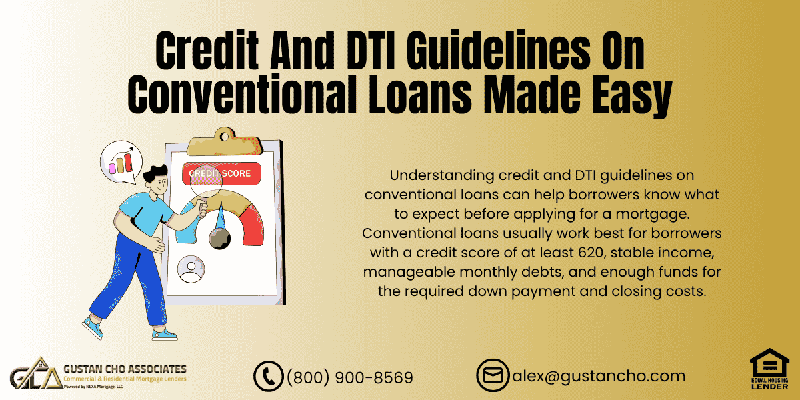
Understanding credit and DTI guidelines on conventional loans can help borrowers know what to expect before applying for a mortgage. Conventional loans usually work best for borrowers with a credit score of at least 620, stable income, manageable monthly debts, and enough funds for the required down payment and closing costs. However, conventional loan approval is not based solely on credit score and DTI. Fannie Mae and Freddie Mac automated underwriting also reviews payment history, reserves, property type, occupancy, down payment, employment stability, and overall risk. A borrower with a higher DTI may still qualify if the rest of the file is strong. If someone has a lower credit score, they’ll need to present solid reasons why they should still be approved.
Lender overlays can also make a major difference. One lender may deny a conventional loan due to stricter internal rules. In contrast, another lender may approve the same borrower if the file meets Fannie Mae or Freddie Mac guidelines. This is why borrowers should not assume they are out of options after one denial.
The best way to prepare for a conventional loan is to review your credit report, avoid new debt, keep all payments current, lower credit card balances, document your income, and save as much as possible before applying. The stronger your full mortgage profile, the better your chances of meeting conventional loan credit and DTI requirements. At Gustan Cho Associates, we help borrowers understand their loan options, review automated underwriting findings, and compare conventional loan approval paths with no unnecessary lender overlays. If you were told you do not qualify for a conventional mortgage, your file may still have options with the right lender and the right loan strategy.
Frequently Asked Questions About Credit And DTI Guidelines On Conventional Loans:
What Are The Credit And DTI Guidelines On Conventional Loans?
The basic credit and DTI guidelines on conventional loans usually require a minimum 620 credit score and a debt-to-income ratio that can be approved by Fannie Mae or Freddie Mac automated underwriting. Many borrowers are strongest with a DTI of 43% or lower, but some files may receive approval up to 50% DTI when the overall mortgage profile is strong.
What Credit Score Do You Need For A Conventional Loan?
Most conventional loans require a minimum credit score of 620. However, borrowers with higher credit scores often have a better chance of approval, lower mortgage rates, and better loan pricing. A borrower with a 620 score may still qualify, but the file may need higher income, lower DTI, more reserves, or a larger down payment.
What Is The Highest DTI Allowed An A Conventional Loan?
Some conventional loan files may be approved with a debt-to-income ratio up to 50% through automated underwriting. However, approval is not guaranteed at 50% DTI. Fannie Mae Desktop Underwriter and Freddie Mac Loan Product Advisor review the full file, including credit score, income, assets, down payment, property type, and overall risk.
Can I Get A Conventional Loan With High DTI?
Yes, it may be possible to get a conventional loan with high DTI if the file has strong compensating factors. These may include a higher credit score, stable employment, cash reserves after closing, a larger down payment, low payment shock, or strong credit history. Some lenders may still cap DTI because of lender overlays, even if automated underwriting allows a higher ratio.
Why Would One Lender Deny My Conventional Loan And Another Approve It?
One lender may deny a conventional loan because of lender overlays. Lender overlays are extra rules added on top of Fannie Mae or Freddie Mac guidelines. For example, one lender may require a higher credit score, lower DTI, more reserves, or stricter rules on credit disputes and late payments. Another lender with no overlays may be able to approve the same borrower if the file meets agency credit and DTI guidelines on conventional loans.
How Can I Improve My Chances Of Meeting Credit And DTI Guidelines On Conventional Loans?
You can improve your chances of meeting credit and DTI guidelines on conventional loans by paying all bills on time, lowering credit card balances, avoiding new debt, saving reserves, documenting income clearly, and keeping your financial profile stable before closing. Borrowers with higher DTI should avoid opening new credit accounts or increasing their monthly debt during the mortgage process.
This article about “Credit And DTI Guidelines On Conventional Loans Made Easy” was updated on April 24th, 2025.