Property taxes can be one of the highest ongoing costs of owning a home. When your home is assessed too high, your annual tax bill can increase even if your property would not realistically sell for that amount in today’s market. That is why many homeowners look into a property tax appeal.
A property tax appeal is the process of asking your local tax assessor or review board to reconsider the value placed on your home. If the assessed value is higher than it should be, you can lower your property taxes by showing evidence such as incorrect property details, recent comparable sales, or problems with the condition of the home.
Homeowners often assume the assessor’s value is final, but that is not always the case. Assessment errors happen. In some cases, similar homes in the same neighborhood may be taxed less because their records are more accurate or their values were reviewed more carefully. When that happens, filing a property tax appeal may help correct the issue. In this guide, we will explain how a property tax appeal works, when it may make sense to challenge your assessment, what evidence helps support an appeal, and what steps homeowners can take to try to reduce their property tax burden.
Property Tax Appeal for Homeowners: Save Money on High Property Taxes
High property taxes can hurt your wallet, especially when the assessed values feel off the charts. Luckily, there’s a way to fight back: the property tax appeal. This step-by-step guide walks you through the appeal process, showing you how to lower your bill without going crazy. If your tax bill keeps climbing or your home’s assessed value seems too high, stick with us. We’ll help you turn numbers back in your favor.
What’s a Property Tax Appeal?
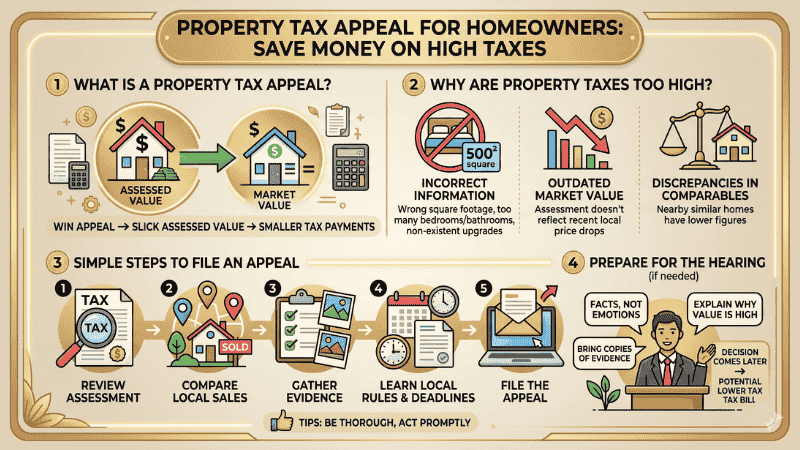
A property tax appeal is your chance to argue that your home’s assessed value—set by the tax office—needs a downgrade. Property taxes usually come from multiplying the assessed value of your house by your town’s tax rate. If that assessed value is higher than what your house is worth on the market, you’re probably overpaying. Win the appeal, and your home’s assessed value is slashed, meaning smaller tax payments.
Why Are Property Taxes Sometimes Too High?
Property taxes are usually based on your home’s assessed value, but that value is not always accurate. When the assessment is too high, homeowners can end up paying more than they should each year.
One common reason is incorrect property information. The assessor’s records may show the wrong square footage, too many bedrooms or bathrooms, or upgrades that do not exist. Even small errors can increase a home’s assessed value.
Another reason is that the assessed value may not reflect current market conditions. If home prices in your area have slowed down or dropped, your tax assessment may still be based on older, higher values. That can leave homeowners paying taxes on a number that no longer matches the market. Property taxes can also feel unfair when similar homes nearby are assessed at lower values. If homes with similar size, age, condition, and location have lower assessments, it may be a sign that your property is overvalued. Understanding why your property taxes are high is the first step in deciding whether a property tax appeal may be worth pursuing.
Navigating Your Property Tax Appeal
- Market Fluctuations: Your assessment still claims values that ignore recent local price drops.
- Overvaluation: The number on your notice is higher than your home is worth.
- Discrepancies in Comparable Properties: Nearby houses like yours have lower figures.
Understanding these points is the first step toward a winning appeal.
Why Appeal Your Property Taxes?
Lowering your assessed value means lower taxes. Slice $50,000 off your number and, at a 2% rate, that’s $1,000 back in your pocket each year. The win is not just dollars; it’s fairness and correcting mistakes that could haunt future bills. The catch? Appeals take time, paperwork, and patience. Always weigh the potential refund against the work ahead.
Simple Steps to File a Property Tax Appeal
 Filing a property tax appeal does not have to be overwhelming. The process is usually easier when homeowners break it down into a few clear steps. Instead of trying to do everything at once, focus on reviewing your assessment, gathering proof, and following your local appeal process carefully.
Review Your Property Tax Assessment Carefully
Start by getting a copy of your latest property tax assessment notice. Check the details for your home. Look at the square footage, number of bedrooms and bathrooms, lot size, and features that can affect its value. If the assessor’s records contain mistakes, those errors could increase your property taxes. You should also confirm that any exemptions you qualify for, such as a homestead exemption, senior exemption, or veteran exemption, have been applied correctly. In some cases, fixing an error or missing exemption may reduce your tax bill without needing a full appeal.
Compare Your Home to Recent Local Sales
Once you confirm the basic facts about your property, the next step is to look at recent sales of similar homes in your area. Focus on homes that are close in size, age, condition, and location. If those homes sold for less than your assessed value, that may support your case for a property tax appeal. This step helps you determine whether your assessment is truly out of line with the market. It also gives you a stronger foundation before you file anything with the county or local review board.
Gather Evidence That Supports Your Case
A successful property tax appeal usually depends on evidence, not opinion. Homeowners should collect documents that help show the property is worth less than the assessed value. This may include recent comparable sales, an independent appraisal, photos showing damage or outdated features, repair estimates, or records that show similar homes are assessed lower. The goal is to show clear reasons why the value should be reduced. The stronger and more organized your evidence is, the better your chances of making a convincing case.
Learn Your Local Appeal Deadline and Filing Process
Property tax appeal rules vary by county and state, so it is important to review the exact process in your area. Many local assessor offices publish deadlines, forms, and filing instructions on their websites. Some counties allow online filing, while others require mailed forms or in-person submissions. Deadlines matter. If you miss the appeal window, you may need to wait until the next assessment cycle before challenging the value again. That is why homeowners should review their notice and local rules as soon as possible.
File the Appeal Clearly and Completely
When you are ready to file, complete all required forms carefully and include the supporting documents that explain why your assessed value is too high. Keep your explanation short, factual, and easy to follow. Instead of making emotional arguments, focus on the numbers, property details, and comparable sales that support your position. A well-prepared appeal gives the assessor or review board a clearer reason to reconsider your property value. In many cases, being organized and accurate can make a major difference.
High Property Taxes? Let Us Help You Appeal Your Assessment
Learn how to lower your property tax burden by filing an appeal with professional guidance.Prepare for the Property Tax Appeal Hearing
If your property tax appeal moves to a hearing, do not panic. Most hearings are straightforward and give homeowners a chance to explain why they believe their assessed value is too high.
The best way to prepare is to keep your information organized. Bring copies of your comparable sales, appraisal if you have one, photos of the property if they help show condition issues, and any records that support your case. Make sure you can clearly explain why you believe the assessed value is too high compared to similar homes or the current market value.
During the hearing, stay focused on facts instead of emotions. Point out any errors in the property record, differences between your home and higher-valued properties, or recent sales that support a lower value. In many cases, a clear and calm explanation is more effective than a long presentation. You do not need to make the process more complicated than it is. Most homeowners need solid evidence, clear reasoning, and a basic understanding of their local appeal rules.
Follow Up on the Decision of Property Tax Appeal
Once the hearing is over, you’ll get a letter with the official decision. If you win, the new assessed value will appear on your next tax bill. If the board decides against you, you can usually take the next step with a state tax appeals board or possibly a court. Remember, those routes can get expensive, so weigh your options carefully.
Tips for a Successful Property Tax Appeal
- Act Promptly: Keep an eye on those filing deadlines. They’re set in stone.
- Be Thorough: Gather every piece of Evidence you can. The more, the better.
- Consider Professional Help: If the paperwork feels like a maze or your property is worth a lot, hiring a tax consultant or attorney might pay off.
- Many charge a percentage of the tax savings, so you only pay if you win.
- Check for Exemptions: Even if your appeal flops, you might still qualify for exemptions that can lower your bill.
- Monitor Future Assessments: Winning an appeal doesn’t guarantee a low value forever.
- Check your property value every year.
Common Property Tax Appeal Mistakes to Avoid
- Failing to Provide Evidence: Saying, “My taxes are too high,” doesn’t cut it. Bring facts, not feelings.
- Using the Wrong Comparables: Always pick comps that closely match your property in size, age, and neighborhood.
- A nearby four-bedroom home built in 2005 tells a different story from a two-bedroom condo built in 1980.
- Missing Deadlines: File your appeal on time.
- Once deadlines pass, the assessor’s decision is final, no matter how strong your case is.
- Set reminders and double-check local calendar dates.
Overlooking Small Savings
A $100 drop in your assessment may seem small, but it compounds yearly. If the assessor makes a mistake, argue it. Small gains lead to big results when interest is factored in.
When to Get Help
Consider hiring a pro when your assessed value is way above market value or the appeal path looks confusing. Property tax consultants and lawyers know the local codes, gather the right data, and represent you at hearings. Find local specialists with good reviews and ask for a clear list of fees before signing.
What Happens After You Submit a Property Tax Appeal?
After you file your property tax appeal, your local assessor’s office or review board will review the information you submitted. In some cases, the assessor may adjust the value without a formal hearing. In other cases, you may be asked to attend a hearing and explain your evidence. If your appeal is approved, the lower assessed value may reduce your future property tax bill. If your appeal is denied, you may still have the option to request another review or appeal to a higher board, depending on your local rules.
What to Know Before Starting the Property Tax Appeal Process
Before starting a property tax appeal, homeowners should understand that the goal is not to lower the tax rate. The goal is to demonstrate that the home’s assessed value is too high. If the assessed value is reduced, the tax bill may also go down.
Property tax appeal rules vary by county, city, and state. Some local offices allow homeowners to file online, while others require a written petition or an in-person submission. The assessment notice should explain the deadline and the basic filing instructions.
Homeowners should also understand that an appeal is based on evidence. Comparable sales, property record errors, photos of condition issues, repair estimates, and appraisal reports can all help support the case. Simply saying the tax bill is too high usually is not enough. If the appeal is denied, there may be another review option through a local board, state tax appeal board, or court. However, homeowners should weigh the possible savings against the time, cost, and effort involved.
Compare Your Property Taxes With Similar Homes Nearby
Before filing a property tax appeal, compare your property taxes and assessed value with similar homes in your neighborhood. The best comparison is usually not a home in another town or county, because tax rates can vary widely by location. Focus on homes near you that are similar in size, age, condition, lot size, and property type. If similar homes are assessed for less, or if recent sales show that your home’s assessed value is higher than market value, you may have a reason to appeal. The strongest case usually comes from clear evidence, such as recent comparable sales, public assessment records, or errors in your property record. Property taxes can differ from one community to another, so the goal is not simply to prove that your tax bill feels high. The goal is to show that your property is being assessed unfairly compared with similar homes under the same local tax rules.
Review Assessment Statement For Errors
When homeowners get their property assessment statements, make sure it is correct with no errors. Specific attention should be given to the number of bedrooms and bathrooms. Is the size of the lot correct? Errors do occur and most homeowners do not pay attention. Finished basements and attics do not count as living spaces. However, an assessor can count bedrooms and bathrooms in the basement and attics as livable spaces thus increasing assessed values.
Researching Comparable Sales And Properties
Sales of properties in the neighborhood are public records. Homeowners should be able to check for comparable sales in the area. Or better yet, ask a real estate agent in the area for 3 to 5 comparable sales. Alex Carlucci, a mortgage loan officer at Gustan Cho Associates says the following about property tax appeal:
Websites like realtor.com list comparable sales in your area. Worst case scenario, homeowners can hire their own home appraisers and get an accurate appraisal.
Comparable sales are listed on home appraisals. Things to look for in comparable sales is to check assessments on the property. Most county agencies have public tax information listed. If other properties that are similar and like your have lower assessments, you then have a strong case to do a property tax appeal and win.
Contact County Property Assessors Office
Every county has its own property tax appeal process. Many rural counties will take taxpayers phone calls and discuss their case scenario over the phone. Some require a formal filing of a petition. Others allow it to be done online. Contact the assessor’s office and learn what their property tax appeal process is like. Tax Appeal cases can take time. Time varies upon the municipality.
Board Review Results and Options For Taxpayers
There are instances where taxpayers get denied their property tax appeal. Decisions of tax appeals can be appealed by homeowners. It is normally appealed to an independent agency. There are fees involved which are normally very nominal. Again, this can take months or more than a year. Alex Carlucci, a senior mortgage loan originator at Gustan Cho Associates says the following about property tax appeal:
The board of appeals can only lower property assessment and not the tax rate. On the flip side, an appeal on the county assessors decision can backfire on homeowners and the board can increase the asses value.
If this is the case, property taxes will increase and not decrease. Homeowners can also explore homeowners’ savings to see if they qualify for property tax exemptions. Many counties and/or towns offer property tax exemptions to homeowners based on military service disability, age, and other factors.
Final Thoughts on Property Tax Appeal for Homeowners
Property taxes are a major part of homeownership, but that does not mean every assessment is accurate. When your home’s assessed value is higher than it should be, you may end up paying more than your fair share year after year.
A property tax appeal gives homeowners a way to challenge that value using clear evidence such as comparable sales, corrected property details, and current market conditions. While the process may take some time, even a modest reduction in assessed value can lead to meaningful long-term savings.
The key is to stay organized, act within your local deadlines, and focus on facts rather than opinions. Reviewing your assessment regularly and comparing it with similar homes in your area can help you catch issues early and decide whether an appeal is worth pursuing. If your situation feels complex or the potential savings are significant, consider working with a local professional who understands the property tax appeal process in your area. Otherwise, many homeowners can handle the process themselves with proper preparation.
Frequently Asked Questions About Property Tax Appeal:
Can You Appeal Your Property Taxes And Win?
Yes, homeowners can win a property tax appeal if they provide strong evidence that their home’s assessed value is too high. Successful appeals usually include comparable home sales, proof of errors in property records, or documentation showing the home is worth less than the assessed value.
What Evidence Is Needed For A Property Tax Appeal?
The best evidence for a property tax appeal includes recent comparable sales (comps), a professional appraisal, photos of property condition issues, repair estimates, and records showing similar homes are assessed at lower values. Clear and organized documentation increases your chances of success.
How Long Does A Property Tax Appeal Take?
A property tax appeal can take a couple of weeks to a few months, depending on where you live and your local tax office. Some cases are resolved quickly, while others may require a formal hearing and additional review.
Is It Worth Appealing Property Taxes For A Small Reduction?
Yes, even a small reduction in assessed value can lead to long-term savings. Since property taxes are paid every year, even a small reduction in your assessment can add up over time.
What Are The Chances Of Winning A Property Tax Appeal?
The chances of winning a property tax appeal depend on the strength of your evidence. Homeowners who provide accurate comparable sales, correct property errors, and support their case with documentation generally have a higher success rate.
Do You Need A Lawyer To File A Property Tax Appeal?
No, most homeowners do not need a lawyer to file a property tax appeal. Many appeals are handled directly by homeowners. However, for higher-value properties or complex cases, hiring a tax consultant or attorney may help improve your chances.
This article about “Property Tax Appeal For Homeowners With High Property Taxes” was updated on April 23rd, 2026.