
Your credit score is important when it comes to getting a mortgage, figuring out interest rates, and choosing loan options. When lenders review your application, they want to see how you have handled credit over time and whether your current credit profile shows financial stability. Even a little bump in your score can boost your chances of qualifying and snagging a better mortgage rate. The good news is that credit scores are not random. They are built on a few well-known factors, and each one affects your mortgage application differently. Understanding these factors can help you prepare before applying for a home loan and avoid surprises during underwriting.
Why Credit Scores Matter for Mortgage Approval
Mortgage lenders use credit scores to measure risk. In general, higher scores show a stronger history of managing debt, while lower scores may signal late payments, high balances, or other credit concerns. Having a better credit score can help you snag a mortgage more easily. Plus, it might help you get lower interest rates, smaller monthly payments, and more loan options.
The Five Main Factors Influencing Credit Scores
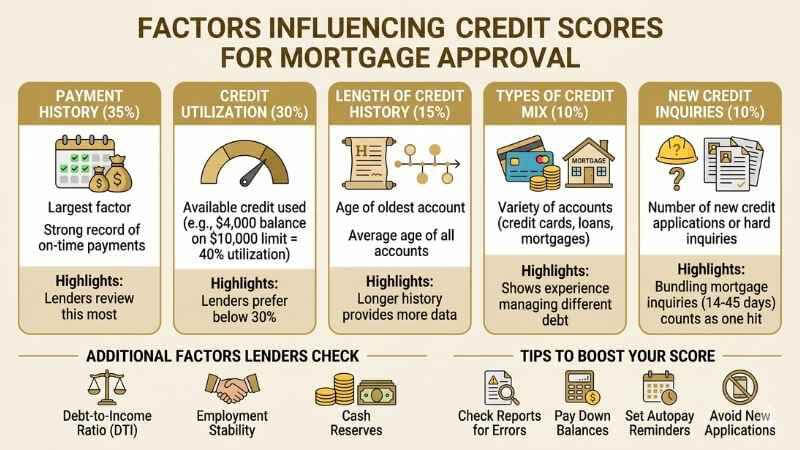
There are five main factors influencing credit scores when applying for a mortgage: payment history, amounts owed, length of credit history, credit mix, and new credit inquiries. Some factors carry more weight than others, but all five can affect how lenders view your application. Knowing how these categories work can help you focus on the areas that matter most before you apply.
What Mortgage Lenders Look for in Your Credit Report
Lenders do not rely solely on your credit score. They also review your credit report to understand the story behind the number. They want to see whether you pay on time, how much available credit you are using, how long you have managed credit, and whether you have recently taken on new debt. When these areas are strong, borrowers are usually in a better position for mortgage approval.
Start With the Most Important Credit Score Factor
Payment history is usually the biggest factor influencing credit scores. A strong record of on-time payments can help your score, while recent late payments, collections, charge-offs, or major derogatory events can make mortgage approval more difficult. That is why most borrowers should begin by reviewing their payment history first when preparing for a home loan.
How Lenders Use Your Credit Report During Mortgage Underwriting
Mortgage lenders do not rely on your credit score alone. Underwriters also review your full credit report to look for patterns, such as recent late payments, high credit card balances, collections, charge-offs, or major derogatory events like bankruptcy or foreclosure. They want to understand not just your score, but how you have managed credit over time. For most mortgage borrowers, the biggest concern is whether recent credit history shows stability. A borrower with past hardship may still qualify for a home loan, but underwriters usually look more closely at how that borrower handled credit after the hardship. In many cases, recent on-time payments matter more than older problems.
Payment History Is the Key Factor in Deciding Your Credit Score
Payment history is the biggest factor influencing credit scores, accounting for about 35% of the total score. Lenders want to see that you pay your loans, credit cards, and other obligations on time. A strong payment record helps your credit score and shows mortgage lenders that you manage debt responsibly.
Late payments, collections, charge-offs, judgments, and major derogatory events such as bankruptcy or foreclosure can lower your score and raise concerns during mortgage underwriting.
In most cases, recent late payments carry more weight than older credit problems because lenders want to see stable, on-time payment behavior leading up to your mortgage application. One late payment can mess with your score, especially if it happened not too long ago. That is why borrowers preparing for a home loan should focus first on bringing all accounts current and avoiding any new delinquencies.
Improve Your Score, Improve Your Mortgage Terms
The better your credit, the better your rates and options. Start your improvement plan now.Tips to Improve Payment History:
- Pay every account on time each month.
- Set up autopay or reminders to avoid missed payments.
- Catch up on past-due accounts as quickly as possible.
- Avoid new late payments in the 12 months before applying for a mortgage.
Factors Influencing Credit Scores-Tips to Improve:
- Set up automated payments so bills are paid even if you forget to pay them.
- Always pay at least the minimum on every account to keep them current.
- Deal with overdue balances or talk to creditors about wiping negative marks.
- Credit Utilization (30%): Credit utilization shows what portion of your total credit you’re using. To find it, divide your total card balances by your credit limit.
- Impact on Mortgage: Lenders like a utilization rate below 30 percent because anything higher signals money stress.
Factors Influencing Credit Scores-Example:
If your cards add up to a $10,000 limit and you owe $4,000, your ratio is 40 percent, which can weigh down your score.
Factors Influencing Credit Scores-Tips to Improve:
- Pay down balances so utilization sits below 30 percent.
- Ask for a credit-limit increase to nudge the ratio lower, but don’t spend the extra room.
- Letting an old credit card sit unused is better than closing it.
- Closing cards shrinks your total credit limit, nudging your utilization ratio in the wrong direction.
- Length of Credit History (15%): This part of your score looks at how old your oldest account is, the average age of all your accounts, and how new your newest account happens to be.
- A longer history gives lenders more data to trust when applying for a mortgage, so your score will likely improve.
- Borrowers with short or thin records usually score lower, giving lenders a reason to be careful.
Picture this: a borrower with one ten-year-old credit card and several others averaging seven years will still outscore someone who started everything just two years ago.
Tips to Improve:
- Keep those dusty, old accounts open, even if they rarely see a purchase, so your history can grow.
- Opening many new cards or loans in a few months lowers the average age of all your accounts, which hurts your score.
- If your file is thin, ask a trusted friend or relative if you can be an authorized user on their long-standing account.
- That can quickly add age.
- Types of Credit (10%): Your credit mix shows how well you manage different kinds of loans: credit cards, mortgages, auto loans, and student loans all count.
Impact of Credit Mix on Your Mortgage
 A mix of credit accounts, even a little variety, can nudge your score because it proves you handle more than one kind of debt. Still, lenders mostly look at your payment record and how much of your available credit you use before caring about the mix.
Example:
A borrower with a credit card, an auto loan, and a student loan usually scores slightly higher than a borrower with only credit cards.
Tips to Improve:
- Don’t open new accounts just for variety.
- Applying can knock a few points off your score.
- Put most of your energy into using and paying your current accounts on time.
- New Credit Inquiries (10%): This part of your score counts the times you ask for new credit and wind up with hard inquiries on your report. Each new hard pull can take a small toll on your score that fades in a few months.
- Impact on Mortgage: If you submit lots of applications in a hurry, almost at once, it can look like you are in trouble, which dents your score and makes lenders pause. The good news is that all the mortgage pulls within a 14-to-45-day stretch are bundled together, so they count as one hit.
Example:
If you go to three mortgage shops in two weeks, you will see just one hard inquiry, but if you ask for a credit card and an auto loan at the same time, those pulls will pile up separately.
Tips to Improve:
- Keep new loan and credit-card requests minimum in the few months before applying for your mortgage.
- Shop for mortgage rates quickly to cut the impact of credit inquiries.
- Monitor your credit report for surprise inquiries and dispute any mistakes.
Extra Factors Mortgage Lenders Check
Beyond the main FICO score, lenders look at other pieces that might affect your score or decide whether to approve your loan.
Debt-to-Income Ratio (DTI)
DTI isn’t part of your score but shows how much of your income goes to debt. Divide all monthly debt payments by gross monthly income for the number. A high DTI can cancel out a great score because you have little room for new bills.
- Guideline: Most lenders want DTI below 43 percent for conventional loans and between 41 and 50 percent for FHA or VA options.
- Tip: Trim high-interest balances or boost income to lower that DTI.
Employment and Income Stability
Lenders usually check two years of steady work and enough pay to cover a new mortgage. Breaks in employment or income that change month to month can worry them, even if your score shines.
- Tip: Bring clear documents, especially if you are self-employed or just switched jobs.
- Cash Reserves: Many mortgage lenders ask for cash reserves, which usually means setting aside the equivalent of one to six months’ worth of your mortgage payment in a separate account.
- They want this cushion so you can still cover your bill if life throws you a curveball.
- Even though reserves don’t appear on your credit report, having very little available makes underwriters look harder at the rest of your profile.
- Quick Tip: Start saving before you fill out your loan application, so you meet the reserve guideline when the time comes.
- Lender Overlays: Because every lender has its risk appetite, many tinker with an overlay.
- These are extra hoops on top of the standard rules for a given loan program, like FHA or VA. For instance, FHA may say a 580 score is okay, yet a specific lender could still demand you come in at 640.
- So even if your score looks decent on paper, those extra hurdles can still knock the wind out of your approval hopes.
Quick Tip:
Talk to three or four lenders to find the one with the lightest set of overlays.
Credit Score Too Low for a Mortgage? Let’s Fix That
Understand what drives your score—and how to raise it quickly for better rates.How to Improve Your Credit Score Before Applying for a Mortgage
Boosting your credit score will not happen overnight, but daily habits can make a difference in weeks. Follow this simple roadmap to achieve a healthier number.
Check Your Credit Reports
Snag a free copy from each bureau at [AnnualCreditReport.com](http://AnnualCreditReport.com
- Look for mistakes, like wrong balances or accounts that aren’t yours, and file a dispute right there.
- Give the bureaus 30 to 60 days; once fixes settle in, you’ll likely see a small score bump.
Pay Down Debt
- Zero in on high-interest credit cards first; less debt means lower utilization, which helps your number.
- If you can, chip away at more than the minimum payment to shorten the balance’s life span.
Make All Payments on Time
Set up calendar reminders or use autopay so bills never slip your mind. If you’ve already missed a payment, catch up fast to limit the damage.
Avoid New Credit Applications
Don’t open new credit cards or make big purchases in the six months before you apply for a mortgage.
Work with a Credit Counselor
If your score is still low, contact a nonprofit credit counselor who can build a step-by-step plan with you.
Consider Rapid Rescoring
Many lenders offer rapid rescoring, letting your credit report refresh days after you pay off a debt or fix a mistake.
How Long Does It Take to Improve Your Credit Score
It depends on what’s holding you back:
- Minor Issues (like high credit use): Pay down balances, and you may see a lift in 1 to 2 months.
- Late Payments: A recent missed payment lingers for 6 to 12 months before its sting fades.
Major Derogatories (like bankruptcy):
These stay for up to 10 years, but good habits soften the blow after 2 to 3 years.
- Focus on these steps at least six months before you plan to get a mortgage, and you’ll give your score its best shot.
- Your credit score, often seen as the gatekeeper of lending, can make or break your dream mortgage.
- It shapes everything from whether you get approved to the interest rate that lingers on your monthly bill.
- When you know the five main pieces-payment history, credit use, how long you’ve had credit, the mix of accounts, and recent inquiries-you can work on each part and boost your score.
- So, check your score early, watch it, and talk with different lenders to lock in the best deal.
- If you’d rather have a pro behind the wheel, contact a mortgage broker or friendly lender; they’ll review your credit, show you options, and steer you toward a loan that fits.
Credit Utilization Can Lower Your Score Quickly
Credit utilization is how much of your available credit you’re actually using, especially when it comes to credit cards. This factor makes up a large part of your credit score, so high balances can hurt your score even if you make your payments on time.
Mortgage lenders generally prefer to see lower credit card balances because high utilization can suggest financial stress. In many cases, keeping your credit card use below 30% of your total limit is better for your score, and even lower utilization may help more.
Example: Say your total credit card limit is $10,000 and you have $4,000 in debt on all your cards, then your credit utilization is 40%. That can weigh down your credit score. Paying those balances down before applying for a mortgage may improve your score relatively quickly. To improve this part of your credit profile, focus on reducing revolving balances, avoid maxing out credit cards, and think carefully before closing older accounts. Closing a card can reduce your total available credit and raise your utilization percentage.
Length of Credit History Also Affects Credit Scores
The length of credit history is another factor that influences credit scores when applying for a mortgage. This part of your score checks out how long you’ve had your credit accounts, what the oldest one is, the average age of all your accounts, and when you last opened new credit. A longer credit history can help your score because it gives lenders more information about how you have managed credit over time. Borrowers with older, well-managed accounts often look less risky than borrowers with a short or thin credit profile. That is why closing old accounts can sometimes hurt more than borrowers expect. Even if you no longer use an older credit card often, keeping it open may help the average age of your accounts and strengthen your credit profile. To improve this factor, avoid opening several new accounts in a short period and think carefully before closing older tradelines. If your credit history is limited, building a longer track record over time can help you qualify for better mortgage terms.
Credit Mix Has a Smaller Impact on Your Score
Credit mix refers to the different types of credit accounts you have, such as credit cards, auto loans, student loans, and mortgages. Having different kinds of accounts can actually boost your credit score since it shows you know how to handle various types of debt. That said, this factor carries much less weight than payment history and credit utilization. Most borrowers do not need to open new accounts to improve their credit mix. It is usually better to focus on paying current accounts on time and keeping balances low before applying for a mortgage.
New Credit Inquiries Can Affect Your Score
Credit inquiries are another factor influencing credit scores when applying for a mortgage. There are two main types of inquiries: hard inquiries and soft inquiries. A hard inquiry usually happens when you’re applying for something like a new credit card, auto loan, or mortgage. On the other hand, a soft inquiry is when you check your own credit or when a company looks at your credit for a prequalification or promotional offer.
When you make a bunch of hard inquiries, like when you apply for several credit accounts at once, it can ding your credit score a bit. Mortgage lenders may also closely review recent credit activity because multiple new applications can signal increased financial risk before closing.
The good news is that mortgage rate shopping within a limited period is generally treated differently from applying for several unrelated credit accounts. That means borrowers can compare mortgage offers without the same level of impact they might expect from applying for multiple new credit cards or loans. To protect your credit before applying for a home loan, avoid opening new accounts unless necessary, keep rate shopping focused within a short window, and review your credit report for unauthorized inquiries.
How to Improve Your Credit Score Before Applying for a Mortgage
If you want to improve your credit score before applying for a mortgage, focus on the factors that matter most. Start by paying every bill on time, reducing credit card balances, avoiding new credit applications, and checking your credit reports for errors. These steps can strengthen your credit profile and improve your mortgage options. It is also important to give yourself enough time. Some credit improvements can happen relatively quickly, such as lowering credit card balances, while other issues, like recent late payments or major derogatory credit events, may take longer to have less impact. The earlier you prepare, the better positioned you may be when it is time to apply. Please click on this BLOG ON HOW TO RAISE YOUR CREDIT SCORES TO QUALIFY FOR MORTGAGE for tips on how to boost your credit scores to qualify for home loans.
Final Thoughts on Factors Influencing Credit Scores When Applying for a Mortgage
The factors influencing credit scores can make a major difference when you apply for a mortgage. Lenders look closely at payment history, credit card balances, account age, credit mix, and recent inquiries to assess the strength of your credit profile. Understanding these factors can help you take the right steps before applying and improve your chances of qualifying for better mortgage terms.
The earlier you prepare, the more options you may have. Reviewing your credit in advance, correcting errors, and building positive payment habits can help you approach the mortgage process with fewer surprises.
If you have questions about how your credit profile may affect mortgage qualification, Gustan Cho Associates can help you better understand your options before you apply.
Frequently Asked Questions About the Factors Influencing Credit Scores:
What are the Main Factors Influencing Credit Scores?
The main factors influencing credit scores are payment history, amounts owed, length of credit history, credit mix, and new credit inquiries. Payment history and outstanding balances usually have the greatest impact, which is why on-time payments and lower credit card balances matter so much when preparing for a mortgage.
Which Factor Influences Credit Scores the Most?
Payment history is generally the biggest factor influencing credit scores. A strong record of paying credit cards, loans, and other obligations on time can help your score, while late payments, collections, foreclosure, and bankruptcy can hurt it significantly.
How Does Credit Card Utilization Affect Mortgage Approval?
Credit card utilization is one of the most important factors influencing credit scores because it measures how much of your available revolving credit you are using. Higher balances can lower your score, and lower scores may reduce mortgage options or lead to higher interest rates. In general, lower utilization is better for both credit health and mortgage readiness.
Do Credit Inquiries Hurt Your Credit Score When Applying for a Mortgage?
A hard inquiry can have a small negative effect on your credit score, but mortgage shopping is a normal part of the loan process. What matters most is avoiding multiple new credit applications for unrelated debt, such as credit cards or auto loans, right before applying for a mortgage. Looking into your own credit, like when you check your score, typically doesn’t hurt it.
Does the Length of Credit History Matter for Mortgage Qualification?
Yes. Length of credit history is one of the standard scoring factors used in FICO-based models. A longer and well-managed credit history can help your score because it gives lenders more data about how you have handled credit over time.
Can You Boost Your Credit Score Before Applying for a Mortgage?
Yes. Many borrowers can improve their credit profile before applying by paying bills on time, reducing credit card balances, avoiding new credit applications, and checking their credit reports for errors. Consumer guidance also recommends reviewing your credit early when planning to buy a home because your credit reports and scores are important factors in mortgage approval and pricing.
This article about the “Factors Influencing Credit Scores When Applying For Mortgage” was updated on April 14th, 2026.