Why mortgage rates are rising is one of the biggest questions homebuyers and homeowners are asking right now. When home loan rates rise, they affect affordability, monthly payments, refinancing opportunities, and borrowers’ confidence in entering the housing market.
Mortgage rates do not rise randomly. They usually move in response to inflation trends, Federal Reserve policy, bond market activity, and broader economic conditions. Understanding why mortgage rates are rising can help borrowers make smarter decisions about when to buy, when to lock a rate, and how to plan in a market that still feels uncertain.
In this article, we will break down why mortgage rates are rising, what is keeping them elevated, and what it means for anyone considering buying a home or refinancing.
How Rising Mortgage Rates Affect Buyers And Homeowners
Rising mortgage rates directly affect affordability. For buyers, higher rates usually mean higher monthly payments and less purchasing power. That can make it harder to qualify for the same loan amount or afford the same home price.
For homeowners, higher rates can reduce the benefit of refinancing and make moving less appealing. Many owners with lower existing mortgage rates are choosing to stay put rather than trade up to a new loan with a higher payment.
This has created a lock-in effect, keeping some housing inventory off the market. Fewer homes for sale can keep prices stronger, even when buyers are already dealing with affordability challenges.
In simple terms, rising mortgage rates affect monthly payments, buying power, refinancing, and housing supply. That is why they matter so much to both homebuyers and homeowners.
Why Mortgage Rates Are Rising
Mortgage rates have been creeping up lately, and that’s making things a bit tricky for both people looking to buy homes and those who already own one. While many borrowers hoped rates would fall, mortgage pricing has remained elevated because inflation concerns, Treasury yields, Federal Reserve policy, and overall economic strength have continued to put pressure on borrowing costs.
The most important thing for readers to understand is that mortgage rates do not move in isolation. They are heavily influenced by the broader financial markets, especially the bond market. When investors expect inflation to stay stubborn or believe interest rates may remain higher for longer, mortgage rates often stay elevated as well.
This matters because even a small increase in mortgage rates can significantly affect affordability. Higher rates can reduce buying power, raise monthly payments, and make refinancing less attractive for homeowners who are waiting for better terms.
Rather than focusing on one short-term weekly move, borrowers should look at the bigger picture. Mortgage rates tend to rise when inflation remains persistent, the Federal Reserve maintains a cautious stance on rate cuts, and economic data shows continued strength. As long as those conditions remain in place, mortgage rates may stay higher than many buyers would like.
In the next sections, we will break down the main reasons mortgage rates are rising, how that affects the housing market, and what borrowers can do in a high-rate environment.
Recent Trends Explain Why Mortgage Rates Are Rising
To understand why mortgage rates are rising, it helps to look at the broader trend instead of just one weekly move. Mortgage rates have remained elevated for an extended period, making home financing more expensive for both buyers and homeowners.
When mortgage rates remain high, borrowers feel the impact quickly. Monthly payments rise, buying power declines, and refinancing becomes less attractive. Even small rate increases can make a noticeable difference in affordability, especially for buyers already stretching to qualify.
This is why the recent trend matters. The issue is not only that mortgage rates have moved higher at times, but that they have stayed high long enough to reshape the housing market. Buyers have become more cautious, homeowners are holding onto lower-rate mortgages, and affordability remains under pressure.
The key takeaway for borrowers is that the broader direction of mortgage rates matters more than day-to-day noise. Understanding that trend makes it easier to see why mortgage rates are rising and what that means for real-world homebuying decisions.
What Is Causing Mortgage Rates To Rise
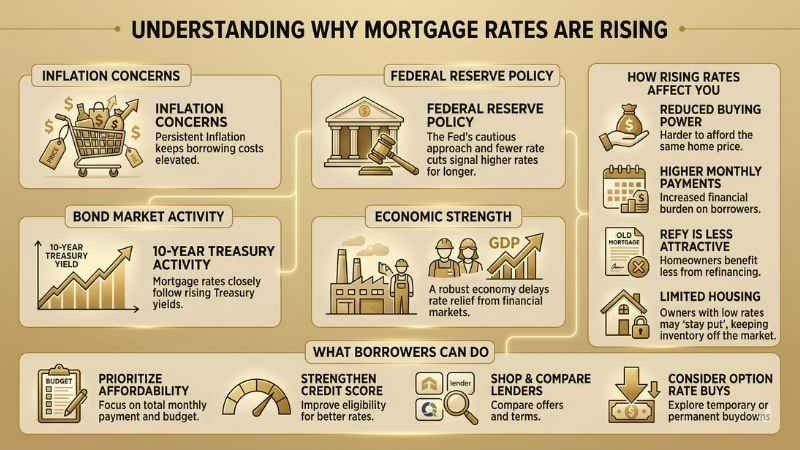
There is no single reason why mortgage rates are rising. In most cases, rates rise because inflation remains a concern, the Federal Reserve is cautious about cutting rates, and bond yields remain elevated.
Inflation matters because it affects how lenders and investors price risk. When inflation stays too high, mortgage rates often stay high too.
Federal Reserve policy matters because markets closely monitor whether rate cuts are imminent. If the Fed holds rates steady or signals that cuts may take longer, mortgage rates can remain elevated.
Bond yields matter because mortgage pricing often moves in the same general direction as the 10-year Treasury yield. When yields rise, mortgage rates often follow suit.
A strong economy can also delay rate relief. If job growth and spending remain steady, markets may expect higher borrowing costs to last longer.
That is the bigger picture behind why mortgage rates are rising. It is usually not one headline driving rates higher. It is a combination of inflation, Fed policy, bond market trends, and economic conditions.
Why Treasury Yields Matter To Mortgage Rates
Mortgage rates often move in the same direction as Treasury yields, especially the 10-year Treasury. When bond investors demand higher returns, home loan rates usually rise too.
Borrowers do not need to understand every market detail. What matters is that investor concerns about inflation, interest rates, and economic strength can push bond yields higher. When yields rise, mortgage rates often follow suit.
That is why mortgage rates can remain high even when many buyers hope they will fall. For borrowers, the real-world impact is higher monthly payments, lower affordability, and fewer refinance opportunities.
How Federal Reserve Policy And Inflation Affect Mortgage Rates
One reason why mortgage rates are rising is that inflation has not fully cooled, and the Federal Reserve has been careful about cutting rates too quickly. When inflation remains a concern, borrowing costs across the market often stay higher than borrowers would like. The Federal Reserve does not directly set mortgage rates, but its decisions still matter. When the Fed keeps rates higher for longer or signals caution, financial markets often respond by keeping mortgage rates elevated as well.
For borrowers, the main point is simple: if inflation remains a problem, mortgage rates may not fall as quickly as many expect. Lenders and investors want to see clearer signs that price pressures are easing before rates move meaningfully lower. This is why mortgage rates can remain high even as buyers and homeowners hope for relief. As long as inflation stays sticky and the Federal Reserve remains cautious, the reasons why mortgage rates are rising may continue to persist.
How Market Uncertainty Can Keep Mortgage Rates High
Mortgage rates can also stay elevated when financial markets feel uncertain. Investors pay close attention to major economic news, policy changes, and global events because those developments can affect inflation, borrowing costs, and bond yields.
For borrowers, the important point is not the headline itself. It is how financial markets react. When uncertainty makes investors more cautious or raises concerns about inflation and the economy, mortgage rates may remain high or even rise further.
That said, this is usually a secondary factor, not the main reason why mortgage rates are rising. Inflation, Federal Reserve policy, and bond yields have a more direct impact on mortgage pricing.
How Mortgage-Backed Securities Affect Mortgage Rates
Mortgage-backed securities also play a role in mortgage pricing, but borrowers do not need to understand all of the technical details. In simple terms, mortgage-backed securities are investments tied to home loans. When investors want higher returns on those investments, mortgage rates often rise. When demand for those investments is stronger, mortgage rates may improve. This is one more reason mortgage rates are shaped by the broader financial markets, not just by lenders alone.
Why Mortgage Rates May Stay High For Longer
Mortgage rates may stay elevated longer than many borrowers expect because the conditions pushing rates higher have not fully gone away. Inflation concerns, cautious Federal Reserve policy, and elevated bond yields are still making it harder for mortgage rates to move down meaningfully.
For borrowers, the key takeaway is simple: mortgage rates do not always fall quickly after they rise. Rates can stay high for an extended period when the broader economy remains steady and financial markets still expect borrowing costs to remain elevated.
That is why many buyers and homeowners are adjusting their plans rather than waiting for a rapid rate drop. In this kind of market, it is often more helpful to focus on affordability, budget, and timing than to expect a sudden correction.
What Borrowers Can Do While Mortgage Rates Are Rising
While borrowers cannot influence why mortgage rates are rising, they can take control of their preparation. When rates increase, it becomes crucial to prioritize affordability, compare different lenders, and thoroughly evaluate available loan options.
Buyers should pay close attention to the full monthly payment, not just the purchase price. A lower loan amount, larger down payment, or stronger credit profile can make a big difference.
It is also wise to compare offers from multiple lenders. Mortgage rates and fees can vary, and better shopping can lead to better pricing.
Some borrowers may also want to explore options like rate buydowns, seller credits, or adjustable-rate mortgages if those choices fit their goals. Homeowners considering refinancing should focus on the long-term benefits rather than assuming every refinance makes sense only when rates drop sharply.
In a high-rate market, the best strategy is to stay flexible, know your numbers, and make decisions based on your budget rather than hope alone.
Where Mortgage Rates May Go Next
Although we can’t know for sure what mortgage rates will do, borrowers can pay attention to key factors that help explain why mortgage rates are rising. Inflation, Federal Reserve policy, bond yields, and general economic conditions will continue to influence the trajectory of mortgage rates.
If inflation eases more consistently and financial markets begin to expect lower borrowing costs, mortgage rates could gradually improve. On the other hand, if inflation remains stubborn or the economy stays stronger than expected, rates may remain elevated for longer.
When it comes to borrowing, the key takeaway is that mortgage rates don’t just go up or down in a straight line. They can jump around, dip, or stay steady depending on what’s happening in the economy and the financial markets.
That is why it is better to treat mortgage rate forecasts as possibilities rather than guarantees. Instead of trying to perfectly time the market, buyers and homeowners should focus on affordability, budget, and whether the loan makes sense for their current goals.
What Borrowers Should Watch Next
Mortgage rates could continue to rise, stabilize, or improve gradually, depending on inflation, Federal Reserve policy, bond yields, and overall economic conditions. Because these factors can change, borrowers should avoid assuming rates will move sharply in one direction.
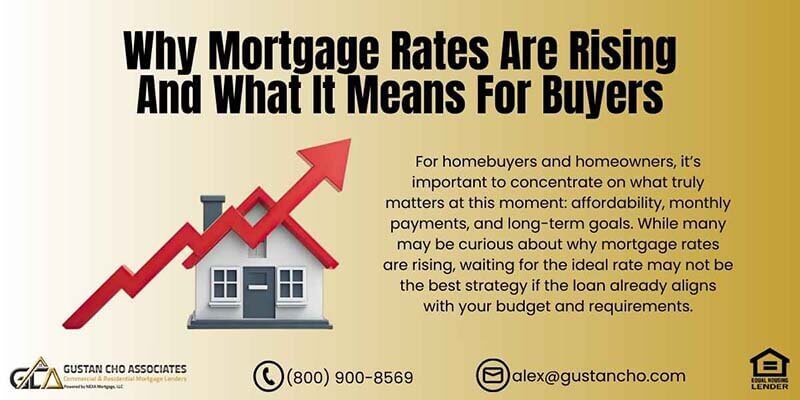
For homebuyers and homeowners, it’s important to concentrate on what truly matters at this moment: affordability, monthly payments, and long-term goals. While many may be curious about why mortgage rates are rising, waiting for the ideal rate may not be the best strategy if the loan already aligns with your budget and requirements.
The most important takeaway is that mortgage rates are influenced by larger market forces, and those forces do not always shift quickly. Borrowers who understand why mortgage rates are rising and how higher rates affect affordability will be better prepared to make informed decisions in any market.
Frequently Asked Questions About Why Mortgage Rates are Rising:
Why are Mortgage Rates Rising?
- Mortgage rates usually rise when inflation stays stubborn, bond yields move higher, and financial markets think borrowing costs may stay high for longer. Mortgage rates are also influenced by investor demand and overall economic conditions, not just by lender pricing.
Does the Federal Reserve Control Mortgage Rates?
- Not directly. The Federal Reserve does not set mortgage rates the way it sets short-term interest rates, but its policy decisions strongly influence the market. When the Fed signals that rate cuts may take longer, mortgage rates often remain elevated.
Why do Mortgage Rates Follow Treasury Yields?
- Mortgage rates often move in the same general direction as the 10-year Treasury yield because both are influenced by inflation expectations, economic strength, and investor sentiment. When bond investors demand higher returns, mortgage rates often rise as well.
Will Mortgage Rates Go Down Soon?
- They could, but there are no guarantees. Mortgage rates may improve if inflation cools further and markets begin to expect lower borrowing costs. They can also remain elevated or fluctuate within a narrow range if inflation and market uncertainty persist.
Should I Wait for Mortgage Rates to Drop Before Buying a Home?
- Waiting can help in some cases, but timing the market perfectly is risky. Many experts recommend focusing first on affordability, monthly payment, credit strength, and whether the home fits your budget now. If rates fall later, refinancing may be an option.
How do Rising Mortgage Rates Affect Homebuyers?
- Higher mortgage rates usually mean higher monthly payments and less buying power. That can reduce how much home a buyer can afford and make some borrowers rethink their budget, down payment, or timing. Higher rates can also keep some homeowners from selling, thereby limiting housing inventory.
This article about “Why Mortgage Rates Are Rising And What It Means For Buyers” was updated on April 9th, 2026.
Mortgage Rates Have Been Up —Act Now
Waiting could cost you more. Let us run the numbers and help you make an informed move.