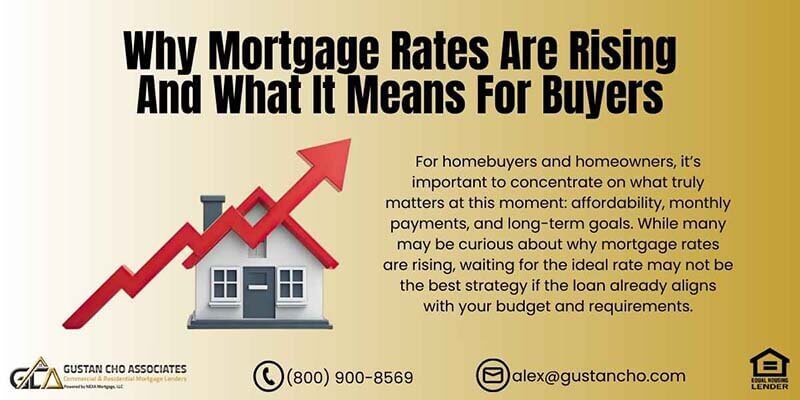
A higher mortgage rate can change a buyer’s entire home search. Even a 1% increase can add hundreds of dollars to the monthly payment and lower the price range a borrower may qualify for. That is why many buyers and homeowners are asking why mortgage rates are rising and whether they should wait, buy now, or rethink their budget. Mortgage rates are rising for several reasons, including inflation, Federal Reserve policy, Treasury yields, investor demand, and the strength of the overall economy. The rate a borrower sees today is not random. It is tied to developments in the broader financial markets. Understanding those factors can help borrowers make better decisions about locking a rate, comparing lenders, buying a home, or refinancing.
Why Mortgage Rates Are Rising Right Now
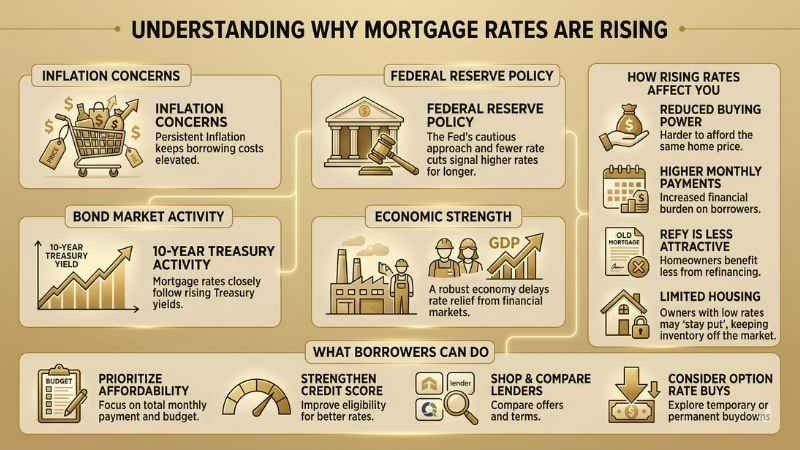
Mortgage rates are rising right now because several parts of the economy are still putting pressure on borrowing costs. Inflation has cooled from its recent highs, but it is still a concern. When prices remain higher than the Federal Reserve wants, lenders and investors are less likely to offer lower mortgage rates.
Treasury yields are another major factor. Mortgage rates often move in the same general direction as the 10-year Treasury yield. When Treasury yields stay elevated, mortgage rates usually stay elevated too.
The Federal Reserve also plays a role, even though it does not directly set mortgage rates. If the Fed is cautious about cutting rates, the bond market may assume borrowing costs will stay higher for longer. Strong economic data can add to that pressure by delaying future rate cuts. In simple terms, mortgage rates are rising because inflation, Treasury yields, Fed policy, and economic strength are all pointing in the same direction. Until those pressures ease, borrowers may continue to see higher mortgage rates than they hoped for.
The Four Biggest Factors Driving Mortgage Rates Higher
Mortgage rates are rising due to multiple factors. A lender does not simply decide to raise rates without a reason. Rates are tied to developments in the economy, the bond market, and investor expectations. These are the four biggest factors that can push mortgage rates higher.
Inflation
Inflation means prices are rising across the economy. When inflation stays high, money loses buying power. Investors usually want higher returns when they believe inflation will remain a problem. That can push borrowing costs higher, including mortgage rates. For borrowers, this means mortgage rates are rising and may remain high until inflation shows more definite signs of easing. Even if inflation decreases from its previous levels, it could still exert pressure on rates if it remains above the Federal Reserve’s target.
Federal Reserve Policy
The Federal Reserve does not directly set mortgage rates. The Fed controls short-term interest rates, not the 30-year fixed mortgage rate. However, Fed policy still has a major influence on the mortgage market. When the Fed keeps rates high or warns that rate cuts may take longer, investors often expect borrowing costs to stay higher. That can keep mortgage rates elevated. If the Fed becomes more comfortable that inflation is under control, markets may begin pricing in lower rates.
Treasury Bond Yields
Mortgage rates often move in the same general direction as the 10-year Treasury yield. The 10-year Treasury is watched closely because it reflects investor expectations about inflation, economic growth, and future interest rates. When Treasury yields rise, mortgage rates usually rise too. Lenders must price home loans in a way that makes sense compared to other investments. If investors can earn higher returns from Treasury bonds, mortgage rates usually need to be higher to attract investors.
Economic Growth And Employment
Strong economic data can also keep mortgage rates higher. When job growth is steady, wages are rising, and consumers are still spending, the economy may be stronger than expected. That can make investors believe inflation may take longer to cool. A robust economy can make the Federal Reserve less inclined to lower rates swiftly. For homebuyers, favorable economic news might occasionally cause mortgage rates to rise. If the economy remains strong, mortgage rates may not decline as quickly as borrowers would like.
How Rising Mortgage Rates Affect Buyers And Homeowners
Rising mortgage rates directly affect affordability. For buyers, higher rates usually mean higher monthly payments and less purchasing power. That can make it harder to qualify for the same loan amount or afford the same home price.
For homeowners, higher rates can reduce the benefit of refinancing and make moving less appealing. Many owners with lower existing mortgage rates are choosing to stay put rather than trade up to a new loan with a higher payment.
This has created a lock-in effect, keeping some housing inventory off the market. Fewer homes for sale can keep prices stronger, even when buyers are already dealing with affordability challenges. In simple terms, rising mortgage rates affect monthly payments, buying power, refinancing, and housing supply. That is why they matter so much to both homebuyers and homeowners.
How Rising Mortgage Rates Affect Current Homeowners
Rising mortgage rates are impacting not only new buyers but also current homeowners with existing mortgages. When mortgage rates are rising, it can make refinancing less appealing since the new loan may lead to a higher monthly payment than the current one. This is a major reason many homeowners are not refinancing unless they have a clear need. A cash-out refinance, debt consolidation refinance, or divorce buyout may make sense in some cases. However, a simple rate-and-term refinance is harder to justify when the homeowner already has a much lower interest rate. Higher rates also affect move-up buyers. Many homeowners want a larger home, a different location, or a property that better fits their family. But if their current mortgage has a low rate, selling that home and buying another one may mean taking on a much higher payment. This creates what many people call the lock-in effect. Homeowners feel locked into their current mortgage because replacing it with a new loan would cost too much. As a result, some owners choose to stay put instead of selling. The lock-in effect can also reduce housing inventory. When fewer homeowners list their properties for sale, buyers have fewer homes to choose from. That can keep home prices stronger in some markets, even as higher mortgage rates make affordability harder for buyers.
How Much Difference Does One Percent Make?
Many buyers focus on the home price, but the mortgage rate can have just as much impact on affordability. A difference of only 1% may not sound significant, but it can add hundreds of dollars to a monthly payment and thousands of dollars in interest over the life of the loan.
Example Payment Comparison
For a $350,000 loan with a 30-year fixed mortgage:
- 6.0% interest rate: Approximately $2,099 per month for principal and interest
- 7.0% interest rate: Approximately $2,329 per month for principal and interest
- Difference: About $230 more per month
That extra $230 per month adds up to roughly $2,760 per year. Over time, the difference can become substantial. This is one reason mortgage rates are rising have such a big impact on the housing market. As rates increase, buyers may need to lower their price range, make a larger down payment, or increase their income to qualify for the same home. Even when home prices stay the same, a higher mortgage rate can significantly affect affordability.
Why Mortgage Rates Stay High Even When The Fed Does Not Raise Rates
 Many borrowers think mortgage rates should fall as soon as the Federal Reserve stops raising rates. That is not how mortgage pricing works. The Fed doesn’t set mortgage rates directly. Instead, it manages the federal funds rate, a short-term interest rate that banks use when lending to each other.
Mortgage rates are different. They are longer-term rates that are more closely tied to bond markets, Treasury yields, inflation expectations, and investor demand. That is why mortgage rates can stay high even when the Fed does not announce a new rate hike.
Markets also move before the Fed acts. If investors believe inflation may stay high or rate cuts may take longer, mortgage rates can remain elevated before any official Fed decision is made. In some cases, mortgage rates are rising because markets react to what they think the Fed may do next, not just to what the Fed has already done. Investor expectations matter because mortgages are often sold into the secondary market. Investors want to be paid enough for the risk of holding mortgage-backed investments. If they expect inflation, uncertainty, or higher borrowing costs to last longer, they may demand higher returns. That pressure can keep mortgage rates high. For borrowers, the simple lesson is this: the Fed matters, but it is not the only driver of mortgage rates. Mortgage rates can stay high when investors believe inflation is not fully under control, Treasury yields remain elevated, or future rate cuts may be delayed.
What We Are Seeing From Borrowers In Today’s Market
In today’s market, many borrowers are not walking away from buying a home. They are adjusting their strategy. Higher mortgage rates have changed the conversation from “What is the highest price I can qualify for?” to “What monthly payment can I comfortably handle?” One trend we are seeing more often is the use of rate buydowns. Some buyers are asking about temporary buydowns to lower the payment during the first year or two. Others are considering permanent buydowns if they plan to keep the loan long-term. The goal is simple: make the monthly payment more manageable. Seller concessions are also becoming more important. Instead of only negotiating the purchase price, buyers are asking sellers to help with closing costs, prepaid expenses, or rate buydown funds. In some cases, a seller credit can do more for the buyer’s monthly payment than a small price reduction. Many buyers are also lowering their budgets. A home price that worked at a lower rate may no longer work at today’s payment. Serious buyers are looking at smaller homes, different neighborhoods, or lower price ranges so they do not become house poor. Adjustable-rate mortgages are getting more attention as well. They are not right for every borrower, but some buyers are asking about them because the initial rate may be lower than that of a fixed-rate mortgage. Borrowers need to understand the risks, future payment changes, and how long they plan to keep the home before choosing this option. Current homeowners are reacting too. Many owners with low existing mortgage rates are staying in place because selling and buying another home would mean taking on a much higher payment. This is one reason inventory remains tight in many markets. Higher rates are not only affecting new buyers. They are also changing the decisions of homeowners who might otherwise move.
Should You Buy A Home While Mortgage Rates Are High?
Buying a home while mortgage rates are high depends on the monthly payment, not just the rate. A higher rate does not automatically mean buying is a bad decision. The real question is whether the home fits your budget today without depending on a future refinance.
You can buy now if the payment is comfortable, your employment is stable, and you plan to keep the home long term. A long-term home gives you more time to build equity, ride out rate changes, and refinance later if rates improve.
Buying can also make sense if the right home is available and the numbers work. Waiting for lower rates does not always guarantee a better deal. Home prices, competition, and inventory can also change. You may want to wait if the payment is already stretching your finances. A mortgage should not leave you with no room for savings, repairs, emergencies, or normal living costs. If the only way to qualify is to push your budget too far, waiting may be safer. Waiting may also help if your credit score is close to improving or if you expect to have a larger down payment soon. A stronger credit profile or more money down could help you qualify for better loan terms. The best decision is not based on headlines. It is based on your payment, your job stability, your savings, and how long you plan to stay in the home.
What Borrowers Can Do While Mortgage Rates Are Rising
While borrowers cannot influence why mortgage rates are rising, they can take control of their preparation. When rates increase, it becomes important to prioritize affordability, compare different lenders, and thoroughly evaluate available loan options. Buyers should pay close attention to the full monthly payment, not just the purchase price. A lower loan amount, larger down payment, or stronger credit profile can make a big difference.
It is also wise to compare offers from multiple lenders. Mortgage rates and fees can vary, and better shopping can lead to better pricing.
Some borrowers may also want to explore options like rate buydowns, seller credits, or adjustable-rate mortgages if those choices fit their goals. Homeowners considering refinancing should focus on the long-term benefits rather than assuming every refinance makes sense only when rates drop sharply. In a high-rate market, the best strategy is to stay flexible, know your numbers, and make decisions based on your budget rather than hope alone.
Will Mortgage Rates Go Down In 2026?
Mortgage rates could move lower in 2026, but there is no guarantee. Rates depend on inflation, Federal Reserve policy, Treasury yields, and the strength of the economy. If those factors improve, mortgage rates may gradually ease. If they remain stubborn, rates could stay elevated longer. Inflation is one of the biggest things to watch. If inflation keeps cooling and moves closer to the Federal Reserve’s target, markets may become more confident that lower borrowing costs are possible. That could help mortgage rates improve over time. Federal Reserve policy also matters. The Fed doesn’t directly set mortgage rates, but what it does definitely affects how investors think about them. If the Fed signals that rate cuts are more likely, mortgage rates may respond before the cuts actually happen. If the Fed stays cautious, rates may not fall quickly. Treasury yields are another key factor. Mortgage rates often move in the same general direction as the 10-year Treasury yield. If Treasury yields move lower, mortgage rates may also improve. If yields stay high, mortgage rates may remain under pressure. Economic growth can play a big role in where rates head next. When the job market is strong and people are spending steadily, it can keep inflation worries buzzing. A slower economy may give markets more reason to expect lower rates. For borrowers, the safest approach is to avoid making plans based on a perfect rate forecast. Mortgage rates can move up, down, or sideways depending on the data. Instead of trying to time the bottom, focus on the payment, your budget, and whether the loan makes sense for your situation today.
Key Takeaways About Why Mortgage Rates are Rising
Rising mortgage rates affect more than the interest rate on a loan. They change the monthly payment, the price range a buyer can afford, and whether refinancing makes sense for current homeowners.
Mortgage rates are rising because of several factors working together. Inflation, Federal Reserve policy, Treasury yields, investor expectations, and economic strength all play a role. That is why rates can remain high even as buyers hope for relief.
For homebuyers, the best move is to focus on the full payment, not just the rate. For homeowners, the decision to refinance or move should be based on the numbers, not headlines. A higher-rate market does not always mean buying or refinancing is wrong, but it does mean the loan needs to make sense for the borrower’s budget and long-term plans.
Frequently Asked Questions About Why Mortgage Rates Are Rising
Why do Mortgage Rates Change Every Day?
Mortgage rates can change daily as lenders adjust pricing in response to movements in the bond market, investor demand, economic reports, and inflation expectations. Even when there is no major news, market activity can cause mortgage rates to move up or down throughout the week.
Why are Mortgage Rates Different from One Lender to Another?
Every lender has different pricing models, operating costs, and risk tolerances. Some may offer lower rates but higher fees, while others have slightly higher rates with lower closing costs. Comparing lenders is essential to find the best overall deal.
Can Mortgage Rates Change After I Get Pre-Approved?
Yes. A pre-approval does not lock your interest rate. Mortgage rates can continue to change until you formally lock your rate with a lender. If rates rise during your home search, your monthly payment and purchasing power could be affected.
Does a Recession Automatically Cause Mortgage Rates to Fall?
Not always. Recessions can put downward pressure on mortgage rates, but many other factors influence mortgage pricing. Inflation, government borrowing, investor behavior, and financial market conditions can all affect whether rates move lower during a recession.
Why are Refinance Rates Sometimes Different from Purchase Rates?
Refinance rates and purchase rates often move together, but they are not always identical. Market conditions, loan type, borrower qualifications, and lender pricing strategies can create differences between refinance and purchase mortgage rates.
Can I Negotiate a Mortgage Rate with a Lender?
In some cases, yes. Borrowers with strong credit, larger down payments, or competing loan offers can negotiate certain loan costs or obtain better pricing. Shopping with multiple lenders can create opportunities to compare and negotiate offers.
Do Mortgage Rates Affect Home Prices?
Mortgage rates can influence home prices by affecting affordability. When rates rise, buyers may qualify for smaller loan amounts, which can reduce demand in some markets. However, home prices are also influenced by inventory levels, local market conditions, and economic factors.
Is it Possible to Refinance if Mortgage Rates Drop in the Future?
Yes. If mortgage rates fall and refinancing provides enough savings to justify the costs, homeowners may be able to refinance into a lower-rate loan. Whether refinancing makes sense depends on the new rate, closing costs, loan balance, and how long the homeowner plans to keep the property.
This article about “Why Mortgage Rates Are Rising And What It Means For Buyers” was updated on June 18th, 2026.