Student loans and car payments can reduce the mortgage amount you qualify for, even when you have a steady income and good credit. How student and car loans affect DTI depends on the required monthly payments, the repayment status of each debt, and whether you apply for an FHA, VA, USDA, Fannie Mae, or Freddie Mac loan. Before shopping for a home, review the payments shown on your credit report. A new car loan, an auto lease, a deferred student loan, or a student loan reporting a $0 payment can change your debt-to-income ratio. Understanding how each mortgage program counts these debts can help you choose the right loan and avoid qualification problems.
How Student and Car Loans Affect Mortgage DTI
Mortgage lenders calculate your back-end debt-to-income ratio by comparing your proposed housing payment and other required monthly debts with your gross monthly income. Car payments and student loans are included because they reduce the income available for a mortgage payment.
Understanding how student and car loans affect DTI is important because lenders generally focus on the required monthly payment rather than the total balance. For example, a large student loan with a low documented payment may affect DTI less than a smaller car loan with a high monthly payment.
A higher combined monthly debt payment can reduce your homebuying power or require you to consider a lower-priced home. However, the payment used for qualification may vary under the guidelines of FHA, VA, USDA, Fannie Mae, and Freddie Mac. Your credit profile, assets, repayment documents, automated underwriting findings, and lender requirements can also affect the final decision.
How to Calculate DTI With Car and Student Loans
To calculate your back-end debt-to-income ratio, add your proposed monthly housing payment to your required monthly debt payments. Divide that total by your gross monthly income before taxes, then multiply the result by 100. DTI formula: Proposed housing payment + monthly debt payments ÷ gross monthly income × 100 = DTI For example, assume a borrower has:
- $8,000 in gross monthly income
- $2,200 proposed monthly housing payment
- $600 car payment
- $300 qualifying student loan payment
- $100 in minimum credit card payments
The borrower’s total monthly obligations are $3,200. Dividing $3,200 by $8,000 produces a back-end DTI of 40%. This example shows how student and car loans affect DTI because their combined $900 monthly payment uses part of the income that could otherwise support the new mortgage. Removing or reducing a qualifying monthly debt may lower the DTI, but a larger down payment does not automatically reduce DTI unless it lowers the proposed monthly housing payment. Your personal calculation is only an estimate. The student loan payment used by the mortgage lender may differ from the amount shown on your credit report, especially when the loan is deferred, in forbearance, or on an income-driven repayment plan. The final DTI also depends on the mortgage program, documented income, automated underwriting findings, and lender requirements.
How Car Loans Affect Mortgage Qualification
A car loan is usually included in your debt-to-income ratio because the required monthly payment reduces the income available for a mortgage. Even when an auto loan has a low interest rate, the full required payment may affect the mortgage amount you qualify for. This is an important part of understanding how student and car loans affect DTI. A $600 car payment generally has a greater effect on mortgage qualification than the remaining auto loan balance. Buying or leasing a vehicle before closing can also change your credit, available cash, and automated underwriting results. Speak with your mortgage loan officer before financing a vehicle or changing an existing auto loan.
Auto Loans With 10 or Fewer Payments Remaining
An auto loan with 10 or fewer scheduled payments remaining may be excluded from DTI under certain mortgage guidelines. However, the exclusion is not automatic. An underwriter may still count the payment if it is large enough to affect your ability to make the proposed housing payment and meet your other obligations. In some cases, borrowers may be allowed to pay down an auto loan so that only 10 or fewer payments remain. Before using money needed for the down payment, closing costs, or reserves, ask your mortgage loan officer whether paying down the loan will improve your qualification. FHA, VA, USDA, Fannie Mae, and Freddie Mac guidelines may treat short-term installment debts differently.
Car Payments Made by Someone Else
A car payment may sometimes be excluded when another person has been making the payments. The lender will normally require documentation showing that the other person made payments from their own funds for the past 12 months without any late payments. Acceptable documentation may include canceled checks or bank statements clearly identifying the person who made each payment. Verbal statements or transfers into the borrower’s account may not be sufficient. The borrower remains legally responsible for the auto loan, so the lender must confirm that the payment history meets the requirements of the applicable loan program before excluding the debt.
Auto Leases and Co-Signed Car Loans
Auto lease payments are generally included in DTI regardless of how few payments remain. When a lease ends, the borrower will usually need to lease another vehicle, purchase the existing vehicle, or obtain another form of transportation. For this reason, lenders generally treat the lease payment as an ongoing monthly obligation. A co-signed car loan can also affect mortgage qualification because the co-signer is legally responsible for the debt. The payment may be excluded if another person has made all required payments for the required period and the lender receives acceptable documentation. Without that proof, the full payment will normally be included in the borrower’s DTI.
How Student Loan Payments Are Calculated
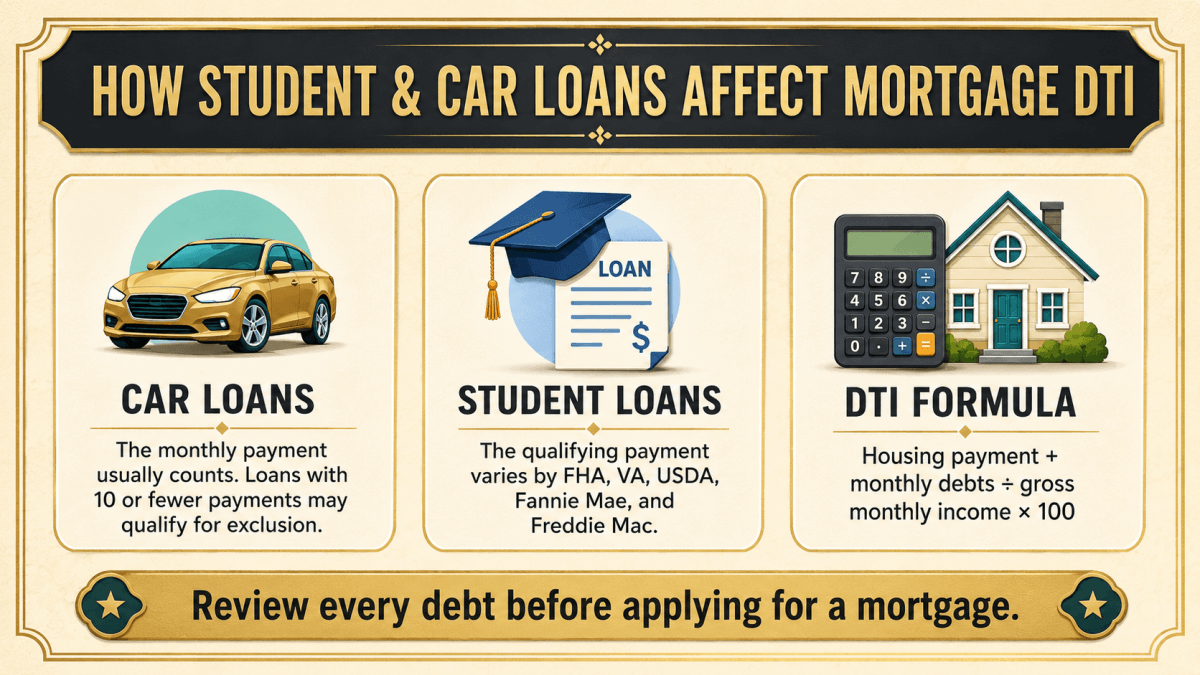
Student loans are generally included in a borrower’s debt-to-income ratio, but the qualifying payment depends on the mortgage program and repayment status. A lender may use the payment shown on the credit report, obtain a current statement from the student loan servicer, or calculate a payment from the outstanding balance. This difference is central to understanding how student and car loans affect DTI. Two borrowers with the same student loan balance could have different qualifying payments depending on whether they apply for an FHA, Fannie Mae, Freddie Mac, VA, or USDA loan.
FHA Student Loan Guidelines
FHA requires lenders to include outstanding student loans regardless of whether they are in repayment, deferment, forbearance, or an income-driven repayment plan. When the credit report shows a monthly payment above $0, the lender may generally use that payment or the actual documented payment. If the credit report shows a $0 monthly payment, the lender must generally use 0.50% of the outstanding student loan balance as the payment. For example, an FHA borrower with a $60,000 student loan balance and a reported $0 payment would generally have a $300 monthly obligation included in DTI: $60,000 × 0.50% = $300 A student loan may be excluded only when written documentation shows that the balance has been forgiven, canceled, discharged, or paid in full. A temporary deferment or $0 income-driven payment does not, by itself, eliminate the debt from an FHA calculation.
Fannie Mae Student Loan Guidelines
Fannie Mae may use the monthly payment reported on the borrower’s credit report. If that amount is incorrect or outdated, the lender may use the payment shown on the borrower’s most recent student loan statement. Fannie Mae provides favorable treatment for certain income-driven repayment plans. If current documentation verifies that the borrower’s required payment is $0, the lender may qualify the borrower using a $0 monthly student loan payment. Different rules apply when a loan is deferred or in forbearance. In those situations, the lender may use either:
- 1% of the outstanding student loan balance; or
- A fully amortizing payment calculated from the documented repayment terms.
For example, a $60,000 deferred student loan could produce a $600 monthly qualifying payment when the 1% calculation is used. This is why borrowers should provide current repayment documents before choosing a conventional loan program.
Freddie Mac Student Loan Guidelines
Freddie Mac generally allows lenders to use the monthly student loan payment shown on the credit report when the reported amount is greater than $0. If the reported payment is inaccurate, additional documentation from the student loan servicer may be required. When the credit report shows a $0 monthly payment, Freddie Mac generally requires the lender to use 0.50% of the outstanding balance. A documented $0 income-driven payment, therefore, does not receive the same treatment under Freddie Mac as it may under Fannie Mae. For example, a $60,000 balance with a reported $0 payment would generally create a $300 monthly qualifying obligation under Freddie Mac guidelines. Borrowers applying for conventional financing should determine whether the loan will comply with Fannie Mae or Freddie Mac requirements, as the difference can materially affect DTI.
VA Student Loan Guidelines
VA student loan guidelines consider both the repayment date and the documented monthly obligation. A student loan may be excluded when written evidence shows that repayment will remain deferred for at least 12 months beyond the VA mortgage closing date. If repayment is underway or scheduled to begin within 12 months after closing, the lender generally calculates a threshold payment by multiplying the outstanding balance by 5% and dividing the result by 12: Student loan balance × 5% ÷ 12 = VA monthly threshold payment For a $60,000 balance, the calculation would be: $60,000 × 5% ÷ 12 = $250 per month If the credit report shows a payment greater than the calculated amount, the lender generally uses the higher reported payment. When the reported payment is lower, a current statement from the student loan servicer may allow the lender to use the documented payment. The statement generally must be dated within 60 days of closing and show the actual loan terms and payment information. VA lenders also evaluate residual income, which measures how much income remains after major obligations and estimated living expenses are deducted. Therefore, a borrower’s DTI is only one part of a VA underwriting decision.
USDA Student Loan Guidelines
USDA requires lenders to consider student loans regardless of their payment status. When the credit report or acceptable student loan documentation shows a payment above $0, the lender generally uses the reported or actual documented monthly payment. When the required payment is $0, USDA generally uses 0.50% of the outstanding balance. For example, a $60,000 student loan with a $0 payment would normally add $300 to the borrower’s monthly obligations: $60,000 × 0.50% = $300 Student loans held solely in the borrower’s name generally remain the borrower’s legal responsibility even when another person makes the payments. Borrowers should provide a current servicer statement so the lender can confirm the balance, repayment status, and required payment before calculating the USDA mortgage DTI.
FHA, VA, USDA, or Conventional—Which Handles Your Debts Best?
Student loans and car loans may be treated differently depending on the mortgage program. We’ll compare your options and show the cleanest approval path.
Mortgage DTI Example
The following hypothetical example shows how the same student loan balance can produce different mortgage DTI calculations. It is for educational purposes only and does not represent a guaranteed approval or an actual borrower. Assume the borrower has:
- $8,000 in gross monthly income
- $2,200 proposed monthly housing payment
- $600 car payment
- $100 in minimum credit card payments
- $60,000 student loan balance
- $0 student loan payment reported on the credit report
Before adding the student loan obligation, the borrower has $2,900 in monthly debts. The payment assigned to the student loan depends on the mortgage program.
FHA Mortgage DTI Example
Because the credit report shows a $0 student loan payment, FHA generally uses 0.50% of the outstanding balance: $60,000 × 0.50% = $300 The borrower’s total monthly obligations would be $3,200: $2,200 housing payment + $600 car payment + $100 credit cards + $300 student loan = $3,200 The resulting back-end DTI would be: $3,200 ÷ $8,000 = 40% DTI
Fannie Mae Mortgage DTI Example
If current documentation verifies that the borrower is on an income-driven repayment plan with a required $0 payment, Fannie Mae may allow the lender to use $0 for the student loan. The borrower’s total monthly obligations would remain $2,900: $2,900 ÷ $8,000 = 36.25% DTI However, if the student loan is deferred or in forbearance rather than an eligible, documented income-driven plan, Fannie Mae may require 1% of the balance or a fully amortizing payment. Using 1% would produce a $600 monthly payment: $3,500 ÷ $8,000 = 43.75% DTI This difference shows why the borrower’s repayment status and documentation matter.
Freddie Mac Mortgage DTI Example
With a $0 payment reported on the credit report, Freddie Mac generally uses 0.50% of the $60,000 balance, or $300 per month. The borrower’s total monthly obligations would be $3,200, resulting in: $3,200 ÷ $8,000 = 40% DTI Unlike Fannie Mae, Freddie Mac generally does not allow a verified $0 income-driven payment to be used as $0 for this calculation.
VA Mortgage DTI Example
If the student loan is not documented as deferred for at least 12 months beyond closing, the VA threshold payment is generally calculated as follows: $60,000 × 5% ÷ 12 = $250 Adding the $250 student loan payment produces $3,150 in total monthly obligations: $3,150 ÷ $8,000 = 39.38% DTI A higher payment reported on the credit report may need to be used. A current servicer statement may support a lower actual payment when it meets VA documentation requirements. VA underwriting also evaluates residual income and the borrower’s complete financial profile.
USDA Mortgage DTI Example
Because the student loan reports a $0 payment, USDA generally uses 0.50% of the outstanding balance, or $300 per month. The borrower’s total monthly obligations would be $3,200: $3,200 ÷ $8,000 = 40% DTI This mortgage DTI example demonstrates how student and car loans affect DTI even when the borrower’s income and debt balances remain unchanged. Depending on how the $60,000 student loan is treated, the borrower’s calculated DTI could range from 36.25% to 43.75%. Actual qualification depends on the repayment documents, mortgage program, credit profile, assets, automated underwriting findings, and lender requirements.
What to Do Before Applying for a Mortgage
Lately, checking your credit report matters – look at what you owe on a car, any student loans, plus other debts each month. Pay stubs from recent jobs help; so do bank records, tax forms if they’re necessary, also paperwork about student loans that shows how much is paid now and the schedule. Before getting a mortgage, stay away from fresh loans. Opening a car deal mid-process? That can complicate things. Signing someone else’s note might shift how lenders see your risk. Shutting down old credit lines isn’t always wise – track every change carefully. Shifting cash around? Only if records show exactly where it went. Banks check pay stubs, savings, current balances, job status, and past borrowing behavior when reviewing applications.
Final Thoughts About How Student and Car Loans Affect DTI
Student loans and car payments do not automatically prevent you from qualifying for a mortgage. What matters most is the monthly payment the lender must include, your gross income, the proposed housing payment, and the requirements of the mortgage program. Because FHA, VA, USDA, Fannie Mae, and Freddie Mac calculate student loan obligations differently, selecting the right program can significantly change your DTI and homebuying power. Auto loans may also receive different treatment when they have 10 or fewer payments remaining or when another person has made the payments for at least 12 months. Before applying, review your credit report, gather current student loan statements, and avoid financing a vehicle or co-signing new debt. A mortgage loan officer can calculate how student and car loans affect DTI under each eligible program and help you compare your options before you begin shopping for a home.
Frequently Asked Questions About Student Loans, Car Loans, and Mortgage DTI
What Monthly Expenses Are Not Included in Mortgage DTI?
Mortgage DTI generally excludes utilities, groceries, internet service, cell phone bills, health insurance, car insurance, and other ordinary living expenses. However, lenders may consider some of these expenses when evaluating residual income or the borrower’s overall ability to repay. Required debts such as credit card payments, personal loans, child support, and tax payment agreements may be included.
Will Settling My Car Loan Negatively Impact My Credit Score Before Applying for a Mortgage?
Paying off a car loan may cause a temporary change in your credit score because the account is closed and your credit mix changes. However, removing the monthly car payment can lower your DTI and improve your mortgage qualification. Before paying off the loan, ask your mortgage loan officer whether preserving cash for the down payment, closing costs, and reserves would be more beneficial.
Should I Refinance My Car Loan Before Applying for a Mortgage?
Refinancing can reduce your monthly car payment and improve your debt-to-income (DTI) ratio, but it involves a credit inquiry and opening a new account. This may impact your credit score and could lead your mortgage lender to reassess your application. Do not refinance during the mortgage process without first speaking with your loan officer.
Do Parent PLUS Loans Count Toward Mortgage DTI?
A Parent PLUS loan generally counts against the parent who legally borrowed the money, even when the child makes the payments. If the parent applies for a mortgage, the lender may include the required monthly payment in the parent’s DTI. Some programs may allow the debt to be excluded when the child or another person has made the payments from their own funds for the required period and provides acceptable documentation.
Can Defaulted Student Loans Prevent Mortgage Approval?
Defaulted student loans can create more than a DTI problem. They may damage the borrower’s credit and, when the debt is federal, appear in the Credit Alert Verification Reporting System. A delinquent federal debt can prevent approval for certain government-backed mortgages until the borrower resolves the default or meets an allowable exception. HUD explains that CAIVRS is used to identify delinquent federal debts.
Can Public Service Loan Forgiveness Remove Student Loans From DTI?
Expected forgiveness through Public Service Loan Forgiveness does not automatically remove a student loan from DTI. Until the loan is officially forgiven, canceled, discharged, or otherwise eligible for exclusion under the applicable mortgage guidelines, the lender may still need to count a qualifying payment. Provide the lender with current servicer records and documentation showing the remaining forgiveness requirements.
Can an Employer-Paid Student Loan Be Excluded From DTI?
An employer’s student loan assistance does not automatically eliminate the debt, as the borrower remains legally responsible for repayment. Depending on the mortgage program, the lender may consider excluding a payment when an employer or another party has made it directly for the required period, and the borrower can document the payment history. Employer contributions deposited into the borrower’s account may not satisfy the same requirements.
How Long After Financing a Car Can I Apply for a Mortgage?
There is no universal waiting period after financing a vehicle. You may apply for a mortgage at any time, but the lender must include the new car payment, review the recent credit inquiry, and confirm whether the purchase reduced the funds available for closing. Waiting does not automatically solve the problem; the important question is whether your updated credit, DTI, and available assets still meet the mortgage requirements.
This article about “How Student and Car Loans Affect DTI for a Mortgage” was updated on August 12th, 2026.