This guide covers mortgage lender overlays on FHA and VA loans. Mortgage lender overlays are mortgage lending guidelines above and beyond those mandated by mortgage loan programs. There are two types of mortgage lending guidelines:
- Mortgage Loan Program Guidelines
- Mortgage Lender Overlays
All banks and mortgage companies must follow loan program guidelines. However, every bank and/or lender can have its own overlays. In this article, we will cover and discuss common mortgage lender overlays on FHA and VA loans imposed by lenders.
Mortgage Lender Overlays on FHA and VA Loans vs. Guidelines: What Borrowers Need to Know
Agency Guidelines vs. Mortgage Lender Overlays on FHA and VA Loans
FHA and VA loans were created to help more people buy homes, such as first-time buyers, modest-income families, and military veterans. Each program spells out clear requirements for who can borrow, what credit scores work, how much debt a borrower can carry, and more.
Mortgage Lender Overlays on FHA and VA Loans: HUD Agency Guidelnes
FHA loans, backed by the Federal Housing Administration, remain a favorite thanks to forgiving standards:
- Minimum Credit Score: 580 for a 3.5 percent down payment.
- 500 to 579 for a 10 percent down payment.
FHA And VA Guidelines vs. Lender Overlays
FHA and VA loans come with baseline rules set by the government. These rules cover topics such as credit, income, down payment, and basic qualification standards. In many cases, those official guidelines are more flexible than borrowers expect.
The problem is that many lenders do not stop at the baseline rules. They add their own stricter requirements, called lender overlays. These extra rules can include higher minimum credit scores, lower debt-to-income caps, additional reserve requirements, or tougher standards for recent credit events.
That means a borrower can meet FHA or VA guidelines and still get turned down by a lender. In many cases, the denial is not because the loan program said no. It is because that particular lender added extra restrictions. Understanding this difference is important. If one lender says no, it does not always mean you do not qualify for an FHA or VA loan. You may need a lender whose guidelines are closer to the actual program rules.
VA Guidelines vs. VA Lender Overlays
VA loans are subject to baseline rules set by the Department of Veterans Affairs. Those rules are often more flexible than many borrowers realize. But even though the VA sets the foundation, individual lenders can still add stricter requirements on top of it. These added rules are called lender overlays. A lender may require a higher credit score, a lower debt-to-income ratio, or additional documentation, even when the VA itself does not. That is why a borrower may be eligible for a VA loan but still get denied by a specific lender. The key point is simple: a lender denial does not always mean you do not qualify for a VA loan. It may only mean that the lender has stricter rules than the basic VA guidelines.
What Are Lender Overlays?
Overlays are the additional boxes a mortgage company asks you to check on top of the main FHA or VA checklist. Those national programs spell out minimum credit and income standards so the loans can be insured or backed, but each lender keeps its safety net by asking for tougher proofs. Because every shop sets its rules, overlays can touch things like credit scores, debt-to-income (DTI) limits, job stability, and asset sizes.
Denied a Mortgage? Don’t Blame FHA or VA
You may still qualify—just not with your current lender. We approve loans others turn away.Why Do Lenders Use Overlays?
Lenders add overlays to reduce risk. Even when a loan program offers flexible guidelines, some lenders remain cautious.
That is why one lender may approve a borrower while another lender denies the same file. The loan program did not change. The lender’s internal rules did.
Some lenders are more conservative than others. They may want higher credit scores, lower debt-to-income ratios, or more paperwork before approving a loan. These extra rules are meant to make the lender feel more comfortable, but they can make qualifying harder for borrowers.
Common Mortgage Lender Overlays on FHA and VA Loans
Every lender has rules in addition to general guidelines, which are known as overlays. Here are some frequent overlays borrowers encounter with FHA and VA loans.
Credit Score Requirements
- FHA: Although FHA loans can start at a 500 score, most lenders still raise that floor to 620 or even 640.
- Certain programs may push the cutoff to 700 or higher.
- VA: The VA itself doesn’t set a score limit, yet many lenders expect at least 620 to 660, and the premium shops often target scores over 700.
Debt-to-Income Ratios and Manual Underwriting
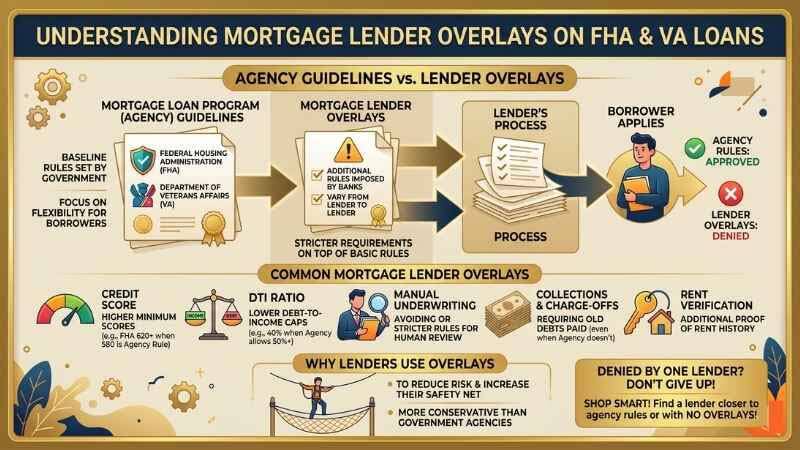 Debt-to-income ratio, often called DTI, is a way lenders measure how much of your monthly income goes toward debt. Even if FHA or VA guidelines allow a higher debt ratio, some lenders set their own lower limit. That can cause a denial even when the loan program itself is flexible.
This is where lender overlays often create problems. A borrower may meet the basic FHA or VA standards. However, the lender may still say no because its internal debt ratio cap is stricter than the actual program guideline.
Manual underwriting can also confuse borrowers. This means a real person reviews the file rather than relying solely on an automated system. Some lenders allow manual underwriting, while others avoid it or make the rules much tougher. Because of that, a borrower who does not get an automated approval may still qualify with a more flexible lender. The main point is simple: a higher debt ratio or a manual underwrite does not always mean you cannot get approved. It may only mean that the lender you spoke with has tighter rules than the loan program requires.
FHA and VA Loans vs. Conventional Loans: The Role of Mortgage Lender Overlays
Overlays are extra lender rules that supplement the basic program guidelines, and they are very important when choosing a loan.
FHA and VA Loans
These programs start with relaxed standards, but many lenders add tougher overlays. The loans work well for borrowers with lower credit or only a small down payment.
Conventional Loans
The baseline for these starts higher, at a 620 credit score and a 3 to 20 percent down payment. Some lenders impose fewer extra rules once a borrower reaches that hurdle since they adhere closely to Fannie Mae or Freddie Mac guidance. Overall, your best path is to compare offers and pick the one that fits your budget and goals. Lender extras on FHA and VA loans can trip borrowers up, but they aren’t impossible to clear. When people know the official FHA or VA rules from the lenders’ twist on them, they can shop smart, boost their finances, and choose loans that match tougher standards. A well-informed loan officer or mortgage broker also makes a big difference by guiding clients through those extras and hunting for the best terms. For tailored help, talk with several lenders so you can compare their overlays and choose the mortgage that best fits your homeownership dream.
Automated Approval vs. Lender Overlays
Getting an automated approval does not always mean the lender will approve your loan. A borrower can receive an approval through the automated underwriting system and still be denied if the lender has stricter internal rules.
This is where lender overlays become important. The loan program may allow the file, but the lender may add its own credit score limits, debt-to-income caps, reserve requirements, or documentation standards. When that happens, the lender can decline the loan even though the automated system said the borrower qualified.
The key point is simple: an automated approval is a strong step forward, but it is not the final word with every lender. If one lender turns you down after an automated approval, it may be because of that lender’s overlays rather than the actual FHA or VA guidelines.
Lender Overlays Explained—and How to Avoid Them
We follow agency guidelines only, with no extra credit score or DTI restrictions.Typical Mortgage Lender Overlays
Before reading any further on overlays, there are mortgage companies with no Mortgage Lender Overlays on FHA and VA loans that I will cover in a later paragraph. Gustan Cho Associates has no Mortgage Lender Overlays on FHA and VA Loans. However, I will cover overlays and what to do if you choose a mortgage banker with lender overlays.
Common Mortgage Lender Overlays on FHA and VA Loans
Different lenders can apply different overlays, even when they are offering the same FHA or VA loan program. That is why one lender may approve a file while another lender denies it. The loan program guidelines may be the same, but the lender’s internal standards may be stricter.
Credit Score Overlays
Some lenders want you to have a better credit score than what the loan program actually needs. This is one of the most common overlays and a main reason borrowers are denied, even when they appear to meet basic FHA or VA guidelines.
DTI Overlays
DTI stands for debt-to-income ratio. Even when a loan program allows a higher debt ratio, some lenders set a lower internal cap. That means a borrower may qualify under program rules but still be denied because the lender is more conservative.
Collection and Charge-Off Overlays
FHA and VA guidelines can be more flexible with old collections or charge-offs than many borrowers expect. However, some lenders require certain debts to be paid off before closing, even when the loan program does not.
Rent Verification Overlays
Some lenders request additional proof of rent history, even when the automated approval does not require it. This can create problems for borrowers who would otherwise qualify under the standard program guidelines.
Manual Underwriting Overlays
Some lenders are open to manual underwriting, while others avoid it or make the rules harder. This matters for borrowers who do not receive an automated approval but may still qualify with a more flexible lender.
Final Thoughts: Understanding Mortgage Lender Overlays on FHA and VA Loans
Mortgage lender overlays can make the home loan process more confusing than it needs to be. Many borrowers assume that if they meet FHA or VA guidelines, they should automatically qualify. In reality, individual lenders can impose stricter rules beyond the basic program standards.
That is why it is important to understand the difference between agency guidelines and lender overlays. A denial from one lender does not always mean you do not qualify for an FHA or VA loan. It may mean that the lender has added extra requirements.
When borrowers understand how overlays work, they can shop smarter, ask better questions, and choose lenders that better match their financial profile. For borrowers who want to explore their options, speaking with a mortgage professional who understands FHA and VA guidelines can help clarify the next steps.
Frequently Asked Questions About Mortgage Lender Overlays:
What are Mortgage Lender Overlays on FHA and VA Loans?
Mortgage lender overlays on FHA and VA loans are additional rules a lender imposes beyond the basic government-backed loan guidelines. These added requirements can include minimum credit scores, debt-to-income limits, reserve requirements, rent history, or additional documentation. In other words, the FHA or VA program may allow the loan, but the lender may still say no because of its own stricter standards.
Can I be Denied an FHA or VA Loan Even if I Meet the Basic Guidelines?
Yes. A borrower can meet the basic loan program rules and still be denied by a specific lender because of overlays. This is one of the biggest reasons borrowers get confused. The denial may not be coming from FHA or VA rules at all. It may be coming from the lender’s tighter credit, debt, or documentation requirements.
Are There Minimum Credit Score Requirements for VA Loans?
The VA itself does not require a minimum credit score for all borrowers, but lenders usually set their own minimums. The VA’s own materials state that lenders use credit history and often consider a credit score as part of their risk review, which is why requirements can vary from lender to lender.
What Credit Score Does FHA Require?
FHA says borrowers are not eligible for FHA-insured financing if the minimum decision credit score is below 500. HUD also says borrowers with scores of 580 or higher may qualify for maximum financing, while scores of 500 to 579 generally require a larger down payment. Even so, some lenders impose higher score requirements as overlays.
Can a Lender Deny My Mortgage After Automated Approval or Preapproval?
Yes. Automated approval or preapproval is not always the final decision. A lender can still deny the loan later if it applies stricter internal rules, finds documentation issues, sees changes in credit or income, or requires conditions the borrower cannot meet. That is why an automated approval does not guarantee final loan approval with every lender.
What Should I Do if One Lender Denies My FHA or VA Loan?
Do not assume the loan program denied you. First, ask whether the issue came from FHA or VA rules or from that lender’s overlays. Then compare other lenders, because VA specifically notes that some lenders have their own credit requirements and encourages borrowers to contact more than one lender. In many cases, a denial from one lender does not mean every lender will say no.
Can I Get an FHA or VA Loan During or After Chapter 13 if One Lender Denied Me?
Yes. In some cases, a lender denial during or after Chapter 13 is due to lender overlays, not to the FHA or VA loan program itself. Some lenders are stricter than others, so a denial from one lender does not always mean you cannot qualify.
This article about “Mortgage Lender Overlays on FHA and VA Loans vs Guidelines” was updated on April 14th, 2026.