This guide focuses on the Fannie Mae-Freddie Mac Condo guidelines on conventional loans. These guidelines enable eligible borrowers to secure conventional condominium loans with a down payment as low as 3%. One of the primary draws of condominiums is their low-maintenance nature compared to single-family homes. Tanhia Romero, NMLS 489760, is a loan originator at Gustan Cho Associates says the following:
Condominiums have seen a surge in popularity in recent years, attracting various demographics, including seniors, millennials, and single, unmarried individuals.
Low maintenance on condos appeals to homeowners who travel frequently or leave their residences unattended for extended periods, as condos offer added security. It’s important to note that purchasing a condo involves certain risks, which lenders acknowledge through additional loan-level pricing adjustments, resulting in higher interest rates than single-family homes. In this blog, we will explore the particular standards and instructions given by Fannie Mae and Freddie Mac for buying condominiums with conventional loans. In this guide, we will cover Fannie Mae-Freddie Mac condo guidelines on conventional loans.
Understanding Fannie Mae-Freddie Mac Condo Guidelines

Condo loans operate under distinct parameters compared to single-family home lending, as the Fannie Mae-Freddie Mac Condo Guidelines dictated. These guidelines outline stringent criteria that the borrower and the property must meet—initial qualification hinges on the borrower’s eligibility, followed by a thorough assessment of the condominium project. Condos must satisfy the requirement of being warrantable, ensuring compliance with regulatory standards.
Adherence to warrantable condo HUD Guidelines necessitates that the condominium complex boasts at least 51% owner-occupancy.
Conversely, if the ratio of non-owner occupants surpasses 51%, the condo is classified as non-warrantable. Such non-warrantable condos need more support for conventional loans, creating a financing challenge for prospective buyers. However, Gustan Cho Associates offers tailored financing solutions for non-warrantable condominiums, requiring a 20% down payment to proceed with the loan process.
Fannie Mae and Freddie Mac Condo Guidelines for Conventional Loans in 2026
Purchasing a condominium with a conventional mortgage differs from buying a single-family home. Strong credit, steady income, a good debt-to-income ratio, and sufficient savings do not guarantee mortgage approval.
What Changed in the 2026 Fannie Mae-Freddie Mac Condo Guidelines?
Limitations of Fannie Mae’s Limited Review
Fannie Mae Continues to Broadly Interpret the Waiver of Project Review
Freddie Mac Adjusted Its Framework for Condo Review
Borrowers of a Conventional Condo Loan
The second layer is a review of the unit for normal property requirements. The final layer is the review of the condominium project, when required. Project risk is distinguished by Fannie Mae from borrower credit risk.
Warrantable Condo?
Requisite Down Payment for Conventional Condos
Primary Residence Condo With as Little as 3% Down
Second-Home Condo Down Payment
Investment Condo Down Payment
Fannie Mae Condo Project Review Requirements
Summary
- A Full Review is typically conducted for both new and existing condo projects.
- Lenders assess whether a condo project meets requirements, often using the Fannie Mae Condo Project Manager (CPM) system.
- Fannie Mae stipulates that lenders will review project documents and ensure accurate input in CPM.
Waiver of Project Review
- Certain projects and transactions may qualify for a Waiver of Project Review.
- By 2026, this category may include qualifying two- to ten-unit condo projects, refinances, and other eligible transactions. Five- to ten-unit attached projects within a larger development or master association have different review requirements.
Project Eligibility Review Service
Freddie Mac Condo Project Review Requirements
The system can deliver findings for surveyed projects and identify challenges relating to commercial real estate, lawsuits, reserve funding, delinquent assessments, single-owner situations, and other project-related issues.
HOA Reserve and Budget Requirements
Current Fannie Mae Reserve Requirement
A 15% Fannie Mae Reserve Requirement Will Occur in 2027
- Fannie Mae has updated the Full Review process, increasing the minimum reserve allocation from 10% to 15% for loan applications dated on or after January 4, 2027.
- References stating that ‘10% is always the rule’ will soon be outdated.
- Freddie Mac’s current condo guidance also uses a 10% replacement-reserve benchmark in applicable project reviews and permits qualifying reserve studies under its criteria.
- HOA delinquencies can negatively impact the approval of a condo project.
- A high number of condominium association owners who are delinquent in payment of their HOA obligations can cause a project to fall short of traditional standards.
- As stated in the Fannie Mae Selling Guide under the Full Review requirements, no more than 15% of project units may be at least 60 days delinquent in payment of common expense assessments.
- Fannie Mae also uses the 15% standard for units that are at least 60 days delinquent in payment of special assessments.
- Freddie Mac also evaluates HOA assessment delinquency as part of its applicable project reviews.
- High delinquency rates can reduce the HOA’s ability to pay insurance premiums, maintain property, and cover utilities and other expenses.
- The most significant element in the underwriting of condominium mortgages in recent years has been the evaluation of structural conditions.
- Fannie Mae may consider a project ineligible if it contains significant problems with safety, soundness, structural integrity, or habitability.
- According to the Fannie Mae Selling Guide, unaddressed critical repairs reported in an inspection or engineering report would make a project ineligible until such repairs are completed and properly reported.
- In such instances, lenders may request engineering reports, inspection reports, repair records, special assessment records, HOA meeting minutes, and similar documents.
Condos and Insurance
Depending on the policy, the borrower may need individual insurance for each condominium unit. The lender is responsible for assessing if the insurance prerequisites have been met.
Conventionally Underwritten Loans and Litigation
Certain minor litigation may be acceptable to the lender if the financial impact is minimal, insurance adequately addresses the situation, or the litigation does not affect the project’s safety or finances.
Special Assessments and Condo Financing
The lender must determine why the assessment was levied, how much remains unpaid, whether owners are paying the assessment, how long the assessment will remain in place, and see the problem involves repairs.
What Are Condo Hotels
In addition to catering to non-warrantable condos, Gustan Cho Associates extends their financial services to include condotel financing, requiring a down payment of 25%. This demonstrates their commitment to providing comprehensive financing options tailored to diverse real estate scenarios. By offering specialized solutions for non-traditional properties, Gustan Cho Associates empowers borrowers to navigate the complexities of condo financing with confidence and ease.
Fannie Mae-Freddie Mac Condo Guidelines and Requirements
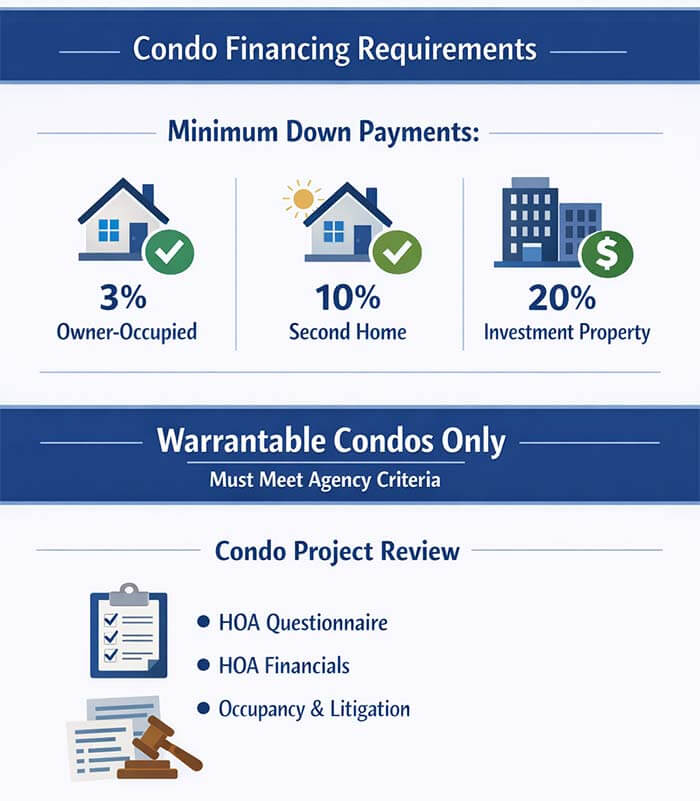
The Fannie Mae-Freddie Mac Condo Guidelines outline the eligibility criteria for condominium financing, and both agencies maintain similar requirements. Under these guidelines, borrowers may qualify for conventional loans with a down payment as low as 3% for owner-occupied condos. However, a higher down payment of 10% is necessary for second-home condos, while investment condos typically require a 20% down payment. It’s crucial for condo projects seeking financing to adhere to these guidelines to qualify for conventional loans through Fannie Mae or Freddie Mac.
Only condominium deemed warrantable, meeting the specific criteria outlined by the agencies, are eligible for warrantable condominium financing.
In the assessment process, a comprehensive condominium project questionnaire must be completed by the HOA Manager of the condo complex. This questionnaire serves as a detailed overview of the condominium project and its compliance with Fannie Mae and Freddie Mac Agency Guidelines. It covers various aspects, such as the financial health of the HOA, insurance coverage, litigation history, and occupancy rates.
Owner Occupancy Rules for Conventional Condos
- That is not the case for 2026.
- Fannie Mae officially eliminated its holding investment concentration for established projects in 2026.
- Freddie Mac also updated its established project policies and eliminated the owner-occupancy requirement for investment properties under review.
New Condo Projects Are Different
- New and newly converted condominiums have additional stipulations.
- For a Fannie Mae Full Review of a newly established project, at least 50% of the project, or a legal phase under a contract, must be sold to principal-residence or second-home buyers.
- Freddie Mac also maintains occupancy and presale requirements for applicable reviews of new condominium projects.
- Buyers must distinguish between the rules for established condo projects and those for new developments.
Commercial Space in a Condominium Project
- Some condominium projects with mixed-use components can secure conventional financing, though excessive commercial space may create some obstacles.
- Under its applicable project standards, Fannie Mae generally limits commercial or mixed-use space to no more than 35 percent of the condominium project or building.
- Commercial space requirements may vary somewhat depending on the size and type of the project under review by Freddie Mac, though the specific treatment may differ.
- A condominium above retail stores or restaurants is not automatically considered non-warrantable.
- The entire project must be evaluated.
One Owner Equals a Lot of Units: A Warning to Avoid Condo Projects
Fannie Mae’s limits may vary, depending on the size of the project. For example, its ineligible project rules set different single-entity ceilings for projects with 5–10 units, 11–20 units, and 21 or more units.
What Is a Condo Questionnaire?
Submission of a similar questionnaire is acceptable to Fannie Mae, provided the lender obtains the information to evaluate the project’s eligibility.
Documents a Condo Buyer Should Review Early
What Is Condotel Financing?
Condotel units represent a unique hybrid of condominium and hotel accommodations, providing the benefits of both residential ownership and hotel amenities. Within these hotel complexes, certain units are designated condotels, offering private ownership opportunities to individuals seeking a blend of investment and leisure.
Despite the allure of condotel ownership, securing financing for such units can often prove to be a formidable task, as many lenders tend to be hesitant due to the unconventional nature of condotel investments.
Gustan Cho Associates is an exceptional choice in this field, offering specialized financing options for condotels. At our company, we specialize in providing options that meet the unique needs of each potential homebuyer. By providing access to portfolio loans, Gustan Cho Associates facilitates the acquisition of condotel units, enabling individuals to capitalize on this unique investment opportunity.
Not Sure if Your Condo Meets Fannie Mae or Freddie Mac Rules?
Apply Now And Get recommendations From Loan Experts
Condotel versus Warrantable Condominium Units
It’s important to note that condotel financing typically comes with specific requirements and conditions that borrowers must meet to qualify. According to Fannie Mae-Freddie Mac Condo Guidelines, condotel financing typically entails a minimum down payment requirement, with second-home condotel units necessitating a 25% down payment and investment condotel units requiring a higher 40% down payment. Lenders may require borrowers to maintain reserves equivalent to at least one year’s PITI to mitigate risk.
Beyond financial considerations, condotel units must also meet certain structural and legal criteria to comply with lending standards.
These criteria often include minimum square footage requirements, with condotel units typically needing to exceed a certain threshold, such as 500 square feet, to qualify for financing. Additionally, condotel units must feature at least one bedroom and a fully functional kitchen, mirroring the amenities expected of traditional residential units.
Mortgage Guidelines of Condominium Complex of Warrantable and Non-Warrantable Condos
Furthermore, lenders typically scrutinize the legal status of the condo complex in which the condotel unit is located, ensuring no pending litigations or disputes could jeopardize the investment’s stability. Compliance with these guidelines enhances the desirability of condotel units as investment opportunities.
The condominium complex mitigates risk for lenders, thereby facilitating smoother financing processes for prospective buyers.
In summary, while condotel ownership presents a unique investment opportunity blending residential and hotel accommodations, securing financing for such units can be complex. However, with specialized lenders like Gustan Cho Associates offering tailored condotel financing solutions and adherence to Fannie Mae-Freddie Mac Condo Guidelines, prospective buyers can navigate the process more confidently, unlocking the potential of condotel investments with greater ease and assurance.
Freddie Mac Condo Requirements
Gustan Cho Associates has cultivated partnerships with numerous non-QM wholesale lenders, facilitating access to financing for individuals seeking non-warrantable condos. Our team can assist you if you’re inquiring about non-QM or alternative mortgage loans. Feel free to contact Gustan Cho Associates at 800-900-8569, text us for expedited responses, or email us at alex@gustancho.com.
We prioritize accessibility and are committed to serving you seven days a week, including evenings, weekends, and holidays. Navigating the intricacies of condo financing can be daunting.
Gustan Cho Associates is here to streamline the process and provide tailored solutions. At Gustan Cho Associates, our team excels in guiding homebuyers with personalized support and comprehensive guidance throughout the loan acquisition journey. Whether exploring traditional options or seeking alternative financing, trust Gustan Cho Associates to deliver transparent, efficient, and reliable service at every step.
FAQs: Fannie Mae-Freddie Mac Condo Guidelines on Conventional Loans
- 1. What are the key points regarding Fannie Mae-Freddie Mac Condo Guidelines? The article discusses how these guidelines enable conventional condo loans with a low 3% down payment, emphasizing the growing popularity of condos and the risks involved in their purchase.
- 2. How do Fannie Mae and Freddie Mac’s guidelines affect condo financing? These guidelines set criteria for condos to qualify for conventional loans, covering borrower eligibility and condo project assessment. Non-warrantable condos may still secure financing through Gustan Cho Associates with a 20% down payment.
- 3. What’s the importance of the condo project questionnaire mentioned? The questionnaire ensures compliance with Fannie Mae-Freddie Mac condo guidelines, detailing the condo project’s financial health, insurance, litigation history, and occupancy rates, aiding mortgage underwriters’ review.
- 4. Can individuals secure financing for condotel units, and what are the requirements? Yes, through specialized lenders like Gustan Cho Associates. The guidelines specify down payment requirements (25% for second-home, 40% for investment condotels) and may require reserves equivalent to one year’s mortgage payments. Compliance with structural and legal criteria is vital for approval.
This blog about Fannie Mae-Freddie Mac Condo Guidelines On Conventional Loans was updated on March 4, 2024.
Want the Lowest Down Payment on a Warrantable Condo?
We’ll check if your condo qualifies for standard conventional terms and best-rate pricing