Payment shock can contribute to mortgage denial, but a large increase in housing expenses does not automatically disqualify a borrower. The underwriter or automated underwriting system evaluates the complete loan profile, including income, credit history, debt-to-income ratio, reserves, housing payment history, residual income, when applicable, and the proposed total monthly payment.
Payment shock may receive closer review when the loan requires manual underwriting or the borrower has other risk factors. FHA, VA, USDA, conventional, and lender-specific programs treat payment shock differently. Some lenders also impose overlays that are stricter than the minimum agency guidelines.
What Mortgage Payment Shock Means
A payment shock is the increase between a borrower’s current housing payment and the proposed new mortgage payment. A large increase does not automatically mean the loan will be denied, but it can receive closer review during underwriting.
Payment Shock From Rent to a Mortgage
Payment shock is the increase a renter would experience when moving from renting to purchasing a home. To calculate payment shock, a lender would estimate the total cost of a mortgage, including principal, interest, property taxes, insurance, and applicable mortgage insurance or HOA dues.
A large level of payment shock would not necessarily result in a borrower being denied a mortgage. The credit history, income, debt-to-income ratio, reserves, and the loan program are all considered by the underwriter in their decision to approve or deny the mortgage.
Payment Shock for Rent-Free Borrowers
A borrower who is rent-free can usually obtain a mortgage, as there is no payment to compare with the proposed mortgage payment.
For FHA manual underwriting, a rent-free borrower is someone with no current payments. These people would not fall under the FHA minimal-increase-in-housing-payment compensating factor.
How to Calculate Payment Shock
Payment shock can be calculated by comparing the proposed housing payment with the borrower’s current housing payment.
Payment Shock Formula
Payment Shock = (New Housing Payment – Current Housing Payment) ÷ Current Housing Payment × 100
Example:
- Current Housing Payment = $1,500
- New Housing Payment = $1,950
- Increase: $450
The payment shock is:
$450 ÷ $1,500 × 100
Payment Shock = 30%
The borrower’s new housing payment is 30% higher than the current rent.
Payment shock should not be confused with debt-to-income ratio. Payment shock measures the increase in housing expense, while DTI compares qualifying monthly debts with qualifying income
Does Payment Shock Affect Mortgage Approval?
Payment Shock does not automatically disqualify mortgage applications, but it can impact approval. Payment Shock is often a factor in the approval process, depending on the loan, the type of credit profile, the extent of automation used in credit underwriting, and the borrower’s credit profile.
Payment Shock vs Debt-to-Income Ratio
A borrower can have a payment shock and still have a favorable DTI. The same can be vice versa. A borrower can experience a small payment shock yet still have a high DTI due to an auto loan, credit card debt, student loans, and other financial obligations.
Why Housing Payment History Matters
By providing documentation of on-time housing payments, the borrower can demonstrate their ability to manage a housing obligation.
FHA Payment Shock and Manual Underwriting
Loan Payment Shock can occur when seeking an FHA loan that requires manual underwriting, because an increase in a housing payment, which FHA considers a possible compensating factor, can be small.
FHA Minimal Increases in Housing Payment
FHA manual underwriting considers a factor compensating when the total monthly mortgage payment is not significantly greater than the current housing payment.
This can be a supporting factor for a manual underwriting of a loan, assuming the FHA criteria are met, and the qualifying ratios are on the high side.
FHA $100 or 5% Rule
The mortgage payment cannot be greater than the current housing payment by an amount greater than:
$100 or 5% of the current housing payment, whichever is less.
For example, if the borrower is currently paying $1,800 in rent, of which $90 is 5%.The increase must be $90 or less; the proposed total payment could be no more than $1,890 for this compensating factor.
Required Housing Payment History
To use this compensating factor, the documented 12-month housing-payment history may include no more than one 30-day late payment.
The lender must document the housing payment history, per FHA requirements. The lender cannot rely on the borrower’s statement in this case.
FHA Borrowers Living Rent-Free
An FHA borrower residing rent-free may still qualify for an FHA mortgage. Since no housing payments are currently being made, the borrower cannot use the small increase in housing payments as an FHA compensating factor.
Other qualifying factors may further strengthen the loan.
Denied Because of Payment Shock? Get a Second Opinion
Payment shock does not always mean automatic denial. We’ll review your DTI, reserves, housing history, credit, income, and loan program to see what may still work.
VA Payment Shock and Housing Payment History
Calculations made by VA underwriters do not include the FHA $100-or-$5% compensating factor. Instead, the lender assesses whether the borrower can cover the expenses associated with the proposed housing.
When considering a VA loan, the underwriter also reviews the borrower’s credit and employment history, housing payment history, debt-to-income ratio, and residual income.
An increase in the proposed mortgage payment will not automatically disqualify a veteran or eligible borrower from financing.
Housing history is more important when other components of the loan file are of greater concern. For VA loans, emphasis is placed on the dollar amount of income that remains after all obligated expenses, including the housing payment, have been satisfied.
A borrower with stable employment and good credit who shows high residual income may still qualify for financing, even if the new mortgage payment is significantly higher than the current rent.
USDA Payment Shock Guidelines
The USDA treatment for payment shock varies depending on whether the borrower is using the Guaranteed Loan Program or the USDA Direct Loan Program.
USDA Guaranteed Loans
Payment shock can no longer be used by the USDA as a compensating factor for waiving the debt-to-income ratio under the Guaranteed Loan Program. Payment shock should not be used as a stand-alone, unrelated criterion when considering a USDA-backed mortgage.
The lender will still perform an evaluation of the borrower’s credit and repayment history under USDA guidelines.
USDA Direct Loans
The treatment of payment shock under the USDA Direct Loan Program is different. For the Direct Loan Program, payment shock is the difference between the applicant’s current housing expense and the proposed housing expense.
USDA says that when shock exceeds 100% or cannot be measured, additional risk layering should not be allowed without strong justification, and the Loan Approval Official must document the rationale.
Payment Shock With Automated Underwriting
An acceptable recommendation for automated underwriting does not mean that a universal limit on payment shock will apply for a mortgage with a higher proposed payment than the current rent.
The automated underwriting system evaluates all of the factors related to the loan, e.g., income, debts, credit, assets, etc.
HUD does not require a manual underwriting analysis to determine the housing payment for a loan that receives an Accept recommendation through TOTAL, provided the loan remains within automated underwriting.
Some lenders may have their own policies or request additional documents to justify increased payments and a high-risk loan.
Conventional Loan Payment Shock Guidelines
The FHA rule allowing a minimal payment increase of no more than $100 or 5%, whichever is less, does not apply to conventional loans. Fannie Mae and Freddie Mac do not establish a universal payment shock percentage that automatically approves or denies a conventional mortgage applicant.
Most conventional loans are evaluated through Fannie Mae’s Desktop Underwriter (DU) or Freddie Mac’s Loan Product Advisor (LPA). These automated underwriting systems evaluate the borrower’s overall risk profile, including credit history, debt-to-income ratio, income, assets, reserves, loan-to-value ratio, and housing-payment history. Fannie Mae and Freddie Mac provide additional information about their respective underwriting systems.
A substantial increase from rent to a new mortgage payment does not automatically disqualify a conventional borrower. However, limited reserves, high DTI, recent late payments, or other risk factors may result in additional underwriting scrutiny. Lenders may also impose overlays that are more restrictive than the requirements of Fannie Mae or Freddie Mac.
Some mortgage websites refer to a 20% payment-shock threshold. Borrowers should not treat 20% as a universal Fannie Mae or Freddie Mac approval rule. The loan must be evaluated in accordance with the applicable agency guidelines, automated underwriting findings, and the lender’s own requirements.
How Lenders Verify Rental Payment History
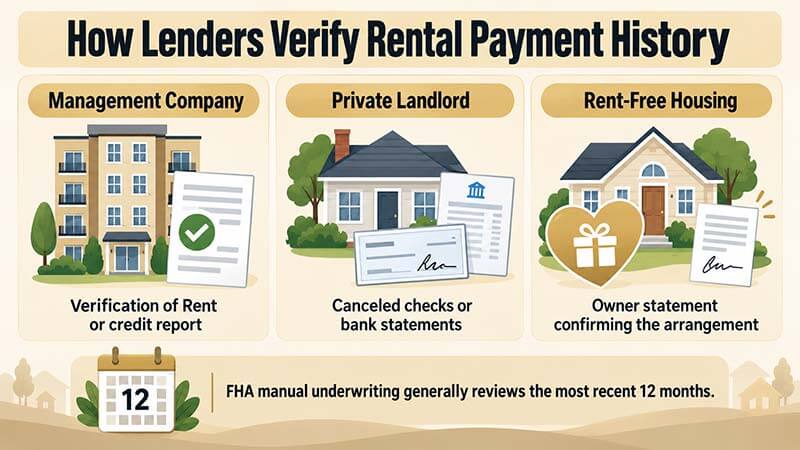
There are instances in the mortgage process that require verification of rental payment history. For FHA loans, if a mortgage application must be manually underwritten, mortgage lenders must gather the last 12 months of the applicant’s rental payment history.
Property Management Companies
For rents paid to a management company or an independent landlord, mortgage lenders may request rent verification directly from the landlord. The rental payment history can also be found on the applicant’s credit report.
Private Landlords
When a borrower rents from a private landlord, mortgage lenders must comply with the documentation requirements of that loan program. Checks or account statements can be provided by the borrower, or if allowed, verification can be done by the landlord.
For payment history verification, documentation should be provided showing that the borrower made the required rent payments, rather than the borrower’s statement to that effect.
Rent-Free Housing
Being housed rent-free is not a barrier to obtaining a mortgage.
For FHA loans that require manual underwriting, the mortgage lender must obtain a statement from the property owner confirming that the borrower has been living rent-free and specifying the length of the agreement.
A rent-free borrower cannot use FHA’s small increase in housing payment compensating factor because there is no current housing payment to consider in relation to the proposed mortgage payment.
What We See in Real Payment Shock Files
Payment shock does not produce the same underwriting result for every borrower. The following are common situations encountered by our mortgage team. No borrower-identifying information is included.
High Payment Shock With an AUS Approval
We have reviewed files in which a renter’s proposed total housing payment—including principal, interest, taxes, homeowners’ insurance, mortgage insurance, and applicable HOA dues—was substantially higher than the current rent. The borrower still received an acceptable automated underwriting finding because the AUS evaluated the entire loan profile rather than applying a universal payment-shock limit.
An AUS approval does not eliminate documentation requirements or guarantee final approval. Income, assets, debts, credit, and other information must still be accurate and verified.
Rent-Free FHA Borrower
We also encounter FHA borrowers who live with relatives or otherwise have no current housing payment. Living rent-free does not automatically prevent someone from qualifying for an FHA loan. However, if the loan requires manual underwriting, the borrower cannot use FHA’s minimal increase in housing payment as a compensating factor because there is no current payment to compare against.
The lender may instead evaluate other documented strengths permitted under FHA guidelines.
Manual Underwriting With Other Financial Strengths
In manually underwritten files, payment shock is only one part of the overall credit decision. Documented cash reserves, residual income, stable employment, qualifying additional income, and a satisfactory housing-payment history may strengthen a file when supported by the applicable program guidelines.
These factors do not guarantee approval. The underwriter must determine whether the borrower meets the program’s requirements and has demonstrated the ability to manage the proposed payment.
Lender Overlays Stricter Than Agency Guidelines
We have also reviewed borrowers who met the underlying agency requirements but encountered a lender policy that imposed stricter payment-shock limits, reserve requirements, credit standards, or housing-history requirements.
This distinction is important: a lender overlay is not necessarily an FHA, VA, USDA, Fannie Mae, or Freddie Mac rule. Borrowers should ask whether a condition comes from the agency guidelines or from the individual lender’s internal underwriting policy.
Hypothetical FHA Payment Shock Example
Hypothetical Example: Purchase of a primary residence with an FHA loan that requires manual underwriting.
- Current rent: $1,800
- Proposed mortgage payment: $1,875
- Increase: $75
- Payment shock: 4.17%
- Evidence of 12 months of rental history provided
- No record of late payments on housing
- AUS finding: Refer
5% Of the borrower’s $1,800 rent, 5 percent is $90. Therefore, the actual increase of $75 is less than $100 and 5 percent of the current housing payment.
Assuming the other FHA conditions have been satisfied and the required rental payment history is documented, a small increase in the borrower’s housing payment may be considered a compensating factor.
This is not a definitive approval for a mortgage. The underwriter will perform a full credit review to determine whether the borrower meets other FHA requirements and complies with the credit review. HUD has established the following guidelines for this compensating factor: an increase of up to $100 or 5 percent, whichever is less.
How Borrowers Can Prepare for a Higher Mortgage Payment
To qualify for a mortgage, borrowers are not required to remain within the payment shock percentage. Rather, having a mortgage payment that falls well within the budget demonstrates the strength of the loan application.
Prior to making an application for a mortgage, borrowers should consider the following:
- On-time payment of all existing housing obligations.
- Avoiding taking on new debt, or at least minimizing new debt.
- Build cash reserves.
- Retain all records and evidence of rent payments.
- Avoid making large deposits that cannot be explained or documented.
- Levels of employment and stable income.
- Retaining a qualifying income.
When calculating a large anticipated increase in monthly mortgage payments relative to prior rent, the total housing payment should include principal, interest, taxes, insurance, and mortgage insurance, where applicable, as well as HOA dues.
A larger mortgage payment doesn’t necessarily correlate to a loan with better terms. The housing payment after closing should also be considered.
Lender Overlays and Payment Shock
Additional standards set by mortgage lenders above the FHA, VA, USDA, Fannie Mae, and Freddie Mac guidelines are called lender overlays.
A lender may implement stricter standards for files that have high payment shock, are manually underwritten, have low credit scores, have low reserves, or have other risk factors.
Consequently, the borrower may comply with the loan program’s standards but be rejected by the lender due to the lender’s own requirements. To avoid this, the borrower should check whether the issue is an agency guideline or a lender overlay.
Final Thoughts on Payment Shock
Payment shock is the increase in a borrower’s proposed monthly housing cost from the borrower’s current monthly housing cost. Just because there is a large payment shock does not mean a borrower will not be approved for a mortgage.
Payment Shock’s significance is determined by the loan program, the underwriting method, the borrower’s history of housing payments, the borrower’s credit report and score, the borrower’s debt-to-income ratio, the borrower’s available reserves, and many other factors.
For example, with FHA manual underwriting, a small increase in the housing payment can be a compensating factor if the borrower meets all the FHA requirements. The requirements and treatment of housing payments for VA and USDA loans are different, so borrowers can’t apply a $100 or 5% payment shock standard to all mortgage programs.
The most important thing to do is to review the entire loan file against the correct program guidelines rather than relying on a payment shock percentage in a vacuum.
Don’t Let a Higher Payment Derail Your Homeownership Goals
We specialize in helping renters transition to mortgage payments—even with high DTI or payment shock concerns.