Online Mortgage Application: Everything from Getting Preapproved to Closing
In this guide, we will cover and discuss the online mortgage application leading to clear to close. The mortgage application process has changed over the years. There was a time when borrowers met mortgage loan officers face to face. Borrowers either met their loan officers at the mortgage company or the mortgage loan originator visited their home or office.
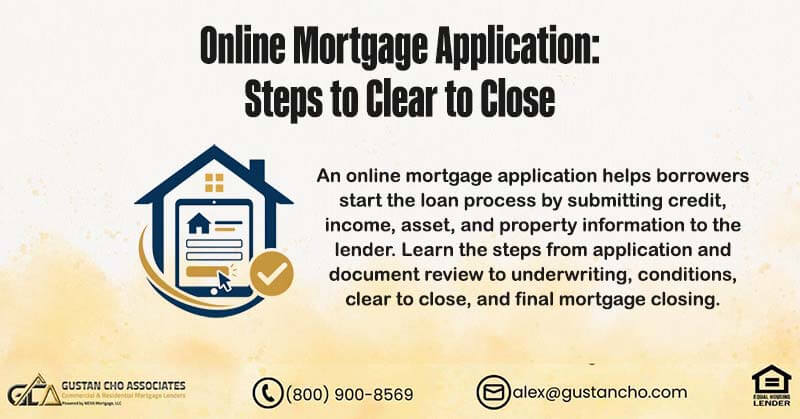
An online mortgage application enables homebuyers or homeowners to submit their information to lenders, starting the process of purchasing or refinancing a home.
This is only the first step. After submission, the lender will review your credit, verify documentation, conduct underwriting, assess the property, and determine final approval and clear-to-close status. Complete your application carefully and ensure consistency in your reported income, employment history, assets, debts, and property details to help expedite the mortgage process.
What Happens After an Online Mortgage Application?
After submission of your online mortgage application, a loan officer will review the information, outline subsequent steps, and may request authorization to conduct a credit check.
The lender will then request supporting documentation for your loan. Your application will be evaluated either by an automated system or through manual review, depending on the lender’s process.
Preapproval does not guarantee final mortgage approval. The lender must verify all information, assess the property, and confirm all loan requirements are met before granting final approval and clear-to-close.
What Is an Online Mortgage Application?
An online mortgage application is the digital version of a traditional home loan application. Most lenders will ask you to fill out the Uniform Residential Loan Application (URLA). This is also referred to as the Fannie Mae Form 1003 or the Freddie Mac Form 65. The URLA will ask you to provide information about your employment, income, assets, debts, real estate owned, and the loan you are requesting and applying for.
The URLA Will Ask Information About Loans Used for:
- Purchase loan
- Rate-and-term refinance loan
- Cash-out refinance loan
- Primary residence
- Second home
- Investment property
- FHA, VA, USDA, conventional, jumbo, or Non-QM financing
Submitting the URLA does not result in immediate approval; rather, it initiates the lender’s review process for your loan. Is there a difference between an online application and a paper application? Both online and paper applications require the same information. The primary difference is how you complete and submit your details.
Allow You To:
- Complete the application
- Submit supporting documentation
- eSign required disclosures
- Track condition milestones
- Interact with the mortgage team
- Pre-review mortgage documents
- Prepare for loan closing
You may contact a mortgage professional if you have questions, need to correct errors in your application, or wish to review available loan options.
What Will a Lender Ask for on a Loan Application?
A loan application requires personal details, employment history, and financial information. Provide accurate figures and ensure you have supporting documentation to verify your disclosures. Personal and Contact Info
Applications May Require Information Such As:
- Name
- Birth Date
- Social Security number
- Citizenship or residency status
- Marital status
- Current and recent addresses
- Phone number
Lenders May Require a Legal Photo ID and Documents That Verify Residency
Employment and Income
Information May Include:
- Employer name and address
- Position
- Employment start date
- Base salary
- Hourly income
- Overtime
- Bonuses
- Commissions
- Self-employment income
- Income from retirement or pensions
- Social Security income
- Disability income
- Income from real estate investment
- Other qualifying income
- Not all income sources will qualify.
- The lender will determine which income types and documents are acceptable for loan qualification.
Applications Can Include Info About:
- Bank, Savings, and Money Market
Applications May Also Request Information About:
- Investments
- Earnest money
- Gift Funds
- Down payment assistance
- Sale of a property
- Cash-value life insurance
- Other assets
- If you have large or unusual deposits, you may need to provide explanations.
- Avoid transferring funds between accounts unless you can provide proper documentation.
The Lender Considers the Borrower’s Monthly Obligations That May Affect the Borrower’s Debt-to-Income Ratio. These May Include:
- auto loans
- student loans
- credit cards
- personal loans
- mortgages
- home equity accounts
- child support
- alimony
- tax payment agreements
- other recurring obligations
If you own additional real estate, you may need to provide the lender with details such as the address, estimated value, mortgage balance, monthly payment, rental income, taxes, insurance, and HOA dues.rmation
You May Also Need to Provide the Following Information:
- Requested loan amount
- property address
- estimated value of property
- property type
- number of units
- intended occupancy
- down payment
- source of funds
- loan purpose
- preferred loan program
- You may initiate the preapproval process before selecting a property.
- However, a property address is one of the six essential items required for a Loan Estimate application.
When Is Providing a Loan Estimate Mandatory?
Lenders are Required by the TILA-RESPA Integrated Disclosure Rule to Provide a Loan Estimate Within a Specific Timeframe, Once They Have Received the Following Six Pieces of Information:
- The borrower’s name
- The borrower’s income
- The borrower’s Social Security Number to pull a credit report
- The address of the property
- The estimated value of the property
- The amount of the loan requested
Loan Estimates will generally be provided within 3 business days after the lender receives the remaining items listed above. Additional documents related to the loan are not counted toward the six.
The Loan Estimate Provides a Summary of the Following Information:
- The amount of the loan
- The interest rate
- The estimated monthly payment
- The estimated total closing costs
- The total cash required to close
- The total amount of mortgage insurance
- The total amount of prepayment penalties (if applicable)
- The total amount of the rate lock (if applicable)
- The total payment (if applicable)
- Review your Loan Estimate thoroughly.
- If you have questions regarding mortgage insurance, rate locks, points, fees, or lender credits, request clarification from your lender.
Move From Application to Clear to Close With Fewer Delays
We’ll help you avoid common roadblocks like large deposits, credit changes, incomplete documents, and unanswered underwriting conditions.The Online Mortgage Application Process
Most mortgage processes follow the steps below, though the details can vary depending on your lender and the other parties involved.
Step 1: Complete the Online Mortgage Application
- The Borrower completes the mortgage application and sends it to the lender to review and approve.
- Exercise care and be thorough and accurate when completing your application.
- Errors such as incorrect income, omitted properties, undisclosed debts, or inaccurate employment dates may result in denial if inconsistencies are found
Licensed Mortgage Loan Originator
A Mortgage Loan Originator Will Analyze the Application and Cover, Among Other Things:
- the objective (for a purchase or refinance)
- the estimated housing budget
- the down payment
- credit history
- employment and income
- assets
- the type of property
- how the property will be used
- the loan programs available
- Your loan officer will let you know whether a credit check is needed and which documents you should provide to ensure a strong preapproval.
Step 3: Credit Is Reviewed
After the borrower authorizes it, a lender may get a mortgage credit report.
The Credit Check May Show:
- credit scores
- debts
- payment history
- inquiries
- collections
- charged-off accounts
- payment delinquencies
- bankruptcies
- foreclosures
- accounts in dispute
- other credit issues
- Your credit score is just one part of what the lender looks at.
- They also review your credit history, recent payments, housing history, and the severity of any past credit issues.
Step 4: Supporting Documents Are Collected
This depends on how the required documents will depend on your income sources and the loan program., This may include pay stubs, W-2s, and bank statements. For self-employed borrowers, this may include personal and business tax returns and business bank statements. Providing clear and complete documentation may reduce the likelihood of additional requests from underwriting.
Step 5: Issuance of Prequalification or Preapproval
Typically, prequalification refers to an initial assessment based on a borrower’s self-reported information. Preapproval, on the other hand, usually refers to a more in-depth assessment, though this can vary by lender. Neither prequalification nor preapproval equates to a formal loan offer.
The CFPB describes preapproval as a lender’s tentative intent to extend credit up to a specified limit, based on their assumptions and the readily available information.
A strong preapproval will identify any issues with your credit, income, assets, debts, or property eligibility. Most mortgage applications are underwritten through an automated assessment.y be referred to as Desktop Underwriter (DU), and Freddie Mac’s system may be referred to as Loan Product Advisor (LPA). These systems may assist lenders in assessing credit risk and determining whether a loan meets required eligibility criteria. Automated underwriting may be employed as a component of other government loan programs, in accordance with other applicable agency directives.
Results from Automated Underwriting are Not a Final Approval. The Lender Still Needs To:
- Submit accurate data
- Review results
- Validate documentation
- Validate loan-program compliance
- Validate the subject property
- Fulfill underwriting requirements
Step 7: Loan in Processing
Once You Have Selected a Property and Agreed to Proceed, Your Loan Enters the Processing Stage. Take Any of the Following Actions:
- Submit the application and supporting documentation to validate that there are no outstanding issues.
- Finalize the arrangement of all income and asset documentation.
- Verify employment
- Request additional statements
- Order the appraisal
- Coordinate title work
- Obtain insurance information
- Review the purchase contract.
- Prepare the file for underwriting.
- The processor may send you a list of missing items before your file is submitted to underwriting.
- A mortgage considers the borrower and the property.
For the Type of Transaction Involved, the Lender Might Look at:
- Appraised value
- Property condition
- Comparable sales
- Title history
- Property taxes
- Homeowners insurance
- Flood-zone information
- Homeowners association documents
- Condominium project eligibility
- Required repairs
- Occupancy
- Property use
- Even if you meet all mortgage qualification criteria, property-related issues may delay or prevent approval.
- The underwriter looks at the applicaThe underwriter reviews your application, supporting documents, credit, income, employment, and property information with conditions
- Suspended pending additional information
- Ineligible for the requested program
- Denied
- Referred to manual underwriting when allowed
- In most cases, approval is granted with conditions.
- You must submit additional documentation or explanations before final approval is issued.
Conditions Can Include:
- Pay stubs
- Bank statements
- Verification of employment
- Credit inquiry explanations
- Evidence of large deposits
- Gift funds papers
- Debt-proof papers
- Transcripts
- Insurance
- Appraisals
- Titles
- HOA info
- Explanation letters
Step 10: Submit All Required Documents
- You must submit all required documents to satisfy underwriting conditions.
- Ensure all information is complete and addresses each requirement clearly.
- After an underwriter reviews it, the lender may give final approval, or the loan may be marked “clear to close.”
- “Clear to close” means the lender has completed the approval process and your loan is ready to close.
- Avoid making financial changes at this stage.
- Check, confirm your job, verify the closing amount, prepare closing documents, and work with the settlement agent to finish the process.
Step 12: Review the Closing Disclosure
- The Closing Disclosure highlights the final terms of the loan, including the monthly payment, closing costs, prepayments, adjustments, and the amount due at closing.
- For covered transactions, lenders must send you the Closing Disclosure at least three business days before closing.
- This allows you time to review, compare, and ask about any changes from your Loan Estimate.
- Review closing costs, cash to close, loan amount, principal and interest, taxes, mortgage insurance, hazard insurance, seller and lender credits, escrow, prepayment penalties, and any adjustable rate features.
- Questions about the closing terms before you sign the loan agreement.
Step 13: Complete the Mortgage Closing
The borrower will now execute the Loan agreement and transfer the required funds to the settlement agent. Before the settlement is complete, you may do a final walkthrough of the property in addition to signing the loan documents.
What Documents Are Needed After Applying Online?
The documents you need after applying will depend on the information you provided. Be prepared to supply paperwork that verifies the details in your application.,
The Following Items are Requested:
- Most recent pay stubs
- W-2 forms
- Bank Statements
- Government-issued ID
- Employment history
- Bonuses, overtime, commission documentation
- Contract once a property is selected
Documents for Self-Employed Borrowers
Self-Employed Borrowers May Require the Following:
- Personal tax returns
- Business tax returns
- YTD profit and loss statements
- Balance sheet
- Business bank statements
- Business license
- CPA or tax preparer info
- Docs showing business ownership
- Declining or irregular income explanation
The documentation required will depend on your loan program and the method by which you qualify for income.
Lender May Request the Following:
- Social Security award letter
- Pension statements
- Retirement account statements
- Distribution history
- Disability award letter
- Divorce decree
- Child support order
- Lease agreements
- Tax statements
- You will need to provide proof of income if requested by the lender.
Borrowers May Require the Following:
- Checking account statements
- Savings account statements
- Retirement account statements
- Investment account statements
- Gift letters
- Donor bank record gift letters
- Earnest money docs
- Sale of property docs
- Down payment assist approval
- Docs for large deposits
- Each lender may evaluate your assets differently when determining your loan eligibility.
Automated Underwriting System Approval Vs. Manual Underwriting
While most lenders use automated underwriting, some borrowers may not get an automated approval.
The New Normal For Mortgage Lenders
Now everything is done online, including sending out eDisclosures. Due to the online mortgage application system, a mortgage loan borrower can deal with any licensed mortgage loan originator from any state. Mortgage loan borrowers are not limited to their local mortgage companies anymore. A borrower from California can deal with a lender in Florida and vice versa. The technological systems implemented in the mortgage industry expand the choice of borrowers in choosing a licensed mortgage loan originator anywhere in the country.
How Does The Online Mortgage Application Process Work?
Most mortgage companies today have a website where the mortgage loan originator can apply online. These online mortgage application platforms are secured sites where it is fully protected. The initial online mortgage application is a 4-page 1003 mortgage application. It asks mortgage applicants for personal and financial information such as the following:
- Name
- Address
- Phone number
- Social security number
- Date of birth
- Email address
- Reserves
- Employment
- Employment history
- Bank name and amount
- Present address
- Subject property address
- Asset information
- Co-borrower information
Disclosures on Online Mortgage Application
Disclosures such as the following need to be disclosed by borrowers:
- Bankruptcy
- Foreclosure
- Short Sale
- Judgments
- Party of a lawsuit
- First time home buyer
- Oher federally mandated disclosures
Questions Asked On Online Mortgage Application
The Online Mortgage Application Will Also Ask the Following:
- The purchase price of the subject property
Type of Loan Program
- FHA loans
- VA loans
- USDA loans
- Conventional loans
- Jumbo loans
- Non-QM mortgages
- No-Doc loans
- Doctors Mortgage Loan Programs
- Homes for Heroes
- Fix and flip loans
Once the applicant has completed an online mortgage application, a licensed mortgage loan originator will be alerted via email. Borrowers will be contacted by a loan officer and go over the application prior to running a credit check. Once the mortgage application is reviewed by the licensed mortgage loan originator.
Online Mortgage Application Process
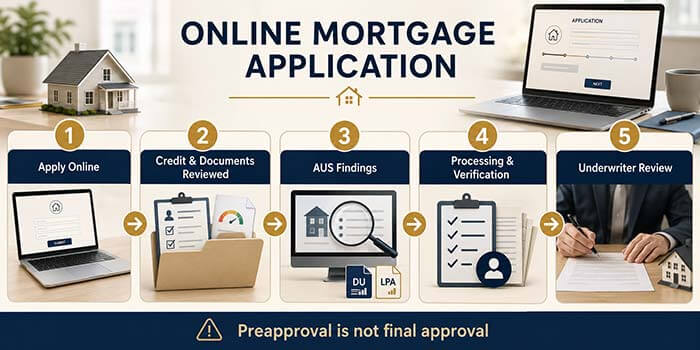
Loan Officer Will Do the Following:
- Run a credit check
- Review credit report
- Go over the online mortgage application to verify the information stated
- Collect necessary docs
Once the mortgage loan originator deems that the applicant can get approved, the mortgage loan originator will run the mortgage file, application, and credit report, through the Automated Underwriting System for automated approval. If a borrower gets automated approval from either DU or LP automated findings, they are in good shape. DU stands for Desktop Underwriter and it is the Fannie Mae version of the automated underwriting system. LP is the Loan Prospector and it is the Freddie Mac of the automated underwriting system.
How Mortgage Pre-Approvals Are Issued
Everyone issues pre-approval differently. All of our pre-approvals at Gustan Cho Associates are full credit approvals issued by our underwriters. They are called TBD Property Underwriting Approvals.
Once the above tasks are completed, the loan officer submits them to the Loan Officer’s Assistant. LOA then goes further and may order VOE and get VOR as well as other necessary docs.
Once LOA completes tasks, it is then submitted to processing, and the mortgage processor is assigned. The processor preps the file for an underwriter. Underwriter reviews docs and loan packages and issues a pre-approval which is also a conditional mortgage approval.
What is Automated Underwriting?
Automated Underwriting Systems (AU) review a borrower’s application and credit report and provide findings to the lender.
These Findings May Include:
- Eligibility status
- Risk analysis
- Requirements for documentation
- Income needs
- Asset needs
- Credit requirements
- Property requirements
- Messages for lender review
- Automated underwriting results depend on the accuracy and completeness of your information.
- If your income, assets, debts, or property details change, the system’s recommendation may also change.
Manual Underwriting?
Manual underwriting is the review of a loan submission by an underwriter (underwriting a loan) and is performed in accordance with the rules of the loan program.
Manual Underwriting May be Performed if:
- An AUS returns a refer finding.
- The borrower has little or no conventional credit.
- The loan program allows manual underwriting.
- The file requires manual underwriting due to individual borrower circumstances.
- The borrower has non-conventional credit and/or credit events.
- Additional payment/trade verification is required.
- Manual underwriting may require additional steps or documentation.
- Lenders offer manual underwriting.
- You might get approved by a different lender if their requirements are less strict.
What Causes Delays When Applying for a Mortgage Online?
Most delays are due to missing documentation, changes in the borrower’s financial situation, property-related issues, and information that cannot be verified.
Incomplete or Inaccurate Application Information
- Omitting or inaccurately reporting debts, properties, employers, or income can cause complications.
- Review your application carefully before submission and correct any errors.
- If you delay sending documents, the underwriter may request updated versions because older documents may no longer be valid.
Large Unexplained Deposits
If you make a large deposit toward your down payment, closing costs, or reserves, the lender will probably ask you to explain its source and provide documents for any transfers, sales, gifts, or deposits.
New Credit Before Closing
Taking on new credit, financing a purchase, buying a car, or increasing your credit card balances can affect your credit and debt-to-income ratio. Talk to your loan officer before making any big purchases.
Changes to Employment or Income
If your job or income changes, or you take a leave of absence, your loan will probably need to be reviewed again.
New Appraisal or Property
Even if you qualify, things like a low appraisal, needed repairs, title or insurance issues, or an ineligible condo can delay your loan.
Missing Closing Cost
You need to have enough verified funds to cover your down payment, closing costs, prepaid expenses, and any required reserves.
Clear to Close
Here are practical steps you can take to keep your loan process moving smoothly. Provide full legal names, precise employment dates, complete housing histories, and precise account information.
Submit Complete Documents
When you send in statements, include every page—even the blank ones. Make sure your documents are complete, easy to read, and include your identifying details.
Respond to Conditions.
Read each condition. Respond to conditions promptly. Read each request carefully. If you have questions, contact your mortgage team for clarification. Before opening new accounts, making large transfers, changing jobs, or cosigning for someone else, consult your lender about the potential impact on your loan. our mortgage, rent, credit cards, car loans, student loans, and other financial obligations.
Monitor Email and Phone Messages
Your loan officer, processor, underwriter, appraiser, and other team members may send time-sensitive requests. Check your email and phone messages regularly. For example, a homebuyer may complete a mortgage application online before beginning their home search. The mortgage loan officer will complete a credit report and request the applicant to provide pay stubs, W-2s, bank statements, and a government-issued identification.
The mortgage applicant receives a preapproval for a specified purchase price and an estimation of their monthly mortgage payment after the mortgage loan officer completes the review of the submitted documents.
The mortgage applicant would sign the purchase contract as the next step in the home-buying process. The mortgage lender would complete the process by updating the mortgage application to include the subject property, preparing all required disclosures, and completing the appraisal and title work. The mortgage file would be submitted to the underwriting department for review.
Conditional Loan Approval
The underwriter issues conditional approval, and an updated bank statement is required, along with proof of earnest money, homeowners’ insurance, and a letter of explanation regarding the credit inquiry.
The documentation is supplied by the borrower. The appraisal and title work are fine. The final conditions are cleared, and the lender issues a clear-to-close.
This overview is intended as a general guide. Specific requirements may vary based on your circumstances, the property, the loan program, your lender, and the underwriter’s findings.
Mortgage Professional Review
Online mortgage applications are designed to streamline the process for borrowers. However, technology may sometimes complicate structuring the best mortgage for your needs. If you have a high debt-to-income ratio, are self-employed, have a bankruptcy, credit issues, or own a unique property, it is best to work with a mortgage professional who understands agency guidelines, manual underwriting, and special loan requirements. Call us today at 800-900-8569 to talk about your mortgage options, or start your online application now.
Frequently Asked Questions: FAQs
Are You Able to Complete an Online Mortgage Application Before You Have Selected a House?
Yes, you can apply for pre-approval by sharing your financial details even if you haven’t picked a property yet. You’ll need to provide a property address later to finish the loan process and disclosures.
Does an Online Mortgage Application Impact My Credit Score?
Filling out the application itself won’t affect your credit score. But if you let the lender check your credit, it will show as an inquiry. Ask your lender if it will be a soft or hard inquiry.
How Long Does it Take to Do an Online Mortgage Application?
The time it takes depends on your job, assets, debts, properties, and sources of income. Having your pay stubs, tax forms, bank statements, and ID ready can help speed things up.
Is Doing an Online Mortgage Application the Same Thing as Being Preapproved?
No. A mortgage application. A mortgage application is the form you use to provide your information to the lender. Preapproval means the lender has done an initial review and made a preliminary decision, but it’s not a final approval.
Estimate Before a Purchase Agreement is Signed?
You don’t need a signed purchase agreement to get a Loan Estimate. Once the lender has the six required pieces of information, they must provide you with the Loan Estimate.
Is it Possible to Get a Mortgage After Being Preapproved?
Yes. Even after preapproval, your mortgage can be denied if your finances change, the property doesn’t qualify, or there are issues with the appraisal or underwriting.
Are There Issues with Mortgages After Clear-to-Close?
Yes, issues can still come up. Lenders may call your employer, check your assets, and look for new debts or credit inquiries. Don’t make big financial changes, miss payments, take on new debt, or make unexplained transfers. Lenders can still do a final check after you’re clear to close.
Is Uploading Documents on to Online Mortgage Apps Secure?
Uploading documents through a secure portal is much safer than emailing them. Make sure your lender or mortgage company is licensed. Avoid sending sensitive documents by personal email, and always check that your lender is licensed to operate in your area.
There are lenders like myself that have relationships with wholesale mortgage lenders with no mortgage lender overlays. Borrowers who get an approve/eligible per DU or LP FINDINGS can get a mortgage approved with no mortgage lender overlays. Automated approval is final approval as long as conditions can be met. Homebuyers who need to qualify for a mortgage with a mortgage broker licensed in 48 states with no overlays, please contact us at Gustan Cho Associates at 800-900-8569 or text us for a faster response. Or email us at gcho@gustancho.com.