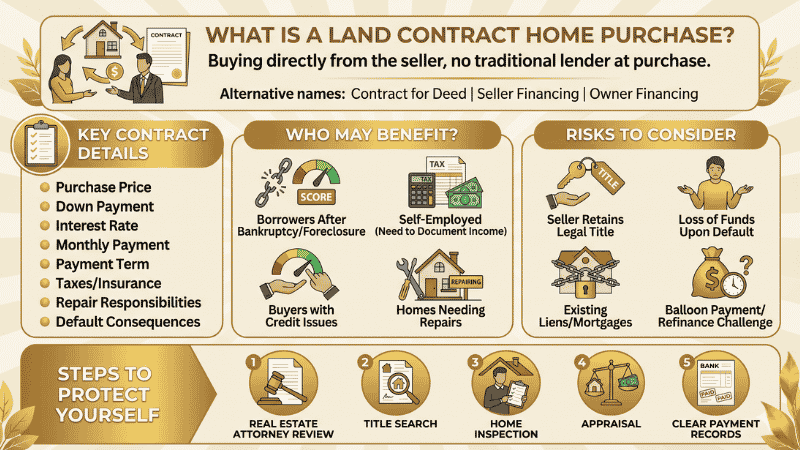
A land contract home purchase is a way to buy a home directly from the seller without using a traditional mortgage lender at the time of purchase. Instead of getting approved for a mortgage right away, the buyer makes payments to the seller under the terms of the land contract. This type of agreement is also commonly called a contract for deed, seller financing, or owner financing.
In a land contract home purchase, the seller often acts like the bank. The buyer can move into the house and start making monthly payments. However, the seller retains legal title to the property until the contract is fully paid off or the buyer switches to a regular mortgage.
The contract usually explains the purchase price, down payment, interest rate, monthly payment, payment term, taxes, insurance, repair responsibilities, and what happens if the buyer defaults. Land contract home purchases can help buyers who are not ready to qualify for a traditional mortgage because of recent bankruptcy, foreclosure, bad credit, self-employment income issues, or a property that needs repairs. However, a land contract home purchase also comes with risks. Buyers need to understand who holds title, whether there are existing liens, how payments will be documented, and whether they can refinance out of the contract later. Before signing a land contract, both the buyer and seller should have the agreement reviewed by a real estate attorney. A title search, home inspection, appraisal, and clear payment records can also help protect both parties. In this guide, we will explain how a land contract home purchase works, the benefits, the risks, and what buyers should know before using seller financing to buy a home.
What Is A Land Contract Home Purchase?
A land contract home purchase is a real estate agreement in which the buyer purchases a home directly from the seller rather than using a traditional mortgage lender at the time of purchase. The buyer pays the seller based on what they agreed in the contract. This type of agreement is also known as a contract for deed, seller financing or owner financing. In a traditional home purchase, the buyer usually gets a mortgage, closes on the loan, receives legal title to the property, and then makes monthly payments to the lender. In a land contract home purchase, the process is different. The seller may allow the buyer to move into the property and make monthly payments, but may retain legal title until the contract is paid off or refinanced.
The land contract should clearly explain the purchase price, down payment, interest rate, monthly payment, payment due date, contract term, balloon payment (if any), property tax responsibility, homeowners’ insurance responsibility, repair obligations, and what happens if the buyer defaults.
A land contract can be useful for buyers who cannot qualify for a traditional mortgage right away. This may include buyers with recent bankruptcy, foreclosure, bad credit, self-employment income issues, or a property that needs repairs before it can qualify for regular financing. However, a land contract is not the same as a mortgage approval. The buyer should understand when legal title transfers, whether the seller has an existing mortgage, whether there are liens on the property, and how payments will be documented for a future refinance. Before diving into a land contract home purchase, it’s a good idea to have a real estate lawyer review the contract. Make sure to consider a title search, a home inspection, an appraisal, and a clear plan for payment documentation.
Who May Benefit From A Land Contract Home Purchase?
A land contract home purchase may help buyers who want to purchase a home but are not ready to qualify for traditional mortgage financing. Instead of getting a mortgage from a lender at closing, the buyer makes payments directly to the seller under the terms of the land contract. This type of seller financing may work best when the buyer has a clear plan to improve their credit, document income, and refinance into permanent mortgage financing later.
Borrowers Recovering From Bankruptcy Or Foreclosure
A land contract home purchase could be a good option for people who have recently gone through a Chapter 7 or Chapter 13 bankruptcy, faced foreclosure, done a deed-in-lieu of foreclosure, or experienced a short sale. These borrowers may need more time before they qualify for FHA, VA, USDA, conventional, or Non-QM financing. A land contract can give them time to rebuild credit, save money, and document on-time housing payments.
Self-Employed Borrowers Who Need Time To Document Income
Self-employed borrowers may have strong cash flow but may not qualify for a traditional mortgage right away because of tax write-offs, limited income history, or recent business changes. A land contract may give self-employed buyers time to prepare stronger tax returns, document deposits, improve business income records, or explore future mortgage options such as bank statement loans, Non-QM loans, or traditional mortgage financing.
Borrowers With Recent Credit Issues
Some buyers may have recent late payments, collections, charge-offs, judgments, tax liens, or other credit problems. These issues can make it harder to qualify for a traditional mortgage. A land contract may give the buyer time to repair credit, pay or resolve required debts, establish new positive credit, and build a clean housing payment history.
Buyers Purchasing A Property That Needs Repairs
Some homes cannot qualify for FHA, VA, USDA, or conventional financing because of property condition issues. The home may need repairs before a lender will approve the property. A land contract may allow the buyer to purchase the property and complete repairs before refinancing. However, this can be risky because the buyer may spend money improving a home before receiving full legal title.
Buyers Who Need Time Before Qualifying For Traditional Financing
A land contract home purchase may also help buyers who are close to qualifying for a mortgage but need more time. This may include buyers who need to lower debt, increase savings, improve credit scores, document employment, or wait out a mortgage waiting period. The land contract period should be used to prepare for the next step. Buyers should document every payment, keep clean bank records, avoid new late payments, and stay focused on the refinance plan.
A Land Contract Is Not Automatically Safer Or Cheaper
A land contract home purchase is not automatically safer, cheaper, or easier than a mortgage. The seller may keep legal title until payoff. The buyer may be responsible for repairs, taxes, insurance, and maintenance. Some contracts include balloon payments, higher interest rates, default risks, and title issues. Before signing, buyers should have the contract reviewed by a real estate attorney. They should also verify title, liens, property taxes, insurance, property condition, payment terms, and the refinance deadline. A land contract can be useful in the right situation, but it should be reviewed carefully before the buyer commits.
Before You Sign, Know the Biggest Land Contract Red Flags
We’ll help you spot common deal-killers—no recorded agreement, unclear interest rate/term, missed tax/insurance handling, weak default language, and title issues that can cost you the home.Can A Land Contract Help After Bankruptcy Or Foreclosure?
A land contract home purchase may help some buyers who are not ready to qualify for a traditional mortgage after a bankruptcy, foreclosure, deed-in-lieu of foreclosure, or short sale. Instead of getting a mortgage from a lender at the time of purchase, the buyer makes payments directly to the seller under the terms of the land contract.
This can give the buyer time to rebuild credit, document stable income, save money, and prepare for a future mortgage refinance. For this reason, some borrowers use a land contract as a temporary bridge until they can qualify for FHA, VA, USDA, conventional, or Non-QM financing.
However, a land contract is not the same as a mortgage approval. The buyer still needs to understand the contract terms, payment schedule, title issues, liens, property taxes, insurance, and what happens if they default. The goal should be to enter into the land contract with a clear plan to refinance into a permanent mortgage when eligible.
Land Contracts After Bankruptcy
A buyer who recently filed Chapter 7 or Chapter 13 bankruptcy may not meet traditional mortgage waiting period requirements right away. A land contract may allow the buyer to purchase a home before they qualify for a standard mortgage. During the land contract period, the buyer can rebuild credit, make on-time housing payments, and prepare the documents needed for future financing. Lenders may later ask for the signed land contract, proof of payments, bank statements, tax records, and a payoff statement from the seller.
Land Contracts After Foreclosure, Short Sale, Or Deed-In-Lieu
Borrowers with a recent foreclosure, short sale, or deed-in-lieu may also face mortgage waiting periods depending on the loan program. A land contract may give the buyer a path to move into a home while they wait to become eligible for traditional financing. The key is documentation. Buyers should make every land contract payment by check, automatic bank transfer, or another traceable method. Future mortgage lenders should see a clear 12-month payment history before approving a refinance.
Land Contract Versus Non-QM Loan
A Non-QM loan may be another option for borrowers with recent bankruptcy, foreclosure, self-employment income issues, or other credit challenges. Unlike FHA, VA, USDA, or conventional loans, some Non-QM programs may allow financing with no traditional waiting period after a major credit event. The difference is that a Non-QM loan is still mortgage financing from a lender, while a land contract is seller financing between the buyer and seller. A Non-QM loan may require a larger down payment, stricter credit standards, reserves, and a higher interest rate than those of agency loan programs. A land contract may offer more flexibility upfront, but it can also carry more legal and title risk if not structured correctly.
Why A Refinance Plan Matters
A land contract home purchase should not be treated as a permanent solution unless both parties clearly understand the long-term terms. Many land contracts are short-term agreements with a balloon payment or refinance deadline. Before signing, buyers should ask:
- Can I realistically qualify for a mortgage before the land contract ends?
- Will my payments be documented in a way a lender can verify?
- Does the contract clearly state the purchase price, down payment, interest rate, balance, and payoff terms?
- Are there liens, unpaid taxes, or an existing mortgage on the property?
- Will the seller cooperate when I refinance?
A land contract home purchase can be useful after bankruptcy or foreclosure, but only when the buyer has a clear exit strategy. The safest approach is to use the land contract period to rebuild credit, document payment history, and prepare for FHA, VA, USDA, conventional, or Non-QM financing.
Mortgage Waiting Periods After Bankruptcy Or Foreclosure
 Mortgage waiting periods after bankruptcy, foreclosure, short sale, or deed-in-lieu of foreclosure vary by loan program. They are not always automatic approvals after the waiting period ends. A borrower still needs to meet credit, income, debt-to-income ratio, down payment, asset, occupancy, and property requirements.
Waiting periods can also be affected by AUS findings, manual underwriting, extenuating circumstances, credit re-established after the event, and lender overlays. This is why two borrowers with the same bankruptcy or foreclosure date may receive different answers from different lenders.
A land contract home purchase may help some buyers bridge the gap while they wait to qualify for FHA, VA, USDA, conventional, or Non-QM financing. However, the buyer should have a clear plan to document payments and refinance out of the land contract when eligible.
FHA Waiting Periods
FHA loans are often used by borrowers who are rebuilding credit after a major credit event. In general, FHA requires a waiting period after Chapter 7 bankruptcy, foreclosure, deed-in-lieu of foreclosure, or short sale before the borrower can qualify. FHA guidance is found in HUD Handbook 4000.1, which is the main FHA single-family housing policy handbook. For many borrowers, the common FHA waiting period is two years after a Chapter 7 bankruptcy discharge and three years after a foreclosure, deed-in-lieu of foreclosure, or short sale. However, the borrower still needs to show re-established credit and meet FHA mortgage guidelines. Chapter 13 bankruptcy may be treated differently. Some borrowers may be eligible while still in Chapter 13 repayment if they have made enough on-time payments, have trustee approval when required, and meet manual underwriting guidelines.
VA Waiting Periods
VA loans may offer more flexible options for eligible veterans, active-duty service members, and surviving spouses. The VA buyer’s guide states that bankruptcy does not automatically disqualify a borrower, and lenders must review the reason for the bankruptcy and the type of bankruptcy. The guide also notes typical waiting periods for Chapter 7 and Chapter 13 bankruptcy.
For many VA borrowers, the standard waiting period is 2 years after a Chapter 7 bankruptcy discharge. For Chapter 13 bankruptcy, some borrowers may be eligible after a satisfactory payment history, depending on the lender, AUS findings, trustee approval, and overall file strength.
After a foreclosure, short sale, or deed-in-lieu of foreclosure, many VA lenders use a 2-year waiting period. However, final approval still depends on credit history after the event, residual income, debt-to-income ratio, and whether the lender has overlays.
USDA Waiting Periods
USDA loans are designed for qualified homes in rural and suburban areas, and they come with their own set of credit guidelines. USDA’s Single Family Housing Guaranteed Loan Program guidance is found in HB-1-3555. The current USDA handbook is available through USDA Rural Development. USDA borrowers with a prior bankruptcy, foreclosure, deed-in-lieu, or short sale usually need to meet the USDA waiting period and credit re-establishment requirements. A borrower may also need to receive an acceptable USDA underwriting recommendation or meet manual underwriting standards. Because USDA loans have income limits, property eligibility rules, and credit history requirements, borrowers using a land contract as a bridge should confirm early whether the property and household income may qualify for USDA financing later.
Conventional Waiting Periods
Conventional loans follow Fannie Mae or Freddie Mac guidelines. Fannie Mae’s Selling Guide includes waiting periods for significant derogatory credit events, including bankruptcy, foreclosure, deed-in-lieu of foreclosure, preforeclosure sale, short sale, and mortgage charge-offs.
For many conventional borrowers, the standard waiting period is 4 years after a Chapter 7 bankruptcy and 7 years after a foreclosure. Fannie Mae also states that a four-year waiting period applies after a deed-in-lieu of foreclosure, preforeclosure sale, or mortgage charge-off, with a possible shorter period when documented extenuating circumstances apply.
Conventional loans may be harder for borrowers with recent serious credit events because the file must meet AUS, credit, income, reserve, and risk-based pricing requirements. Even after the waiting period is met, the borrower still needs to qualify under the full conventional loan guidelines.
Non-QM Loans With No Waiting Period
Non-QM loans may be an option for borrowers who do not meet the waiting period requirements for FHA, VA, USDA, or conventional loans. Some Non-QM programs may allow financing with no waiting period after bankruptcy, foreclosure, short sale, or deed-in-lieu of foreclosure. However, Non-QM loans are not the same as agency loans. They often require stronger compensating factors, such as a larger down payment, higher credit score, more reserves, lower loan-to-value ratio, or stronger income documentation. Interest rates and costs may also be higher than those of FHA, VA, USDA, or conventional loans. For some borrowers, a land contract home purchase may be used as a temporary bridge until they qualify for agency financing. For others, a Non-QM loan may be a faster path if they have enough down payment, income, and reserves. The right option depends on the borrower’s credit event, income, property, down payment, payment history, and long-term refinance plan.
Terms of a Land Contract Home Purchase
It’s essential to understand that land contract home purchases vary widely in terms and conditions. Buyers and sellers should carefully review and negotiate the contract terms, including interest rates, payment schedules, and default provisions. Additionally, it’s advisable to consult with legal and financial professionals to ensure the contract is fair and compliant with local laws.
The buyer pays the seller, typically including principal and interest. These payments continue until the contract term is completed.
Buyers should also be aware that because they only have legal title once the contract is paid off, they may only be able to use the property as collateral for other loans or easily transfer ownership once the contract is fulfilled. Before entering a land contract, it’s crucial to do thorough research, seek legal advice, and consider whether this arrangement aligns with your financial goals and circumstances.
What Is A Wrap-Around Land Contract?
A wrap-around land contract is a type of seller financing where the seller may still have an existing mortgage on the property. Instead of the buyer getting a new mortgage from a lender, the buyer makes payments directly to the seller. The seller is then supposed to use those payments to keep paying the original mortgage. This can work when structured correctly, but it can also pose serious risks to the buyer. The buyer may believe they are protected because they are making payments on time. However, if the seller does not make the underlying mortgage payment, the lender holding the original mortgage could take action against the property.
Why Wrap-Around Land Contracts Can Be Risky
The biggest risk is that the seller’s original mortgage may still be in place. The buyer may pay the seller each month, but the buyer does not control whether the seller pays the existing lender. For example, the buyer may make every land contract payment on time. But if the seller falls behind on the original mortgage, the property could become delinquent or even face foreclosure. This can put the buyer’s money, repairs, improvements, and future ownership at risk.
Buyers Should Verify The Underlying Mortgage Is Being Paid
Before signing a wrap-around land contract, the buyer should know whether there is an existing mortgage on the property. If there is, the buyer should ask how the underlying mortgage payment will be verified. The contract should clearly explain:
- Who receives the buyer’s monthly payment.
- Who pays the existing mortgage.
- How the buyer can confirm the original mortgage is current.
- What happens if the seller fails to pay the existing mortgage.
- Whether payments can be handled through an escrow company or third-party servicing company.
Using a neutral third-party servicing company may help document payments and reduce risk. However, the buyer should still have the full agreement reviewed before signing.
The Due-On-Sale Clause Must Be Reviewed
Many mortgage loans include a due-on-sale clause. This clause may allow the lender to call the loan due if the property is sold or transferred without the lender’s approval. This is important in a wrap-around land contract because the seller may still have the original mortgage in place while giving the buyer possession and purchase rights. A real estate attorney should review the seller’s mortgage documents and the land contract to determine whether the due-on-sale clause creates a legal or financial risk.
Lien Position, Taxes, And Insurance Matter
The buyer should also verify the property’s lien position before signing. A title search can show whether there are existing mortgages, tax liens, judgments, unpaid property taxes, or other claims against the property.
Insurance also needs to be handled correctly. The buyer should know who is responsible for homeowners’ insurance, whether the existing lender must be listed, and whether the buyer’s interest in the property is protected.
Property taxes should also be reviewed. If property taxes are not paid, the buyer could face serious problems even if the buyer is making the land contract payment on time.
Default Rights Should Be Clear
A wrap-around land contract should clearly explain what happens if either party defaults. The buyer needs to know what happens if the seller fails to pay the existing mortgage, taxes, or insurance. The seller needs to know what happens if the buyer stops making land contract payments. Default rights vary by state, so both parties should have a real estate attorney review the agreement. The contract should not leave major questions unanswered.
Bottom Line On Wrap-Around Land Contracts
A wrap-around land contract can help a buyer purchase a home when traditional mortgage financing is not available. However, it is more complex than a standard land contract because the seller’s original mortgage may still be in place. Before signing, the buyer should verify the existing mortgage, review the due-on-sale clause, confirm the lien position, check taxes and insurance, and understand default rights. A wrap-around land contract should never be signed casually. The safest approach is to use a real estate attorney, a title company, and, if needed, a third-party servicing company to help protect both the buyer and the seller.
Benefits Of A Land Contract For Buyers
A land contract home purchase can be helpful for buyers who want to purchase a home but are not ready for traditional mortgage approval. Instead of getting a mortgage from a lender at closing, the buyer makes payments directly to the seller based on the terms of the land contract. This type of seller financing may give the buyer time to improve their financial profile while already living in the home.
Can Buy When Traditional Mortgage Approval Is Not Available
Some buyers cannot qualify for a traditional mortgage right away. This may be due to recent credit issues, limited income documentation, self-employment income, or a property condition problem. A land contract may allow the buyer and seller to create a private financing agreement without waiting for immediate approval for an FHA, VA, USDA, conventional, or Non-QM mortgage.
May Help After Bankruptcy, Foreclosure, Or Recent Credit Issues
A land contract may help buyers who have recently gone through bankruptcy, foreclosure, a deed-in-lieu of foreclosure, a short sale, late payments, collections, charge-offs, or other credit challenges. The buyer can use the land contract period to rebuild credit and prepare for a future mortgage refinance. This can be useful when the buyer needs more time before meeting the traditional mortgage waiting period or underwriting requirements.
May Allow Time To Rebuild Credit
A land contract can give buyers time to improve their credit before applying for permanent mortgage financing. During this period, the buyer should focus on making all housing payments on time, lowering debt, avoiding new late payments, and keeping clean bank records. If the buyer plans to refinance later, payment documentation is important. Payments should be made by check, automatic bank transfer, or another traceable method that a lender can verify.
May Allow Time To Document Income
Self-employed borrowers, commission earners, 1099 workers, and borrowers with recent job changes may need more time to document stable income. A land contract may provide time to build a stronger income history before applying for a mortgage. This can help borrowers who recently started a business, had major tax write-offs, changed careers, or need updated tax returns to support their qualifying income.
May Help With Homes That Need Repairs
Some homes do not qualify for traditional mortgage financing because of property condition issues. A land contract may allow the buyer to purchase and repair the home before refinancing. This can help when the property needs repairs that would make FHA, VA, USDA, or conventional financing difficult at the time of purchase. However, the buyer should be careful before spending money on repairs if the legal title has not yet been transferred.
Want to Refinance Out of a Land Contract Later? Plan It Now
Many buyers use land contracts as a bridge. We’ll map a mortgage exit strategy and the steps to build “mortgage-ready” credit, income, and documentation.Risks Of A Land Contract For Buyers
A land contract home purchase can be useful, but it also carries serious risks. Buyers should not assume a land contract is safer or easier than a traditional mortgage. The agreement should be reviewed carefully before signing.
Seller May Keep Legal Title
In many land contracts, the buyer gets possession of the home but does not receive full legal title until the contract is paid off or refinanced. The seller may keep legal title during the contract term. This means the buyer may live in the home, make payments, pay taxes, carry insurance, and make repairs before receiving the deed. Buyers need to understand exactly when title transfers and what conditions must be met.
Buyer May Lose Money If They Default
If the buyer misses payments or violates the contract, they may risk losing the property and the money already paid. This can include the down payment, monthly payments, repair costs, improvements, taxes, insurance, and other expenses. Default rules vary by state. Some states may require foreclosure, while others may allow different remedies depending on the contract and local law. A real estate attorney should review the default language before the buyer signs.
Existing Liens May Create Risk
A buyer should never assume the property has a clean title. There may be an existing mortgage, tax lien, judgment lien, unpaid property taxes, contractor lien, or other claim against the property. A title search should be completed before signing a land contract. If the seller has an existing mortgage, the buyer should understand whether the mortgage is being paid, whether there is a due-on-sale clause, and how the buyer’s interest will be protected.
Balloon Payment May Be Difficult To Refinance
Many land contracts are short-term agreements with a balloon payment due at the end. The buyer may plan to refinance before the balloon payment, but that is not guaranteed. A refinance can be delayed or denied due to credit problems, income issues, a a high debt-to-income ratio, a a low appraisal, property condition issues, title issues, or lender overlays. Before signing, the buyer should know whether they have a realistic path to refinance.
Interest Rate May Be Higher Than Traditional Mortgage Financing
Land contract home purchase terms are negotiated between the buyer and seller. The interest rate may be higher than a traditional mortgage because the seller is taking on more risk. Buyers should compare the land contract terms with available mortgage options, including FHA, VA, USDA, conventional, and Non-QM loans. A land contract may solve a short-term problem, but the long-term cost may be higher.
State Laws Vary
Land contract laws are different from state to state. Rules may vary for recording contracts, default notices, forfeiture, foreclosure, eviction, title transfers, and buyer protections. Because of these differences, buyers and sellers should not rely on a generic contract form without legal review. A real estate attorney familiar with local land contract laws can help both parties understand their rights and risks.
Land Contract Home Purchases Are Used as Temporary Bridge Loans
For those homebuyers who have really bad credit and who cannot qualify due to recent late payments, charge offs, tax liens, judgments, or other recent derogatory credit, it gives the opportunity for the home buyer to have some time to re-establish their credit so they can qualify for a residential mortgage loan.
For those who just opened up a business or those self-employed individuals who took major write-offs and cannot qualify for income, it gives them the opportunity to declare income and establish their income and financial profile.
For sellers, offering a real estate purchase land contract will normally give them the opportunity to sell their home for a higher sales price. If the home has major repairs to be done and does not qualify for residential financing, the new land contract home buyer can do the major repairs until it is financeable.
Structuring Land Contract Home Purchases
Most land contract home sellers will require a down payment from the real estate land contract buyer. The larger the down payment, the less risk the sellers have. Typically, a 5% to 10% down payment is required by most real estate purchase land contracts sellers. In many land contracts, the buyer is responsible for property maintenance and property taxes while they have the property. In some cases, the land contract may be recorded with the local government to protect the buyer’s interest and establish a public record of the agreement.
It is strongly recommended that both parties are represented by real estate attorneys. This is so both parties interests are protected.
The home buyer needs to make sure that there are a clean title and no liens attached to the property. An appraisal is strongly recommended even though the seller will not require it since the seller is not a mortgage lender. Real estate purchase land contracts is when the seller agrees to sell their home via owner financing to the home buyer. The seller holds legal title. The home buyer receives equitable title.
Home Inspection Versus Home Appraisal
A home inspection should be done as well to make sure that there are no major defects with the subject property. The attorney should make sure that there are no potential risks involved such as the seller not making their mortgage payments on an existing first lien on the property.
Part or all of the down payment should be escrowed until the home buyer refinances out of the land contract with a traditional mortgage loan. Every state has different laws and regulations governing real estate land contract.
Make sure when entering into a real estate purchase land contract to make all payments with checks. When it comes to refinancing to an end mortgage, lenders want to see canceled checks or bank statements. Verification of mortgage or rent can be sourced and documented by providing 12 months of canceled checks or bank statements. Paying by checks also includes homeowner’s insurance payments, utilities, and any other payments associated with housing expenses.
What To Check Before Signing A Land Contract
Before signing a land contract home purchase agreement, buyers should review the legal, financial, title, property, and refinance details. A land contract can help some buyers purchase a home without traditional mortgage financing up front, but it can also create serious problems if the agreement is unclear. This checklist can help buyers understand what should be reviewed before moving forward.
Real Estate Attorney Review
A real estate attorney should review the land contract before the buyer signs. This is important because land contract laws vary by state, and the contract controls many important rights and responsibilities. The attorney should review:
- The purchase price
- Down payment
- Interest rate
- Monthly payment
- Payment schedule
- Late payment terms
- Default rights
- Title transfer language
- Balloon payment terms
- Refinance deadline
- Buyer and seller responsibilities
A buyer should not rely only on a verbal agreement or a generic contract form.
Title Search
A title search is basically about making sure the seller has the right to sell the property. It can also show whether there are ownership issues, prior claims, unpaid liens, or other problems that could affect the buyer later. Before signing, the buyer should know whether the title is clear and whether the seller can legally transfer ownership upon payment in full or upon refinancing.
Existing Mortgage Or Lien Review
The buyer should check whether the seller still has an existing mortgage on the property. This is especially important in a wrap-around land contract. If the seller has an existing mortgage, the buyer should understand:
- Whether the mortgage is current
- Who will make the mortgage payment
- How can the buyer verify that the mortgage is being paid
- Whether the loan has a due-on-sale clause
- What happens if the seller stops paying the lender
The buyer should also check for tax liens, judgment liens, contractor liens, HOA liens, or other claims against the property.
Property Tax Status
Unpaid property taxes can create major problems. Before signing a land contract, the buyer should verify whether property taxes are current. The contract should clearly state who is responsible for future property taxes and how those taxes will be paid. If the buyer is responsible, the buyer should know whether taxes are paid directly to the county, through the seller, or through an escrow arrangement.
Homeowners Insurance
The contract should explain who is responsible for homeowners’ insurance. The buyer should confirm that the property is insurable and that the policy protects the buyer’s interest in the home. This is especially important if the seller still has legal title or an existing mortgage. The buyer should ask an attorney, insurance agent, or title company how the insurance policy should be structured.
Home Inspection
A home inspection should be completed before signing. The inspection can help identify roof issues, foundation problems, plumbing defects, electrical concerns, safety issues, mold, water damage, pest problems, and major repair needs. This matters because many land contract buyers become responsible for repairs after they take possession. A buyer should know the property’s condition before agreeing to make payments or spend money on improvements.
Appraisal Or Value Review
Even if the seller does not require an appraisal, the buyer should consider getting one or obtaining another professional value review. This helps the buyer understand whether the purchase price is reasonable. An appraisal may also matter later if the buyer plans to refinance out of the land contract. If the home does not appraise high enough, the refinance may be harder to complete.
Recording Requirements
The buyer should confirm whether the land contract will be recorded with the county or local land records office. Recording the contract may help create a public record of the buyer’s interest in the property. Recording rules vary by state. The buyer should ask the attorney or title company whether recording is required, recommended, or restricted in that state.
Default And Forfeiture Language
The contract should clearly explain what happens if the buyer misses payments or violates the agreement. It should also explain what happens if the seller fails to meet their obligations. The buyer should understand:
- How many missed payments create a default
- Whether there is a grace period
- Whether late fees apply
- Whether the seller can cancel the contract
- Whether foreclosure is required
- Whether the buyer can lose the down payment, repairs, and prior payments
Default and forfeiture rules vary by state, so this language should be reviewed carefully.
Balloon Payment Terms
A lot of land contract home purchase includes a balloon payment. This means the buyer makes monthly payments for a period of time and then owes a larger payoff amount at the end. The contract should clearly state:
- Whether there is a balloon payment
- When the balloon payment is due
- How the payoff amount is calculated
- Whether the seller will provide a payoff statement
- What happens if the buyer cannot pay or refinance on time
A balloon payment can be risky if the buyer does not have a realistic refinance plan.
Refinance Deadline
If the buyer plans to refinance into a traditional mortgage, the refinance deadline should be clear. The buyer should know when they must pay off the land contract and what loan options may be available. Before signing, the buyer should ask whether they may qualify for FHA, VA, USDA, conventional, or Non-QM financing later. The buyer should also ensure that every payment is documented, as future lenders may request canceled checks, bank statements, or other proof of payment.
Final Checklist Before Signing
Before signing a land contract, the buyer should understand the contract, title, liens, taxes, insurance, property condition, payment terms, default rights, balloon payment, and refinance plan. A land contract home purchase can be helpful, but the details matter. The buyer should review everything up front rather than discover problems when it is time to refinance or take legal title.
How To Refinance Out Of A Land Contract
Yes, it may be possible to refinance out of a land contract home purchase and replace the seller-financed agreement with a traditional mortgage. This is often the buyer’s long-term goal when the land contract is used as a temporary bridge because the buyer could not qualify for mortgage financing at the time of purchase. A refinance can help the buyer pay off the seller, transfer or finalize title, and move into a permanent mortgage loan. However, lenders will not simply treat the land contract like a handshake agreement. They will review the contract, payment history, title, property value, liens, taxes, insurance, and the borrower’s full mortgage qualifications.
What Lenders May Ask For
When refinancing out of a land contract, lenders may ask for the signed land contract or contract for deed. The agreement should clearly show the original purchase price, down payment, interest rate, monthly payment, payment term, balloon payment (if any), and payoff requirements. The lender may also ask for a payoff statement from the seller. This helps confirm how much is still owed and how much of the new mortgage will be used to pay off the land contract.
Why Payment History Matters
Borrowers should document every land contract payment. Future mortgage lenders may want to verify that the buyer has made on-time payments.
The safest way to document payments is by using canceled checks, automatic bank transfers, money orders with receipts, or bank statements. Paying the seller in cash can create problems because the lender may not be able to verify the payment history.
Many lenders may require 12 months of canceled checks or bank statements to verify the buyer’s housing payment history. Clean payment records can help support the refinance file.
The Property May Need An Appraisal
The lender usually wants an appraisal to ensure they know the property’s current value. This is important because the new loan amount is often based on the property value, the land contract payoff, and the loan program’s loan-to-value requirements. If the property needs repairs, has safety issues, or does not meet the loan program’s property standards, the refinance may be delayed or denied. This is especially important for FHA, VA, USDA, and conventional loans.
Title, Liens, Taxes, Insurance, And Occupancy Will Be Reviewed
Before approving the refinance, the lender and title company will review the property’s title history. They will check whether the seller has legal ownership, whether there are existing mortgages, tax liens, judgment liens, unpaid property taxes, or other claims against the home. The lender will also review homeowners’ insurance and occupancy. If the borrower is applying for a primary residence mortgage, the lender will verify that the borrower occupies or will occupy the property as required by the loan program.
Timing Can Affect How The Refinance Is Treated
The length of the land contract can affect how the new mortgage is classified. Fannie Mae states that when mortgage proceeds are used to pay off an installment land contract executed within 12 months of the loan application, the loan is considered a purchase-money mortgage. Fannie Mae also states that if the land contract was executed more than 12 months before the loan application, the loan is treated as a limited cash-out refinance, with the LTV based on the appraised value at the time the new mortgage closes. This distinction matters because purchase transactions and refinance transactions can have different loan-to-value rules, documentation requirements, pricing, and underwriting treatment.
Why A Refinance Plan Should Start Before Signing
The best time to plan the refinance is before signing the land contract. Buyers should ensure the contract is clear, the payment terms are documented, the seller can provide a payoff statement, and the property qualifies for future mortgage financing. Before signing, the buyer should ask:
- Can I document every payment?
- Will the seller cooperate with the refinance?
- Is there a balloon payment or refinance deadline?
- Are there existing liens or mortgages on the property?
- Will the property condition meet FHA, VA, USDA, conventional, or Non-QM standards?
- Can I qualify for the new mortgage based on credit, income, debt-to-income ratio, and assets?
A land contract home purchase can be a useful path to homeownership, but the exit strategy matters. The cleaner the contract, title, payment history, and property condition are, the easier it may be to refinance into permanent mortgage financing later.
Land Contract Laws Vary By State
Land contract laws vary by state, so buyers and sellers should not rely on a generic agreement without legal review. A land contract home purchase may be treated differently depending on where the property is located and how the contract is written. Some states have specific rules for how land contracts, contracts for deed, or seller-financing agreements must be handled. These rules may affect default notices, forfeiture rights, foreclosure requirements, eviction procedures, recording requirements, buyer protections, seller remedies, and the transfer of legal title.
Why State Law Matters
State law can make a major difference if the buyer misses payments or the seller fails to comply with the agreement. In some states, the seller may need to go through a foreclosure process before taking the property back. In other states, the contract may allow cancellation or forfeiture if the buyer defaults. This matters because a buyer could lose money already paid toward the property, including the down payment, monthly payments, repair costs, taxes, insurance, and improvements. The exact rights of the buyer and seller depend on the contract and the laws of the state where the property is located.
Recording Rules May Be Different
Some states may require or strongly recommend recording the land contract with the county or local land records office. Recording the agreement can help create a public record of the buyer’s interest in the property. If the contract is not recorded, title issues may become more complicated later. This can affect refinancing, selling, lien priority, and the buyer’s ability to prove their interest in the property.
Use A Local Real Estate Attorney
Before signing a land contract, it’s a good idea for both the buyer and the seller to consult a real estate lawyer who understands local laws. The attorney can review the contract terms, title issues, default language, forfeiture clauses, foreclosure requirements, recording rules, tax responsibilities, insurance requirements, and refinance deadlines. A land contract can be helpful when structured correctly, but the legal details matter. Buyers and sellers should confirm the rules in their state before signing, especially if the agreement includes a balloon payment, an existing mortgage, a wraparound structure, repair obligations, or a delayed title transfer.
Final Thoughts On Land Contract Home Purchases
A land contract home purchase can be a useful option for buyers who are not ready to qualify for traditional mortgage financing. It may help borrowers recovering from bankruptcy, foreclosure, recent credit issues, self-employment income challenges, or property condition problems that make regular mortgage approval difficult. However, a land contract should not be treated as a simple shortcut to homeownership. Buyers need to understand who holds legal title, whether the seller has an existing mortgage, how payments will be documented, who pays taxes and insurance, what happens after default, and whether the contract includes a balloon payment or refinance deadline.
The safest approach is to review the agreement before signing. Buyers should consider a real estate attorney, a title search, a home inspection, an appraisal or value review, and a clear refinance plan. Every payment should be made through a traceable method, such as a check or bank transfer, so future mortgage lenders can verify the payment history.
A land contract home purchase can work when the buyer and seller understand the risks, clearly document the terms, and have a plan for permanent financing. If you are buying a home through a land contract and want to refinance into a traditional mortgage later, Gustan Cho Associates can review your credit, income, payment history, contract terms, and loan options to help determine the best path forward.
FAQs About Land Contract Home Purchase
Is A Land Contract The Same As A Contract For Deed?
Yes, in many cases, a land contract home purchase and a contract for deed refer to the same type of seller-financing agreement. The buyer makes payments directly to the seller, and the seller may keep legal title until the contract is paid in full or refinanced. The exact legal treatment can vary by state, so buyers should have the agreement reviewed by a real estate attorney before signing.
Who Owns The Home During A Land Contract?
In many land contracts, the buyer can live in the home and build equity. However, the seller keeps legal ownership until the buyer fully pays off the contract. This is one of the biggest differences between a land contract and a traditional mortgage. Buyers should confirm when legal title transfers, whether the contract will be recorded, and what happens if either party defaults.
Can I refinance a land contract into a mortgage?
Yes, some buyers can refinance a land contract into a traditional mortgage. Lenders may request a signed land contract, payment history, a payoff statement, an appraisal, a title report, insurance, and proof that the borrower occupies the property if it is a primary residence. Buyers should make payments by check, automatic bank transfer, or another traceable method, as lenders may need to verify payment history.
What Are The Biggest Risks Of Buying A Home With A Land Contract?
The biggest risks include delayed legal title transfer, default and forfeiture language, existing liens, unpaid property taxes, seller mortgage problems, balloon payments, and repair costs. Some buyers may spend money on repairs, taxes, insurance, and improvements before receiving full legal title. Pew and the CFPB have both warned that land contracts can pose serious consumer risks when buyers lack clear protections.
Is A Land Contract Better Than Getting A Mortgage?
A land contract is not automatically better, safer, or cheaper than a mortgage. It may help buyers who cannot qualify for traditional financing right away, such as borrowers recovering from bankruptcy, foreclosure, credit problems, or self-employment income issues. However, a land contract may involve higher interest rates, balloon payments, title risk, and fewer protections than a traditional mortgage. Buyers should compare FHA, VA, USDA, conventional, Non-QM, and seller-financing options before signing.
This article about “Land Contract Home Purchase: Avoid Costly Mistakes” was updated on May 18th, 2026.