
Fix-and-Flip Mortgage Guidelines: Loans for Real Estate Investors
A Fix-and-Flip Mortgage is short-term financing designed primarily for real estate investors who buy a property, renovate it, and sell it for a profit. Unlike a traditional home mortgage, fix-and-flip financing is generally based heavily on the property, renovation plan, total project cost, investor experience, available cash, and projected after-repair value, or ARV.
Many programs can finance part of the purchase price and some or all of an approved renovation budget. Renovation funds are typically released through draws as work is completed.
Exact credit score, down payment, leverage, loan amount, rate, fees, property eligibility, and experience requirements vary by lender and loan program. Fix-and-flip loans are part of the non-QM mortgage loan programs. You can buy a home that is habitable or a fixer-upper with non-QM loans. In the following paragraphs, we will cover the fix-and-flip mortgage guidelines for real estate investors.
What Is a Fix-and-Flip Mortgage?
A Fix-and-Flip Mortgage is a short-term real estate investment loan used to acquire and renovate a property that an investor plans to resell. You may also hear these products referred to as fix-and-flip loans, rehab loans, bridge loans, private-money loans, investor renovation loans, or hard-money loans. These terms sometimes overlap, but they do not always describe exactly the same loan.
What matters most is the structure of the financing. A fix-and-flip investor typically needs money for two major expenses: buying the property and completing the improvements needed to make it marketable.
Instead of obtaining one loan to buy the property and finding a separate source of renovation money, a fix-and-flip loan may combine acquisition and rehabilitation financing. The loan is expected to be temporary. The investor’s primary exit strategy is normally to complete the renovation and sell the property. Some investors instead decide to keep the completed property as a rental and refinance the short-term loan into longer-term investment-property financing.
Are Fix-and-Flip Loans Business-Purpose Loans?
Fix-and-flip financing is commonly structured as business-purpose credit because the investor is acquiring or improving property with the intention of making a profit rather than occupying the home as a personal residence. That distinction is important. Consumer mortgage rules and business-purpose lending rules are not always the same.
The Consumer Financial Protection Bureau’s Regulation Z generally exempts credit extended primarily for business, commercial, agricultural, or organizational purposes.
The regulation also explains that the purpose of the transaction must be evaluated based on the facts and circumstances. A borrower should never assume that calling a loan an “investment loan” automatically determines its regulatory treatment. The intended use of the property, borrower structure, state law, lender requirements, and facts surrounding the transaction can matter. Fix-and-flip financing is generally intended for non-owner-occupied investment property, not a home the borrower plans to use as a primary residence.
How Does a Fix-and-Flip Mortgage Work?
A Fix-and-Flip Mortgage typically begins with the investor identifying a property that can be purchased below its expected renovated market value. The investor prepares a renovation plan and estimates the property’s value after the work is completed. The lender then evaluates both the investor and the project.
The Lender Reviews the Purchase
The purchase contract specifies the amount the investor is paying for the property to the lender. The lender may also review the property’s current condition, comparable sales, title, taxes, insurance requirements, and whether the purchase price appears reasonable. Buying a property cheaply does not automatically make it a good flip. The entire project must make financial sense after accounting for renovation, financing, carrying, and selling costs.
The Lender Reviews the Renovation Budget
A detailed scope of work is one of the most important parts of many fix-and-flip loan applications. The lender may want to know exactly what will be repaired or replaced, what each item is expected to cost, how long the project should take, and who will perform the work.
A renovation could include roofing, HVAC, plumbing, electrical work, flooring, kitchens, bathrooms, windows, siding, structural repairs, paint, landscaping, or other improvements.
A vague estimate, such as “approximately $60,000 for renovations,” may not be sufficient. A detailed, realistic budget can help the lender determine whether the requested financing and the projected property value make sense.
The Lender Estimates the After-Repair Value
After-repair value, commonly called ARV, is the estimated market value of the property after the planned renovations are completed. ARV is one of the most important numbers in fix-and-flip lending.
The lender may use an appraisal, broker price opinion, automated valuation, internal valuation, comparable property analysis, or another approved valuation method, depending on the lender and the property.
The valuation considers what the property should reasonably be worth after the proposed work is completed. ARV should not be confused with the investor’s desired sales price. A successful flip depends on realistic market value, not an optimistic number chosen to make the deal work.
How Do Fix-and-Flip Lenders Determine the Loan Amount?
Most fix-and-flip lenders do not determine the loan amount from a single number. They commonly evaluate several measurements, including the purchase price, renovation budget, total project cost, current property value, and after-repair value. Two important measurements are loan-to-cost and loan-to-ARV.
What Is Loan-to-Cost?
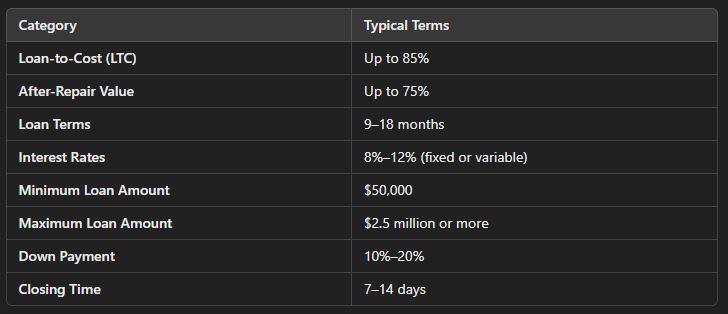
Loan-to-cost, or LTC, compares the loan amount with the cost of acquiring and renovating the property. Assume an investor purchases a home for $200,000 and expects to spend $50,000 on renovations. The total project cost is $250,000 before financing, carrying, and selling costs. If a lender permits an 85% LTC on that transaction, 85% of $250,000 equals $212,500. That does not necessarily mean the investor will receive a $212,500 loan. The property must also satisfy any ARV limitation and other underwriting requirements.
What Is Loan-to-ARV?
Loan-to-ARV compares the loan amount with the property’s projected value after renovations. Using the previous example, assume the completed property is expected to be worth $350,000. If the lender capped that particular transaction at 70% of ARV, the ARV limitation would be $245,000. The LTC limit in this example was $212,500.
Current fix-and-flip lenders use different combinations of LTC, purchase-price leverage, rehab financing, and ARV caps. There is no single industry-wide percentage that applies to every investor.
The ARV limit was $245,000. If the lender requires the loan to satisfy both limits, the lower amount would control before any other loan-level adjustments. This is why investors should not focus only on statements such as “up to 90% financing” or “up to 75% ARV.” The actual loan amount may be determined by several limitations at the same time.
Ready to Finance Your Next Fix-and-Flip Project?
Complete a quick application or send your deal details. We’ll review your property, rehab plan, ARV, cash needed, timeline, and best fix-and-flip mortgage options.Fix-and-Flip Mortgage Down Payment and Cash Requirements
Your required cash may include the portion of the purchase price the lender will not finance, closing costs, loan points, appraisal or valuation expenses, title charges, insurance, prepaid interest, reserves, renovation costs that must be advanced before reimbursement, permit costs, and unexpected construction expenses.
One of the biggest mistakes new investors make is asking only, “How much is the down payment?” Fix-and-flip projects typically require cash beyond the initial equity contribution.
This is why two investors purchasing homes for the same price can need very different amounts of cash. The lender’s leverage is only one part of the calculation.
Credit Score Requirements for a Fix-and-Flip Mortgage
There is no universal minimum credit score for a Fix-and-Flip Mortgage. Published lender programs commonly use minimum scores somewhere in the 600s, but requirements vary widely. Some lenders place more weight on the property and overall deal. Others establish higher credit thresholds for first-time investors or transactions with higher leverage.
Experienced investors may sometimes receive better pricing or higher leverage because they have demonstrated that they can buy, renovate, manage, and successfully exit projects.
Credit history can still matter even when the loan is described as asset-based. The lender may review mortgage history, bankruptcies, foreclosures, judgments, liens, late payments, overall credit depth, and other risk factors. A lower credit score does not automatically mean the project cannot be financed, but it can affect available programs, leverage, interest rate, fees, reserves, and required borrower equity.
Do Fix-and-Flip Loans Require Income Verification?
Many fix-and-flip programs place less emphasis on traditional W-2 income and personal debt-to-income ratios than conventional residential mortgages. That does not mean every fix-and-flip loan is a true “no-doc loan.”
A business-purpose lender may still review bank statements, liquidity, credit history, real estate experience, business information, project economics, guarantor information, and the borrower’s ability to cover expenses.
Some programs do not qualify the investor using the traditional personal DTI calculation used for an owner-occupied mortgage. Others may request additional financial documentation depending on risk. Investors should ask exactly what documentation will be required before assuming that a program involves no income documentation.
Can First-Time Investors Get Fix-and-Flip Loans?
Yes. Some fix-and-flip lenders work with first-time investors. Other lenders prefer or require previous flipping experience. A first-time flipper should expect the lender to pay particular attention to the property’s quality, renovation budget, contractor, cash reserves, credit profile, ARV, and exit strategy.
Some lenders compensate for limited experience by offering lower leverage or requiring more borrower funds in the transaction.
Recent lender programs continue to offer options for first-time flippers, although leverage and credit requirements may differ from those for experienced investors. Having no previous flips does not automatically make the transaction impossible. A poorly planned first project, however, can become expensive very quickly.
What Is a Fix-and-Flip Mortgage?

Property Eligibility varies Significantly.
Some lenders will consider homes needing substantial rehabilitation or properties that are currently uninhabitable. Other lenders restrict heavy structural work. Larger multifamily properties, mixed-use properties, commercial buildings, or projects involving ground-up construction may require a different commercial or construction loan program. The property should be reviewed before assuming it fits a particular fix-and-flip lender.
How Are Renovation Funds Released?
One of the most important things an investor should understand before closing is the lender’s draw process. The renovation portion of a Fix-and-Flip Mortgage is often not paid to the borrower as a lump sum at closing. Instead, approved renovation funds may be placed in a lender-controlled holdback account. The investor completes an agreed portion of the work and then requests a draw.
The lender may require an inspection, photographs, invoices, receipts, contractor information, lien waivers, or other evidence showing that the work has been completed.
After approval, the lender releases the applicable renovation funds. This process continues until the project is complete. Current fix-and-flip lenders commonly use this milestone or reimbursement-style approach to rehabilitation funding.
Why the Draw Process Matters
Investors need sufficient working capital to keep contractors and suppliers moving while awaiting reimbursement. Imagine that the lender approves a $75,000 renovation budget but requires work to be completed before each draw is released.
If the investor assumed the entire $75,000 would be available immediately after closing, the project could run into a cash-flow problem within days. Ask about the draw process before closing.
Find out how draws are requested, how quickly inspections occur, how quickly funds are released, whether there is a fee for each draw, and whether the borrower must pay contractors before requesting reimbursement. Those details can be just as important as the interest rate.
How Is Interest Charged on a Fix-and-Flip Loan?
Many Fix-and-Flip Mortgage programs use interest-only payments during the short loan term.
However, Investors Should Ask Another Important Question:
- On what amount is interest calculated?
- Some structures calculate interest on funds that have actually been advanced.
- Others may calculate interest on a larger committed amount, including renovation funds that have not yet been drawn.
- The latter is sometimes described in private lending as Dutch interest.
- The difference can have a meaningful effect on carrying costs.
- Before choosing between two loan offers, compare how interest is calculated rather than only the stated note rate.
Fix-and-Flip Mortgage Rates, Points, and Fees
Fix-and-flip rates are generally higher than rates on traditional owner-occupied residential mortgages because the financing is short-term and carries different risks. Rates also change with financial markets. For that reason, an evergreen guide should not claim that a particular interest rate is “standard.”
Pricing may depend on credit, experience, loan-to-cost, ARV, property type, project size, location, renovation complexity, reserves, and overall risk. The note rate is also not the investor’s only financing expense.
Origination points are common. There may also be appraisal or valuation fees, underwriting charges, document fees, legal fees, title costs, inspection charges, draw fees, extension fees, interest reserves, and other loan-specific expenses. Read the complete term sheet. A loan offering a lower interest rate can sometimes cost more overall if its points, draw charges, minimum-interest provisions, or extension costs are higher.
Fix-and-Flip Mortgage Versus Hard Money Loan
A fix-and-flip loan and a hard-money loan are not necessarily opposites.
- A hard-money lender may offer fix-and-flip financing.
- A private lender, an institutional investor-lender, a bank, a credit fund, or a specialty mortgage company may also offer short-term rehabilitation financing.
- “Fix-and-flip” generally describes the purpose of the financing.
- “Hard money” generally describes a type or source of asset-based private financing.
- An investor should therefore compare the actual terms rather than deciding based on the label.
- Look at leverage, total cash required, interest rate, points, draw process, appraisal requirements, closing speed, recourse, personal guarantee requirements, loan term, extension options, and exit flexibility.
Fix-and-Flip Mortgage versus Conventional Mortgage
A conventional mortgage is usually not designed to finance a distressed property that an investor intends to renovate and quickly resell. Conventional residential underwriting may require the property to meet certain condition standards and typically evaluates personal income, assets, credit, and debts in accordance with established agency or lender guidelines.
A Fix-and-Flip Mortgage Serves a Different Purpose
It is typically short-term financing centered on an investment transaction and a defined exit. That makes it potentially useful when an investor needs to acquire a property quickly or when the property needs significant work before it can qualify for permanent financing.
Fix-and-Flip Loan Versus DSCR Loan
A fix-and-flip loan and a DSCR loan normally serve different stages of an investment. Fix-and-flip financing is generally used for acquisition and renovation. A DSCR loan is commonly used as longer-term financing for an income-producing rental property.
If an investor decides to keep a renovated property rather than sell it, a DSCR refinance may become one possible exit strategy. The new DSCR loan must qualify independently under the lender’s current requirements.
Rental income, property value, seasoning, credit, reserves, prepayment terms, and other underwriting requirements may apply. The availability of a future DSCR refinance should never be assumed upon closing the fix-and-flip loan.
What Is the Best Exit Strategy for a Fix-and-Flip Mortgage?
The lender wants to know how the short-term loan will be paid off. For a traditional flip, the primary exit is the sale of the renovated home. The investor completes the renovation, lists the property, sells it, pays off the Fix-and-Flip Mortgage, covers selling expenses, and retains any remaining profit.
Fix and Flip Mortgage Property Requirements
A second possibility is to keep the property. An investor may renovate the property, rent it, and refinance the short-term debt into longer-term rental financing. This approach is commonly associated with the BRRRR strategy: Buy, Rehab, Rent, Refinance, Repeat:
- Whichever strategy is chosen, investors should have a backup plan.
- What happens if the home takes three additional months to sell?
- What happens if ARV comes in below the original estimate?
- What happens if permanent financing is not available when the renovation is finished?
- The best time to answer those questions is before purchasing the property.
How to Calculate Whether a Fix-and-Flip Project Makes Sense
Loan approval does not mean a flip will be profitable. Investors need to evaluate the complete transaction. Assume a property costs $200,000 and renovations are expected to cost $50,000. The total cost is not simply $250,000. Dale Elenteny, NMLS 904444, a senior mortgage loan originator at Gustan Cho Associates says the following about whether a fix-and-flip project makes sense:
An investment property can look profitable based on purchase price and ARV, but become much less attractive after all expenses are included. Many projects face cost overruns which can easily affect the profitability.
The real estate investor may also have loan points, closing costs, interest, insurance, property taxes, utilities, maintenance, permit expenses, inspection charges, selling commissions, seller closing costs, staging expenses, pre-payment penalties, and other costs. There should also be room for the unexpected.
Common Fix-and-Flip Mortgage Problems That Delay Approval
Many delays begin before the loan reaches underwriting. An unrealistic ARV is a common problem. If the investor expects the finished property to be worth substantially more than comparable renovated homes, the lender’s valuation may reduce the available loan amount. Keith Richardson, NMLS 165137, the CEO of Coast 2 Coast Mortgage Lending, NMLS 376205 says,
Incomplete renovation budgets create another problem. The lender needs to understand how much work is being completed and whether the proposed improvements support the projected value.
Insufficient liquidity can also delay or prevent approval. Investors may focus so heavily on the down payment that they overlook closing costs, reserves, construction advances, and carrying costs. Title problems, unpaid taxes, liens, property-condition issues, contractor questions, insurance problems, incomplete entity documents, or an unclear exit strategy can also slow the transaction. Submitting a complete project package from the beginning can make the underwriting process much easier.
What Documents May Be Needed for a Fix and Flip Loan?
 Documentation varies by lender, but investors should be prepared to provide sufficient information to enable the lender to understand both the borrower and the project. This commonly starts with the purchase contract, property address, purchase price, renovation scope, rehab budget, estimated ARV, requested loan amount, exit strategy, credit authorization, proof of liquidity, and information about previous real estate projects.
If an LLC or other entity is borrowing, the lender may also request formation documents, an operating agreement, EIN information, certificates of good standing, ownership information, or resolutions authorizing the transaction.
Contractor bids, plans, permits, insurance, property photographs, leases, title documents, or additional financial information may also be requested, depending on the transaction.
How to Improve Your Chances of Fix-and-Flip Mortgage Approval
Start with a realistic deal rather than trying to make a marginal deal fit a loan program. Research comparable renovated properties before deciding on ARV. Build a detailed renovation budget and leave room for reasonable contingencies. Know exactly how much cash you can contribute without exhausting your reserves. Choose contractors who can provide documentation of their experience, pricing, insurance, and project timeline when the lender requires it. Most importantly, understand your exit. A lender is much more comfortable with a project when the purchase price, renovation plan, ARV, borrower experience, liquidity, and exit strategy tell the same story.
Why the Cheapest Fix-and-Flip Loan Is Not Always the Best Loan
Interest rate matters, but execution can matter just as much. A lender promising an attractive rate is not useful if it cannot close before your purchase deadline. A high-leverage loan may sound attractive until you discover that rehab draws take too long to keep your contractors working. A low-cost loan may become expensive if an extension is needed and the extension fee is substantial.
Investors Should Compare the Full Transaction
Before committing to a lender, ask how long underwriting normally takes, what could prevent closing, how draws work, how quickly draws are released, how interest is calculated, whether there is a minimum interest period, what happens if the project is delayed, and what it costs to extend the loan. These questions help uncover costs that may not appear in an advertised interest rate.
Risks of Fix-and-Flip Mortgages
House flipping involves risk even when financing is readily available.
- Real estate values can fall.
- Renovation costs can rise.
- Contractors can fall behind.
- Permits can take longer than expected.
- A property can uncover hidden structural or mechanical problems.
- Insurance costs can change.
- A buyer can cancel shortly before closing.
- The renovated home may also take longer to sell than projected.
Because Fix-and-Flip Mortgages are short-term loans, delays can be particularly expensive. Additional months can mean additional interest, taxes, insurance, utilities, maintenance, and possibly extension charges. Investors should build their project around conservative assumptions rather than assuming that everything will go according to plan.
Why Work With Gustan Cho Associates on Fix and Flip Financing?
Fix-and-flip financing is not a one-size-fits-all mortgage product. One investor may be completing a first small cosmetic renovation. Another may be managing several properties at once.
One project may need $30,000 in improvements, while another requires major structural rehabilitation. The right financing depends on the borrower and the deal.
Gustan Cho Associates works with borrowers seeking traditional and alternative mortgage financing and can help investors evaluate available lending options based on their property, project, credit profile, liquidity, experience, and exit strategy. The goal should not simply be finding a lender that says yes. The goal is to secure financing that provides the project with a realistic path from acquisition through renovation to a successful exit.
Ready to Get Started?
If you’re ready to take your real estate investing to the next level, contact us at Gustan Cho Associates today! Call us at 800-900-8569, text us for a faster response, or email gcho@gustancho.com. Our team is here to help you secure the perfect Fix-and-Flip mortgage to bring your projects to life. Invest smart. Flip fast. Make your next project a success with a Fix and Flip mortgage in 2026!
Frequently Asked Questions About Fix and Flip Mortgage:
What is a Fix and Flip Mortgage?
Fix and Flip mortgage is a short-term loan that helps real estate investors buy, renovate, and sell properties for a profit. These loans encompass the cost of buying the property as well as expenses for renovations, making them perfect for house-flipping endeavors.
Who Can Qualify for a Fix and Flip Mortgage?
Almost anyone can qualify, including first-time flippers and experienced investors. Most lenders require at least a 620 credit score, a down payment of 10% to 20%, and liquid funds to cover part of the project costs.
How Much Money do I Need to Start with a Fix and Flip Mortgage?
You’ll typically need a 10%- 20% down payment and liquid cash for some upfront costs. Many lenders also require your funds to cover 20%- 25% of the renovation costs.
What Kinds of Properties Can I Buy with a Fix and Flip Mortgage?
These loans can be used to buy single-family homes, townhouses, condos, 2–—to 4-unit buildings, and even multifamily properties with up to 20 units.
How Long Does it Take to Get Approved for a Fix and Flip Mortgage?
Approval is usually fast, within 7–14 days, because lenders know that timing is critical in real estate deals.
What Happens if I Don’t Sell the Property Within the Loan Term?
You can ask your lender for an extension, refinance into a longer-term loan, or turn the property into a rental to earn income while you wait for it to sell.
Are Fix and Flip Mortgages Better Than Hard Money Loans?
Yes, for most investors. Fix and Flip mortgages often have lower interest rates, better terms, and fewer fees than hard money loans.
Can I Qualify for a Fix and Flip Mortgage if I’ve Never Flipped a House?
Absolutely! Many lenders offer programs specifically for first-time flippers. While you may face stricter terms initially, completing your first flip successfully can lead to better terms for future projects.
How do Lenders Determine How Much I Can Borrow?
Lenders consider the property’s after-repair value (ARV), which is its estimated value after renovations are completed. They typically lend up to 70%- 75% of the ARV.
What are the Benefits of Using a Fix and Flip Mortgage?
Using a Fix and Flip mortgage offers several benefits, including fast approval and funding, coverage for purchase and renovation costs, and flexible terms catering to first-time and experienced investors.
This Guide About “Fix-and-Flip Mortgage Options For Real Estate Investors” Was Updated on September 9, 2026.