As time pass, the world of home loans is changing. Lenders are looking at various factors, and this makes it even more important for someone like you to stay informed about your options. If your DTI is on the higher side, you might be wondering what that means for your chances of getting a mortgage.
Learn how to get a mortgage with high DTI on home loans, lower your debt ratio, use compensating factors, and avoid lender overlays.
The good news is that with a bit of thoughtful preparation and the proper support, you can easily navigate the challenges ahead. Understanding your DTI is the first step. Consider it a straightforward equation that evaluates the relationship between your monthly debt obligations and income. In the following paragraphs, we will cover how to get a mortgage with high DTI on home loans.
Can You Get a Mortgage with High DTI?
If your DTI is high, it may feel like you’re facing a bigger hurdle, but many lenders are willing to work with you if they see that you have a steady income and a good credit history. They recognize that everyone’s financial situation is unique. The highest DTI depends on the loan program and underwriting method. FHA loans allow up to 46.9% front-end and 56.9% back-end. USDA has a front-end cap of 29% and 41% back-end. VA loans do not have a maximum debt-to-income ratio cap.
FHA, VA, USDA, Conventional loans and non-QM loans have different standards, and VA loans place strong emphasis on residual income.
So, whether you’re a first-time buyer or looking to move into a new home, know that qualifying for a mortgage with high DTI doesn’t have to be out of reach. In this article, we will discuss everything you need to know about getting a mortgage with high DTI.
What Is Debt-to-Income Ratio on a Mortgage?

Debt-to-income ratio, often shortened to DTI, is an important number that helps lenders understand your financial situation. It looks at how much money you owe each month compared to how much money you make before taxes. To figure out your DTI, take all your monthly debt payments—like credit cards, car loans, and student loans—and add them up. A higher DTI can indicate that you may have trouble taking on more debt, which makes lenders cautious about approving your mortgage application. So, keeping your DTI in a healthy range can be a smart move for your financial future!
What Is Considered a High DTI on a Mortgage?
To find the percentage, divide that total by your gross monthly income, representing your earnings before any deductions are taken out. This gives you a percentage that reflects how much of your income is already taken up by your debts.
FHA loans can be an option for borrowers with high DTI. The approval depends on automated underwriting, manual underwriting rules, compensating factors, credit history, and whether the lender has overlays.
For example, if you have a monthly income of $4,000 and your total monthly debt payments add up to $1,200, your DTI would be 30%. Lenders pay close attention to this number because it helps them decide if they want to lend you money, especially when you are looking to get a mortgage with high DTI.
Solutions Getting a Mortgage with High DTI
You can lower your DTI by paying down credit cards, avoiding new debt, paying off small installment loans if it helps, increasing eligible income, adding a qualified co-borrower, choosing a lower purchase price, or increasing the down payment.
The Importance of Debt-to-Income Ratio on a Mortgage?
Your DTI is calculated by adding your monthly debt payments and dividing that number by your gross monthly income before taxes.
Why High DTI Matters When Applying for a Home Loan
Can You Get a Mortgage with High DTI?
Freddie Mac evaluates DTI along with other risk factors, and the Loan Product Advisor uses data points such as DTI, loan-to-value ratio, and reserves in its feedback.
What Is Considered a High DTI on a Mortgage?
A borrower with high DTI may still qualify if the loan file has strong credit, stable income, verified assets, low payment shock, reserves, or an automated approval.
Front-End DTI Versus Back-End DTI
Front-End DTI Ratio
- The front-end DTI looks only at the proposed housing payment compared to gross monthly income.
- This includes principal, interest, property taxes, homeowners’ insurance, mortgage insurance, HOA dues, and other required housing expenses.
Back-End DTI Ratio
- The back-end DTI includes the full housing payment plus other monthly debts.
- These debts may include auto loans, student loans, credit cards, personal loans, child support, alimony, installment loans, and other recurring obligations.
- Most mortgage approvals focus heavily on the back-end DTI because it gives a more complete picture of the borrower’s total monthly debt load.
Common Reasons Borrowers Have High DTI
Student Loan Payments
Auto Loans
Credit Card Debt
Child Support or Alimony
High Property Taxes or Insurance
How to Lower Your DTI Before Applying for a Mortgage
Pay Down Credit Cards Strategically
Avoid New Debt Before Closing
Use a Co-Borrower When Allowed
Choose a Lower Purchase Price
Increase the Down Payment
Document All Eligible Income
Why High DTI Makes Mortgage Approval Challenging
A high DTI often alarms lenders because it indicates that a significant portion of your income is already dedicated to debt, potentially making it harder to manage additional loan obligations like a mortgage. Traditionally, many lenders set caps on DTI, often around 43% to 45%, beyond which they become hesitant to lend.
Despite perfect credit scores, a high DTI can be a roadblock. But don’t worry—there are ways around this hurdle.
High DTI Does Not Always Mean Denied
Some borrowers can still qualify for FHA, VA, USDA, conventional, or non-QM loans with a high debt-to-income ratio if the full file is strong.
Navigating Mortgage with High DTI
Lender Overlays vs. Federal Guidelines
Understanding the difference between lender overlays and federal mortgage guidelines is key. While federal rules might allow a DTI as high as 56.9% on certain loans, individual lenders often impose stricter limits, known as overlays. Just because borrowers do not qualify for a home loan with a particular lender due to their overlays on debt-to-income ratios does not mean that they do not qualify with a mortgage company with no overlays like me.
Loan Options Favorable to High DTI
FHA Loans with High DTI
FHA loans are often a good option for borrowers with credit challenges, limited savings, higher student loan balances, or recent financial hardship. FHA also allows gift funds, seller concessions, and manual underwriting in certain cases.
DTI Guidelines on FHA Loans
FHA loans are good options for people who have a high debt-to-income ratio. For example, if your credit score is 620 or higher, you can have up to 46.9% of your income going toward your housing costs, called the front-end ratio. Even better, the back-end ratio—including all your monthly debt payments—can increase to 56.9%.
If your credit score is lower, there’s no need to be overly concerned. You may still be able to qualify because FHA loans can adjust the DTI limits based on your situation.
FHA loans are known for being more forgiving than some other types of mortgages. This means that even if your credit isn’t perfect, you could still get a mortgage with a high DTI. FHA loans offer flexibility that can help many borrowers find a path to homeownership, even if their financial circumstances aren’t ideal.
FHA High DTI and Lender Overlays
VA Loans with High DTI
DTI Guidelines on VA Loans
If you’re a veteran considering buying a home, you should check out VA loans. They come with some great benefits that can make the whole process easier. One of the best things about VA loans is that they don’t count deferred student loans on hold for over 12 months when calculating your debt-to-income (DTI) ratio.
The fact that deferred student loans on student loans that has been deferred long than 12 months are exempt on VA loans is helpful because a lower DTI can increase your chances of getting approved for your mortgage.
Also, if you have student loans you’re paying off, the full monthly payments will be factored in, which might help lower your DTI even more. This can be a big advantage for veterans who worry about how their student loan payments might affect their ability to get a mortgage with high DTI. Overall, VA loans provide unique benefits that can make homeownership much more accessible!
Why Residual Income Matters on VA Loans
VA Manual Underwriting with High DTI
Fannie Mae DTI Guidelines on Conventional Loans
Fannie Mae DTI Guidelines on Conventional Loans
When looking for a mortgage with high DTI, you’ll find that different loans have different rules about how much of your income can go towards debt. There is no front-end debt-to-income ratio on conventional loans.
Normally, the debt-to-income ratio on conventional loans is capped at 45%. However, borrowers with credit scores higher than 680 FICO, borrowers on conventional loans are capped at 50% DTI.
Deferred student loans are not exempt from debt-to-income ratio calculations. Mortgage underwriters take 0.50% of the outstanding student loan balance as a hypothetical monthly payment and use it toward DTI calculations.
Conventional Loans with High DTI and Automated Underwriting Approval
Why Conventional High-DTI Loans Get Denied
USDA Loans with High DTI
Debt-to-Income Ratio caps on USDA loans cannot exceed 29% front-end and 41% back-end. Student loan guidelines on USDA loans are similar to FHA loans. Deferred student loans is no longer exempt from debt-to-income ratio calculations. If a borrower has a large student loan balance, 0.50% of the outstanding student loan balance is used as a hypothetical debt on DTI calculations. IBR payments that report on the credit report can be used as long as the payment is greater than $1.00.
USDA loans can help eligible homebuyers purchase homes in approved rural and suburban areas with no down payment. USDA loans also review income limits, property eligibility, credit history, and DTI.
Non-QM Loans for High-DTI Borrowers
Different lenders have different overlays. One lender may cap DTI below agency limits, while another lender may follow FHA, VA, USDA, Fannie Mae, or Freddie Mac guidelines more closely.
Compensating Factors That Help High-DTI Mortgage Approval
Cash Reserves After Closing
Strong Payment History
Low Payment Shock
Stable Employment and Income
Verified Additional Income
Why Lender Overlays Matter with High DTI
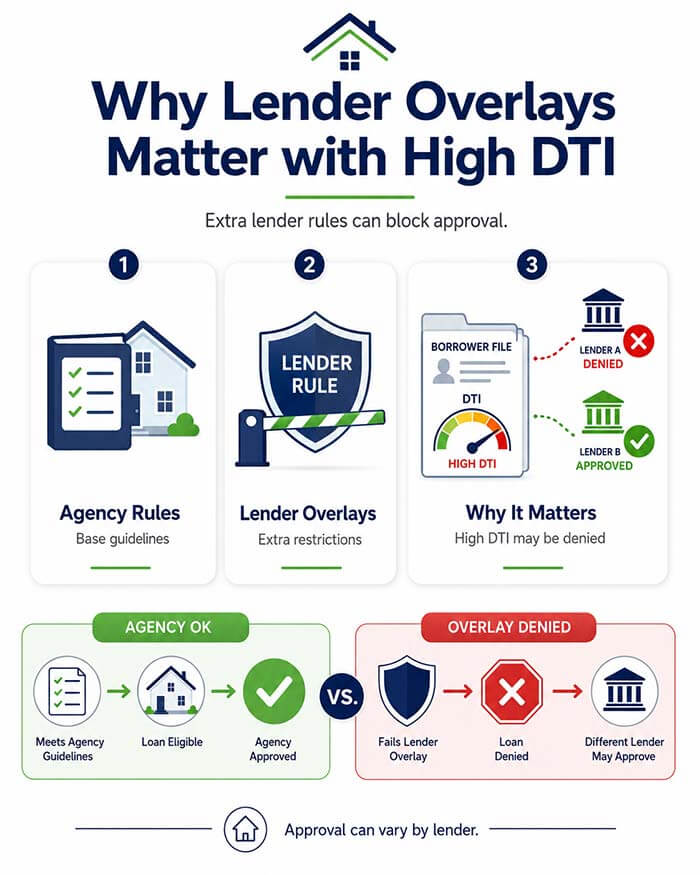
Gustan Cho Associates works with borrowers who need lenders that understand agency guidelines and do not automatically deny loans simply because the DTI is high.
High DTI Mortgage Approval After Bankruptcy or Foreclosure
Manual Underwriting for High-DTI Borrowers
Manual underwriting can help borrowers with strong compensating factors who do not fit perfectly into automated underwriting. However, manual underwriting guidelines applies on FHA and VA loans.
Documents Needed for a High-DTI Mortgage File
- recent pay stubs
- W-2s, tax returns (if required)
- bank statements
- retirement or asset statements
- student loan statements
- proof of rent history
- bankruptcy or foreclosure documents (if applicable)
- divorce decree (if applicable)
- child support documentation (if applicable)
- letters of explanation for credit or employment issues.
Need a Mortgage With High DTI?
Lenders review more than debt ratio alone. Credit score, income, assets, reserves, loan program, and automated underwriting findings can all matter.
Mistakes to Avoid When Applying with High DTI
Best Loan Programs for High-DTI Borrowers
The best loan program depends on the borrower’s credit, income, assets, military eligibility, property location, and homebuying goals.
Can You Refinance with High DTI?
Tips for Buying a House with High DTI
Co-Borrowers Can Help:
- Including a co-borrower who has a stronger financial profile can help offset your high debt-to-income (DTI) ratio.
- This strategy makes you more appealing to lenders and may improve your chances of securing a loan.
Clearing Debt and Increasing Income:
- Consider strategies to pay down debts or increase your income.
- Even small debt reductions or slight income increases can significantly impact your DTI.
Exploring Down Payment Assistance:
- Many buyers are unaware of down payment assistance programs that can ease the initial financial burden.
- These programs can reduce the amount you need to bring to the closing table, indirectly improving your DTI by freeing up resources.
First-Time Homebuyers and High DTI

Buying your first home with a high DTI is daunting, especially with student loans or car payments. An undergraduate degree does not go far these days. Many college graduates proceed to graduate or professional schools. This adds more student loan debts than the undergraduate student loans already incurred. The average starting salary of a college graduate for 2020 was $48,980 a year. However, understanding that mortgage payments are lower than current rental rates can change your perspective. The key is finding the right loan program that accommodates your financial situation.
Down Payments and Closing Costs
Contrary to popular belief, you don’t always need a 20% down payment. Many programs allow as little as 3% down, and VA and USDA loans can offer zero down payment options. Moreover, seller concessions and lender credits can often cover most or all your closing costs, reducing the cash you need upfront.
Getting Your Mortgage with High DTI
At Gustan Cho Associates, we pride ourselves on offering no overlays on government and conforming loans. This means that as long as you meet the federal minimum DTI requirements, we won’t add stricter rules. This approach opens doors for many borrowers who’ve faced rejections elsewhere due to high DTI.
- We are lenders with no overlays
- As long as borrowers meet the federal minimum lending guidelines on debt-to-income ratios, we will not impose any other overlays
- We can approve a mortgage with high DTI as long as the borrower gets an approve/eligible per Automated Underwriting System
- A large percentage of our mortgage applicants have high debt to income ratios and were told that they do not qualify for a home loan due to overlays
Borrowers seeking a mortgage with high DTI, please contact Gustan Cho Associates at 800-900-8569 or text us for faster response. We are available 7 days a week, evenings, weekends, and holidays.
Final Thoughts on How to Get a Mortgage with High DTI on Home Loans
A high debt-to-income ratio is not always a mortgage deal killer. The right lender can review your full financial profile and determine whether FHA, VA, USDA, conventional, manual underwriting, or non-QM financing is the best path forward.
At Gustan Cho Associates, we specialize in helping borrowers like you—those who’ve been told their DTI is too high elsewhere. We offer comprehensive support, guiding you through choosing the best mortgage option for your financial situation and helping you from application to closing. You can get approved for a mortgage with a high debt-to-income ratio if the loan file meets the mortgage program guidelines. Approval depends on credit score, income, assets, reserves, loan program, automated underwriting findings, and lender overlays.
How Gustan Cho Associates Helps Borrowers with High DTI
We look at automated underwriting options, FHA, VA, USDA, conventional, non-QM, manual underwriting, reserves, credit history, income documentation, and possible solutions to lower the DTI before closing.
Our team of experts at Gustan Cho Associates can be creative in structuring a home mortgage program for borrowers with high student loan debts and who qualify for a home loan.
Here are Examples of Possible Closing Costs a Homebuyer May Encounter:
- Prepaid (Escrow for property taxes or homeowners’ insurance)
- Origination charges and discount points
- Processing and Underwriting fees
- Attorney’s fees
- Appraisal fees
- Title charges
- Credit reporting fees Rapid rescore
- charges
- Transfer stamps charged by the village, town, city, or county
- Inspection fees
- Any other fees, costs, or charges associated with the purchase and closing of the home loan
Ready to Take the Next Step?
If you’re eager to discover your mortgage options, even if you have a high debt-to-income ratio, contact Gustan Cho Associates today. We’re available seven days a week—evenings, weekends, and holidays—to help you secure your home loan. Call us at 800-900-8569, text for a faster response, or email gcho@gustancho.com for personalized assistance.
Your dream home might be closer than you think—even with a high DTI!
Frequently Asked Questions About Mortgage with High DTI:
What is a Debt-to-Income Ratio (DTI)?
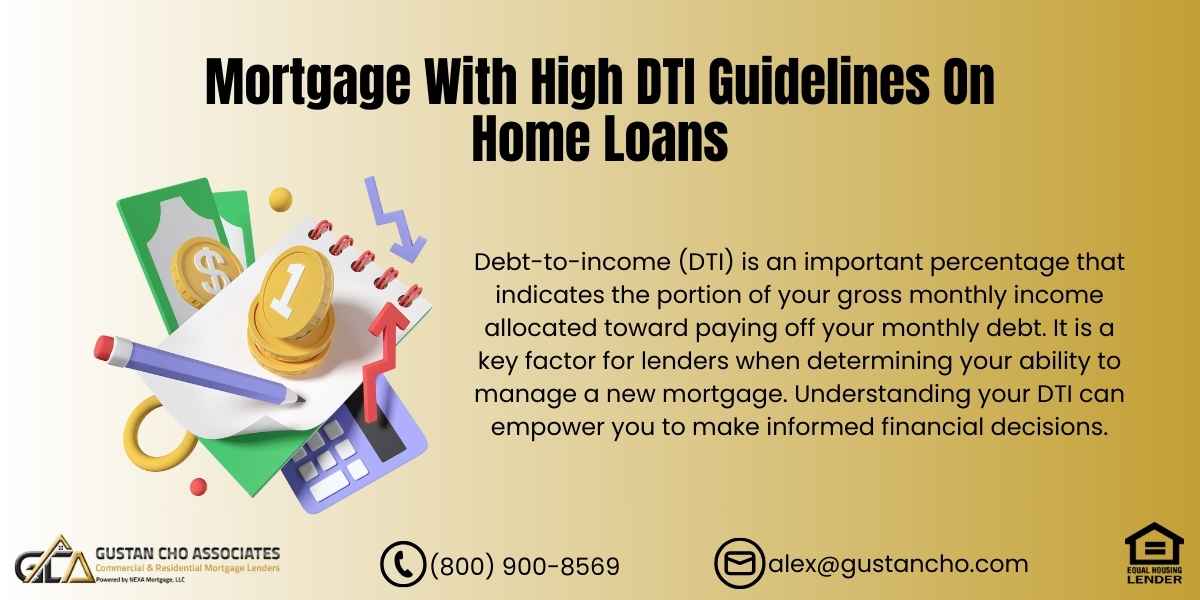
- Debt-to-income (DTI) is an important percentage that indicates the portion of your gross monthly income allocated toward paying off your monthly debt.
- It is a key factor for lenders when determining your ability to manage a new mortgage.
- Understanding your DTI can empower you to make informed financial decisions.
Why is a High DTI a Problem When Applying for a Mortgage?
- A high DTI signals to lenders that a large portion of your income is already tied up with other debts, which could make it difficult to afford additional mortgage payments.
Can I Get a Mortgage with High DTI?
- Yes, you can get a mortgage with high DTI.
- At Gustan Cho Associates, we offer loans without overlays, which means we stick to federal guidelines that might allow higher DTI ratios.
What are Lender Overlays, and How do They Affect My Mortgage Application?
- Lender overlays are additional requirements that lenders might impose over and above federal guidelines.
- If a lender uses overlays, they might reject an application even if it meets federal criteria.
- We don’t use overlays at Gustan Cho Associates, making it easier for you to qualify.
What Loan Options are Available for Someone with a High DTI?
- FHA loans, VA loans, and certain conventional loans can be good options for those with high DTI.
- These programs often have higher DTI limits than other types of loans.
How Can FHA Loans Help if I Have a High DTI?
- FHA loans are more forgiving with DTI ratios, allowing up to 56.9% back-end DTI if your credit score is 620 or higher.
- This makes it easier for you to qualify even with higher debt levels.
What Should Veterans Know About VA Loans and DTI?
- VA loans offer great benefits, such as not counting deferred student loans that have been postponed for over 12 months in the DTI calculation, which can significantly lower your DTI and improve your loan approval chances.
Can I Buy a House with a High DTI and a Low-Down Payment?
- Absolutely!
- Many loan programs, including VA and USDA loans, offer zero-down payment options, and some conventional loans require as little as 3% down.
What are Some Strategies to Manage a High DTI When Applying for a Mortgage?
- Consider adding a co-borrower with a stronger financial profile, paying down debts to lower your DTI, or looking into down payment assistance programs to reduce upfront costs.
How Can I Start Applying for a Mortgage with a High DTI?
- Contact Gustan Cho Associates at 800-900-8569 or text us for a faster response.
- We’re available every day, including weekends and holidays, to help you understand your options and start the application process.
This Guide About “Mortgage with High DTI Guidelines on Home Loans” Was Updated on May 26, 2026
Find a Loan Program That Fits Your DTI
FHA, VA, conventional, USDA, and non-QM loans may treat high DTI differently. Get your income, debts, credit, and assets reviewed.