Understanding FHA Guidelines on Credit Scores vs. DTI in 2026
If you’re thinking about getting a home with an FHA loan, it’s really important to know how your credit score and how much debt you have (that’s your debt-to-income ratio or DTI) can affect things. These factors matter a lot when you’re trying to get approved for a mortgage. We’re going to explain all about the FHA guidelines on credit scores versus DTI. So you have a clear idea of what you need to know.
FHA Guidelines on Credit Scores vs DTI: What Do They Mean
Some homebuyers believe that getting approved for an FHA loan comes down to one number. Some homebuyers say nothing is more important than their credit score, and others believe their DTI is the only number that matters.
FHA will continue to use Handbook 4000.1 as its current policy source, and automated systems also state that a loan cannot be approved or denied solely based on a TOTAL Scorecard recommendation.
FHA guidelines consider both. The DTI and credit score are not viewed as the only factors among many at play. The DTI and credit score are two of the many factors in the underwriting process that look to assess the total picture.
The Difference Between The Credit Score And The DTI
A credit score is an indication of how you have treated credit in the past. It reflects trends like payment history, outstanding balances, and how you manage your accounts. DTI is a different metric. It measures the portion of your gross monthly income that goes toward monthly debt obligations. Simply put, a credit score looks back at your credit history, and DTI looks forward to assess if your current financial situation can accommodate the mortgage payment.
Why Does FHA Use Different Rules For Different Borrowers?
FHA is designed to be flexible, but that does not mean that every borrower will get approved with the same profile. A borrower with a stronger score might have more room for flexibility when it comes to having higher ratios. A borrower with a weaker score might still be able to qualify, but this is typically the case when the borrower is subject to a lower maximum loan-to-value or to tighter, less flexible underwriting standards. This is why it is important to understand the FHA guidelines on credit scores as they relate to DTI, so you can be better positioned to shop for a home.
Understanding FHA Guidelines on Credit Scores Versus DTI: A Guide for Borrowers

Credit Score – This is a number that financial companies look at to decide how risky it is to lend you money. A higher score means you’re good at managing your debt and making payments on time. Which makes lenders more willing to give you a loan with better terms.
Debt-to-Income Ratio (DTI) – This is all about balancing how much money you owe versus how much money you make. It shows lenders whether you have enough income left after paying your monthly debts to afford a home loan. The lower your DTI, the better your chances are of getting approved. The FHA guidelines on credit scores versus DTI offer a more relaxed approach compared to traditional loans. It gives more people the chance to buy a home. However, balancing a decent credit score with a manageable DTI is still important to securing an FHA loan. Understanding how these elements affect your loan options will better prepare you for the homebuying process.
Confused About FHA Credit Scores and DTI? Let Us Help You Understand the Guidelines!
Contact us today to learn how both factors impact your eligibility for an FHA loan and how we can help you qualify.Credit Score Requirements
Your credit score is like a grade that shows how well you handle your money when applying for a home loan. FHA loans are a bit easier to get compared to the usual ones because they’re not as strict about your credit score. Here’s the breakdown:
- If you have a credit score of 580 or more, you’re in luck. To get an FHA loan, you only need to pay 3.5% of the house’s price upfront as a down payment.
- Have a score between 500 and 579? You’re still in the game, but you’ll need to pay more upfront – about 10% of the home’s price.
- If your score is under 500, then you’re out of luck for now. FHA loans won’t be an option.
The FHA guidelines on credit scores versus DTI are there to help more people own homes. The better your credit score, the better your chances of getting a good deal on a loan.
Debt-to-Income Ratio (DTI) Explained
When you’re trying to get a loan, lenders look at your debt-to-income ratio. They want to see if you can handle taking on more debt. This is about comparing what you owe each month to what you earn. There are two types of DTI:
- Front-End DTI: This one is all about your home costs like your mortgage, property taxes, and insurance, measured against your monthly income. According to FHA guidelines, your housing costs shouldn’t take up more than 46.9% of your income.
- Back-End DTI: This type looks at all your monthly debt payments. That means housing costs plus any car loans, credit card debt, and student loans – compared to your income. The FHA says all this together shouldn’t be more than 56.9% of your income.
About FHA guidelines on credit scores versus DTI – having a good credit score can make lenders more flexible with those DTI limits, letting you borrow a bit more.
The Relationship Between Credit Scores and DTI
Understanding how your credit score affects what you can borrow based on your DTI is important when getting an FHA loan. FHA guidelines on credit scores versus DTI show that if you have a good credit score, you can owe more compared to your income. Let’s break it down:
If your credit score is more than 620, you could borrow amounts that leave you with debts up to almost 47% of your income before taxes for your mortgage alone and about 57% for all your debts.
Now, if your credit score is under 620, things get tighter. Lenders might only allow your total debts to be up to 43% of your income for you to get the loan easily. So, having a higher credit score gives you a bit more breathing room with how much debt you can have and still get an FHA loan.
FHA Credit Score Guidelines for Maximum Financing
FHA’s credit score guidelines are frequently misinterpreted. The most critical starting point is that FHA categorizes borrowers into three broad financing buckets based on their minimum decision credit score. According to the handbook, a borrower with a score of 620 or higher qualifies for maximum financing. AUS generally will render an approve/eligible with a 46.9% front-end and 56.9% back-end DTI.
A borrower with a score of 500 to 579 is restricted to a 90% maximum LTV, as opposed to the typical FHA maximum financing level for most purchase loans.
Also, borrowers with 500 to 579 credit scores, the automated underwriting system will most likely render an approve/eligible per AUS with a 31% front-end and 43% back-end debt-to-income ratio. For purchase transactions, FHA specifies that the maximum LTV (loan-to-value ratio) is 96.5% of the adjusted value, which means the standard down payment is 3.5% for borrowers who qualify for maximum financing.
The 580 Benchmark And What It Means
The 580 benchmark is important because it marks the point at which FHA permits maximum financing for borrowers with conventional credit. That does not imply that every score at or above a 580 will receive an automatic approval. This means the borrower may qualify for the typical high-LTV FHA structure, provided the remainder of the file supports an approval.
Scores From 500-579
A score within this range does not totally prevent someone from getting FHA financing, but it does make it more difficult. The most common change is setting the LTV to 90%, which means a 10% down payment is required. This example illustrates why borrowers should not rely solely on their credit score. An applicant could be considered within the FHA’s minimum score perimeter, but then find requirements that are cash-to-close elevated to an unforeseen level.
How FHA Accounts For The Debt-to-Income Ratio
When lenders decide whether to approve a case, DTI is a major factor. This is because the DTI seeks to measure the client’s ability to repay the loan. The lenders are looking not only at the proposed payment for the house being purchased, but also at the client’s total monthly obligations, which are compared with the client’s monthly gross income.
For FHA loans that require manual underwriting, the HUD matrix uses a base benchmark of 31/43, which means the housing ratio and the total fixed payment ratio start from there.
For borrowers with credit scores of 580 or higher, the matrix allows higher qualifying ratios in some cases if there are acceptable compensating factors. For people with a 580 or lower credit score or those without a credit score, the matrix states that this can be used to avoid 31/43, except in some edge cases.
The Importance of Credit Scores Versus DTI
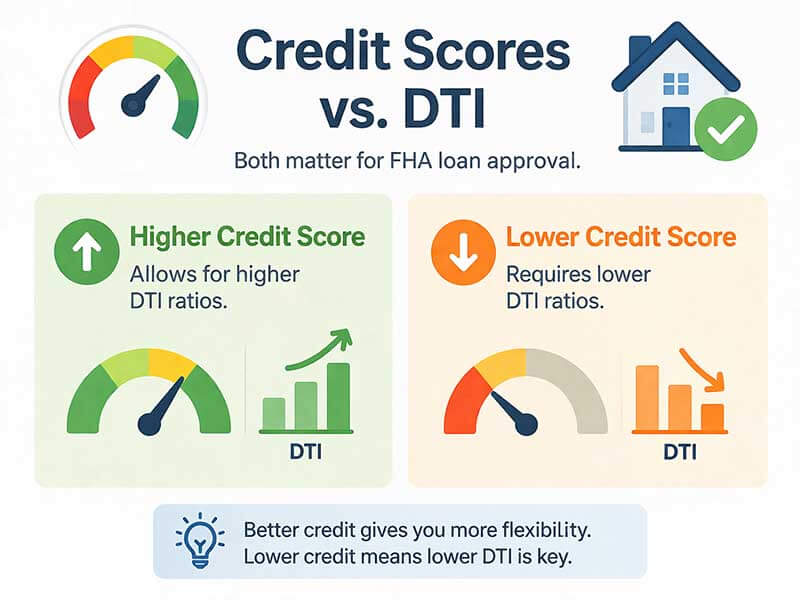
Focus on maintaining good credit and managing your debt. Both elements are crucial when qualifying for an FHA loan as per FHA guidelines on credit scores versus DTI. Remember this especially if you have higher debt-to-income ratios. Let’s look at why these factors matter:
- Higher Credit Scores Enable Higher DTI Ratios: With a higher credit score, lenders are more likely to approve higher DTI ratios. This means you can have more debt relative to your income and still qualify for a loan.
- Lower Credit Scores Require Lower DTI Ratios: If your credit score is lower, you’ll need to maintain lower DTI ratios to qualify. This ensures you can manage your debts and monthly payments effectively.
Understanding FHA guidelines on credit scores versus DTI can help you plan and prepare better for your home purchase.
FHA Guidelines on Credit Scores Versus DTI Caps
To get an approve/eligible status per the automated underwriting system (AUS), your credit score and DTI ratios must align with FHA guidelines. Here’s a breakdown:
- Credit Scores 620 and Above: You can have a front-end DTI ratio of up to 46.9% and a back-end DTI ratio up to 56.9%.
- Credit Scores Below 620: Your DTI ratios need to be lower to get an automated approval, typically capped at a 43% DTI.
Lenders rely on the AUS to determine your eligibility. If the AUS gives an approve/eligible status, and you meet the required conditions, your loan is likely to close and fund. However, some lenders impose additional requirements, known as overlays, which can affect your approval.
Lender Overlays on Credit Scores and DTI Ratios
While FHA sets the baseline guidelines, some lenders may have overlays. These are additional criteria that go beyond FHA’s requirements. Here are common overlays related to credit scores and DTI ratios:
- Credit Score Overlays: Some lenders require a minimum credit score of 620, even though the FHA allows for scores as low as 580 with a 3.5% down payment.
- DTI Ratio Overlays: Lenders may cap DTI ratios at 45% or 50%, even if FHA allows up to 56.9% for borrowers with credit scores of 620 or higher.
These overlays vary by lender. It’s important to shop around for a lender with flexible guidelines.
Tips for Managing Your Credit Score and DTI Ratio
If you’re hoping to get approved for an FHA loan, it’s important to keep an eye on your credit score. You also need to see how much debt you have compared to your income. Here’s how to make your chances better:
- Boost Your Credit Score: Pay your bills on time, keep your credit card balances low, and try not to take on new debt. Check your credit report regularly for errors and correct them if you find any.
- Lower Your Debt-to-Income Ratio: You can do this by either making more money or paying off some of your existing debts. Try not to borrow more money right before you apply for a home loan.
- Pick a Lender That Fits: Some lenders are easier to work with or have rules that are more favorable for borrowers. Finding one can help you get your loan application through.
Knowing about FHA guidelines on credit scores versus DTI can really help you understand what’s important and work on improving your chance of being approved for an FHA loan.
FHA Guidelines on Credit Scores Versus DTI: Co-Borrowers
Including a co-borrower on your FHA loan can impact your eligibility and loan terms. Here’s what you need to know:
- Single Borrower: If you’re the sole borrower, only your credit score and DTI ratio are considered.
- Co-Borrowers: When there are multiple borrowers, the lower middle credit score of all borrowers is used. For example, if one borrower has a middle score of 750 and the other has 600, the 600 score will be considered.
Including a co-borrower with a lower credit score can reduce your maximum allowable DTI ratio. If one borrower’s income is sufficient, it might be better to exclude the lower-scoring co-borrower from the loan application to benefit from higher DTI limits and better loan terms.
Worried About Your Credit Score or DTI? FHA Guidelines Make It Easier to Qualify!
Reach out now to discuss how your credit score and DTI can affect your FHA loan approval.Example Scenario: John and Mary Smith
Let’s consider a scenario involving John and Mary Smith to illustrate how FHA guidelines on credit scores versus DTI apply:
- John’s Credit Scores: 700 (Experian), 750 (TransUnion), 800 (Equifax)
- Mary’s Credit Scores: 550 (Experian), 600 (TransUnion), 650 (Equifax)
John’s middle score is 750, and Mary’s middle score is 600. If John alone qualifies for the loan, he benefits from his higher credit score. This will potentially allow a DTI ratio up to 56.9%. If Mary is added to the loan, the 600 score is used, and the DTI ratio is capped at 43%. In this case, it’s advantageous for John to apply alone, keeping Mary off the mortgage. Mary can still be on the title without affecting the loan terms.
Final Thoughts on FHA Guidelines on Credit Scores Versus DTI
Understanding the FHA guidelines on credit scores versus DTI is essential for anyone considering an FHA loan. These guidelines help determine your eligibility and the terms of your mortgage. Remember:
- Credit Scores and DTI Ratios Are Interconnected: Higher credit scores allow for higher DTI ratios.
- Lender Overlays Can Impact Approval: Shop around for lenders with flexible guidelines.
- Manage Both Credit and DTI: Improving your credit score and managing your debt effectively can enhance your loan eligibility.
Use this guide to help you through the process of purchasing a home and make well-informed decisions. Understanding FHA guidelines on credit scores versus DTI can help you achieve your homeownership goals in 2026. Stay informed and proactive to improve your chances of getting approved for a mortgage and getting closer to owning your dream home.
FAQs: Understanding FHA Guidelines On Credit Scores Versus DTI
What Is The Minimum Credit Score For An FHA Loan?
To be eligible for an FHA loan with a 3.5% down payment, a minimum credit score of 580 is required. If credit score is between 500 and 579, a 10% down payment will be necessary.
What Does DTI Stand For In Mortgage Terms?
Your debt-to-income ratio (DTI) is the result of comparing your total monthly income to your monthly debt payments. This helps determine your ability to afford a mortgage.
How Does A Higher Credit Score Affect My DTI Ratio For An FHA Loan?
According to FHA guidelines on credit scores versus DTI, a higher credit score allows for a higher DTI ratio. This means you can have more debt relative to your income and still qualify for a loan.
What Is The Maximum DTI Ratio Allowed By FHA?
Borrowers with credit scores 620 or higher can have a front-end DTI ratio of up to 46.9% and a back-end DTI ratio of up to 56.9% as per the FHA guidelines.
Can I Get An FHA Loan If My Credit Score Is Below 500?
No, if your credit score is below 500, you cannot qualify for an FHA loan.
How Do Lenders Use The Automated Underwriting System (AUS)?
Lenders use the AUS to determine if you qualify for a loan. The system gives an approve/eligible status based on your credit score and DTI ratio. Meeting the AUS conditions typically leads to loan approval.
What Are Lender Overlays?
Lender overlays are additional requirements set by lenders that go beyond FHA guidelines on credit scores versus DTI. For example, a lender might require a higher credit score or lower DTI ratio than FHA guidelines.
How Can I Improve My Credit Score To Qualify For An FHA Loan?
Remember, you can boost your credit score by paying bills on time, lowering credit card balances, avoiding new debt, and reviewing your credit report for any mistakes.
Should I Include A Co-Borrower On My FHA Loan?
Including a co-borrower can affect your loan terms. The lower middle credit score of all borrowers is used, which might lower your maximum allowable DTI ratio. It’s often better to apply alone if one borrower’s income is sufficient.
What Happens If My DTI Ratio Is Too High For An FHA Loan?
Your FHA loan approval may be affected if your DTI ratio is too high. You can improve your chances by paying off some debts or increasing your income to lower your DTI ratio according to FHA guidelines on credit scores versus DTI.
If you have any questions about FHA Guidelines On Credit Scores Versus DTI, please contact us at 800-900-8569. Text us for a faster response. Or email us at alex@gustancho.com. The team at Gustan Cho Associates is available 7 days a week, on evenings, weekends, and holidays. This blog about Understanding FHA Guidelines On Credit Scores Versus DTI was updated on April 7, 2026.