Mortgage Guidelines After Unemployment For FHA, VA, USDA, And Conventional Loans
Losing your job can feel like pausing your dream of buying a home. But the good news is, getting a mortgage after unemployment is still possible—even in 2026.
If you’re back to work and wondering how soon you can qualify, this guide will walk you through the current mortgage guidelines after unemployment and help you prepare for homeownership.
At Gustan Cho Associates, we help borrowers who’ve had job gaps, career changes, or temporary layoffs daily. We believe everyone deserves a second chance, without unnecessary roadblocks or lender overlays.
Can You Get a Mortgage After Being Unemployed?

Mortgage Guidelines After Unemployment: What Lenders Look For
Whether you’re applying for an FHA, VA, USDA, or conventional loan, these rules apply to most mortgage programs:
Find answers to common mortgage questions, including best practices for addressing employment gaps and returning to work, as outlined by FHA, VA, USDA, and conventional loan guidelines.
If Your Unemployment Gap Was Less Than 6 Months:
- No waiting period is required once you return to work.
- You do not need to return to the same job or industry.
- You must now have a full-time job (part-time jobs may require additional documentation).
You may become eligible for a mortgage when you begin your new full-time job. If debt levels remain unchanged during unemployment, your debt-to-income ratio may still be high after returning to work.
If You Were Unemployed for More Than 6 Months:
- You’ll need to be in your new job for at least 6 months before applying.
- If you’re returning to your old job, you may not need to wait, especially if it’s the same position.
These rules are part of the standard mortgage guidelines after unemployment and haven’t changed much in recent years. But some lenders have overlays that complicate things—we don’t.
Mortgage Guidelines After Unemployment: What You Need to Know to Get a Home Loan
Job loss can create challenges for homebuyers, but a layoff does not automatically result in mortgage denial. Applicants who have returned to work, can verify employment, and show stable income may still qualify for a home loan.
The main issue with mortgage guidelines after unemployment is how lenders assess employment gaps.
While gaps are reviewed, current income is the most important factor. Fannie Mae advises lenders to carefully evaluate employment gaps, considering the duration of re-employment and the likelihood of continued income. USDA and FHA follow similar policies, focusing on income stability and reliability. Prior unemployment often does not prevent mortgage approval. Providing clear documentation and showing a stable current income are essential.
Can You Qualify For A Mortgage After Unemployment?
You may still qualify for a mortgage after a period of unemployment. Lenders do not automatically disqualify applicants with employment gaps. They assess whether you have returned to work, if your job is stable and likely to continue, and the quality of your income. Lenders also consider the type of income (hourly, salary, self-employed, commission, or bonus) and whether there is enough history to deem it stable.
A Gap In Employment Doesn’t Mean You Are Disqualified
A gap in employment can raise questions with underwriters, but it does not automatically mean the loan application will be denied. Fannie Mae specifically states in its selling guide that gaps in the last 12 months of employment may indicate a higher risk of employment instability, but the lender must assess the employment to determine the likelihood of stability.
USDA guidance states that lenders need to review information before making a stable and dependable income assessment or judgment on a borrower.
Multiple employment gaps do not necessarily preclude mortgage approval if the applicant currently demonstrates a high and stable income. The primary consideration is the applicant’s employment and income status following the period of unemployment.
Stability and Predictability of Income
Income continuance is a major factor across the mortgage industry. Requirements for income stability appear in the Fannie Mae guidelines. Potential borrowers must be qualified based on permanent income. USDA guidelines require the lender to demonstrate a high likelihood of sustained income for three years post-mortgage.
Because of challenges with income cessation, underwriters focus on the applicant’s new employment, income, and supporting documents.
A clear, stable income path in documentation increases approval chances. If current income shows continuity, the applicant’s position is stronger, underwriters focus on your new job, income, and supporting documents. If your paperwork demonstrates a clear and stable income path, your approval chances improve. Shorter unemployment periods may prompt a more detailed review.
Back to Work? Let’s Get You Home Loan Approved
Just got a new job after unemployment? You may still qualify for a mortgage sooner than you think.Gaps in Employment Require Clarification
USDA requires you to explain any employment gap over 30 days with a letter and supporting documents. For shorter gaps, you may need to provide a brief explanation, including the gap’s length and reason. Lenders want to know if the gap is a concern or a normal part of your work history.
Closely Examining Recent Employment
Recent employment gaps are often reviewed more closely than older ones. Underwriters may ask for your offer letter and other documents to confirm your job history. At a minimum, you will likely need to provide your W-2. Applicants are more likely to be approved if a recent employment gap has been addressed and current employment is stable. There is a significant distinction between a recently resolved gap and an extended history of stable employment.
Conventional Loan Mortgage Guidelines After Employment Gap
To qualify for a mortgage after an employment gap, you must provide documented steady employment. Borrowers who recently changed jobs but remain in the same field and earn a regular paycheck are more likely to qualify than those switching industries.
Fannie Mae specifies the documentation needed to support employment changes.
Although employment gaps may be discouraging for some borrowers, individuals with recent gaps and strong financial profiles may still be considered strong candidates for mortgage approval.
Overtime, Commission, and Part-Time Gap
A documented employment gap is not the only factor. The type of income you earn also matters. Income from overtime, commission, or part-time work may make qualification harder, as these sources are seen as less stable. For those returning to work after unemployment, not all income types count immediately.
Usually, only base pay is considered at first, while bonuses or commissions may require a longer employment history before inclusion.
For those recovering from job loss, FHA may be a good mortgage alternative, and FHA loans are not as difficult as many think. However, FHA expects income used for qualification to be legally documented in accordance with Handbook 4000.1. HUD guidance regarding undocumented employment gaps or income drops during economic downturns, such as the COVID-19 pandemic, requires confirmation and documentation to prove the loss is temporary and that income has been restored or the borrower has returned to formal employment.
FHA, VA, USDA, and Conventional Loans: Which Is Best After Unemployment?
FHA Loans and the Effective Income
The FHA will not lend to most people solely on the basis of a return to work. FHA expects the income to be effective, documented as stable, and continuously documented. Employment must be shown as restored, and underwriters focus on the ability of the employment to sustain mortgage payments.
FHA as a Tool for Recent Unemployment and Unemployed Borrowers
After unemployment, FHA loans may be advantageous due to more flexible credit and down payment requirements compared to conventional loans. However, applicants with recent or extended unemployment and unstable new employment may face additional scrutiny.
Guidelines after VA Unemployment
For eligible borrowers who have been unemployed, VA financing may be an appealing option, but the same overall principle applies. Satisfactory income and employment must be verified. VA has had a focused lens considering employment and income verification as a credit decision in the past. Regarding the ways in which credit decisions are underwritten, VA has suggested using employment verification services.
VA Financing Through Employment
Stable income, low debt, and a recent period of unemployment support a borrower’s ability to repay. Returning to the same position after unemployment shows stability and predictability, which underwriters view favorably.
If income is seasonal, lenders usually compare projected income with the last two years to confirm it is expected to continue.
A common misconception is that USDA guidelines focus only on current income; however, work history and likelihood of continued income are also considered. Returning to work after unemployment usually does not hurt approval chances if clear documentation is provided.
Gaps in Employment Warrant Special Treatment
USDA recognizes that employment gaps do not always indicate unstable income. However, lenders must assess documented employment gaps. Sometimes, a seasonal gap is preferable to an unexplained one. Clear documentation is essential for approval after an unemployment gap. A well-organized and easily traceable work history increases the likelihood of a favorable outcome.
Basic Paperwork Mortgage Lenders Will Request
Most lenders will request a recent pay stub, W-2, tax return, a written explanation of the employment gap, job verification, and documentation showing the gap has closed.
Fannie Mae specifically requires employment income documentation, which may include employee records, employer verification, or third-party verification.
The lender may request, but is not limited to, an offer letter, an employment contract, and/or confirmation of return from a temporary layoff. Additional history may be required if you carry a variable income component (e.g., bonus or commission) to be eligible for a full income qualification.
The Value of Keeping it Simple
After unemployment, keeping organized and accurate documentation is crucial. Avoid errors like missing dates, unexplained gaps, or missing letters. A clear, complete file streamlines underwriting.
Employment, Duration, and Mortgages
Many people want to know how long they must be back at work after unemployment to get a mortgage. The answer depends on the loan program, income type, automated underwriting results, and the overall strength of your application.
There is no universal requirement for how long you must be re-employed before qualifying for a mortgage.
Applicants with steady, salaried jobs and straightforward work histories may qualify more quickly, while those with new jobs, variable income, or complex records may need more time. The amount and stability of each borrower’s income are as important as the length of time since returning to work.
Variable Income May Need A Longer History.
Salaried or hourly employees usually have an easier time getting approved than self-employed borrowers. Two people with the same time off work can have very different outcomes, depending on their job type and income.
What Happens Outside The Workplace Is Also Relevant
Applicants with high credit scores, low debt, and savings generally have more mortgage options than those with lower credit, higher debt, and limited savings.
Several employment-related factors may present challenges in obtaining mortgage approval.
A career change, especially to a field unrelated to previous employment, can make it harder to demonstrate steady income. Lenders may initially be hesitant to recognize the stability of new income sources.
Can You Switch Careers and Still Get a Mortgage?
Absolutely. In 2026, career changes are common, especially after the pandemic and the rise of remote work, gig work, and self-employment. You do not need to return to the same field to get approved.
For Example:
- A restaurant worker can become a delivery driver.
- A teacher can become an office manager.
- A factory worker can shift to customer service.
As long as the new job is full-time and verifiable, you may still qualify based on current mortgage guidelines after unemployment.
How Lenders Verify Employment After a Job Gap
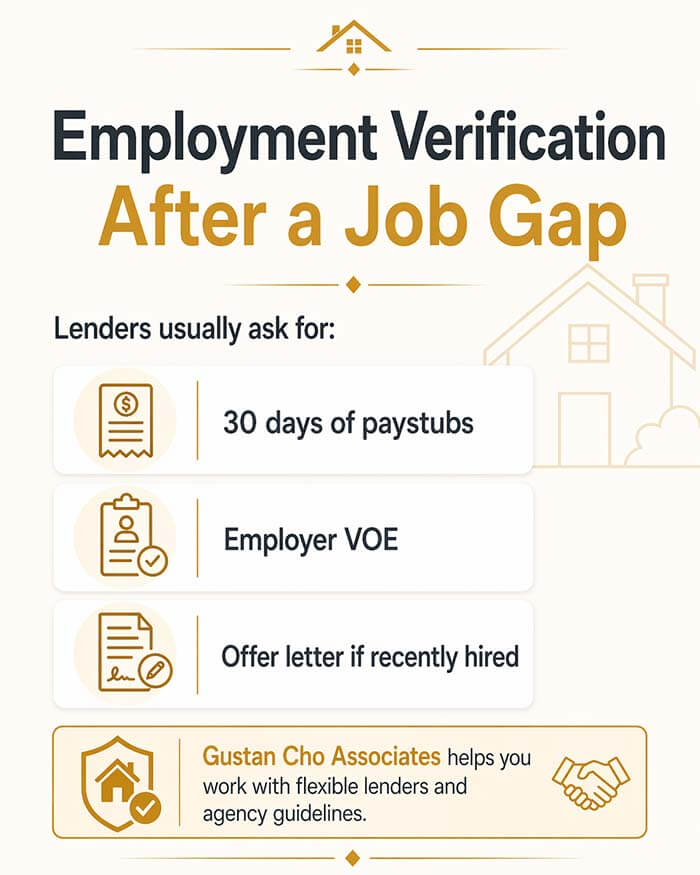
Lenders need to know your income is reliable before approving your mortgage. Here’s what they typically ask for:
- A paystub showing at least 30 days of income from your new job
- A Verification of Employment (VOE) directly from your employer
- Possibly a written offer letter (especially for jobs that started within the past 30–60 days)
At Gustan Cho Associates, we help you gather all this and work with flexible lenders that don’t add extra rules. We follow only the agency guidelines, not overlays.
Do Self-Employed Borrowers Need to Wait Longer?
If you’re self-employed and had a break in business activity, getting approved may be trickier, but not impossible. You’ll need to show:
- Your business is back up and running
- You’ve had consistent deposits or invoicing for at least 3–6 months
- Your income is steady enough to support a mortgage
We also offer bank statement loans that don’t require tax returns—perfect for gig workers, freelancers, or anyone who doesn’t get a W-2. These programs follow different mortgage guidelines after unemployment and give you more options.
What If You’re Still in a Probationary Period?
Many new jobs have a 90-day probationary period. The good news? You can still qualify for a mortgage during this time, as long as:
- You’ve already started working, and
- Your income is verified with pay stubs or an offer letter
Some lenders may hesitate, but Gustan Cho Associates can help you get approved even if you’re still in the early days of your new job.
Job Changes/Gaps That Lack An Explanation
A single period of unemployment is typically not problematic; however, multiple employment gaps within a short timeframe may raise greater concerns for lenders.
Applicants can improve approval chances by presenting a straightforward, low-risk application.
Simplified documentation helps lenders review your file and increases approval likelihood. Staying employed in the same field enhances the clarity of the application and improves the chances of a favorable assessment.
Reduce Existing Debts
Reducing existing debt improves debt ratios and reduces the need for extra explanations during the application process.
Maintain Available Cash
Maintaining additional cash reserves after closing provides a financial buffer. Avoid taking on new personal loans, car loans, or credit card debt after re-employment. Provide the lender with a clear letter of explanation. Explanations should be concise and clearly state the unemployment circumstances, duration, re-employment date, and reasons your current income is stable.
When Waiting To Apply May Be The Smarter Move
Sometimes, postponing a mortgage application after unemployment may be beneficial. Applicants with new jobs, unstable income, or limited pay history and savings may improve their chances by waiting. This does not mean you cannot get a mortgage, but your chances, rates, or loan options may improve if you wait longer.
Mortgage Approval After Unemployment Is Possible
Even with a recent job gap, you could still qualify. Find out the updated 2026 guidelines and get pre-approved todayCommon Myths About Getting a Mortgage After Unemployment
Let’s clear up a few misconceptions:
Myth #1: You Need to Be on the Job for a Full Year
- Not true. If you were unemployed for less than 6 months, you don’t need any job seasoning at all.
Myth #2: You Must Go Back to the Same Job
- Wrong again. Lenders just want to see full-time, stable income, regardless of industry.
Myth #3: A Layoff Automatically Disqualifies You
- Absolutely not. Millions of Americans experience layoffs. What matters is what you’ve done since the unemployment period.
- Understanding the truth about mortgage guidelines after unemployment can open the door to homeownership sooner than you think.
Tips to Strengthen Your Mortgage Application After Unemployment
Here’s how to improve your chances of getting approved:
- Get a full-time job as soon as possible.
- Keep all documents: pay stubs, offer letters, and Verification of Employment (VOE).
- Watch your credit score—avoid late payments and keep credit card balances low.
- Save money—having a solid down payment and reserves helps a lot.
- Work with a lender that doesn’t add overlays, like Gustan Cho Associates.
Following the correct mortgage guidelines after unemployment and applying with a lender who understands your story can make all the difference.
What Makes Gustan Cho Associates Different?
We specialize in helping borrowers who:
- Recently changed jobs
- Have lower credit scores
- Are recovering from unemployment
- Were denied by other lenders due to overlays
We don’t add extra rules. We follow only HUD, VA, USDA, and Fannie/Freddie guidelines, and close loans quickly. Our team understands that life happens. If you’re back on your feet and ready to move forward, we can help you buy a home.
Final Thoughts: You’re Not Alone, and You’re Not Out
Millions of people experience job loss every year. What matters now is that you’re working again and ready to become a homeowner. The mortgage guidelines after unemployment in 2026 are more flexible than most people think. If you’ve been denied before, don’t give up.
At Gustan Cho Associates, we approve loans that other lenders won’t. Whether you’ve had a job gap, career change, or credit issues, we’re here to guide you every step of the way.
A common misconception is that unemployment eliminates the possibility of homeownership. In most cases, lenders seek evidence that current income is genuine, stable, well-documented, and likely to continue. Applicants who have resumed employment, have a reliable income, and can clearly explain employment gaps may still qualify for FHA, VA, USDA, or conventional loans. The strongest applications present a clear narrative: a setback occurred, it was resolved, income has been restored, and the applicant can afford the payments. This approach aligns with underwriter expectations and is the focus of this article. You may still qualify for a mortgage after unemployment if you are back at work and your current income is documented, stable, and likely to continue. A prior unemployment period does not automatically disqualify you.
Ready to See If You Qualify?
Borrowers who need a five-star national mortgage company licensed in 48 states with no overlays and who are experts on mortgage guidelines after unemployment, please contact us at 800-900-8569, text us for a faster response, or email us at gcho@gustancho.com. The team at Gustan Cho Associates is available 7 days a week, on evenings, weekends, and holidays.
Frequently Asked Questions About Mortgage Guidelines After Unemployment:
Can I Get A Mortgage If I Just Started A New Job After Being Unemployed?
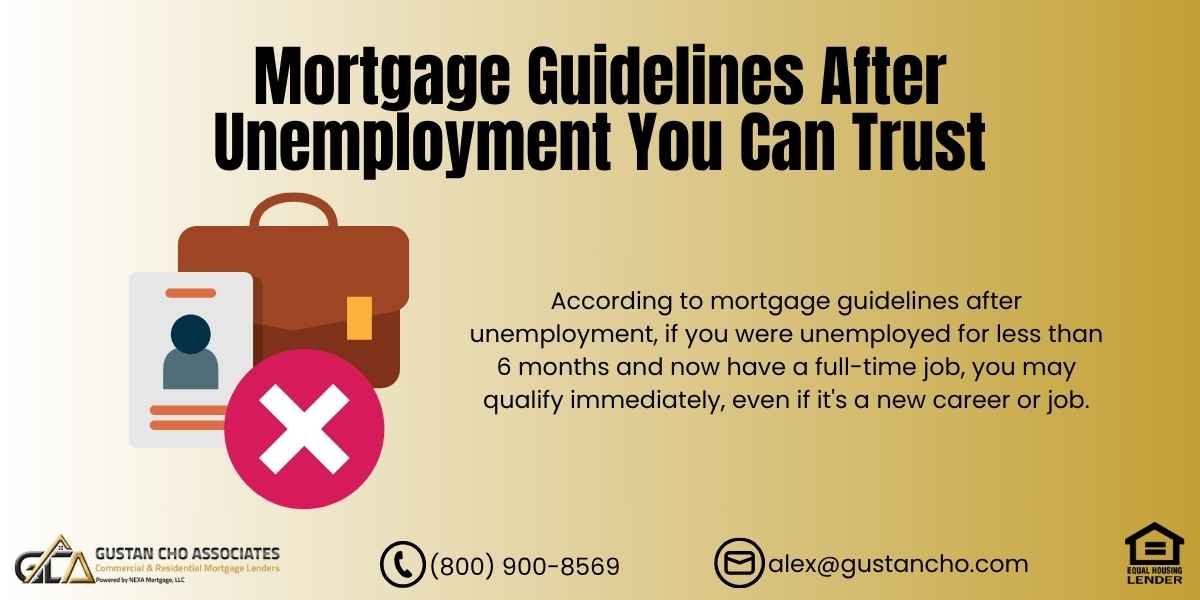
Yes, you can. According to mortgage guidelines after unemployment, if you were unemployed for less than 6 months and now have a full-time job, you may qualify immediately, even if it’s a new career or job.
Do I Have To Go Back To The Same Job To Get A Mortgage?
No. Mortgage guidelines after unemployment let you switch jobs or even switch industries. You can still qualify as long as your new job is full-time and stable.
How Long Must I be at My New Job Before Applying for a Mortgage?
If you have been out of work for less than 6 months, there’s no waiting—you can apply as soon as you start working. If you were unemployed for over 6 months, mortgage guidelines after unemployment usually require you to be back at work for 6 months before applying.
Can I Get Approved for a Mortgage if I’m Still on Probation at My Job?
Yes. Many lenders will approve you once you’ve started working and your income is verified with pay stubs or a job offer letter. Mortgage guidelines after unemployment don’t disqualify you for being on probation.
Do Mortgage Guidelines After Unemployment Apply to Self-Employed People, Too?
Yes, but the rules are different. If you’re self-employed, you’ll need to show that your business is active again and has consistently earned income for 3–6 months. We also offer bank statement loans for self-employed borrowers without tax returns.
Will Being Laid Off Last Year Hurt My Chances of Getting a Mortgage Now?
Not necessarily. Mortgage guidelines after unemployment focus on your current job and income. You’re likely still eligible if you’re back to full-time work, especially after a short unemployment period.
What Documents Do I Need to Get A Mortgage After Unemployment?
You’ll need pay stubs (usually 30 days), a Verification of Employment from your employer, and possibly an offer letter. These are standard under mortgage guidelines after unemployment.
Can I Still Get a Low Credit Score Loan if I was Recently Unemployed?
Yes. At Gustan Cho Associates, we offer FHA and VA loans down to 500 credit scores. You can qualify under mortgage guidelines after unemployment, even with lower credit, as long as you meet income and job requirements.
Which Loan is Better After Unemployment—FHA, VA, or Conventional?
It depends. FHA is flexible with job gaps, VA is great for eligible veterans with solid income, and Conventional works well if you have good credit. All follow mortgage guidelines after unemployment, and we’ll help you find the best fit.
Why Work With Gustan Cho Associates After Unemployment?
Because we don’t add overlays. We follow only the agency mortgage guidelines after unemployment, which means we approve borrowers that other lenders turn away, especially those with job gaps or recent career changes.
This Guide About “Mortgage Guidelines After Unemployment You Can Trust” Was Updated On April 21, 2026.