Mortgage rates during the COVID-19 pandemic changed quickly and did not affect every borrower the same way. National averages eventually fell to record lows, but the first months of the pandemic brought uncertainty to lenders, investors, and homeowners. Some borrowers with strong credit, equity, and stable income were able to refinance at very low rates. Others saw higher pricing, discount points, stricter lender requirements, or fewer loan choices. The difference came down to more than the advertised rate. Credit profile, loan type, down payment or equity, and lender policies all played a role.
Why Mortgage Rates Became Volatile in Early 2020
When COVID-19 first disrupted the economy in early 2020, mortgage rates did not simply drop overnight and stay low.
Financial markets moved quickly as investors reacted to uncertainty, and the mortgage-backed securities market became unstable. Lenders had to reprice loans more often, manage a sudden surge in refinance applications, and adjust to rapidly changing investor demand.
This is why the mortgage rates during the COVID-19 pandemic reported in the news did not always align with what a borrower could actually receive. National averages are derived from a broad sample of loans and borrowers. A borrower’s interest rate can be affected by credit score, down payment, home equity, loan type, property use, loan amount, discount points, and the lender’s pricing at the time the rate is locked. Some well-qualified borrowers secured particularly low rates, while others incurred higher costs or had limited loan options during the most volatile periods.
How the Federal Reserve Responded
As the pandemic caused turmoil in financial markets in March 2020, the Federal Reserve implemented significant measures to bolster the economy and ensure the functionality of essential lending markets. The federal funds rate was established within a target range of 0%-0.25%, and extensive purchases of U.S. assets commenced, including Treasury securities and agency mortgage-backed securities. These actions played a crucial role in influencing mortgage rates during the COVID-19 pandemic. These steps aimed to enhance market efficiency and to ensure credit access for households and businesses. They did not directly set the interest rate on an individual mortgage. Mortgage rates still moved based on investor demand, mortgage-backed security prices, lender capacity, loan costs, and each borrower’s credit profile, down payment or equity, loan type, and other pricing factors.
When Mortgage Rates Reached Record Lows
Mortgage rates reached a modern record low during the first week of January 2021. Freddie Mac reported at that time that the average 30-year fixed-rate mortgage was 2.65%. That figure showed how far national average mortgage rates had fallen during the pandemic, but it was not a rate every borrower could expect to receive. A borrower’s actual quote still depended on the loan program, credit profile, down payment or available equity, loan amount, occupancy, and whether discount points were used to lower the rate. Lender pricing also changed throughout the day during volatile periods. A low advertised rate could come with points or be available only to borrowers who met specific credit, equity, and loan requirements.
Why Some Borrowers Still Paid Higher Rates
Even though mortgage rates during the COVID-19 pandemic reached record lows, not all borrowers received the same loan quote. Lenders assess the overall risk and cost of a loan, rather than relying solely on the national average rate reported in the news. While credit score played a role, it was not the only consideration. Borrowers with lower credit scores may still qualify but will likely get different rates, points, or loan options than those with better credit.
Loan-to-value ratio also mattered. This compares the loan amount to the home’s value. A larger down payment on a purchase or more equity in a refinance can reduce the lender’s risk. Occupancy and loan purpose can also affect pricing.
A primary residence purchase may be priced differently than a second home, investment property, cash-out refinance, or limited cash-out refinance. Borrowers also needed to look beyond the interest rate itself. Discount points are charges that you pay at closing to reduce the interest rate on your loan. A single point is equivalent to 1% of the total loan amount, though the decrease in the interest rate associated with that expense can differ. Some low-advertised rates included points, while another loan with a slightly higher rate may have required less cash at closing. For many conventional loans, these pricing differences are reflected through loan-level pricing adjustments, often called LLPAs. LLPAs are pricing adjustments tied to loan features and eligibility factors, such as credit score and other characteristics of the transaction. They are not the same as lender overlays, which are extra lender requirements beyond the basic program guidelines. During periods of market stress, both investor pricing and lender policies could make mortgage quotes look very different from one borrower to another.
Temporary Lender Overlays During the Pandemic
Mortgage programs have baseline rules set by the applicable agency or investor, such as FHA, VA, USDA, Fannie Mae, or Freddie Mac. Those rules establish the basic requirements for credit, income, assets, property eligibility, and underwriting. A lender overlay is an additional rule created by an individual lender, bank, or investor that is added on top of the baseline requirements. During the uncertainty of the COVID-19 pandemic, some lenders and investors implemented temporary overlays to manage risk and adapt to changing market conditions. This could entail higher minimum credit score requirements, lower debt-to-income ratios, increased reserves, more stringent employment verification, or limited options for certain loan types. While mortgage rates during the COVID-19 pandemic varied, these overlays did not indicate that the core program rules had changed for all borrowers. Instead, one lender might decline or price a loan differently, while another lender, adhering to the same program guidelines, could still offer an option. This is why borrowers were often told they did not qualify even when they appeared to meet FHA, VA, USDA, Fannie Mae, or Freddie Mac requirements. The issue could have been the lender’s own overlay rather than the loan program itself. During volatile markets, comparing loan options and asking which requirement is creating the problem can help borrowers understand whether the barrier comes from the program or the lender.
Mortgage Forbearance and the Servicing Strain
The CARES Act provided homeowners with federally backed mortgages a crucial form of temporary relief in response to financial hardships related to COVID-19. Eligible borrowers could apply for up to 180 days of mortgage forbearance, with the option for one additional extension of the same length. While forbearance allowed homeowners to pause or reduce their payments for a period, it did not eliminate the amount owed.
Additionally, homeowners with private mortgages may have had access to different relief options through their servicer, all amidst fluctuating mortgage rates during the COVID-19 pandemic.
The relief helped many households stay current on housing needs during a sudden economic shutdown. But it also created pressure behind the scenes. Mortgage servicers are the companies that collect payments, manage escrow accounts, communicate with borrowers, and send funds through the mortgage system. When large numbers of homeowners paused payments at once, servicers still had operational duties and, depending on the loan and servicing arrangement, could face obligations to advance scheduled payments or cover certain costs. Servicers also had to process a high volume of forbearance requests, answer borrowers’ questions, update account records, and later help homeowners move into repayment, deferral, or loan modification options. The situation created real liquidity and staffing challenges, especially for nonbank servicers. It did not mean another mortgage collapse was certain, but it showed how quickly a nationwide payment pause could affect the mortgage market beyond the individual homeowner.
What Refinancing Looked Like During COVID-19
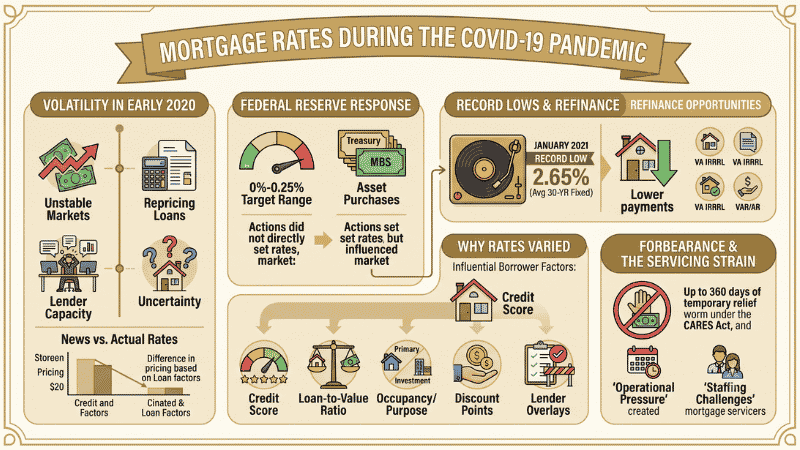 Record-low mortgage rates during the COVID-19 pandemic provided numerous homeowners with the opportunity to refinance, decrease their monthly payments, shorten their loan terms, or tap into their available equity. According to Freddie Mac, the average 30-year fixed rate was 3.1% in 2020, leading to an increase in refinance activity as homeowners took advantage of the lower rates and rising home values. However, the reduced national average did not necessarily mean that refinancing was the best option for every homeowner. Borrowers who benefited most often had a clear payment or interest savings, stable income, enough equity, and a loan that met the lender’s current requirements. Others had less favorable options because of credit concerns, limited equity, a recent forbearance, appraisal challenges, high loan balances, or higher costs and discount points. A refinance also had to make sense after reviewing closing costs, the new loan term, and how long the homeowner expected to keep the mortgage. FHA Streamline Refinances and VA Interest Rate Reduction Refinance Loans, commonly called VA IRRRLs, remained available during the pandemic for eligible homeowners. These programs can reduce documentation or appraisal requirements in some situations, but borrowers must still meet the applicable program rules and lender requirements. VA data show that IRRRL volume rose sharply during the low-rate period, while FHA and VA borrowers continued to use refinancing options when the new loan offered a meaningful benefit.
What Borrowers Can Learn From the COVID-19 Rate Cycle
The cycle of mortgage rates during the COVID-19 pandemic highlighted the importance of looking beyond just a low advertised rate. Although a rate might appear attractive initially, the true cost of the loan accounts for multiple factors, such as loan terms, lender fees, discount points, mortgage insurance, and the duration for which the borrower intends to maintain the loan.
Before choosing a mortgage or refinance, compare Loan Estimates from more than one lender. The Loan Estimate shows the interest rate, monthly payment, cash needed to close, lender charges, and whether the rate is locked. Ask whether discount points are included in the quote and how much those points cost.
Paying points may make sense for some borrowers, but not for someone who may sell, refinance, or pay off the loan within a few years. It is also important to understand the rate lock. Mortgage pricing can change daily, sometimes several times in a single day. A rate lock helps protect the quoted rate for a set period while the loan is processed, but borrowers should ask how long the lock lasts and what happens if closing is delayed. The best mortgage is not always the one with the lowest interest rate. Review the full Loan Estimate and compare the total cost, payment, closing fees, loan term, and break-even period before making a decision.
Final Thoughts About Mortgage Rates During the COVID-19 Pandemic
The COVID-19 pandemic highlighted that mortgage rates during the COVID-19 pandemic do not provide a complete picture. Market conditions can fluctuate rapidly, leading to different loan quotes for two borrowers who apply within a similar timeframe. Borrowers comparing mortgage options today should review the full Loan Estimate, not just the advertised interest rate. Compare the monthly payment, closing costs, discount points, mortgage insurance, rate-lock terms, and total cost over the time you expect to keep the loan. A thorough review can help you select a loan that aligns with your budget and long-term goals.
FAQs About Mortgage Rates During the COVID-19 Pandemic
Did COVID-19 Mortgage Forbearance Hurt Your Credit Score?
Mortgage forbearance did not automatically hurt a borrower’s credit score. Under the CARES Act, many borrowers who were current before entering COVID-related forbearance and followed the terms of their agreements were generally expected to have their accounts reported as current. However, borrowers who were already behind before forbearance, missed required payments under a repayment plan, or had inaccurate reporting could still face credit issues.
Can You Refinance After a COVID-19 Mortgage Forbearance?
It may be possible to refinance after a COVID-19 forbearance, but approval depends on the loan program, current payment status, repayment arrangement, credit history, income, equity, and lender requirements. A past forbearance does not automatically mean a borrower cannot refinance. Borrowers should be prepared to document that the forbearance has ended and that they are meeting the terms of any repayment, deferral, or modification agreement.
Why Did Mortgage Rates Not Always Follow the 10-Year Treasury Yield During COVID-19?
Mortgage rates are influenced by the bond market, but they do not move in exact step with the 10-year Treasury yield. During the early pandemic, mortgage-backed securities, lender capacity, hedge costs, investor demand, and a flood of refinance applications also affected pricing. That is why Treasury yields could fall even as some borrowers still saw higher mortgage quotes or additional discount points.
Why Did Mortgage Rates Rise After the Pandemic?
Mortgage rates rose sharply after the pandemic as inflation increased and financial markets expected tighter monetary policy. Mortgage rates are tied closely to long-term bond market conditions and mortgage-backed securities pricing, not just the Federal Reserve’s short-term rate. As inflation and market uncertainty increased, the cost of long-term mortgage borrowing rose as well.
Were 3% Mortgage Rates During COVID-19 Normal?
No. Mortgage rates below 3% were unusual and reflected extraordinary economic conditions during 2020 and 2021. Those conditions included emergency Federal Reserve actions, large purchases of mortgage-backed securities, low inflation expectations at the start of the pandemic, and severe economic uncertainty. Borrowers should avoid assuming those rates will return on a certain schedule.
Are COVID-19 Mortgage Forbearance Programs Still Available?
The broad COVID-era mortgage relief programs were temporary and should not be assumed to be available today. Homeowners facing a current hardship should contact their mortgage servicer as soon as possible to ask about available forbearance, repayment, deferral, modification, or other loss-mitigation options.
Did Home Prices Increase During the COVID-19 Pandemic?
Home prices increased rapidly in many parts of the country during the pandemic. Lower mortgage rates, limited housing supply, changing housing needs, and strong buyer demand all contributed. Lower rates helped some buyers afford larger loan amounts, but rising prices and competition also made buying more difficult for many households.
This article about “Mortgage Rates During the COVID-19 Pandemic” was updated on June 29th, 2026.