What is a Private Money Loan
A private money loan is a type of financing provided by non-institutional lenders. Unlike loans from banks or other traditional financial institutions, private money loans often come from individual investors or companies that see value in this potentially risky investment. Here are key aspects of private money loans:
Source of Funding of Private Money Loan
Generally interest rates on private money loans are higher than those offered by banks due to the higher risk associated with these loans. Rates are often in the double digits. Private money loans are offered by several types of investors. Here are the three most common types of private money lenders.
- Individual Investors: These are often people with available capital who are looking for a higher return on investment than traditional savings methods.
- Investment Groups: These can be groups specifically formed to pool resources and fund various types of loans.
- Private Companies: Specialized finance companies that are not governed by the same regulations as banks might also offer these loans.
Loan Terms of Private Money Loans
Terms can be much shorter than traditional loans, ranging from a few months to a few years. The structure can vary significantly depending on the agreement between the borrower and the lender. Private money loans is common in real estate investments, particularly for renovation projects, flips, and other situations where traditional financing may be hard to obtain or need to be more flexible. It is sometimes used by small business owners or individuals who cannot secure financing through banks due to credit issues or unconventional investment proposals.
Collateral Required For a Private Money Loan
They are typically secured by the purchased property or another form of real estate as collateral to protect the lender in case of default. The loan amount is usually based on a percentage of the property’s value, known as the loan-to-value (LTV) ratio.
Approval Process of Private Money Loan
Faster and more flexible than traditional bank loans. Lenders focus more on the collateral and the project’s potential than the borrower’s credit history. Due diligence is often still conducted but can be less stringent than traditional financing.
Risks of Private Money Loan
Both the borrower and lender face higher risks. Borrowers face higher interest rates and more severe default terms, while lenders risk higher losses if the investment fails.
Private Money Lender in Real Estate: An Introduction
This guide covers how to become a private money lender for real estate investors. We will also cover good opportunities to lend private money as well as what constitutes a good opportunity to lend.
Become a private money lender in real estate. Understand private lending, crucial risks, legal aspects, and strategies to safeguard your investment.
There are a couple of things you as a private money lender can do to be sure you’re getting the best possible opportunity to lend on. This takes a few factors that are controllable and then mitigating the rest that may not be as much. The idea is to make sure that you have the best possible scenario available to earn interest income.
Steps To Become A Private Money Lender In Real Estate
Private money lending in real estate attracts individuals seeking to earn income by funding real estate investors. Private money lenders provide essential capital to real estate investors.
If you can allocate funds and wish to maximize your earnings, you must first understand how to become a private money lender in real estate.
Private money lending supports investors by funding flip-and-fix projects, acquiring rental properties, and supplying bridge loans.
How To Get Started With Private Money Lending?
Many people researching how to become a private money lender want to know whether they need a license, what the minimum capital requirements are, how to find borrowers, and how to manage risk. Private money lending serves as an effective investment strategy for many. In this article, we will discuss the pros and cons, and risk factors involved in becoming a private money lender.
Beginner Questions in Private Money Lending in Real Estate
With thorough planning, precise documentation, and a robust understanding of real estate lending fundamentals, individuals can successfully become private money lenders. The profit potential is high, and the upfront investment is well justified. The process for private real estate lending is outlined here, along with the steps to initiate lending, the risks involved, and how private real estate lenders can protect their interests while funding these deals.
What Is A Private Money Real Estate Lender?
A private money lender in real estate is a person or organization that provides loans from their own funds to real estate investors, buyers, or developers who need financing. These loans originate outside traditional banks or typical lending institutions. Private money lenders often serve borrowers who need quick access to funds for real estate projects, such as fix-and-flip renovations, or those who do not qualify for conventional mortgages.
Private Money Lenders Use Their Personal Funds
Private money lenders are in a unique position to fund their clients with cash, whereas conventional lenders are unable to do so because their institutions lack investment. This is a great tool for these private money lenders; however, that flexibility also means the lender must take on greater responsibility and conduct their own due diligence.
Real Estate Investors Need Cash
Private money lenders serve real estate investors who encounter barriers to securing needed capital with either rapid funding or quick-turnaround deals. Traditional mortgage financing is often too slow for investments. Private money lenders bridge this gap and offer what was previously inaccessible.
Your Returns Primarily Come Through Interest and Fees
Private money lenders generate returns by charging borrowers interest, origination fees, and extension fees. These terms are fully negotiable and depend on the deal structure, the borrower, the property, the risk, and the lender’s discretion.
Private Money Lending In Real Estate
To become a private money lender, first learn how private money lending deals are structured. The lender gives a loan backed by real estate. The borrower signs a note, agreeing to short-term, interest-only payments and a final balloon payment. Borrowers may sell the property, get a long-term loan, or have the lender record a mortgage or deed of trust as an exit strategy.
Become A Private Money Lender: A First-Time Guide
In many cases, the borrower primarily uses the money towards the purchase, renovation, refinancing, or holding the property. These loans are usually financed or paid off with cash from the business or another asset. These deals require quick access to cash, making private lending ideal for flipping properties. Traditional lenders may not be interested, but private lenders step in when the property, borrower, and exit plan match.
The Attraction to Private Money Lending
To become a private money lender, an investor must actively manage their finances. Private money lending offers an opportunity for hands-on engagement rather than passive involvement. Active private money lenders generate income by evaluating the viability of borrowers, projects, or timelines.
Private Lending: The Passive Approach to Active Investing
Many private money lenders anticipate earning higher income. Their investments are secured by real estate, reducing risk compared to unsecured lending.
Former real estate investors, business owners, landlords, or professionals often pursue private money lending to increase income and leverage their expertise.
For these private money lenders, lending offers an opportunity to diversify income. Many aim to widen their portfolios. While private money lending offers higher returns, it carries greater risk than stocks or mutual funds. Rigorous research should always precede any loan commitment.
A Quick Guide to Private Money Lending
This guide provides concise advice for individuals seeking their initial experience with private money lending at a larger scale.
Lending starts with clear goals and a lending strategy.
You need clear goals before making a loan. Lending goals vary. Private lenders may prefer short-term, bridge, or property loans.
Some focus on returns, while others value steady cash flow. A clear lending strategy is essential for private lenders. Without one, you risk losing capital.
As a private lender, define how much to lend, the type of property to back, and the geographic market to target. Conservative lenders tend to fund single-family homes, while aggressive ones pursue riskier assets.
Learn the fundamentals of real estate lending.
If you want to be a private money lender, start by learning the basics. Understand collateralized loan-to-value (LTV), after repair value (ARV), debt service, promissory notes, deeds of trust, lien order, maturity date, and default interest. These basic terms will help you make informed decisions. Good lenders know how real estate investors can effectively make money. A private lender should understand how cash flow is generated and how funding is structured. If you want to make lending decisions, a good knowledge of real estate investments is a benefit.
Is Private Lending a Good Investment?
Private lending is a promising investment opportunity, particularly for investors seeking potentially higher returns than traditional avenues like stocks or bonds. However, this potential for increased returns comes hand in hand with elevated risks, necessitating carefully evaluating several key factors.
Client Risk Analysis: Private Money Lending
One crucial consideration is the risk-return tradeoff, where the higher risk of borrower default counterbalances the potential for higher returns in private lending. Diversification emerges as a critical strategy in mitigating this risk, as spreading investments across various loan types, industries, and borrower profiles can help cushion against losses from individual defaults.
Money Lending: An Analysis of Private Money Lending
Conducting thorough due diligence on borrowers is paramount, involving assessments of their creditworthiness, financial stability, and the purpose behind seeking the loan.
When assessing the ability of borrowers to repay their loans, it is important to consider external factors such as market conditions and fluctuations.
Scrutinizing loan terms, including interest rates, repayment schedules, collateral, and default provisions, is equally important to gauge the investment’s attractiveness and risk exposure. These factors play a crucial role in determining the borrower’s repayment capacity. These factors can have an impact on the investment returns.
Want Passive Income Secured by Real Estate?
Become a private money lender and earn solid returns while helping investors close fast.Assemble Your Lending Team Prior To Making Your First Deal
Even experienced private lenders should avoid lending alone. An effective team includes a real estate attorney, a title company, an escrow officer, and an insurance provider.
Consider involving a CPA or loan servicing company, along with an appraiser, contractor, or realtor, to assess the property’s value and potential.
Forming a team before lending allows you to avoid the most costly mistakes that first-time private lenders often make. These mistakes are often avoidable because lenders skip the legal, title, and valuation steps, while the lending concept is sound.
How To Find Borrowers As A Private Money Lender
Once you decide to become a private money lender, the next question is how to find borrowers. Many private lenders start by networking with local real estate investors, real estate agents, wholesalers, rehabbers, landlords, and investment groups.
Real estate meetups and industry relationships often produce the first lending opportunities.
Some lenders work only with referrals from trusted professionals. Others create private lending websites, join investor associations, or advertise within legal limits allowed by state law. The goal is not simply to find more borrowers. The goal is to find quality borrowers with strong deals and realistic exit strategies.
Lending Within a Defined Strategy and Goal
A borrower’s confidence or sales pitch should never replace documentation and analysis. Private lenders should review every opportunity based on facts, not excitement. A flashy deal presentation means little if the property is overvalued, the renovation budget is unrealistic, or the borrower lacks a credible repayment plan.
How To Evaluate Real Estate Borrowers And Deals
A major part of learning how to become a private money lender is understanding how to evaluate risk before funding a loan.
Review The Property, Borrower, And Exit Plan Carefully
Every private money loan should be evaluated based on three main elements: the property, the borrower, and the exit strategy.
The property serves as collateral. The borrower is the person responsible for performance. The exit strategy explains how the loan will be repaid.
You should review the property’s current market value, condition, neighborhood, title history, insurance coverage, and estimated repair costs if applicable. You should also review whether the borrower has experience with similar projects, available reserves, and a believable timeline for completion or repayment.
What is The Key Difference of Hard Money and Private Money Loan
Private money loans and hard money loans are both non-traditional financing options commonly used in real estate and other high-risk investments. While they share some similarities, they have distinct differences primarily based on the source of the funds, the terms of the loans, and the relationships involved.
Private Money Loans
Private money loans are typically sourced from individual investors or small groups of people the borrower may know personally, such as friends, family, or business associates.
Terms and Flexibility
The terms are often very flexible, negotiated between the borrower and the lender based on their relationship. Interest rates might be lower compared to hard money loans due to the personal relationship.
Purpose and Approval
Private lenders may offer funds for a variety of reasons, not limited to real estate. The decision may be based more on personal trust and the borrower’s character. The approval process can be informal and based more on the relationship than strict lending criteria.
Loan-To-Value Is One Of The Most Important Risk Factors
One of the most important concepts in private money lending is loan-to-value (LTV). This measures how much you are lending compared to the property’s value. In general, lower LTV ratios provide greater protection because there is a larger equity cushion in the property.
If the borrower defaults, a lower LTV may improve the lender’s chance of recovering funds through sale or foreclosure.
Many private lenders also consider after-repair value, especially in fix-and-flip projects. However, projected future value should be treated conservatively. Overestimating repair quality, market appreciation, or resale speed can lead to major losses.
A Promissory Note And Mortgage or Deed of Trust Matter
Private loans should always be documented properly. The promissory note outlines the borrower’s promise to repay the loan. The mortgage or deed of trust gives the lender a recorded security interest in the property. Without proper documentation and recording, a private lender may have far fewer protections if the borrower defaults.
How Private Money Lenders Protect Their Investments
Private lending is not risk-free. Even experienced lenders can lose money if they fail to conduct due diligence, lend too much, or rely on weak legal documentation. That is why risk management should be at the center of every private lending strategy.
First Lien Position Offers More Protection
Many private lenders prefer to be in the first lien position. A first lien is the primary mortgage or deed of trust recorded against the property. If the borrower defaults and foreclosure becomes necessary, the first lien holder typically has a stronger claim to repayment than junior lien holders. This does not eliminate risk, but it may improve the lender’s position.
Require Title Work, Insurance, And Legal Review
Before funding a loan, private lenders should review title work to confirm ownership, identify liens, and make sure there are no surprises that could affect the lender’s security interest.
Hazard insurance should be verified, and many lenders require being named as mortgagee or loss payee where appropriate.
Legal review of documents is also essential, especially for lenders doing multiple deals or lending in states with complex compliance requirements.
Use Conservative Terms Instead Of Chasing The Highest Return
A common mistake among new private lenders is chasing the deal with the highest interest rate. A higher rate often reflects higher risk. Conservative lending terms, lower leverage, verified documentation, and a clear exit strategy may slightly reduce yield, but they can also reduce the risk of loss. Consistency and protection often matter more than chasing the highest advertised return.
What Do You Need to be a Money Lender?
Several key steps and considerations must be addressed to become a money lender. First and foremost, it’s crucial to understand and comply with the legal requirements in your jurisdiction. This may involve obtaining licenses, permits, or registrations from regulatory authorities to operate as a legitimate lender.
Resources For First-Time Private Money Lenders
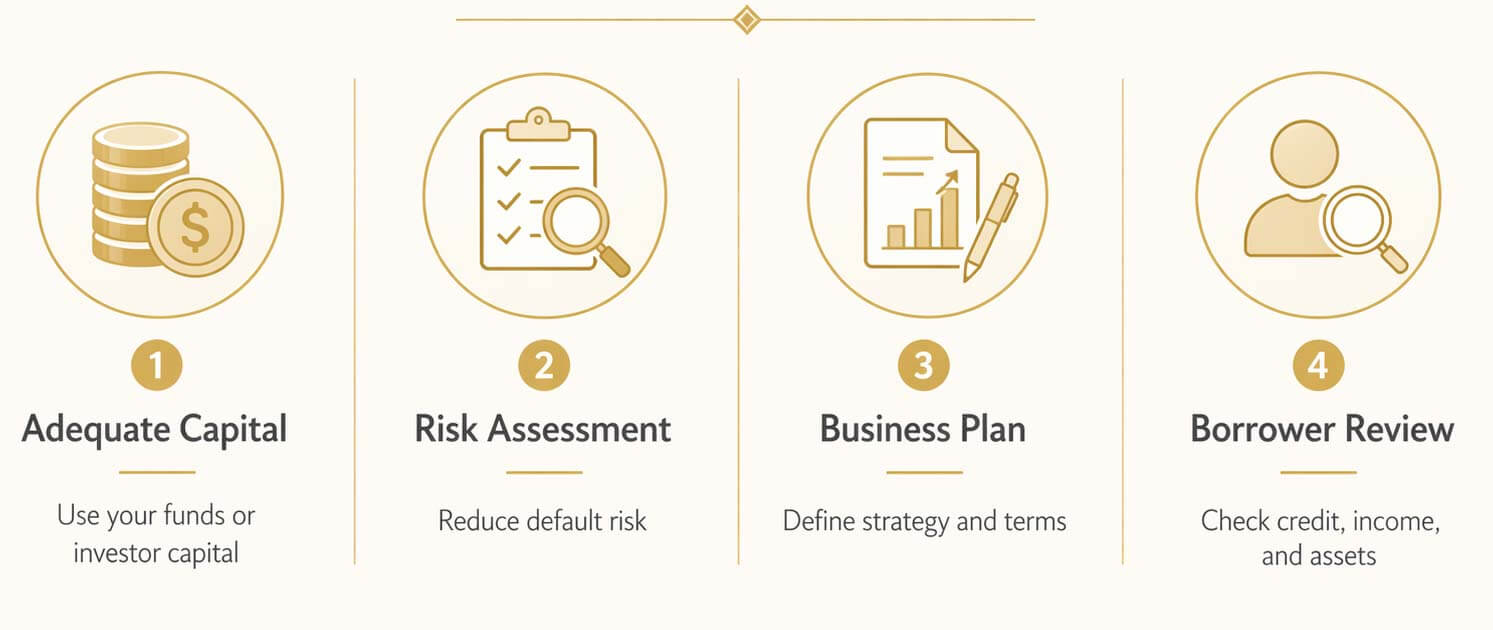
Having sufficient financial resources is essential. Whether using your funds or acquiring capital from investors or financial institutions, adequate capital is necessary to lend to borrowers.
Conducting thorough risk assessments of potential borrowers is also critical to minimize the risk of defaults.
A well-thought-out business plan is another vital component. This plan should outline your lending strategies, target market, risk management policies, interest rates, and repayment terms. This involves assessing creditworthiness, conducting background checks, verifying income and assets, and evaluating credit history.
State Compliance and Private Investing Rules: An Overview
Legal documentation plays a significant role in the lending process. You’ll need to prepare legally binding documents such as loan agreements, promissory notes, and disclosure statements that clearly outline the terms and conditions of the loan, including interest rates, repayment schedules, and consequences of default.
Regulatory Considerations for Private Money Lending
Compliance with relevant laws and regulations is non-negotiable. This includes adherence to lending practices, consumer protection laws, fair lending practices, privacy regulations, and debt collection laws. It is very important to provide excellent customer service and clear communication to borrowers regarding their obligations, rights, and options in case of financial difficulties.
The Risk Advantages of First Position Lien Lending
Implementing robust risk management practices, such as diversifying your loan portfolio, setting appropriate loan limits, monitoring borrower performance, and having contingency plans for handling delinquencies and defaults, is essential for long-term success as a money lender. Upholding ethical conduct, transparency, and integrity in all lending activities is paramount, along with staying informed about market trends, regulatory changes, and industry developments to adapt lending practices accordingly and mitigate risks effectively.
First Step On How To Become A Private Money Lender Is To Make Sure To Have Finances In Order
Before you can begin to take on external interest-only income investments you really need to be sure you have enough room to make this type of investment. As much as this is a rewarding investment tool to get into, it does have its risks. In doing your own due diligence at home first, you have the greatest opportunity to maximize your investment.
Next, Make Sure You Have The Right Financial Tool To Make It Work
There are a lot of ways you can make investments and professionals that are more than willing to take control of your money and put it to good use.
That said if where the money is stored, withdrawn, and deposited to or from is not “protected, you stand to lose as much as you gain; in some cases, even more.
The best start on How To Become A Private Money Lender is to find out what financial tool is best to store your hard-earned money. It may make sense to use a Money Market Account. Or as is the case with many of our investors, a self-directed IRA is best. Whatever your choice you will want the right professional to help guide you through that process.
Now Find Your Risk Tolerance
This is one of those things where you sit down and write out a list of investments that you can think of in the private money lending realm and place a checkmark next to the ones that you actually feel good about.
If you’re not sure who to talk to about those things we have a few pros we can send you to that are licensed and vetted by Gustan Cho Associates.
Let’s say you look t Single Family Residences, and you think it is a good idea. You then place a check next to it. That means when someone brings you a deal like that, you will take the time to go through it, investigate it to your best ability, or through your broker’s intel gathering. Then you make a decision based on what facts have been gathered and how much risk you are willing to take.
How To Become A Private Money Lender Is To Make Your Choice And Get To It
Now that you’ve figured out what you’re willing to risk, what you’re going to use to store and invest money with, and what you’re willing to invest in, (homes, buildings, etc.) you can begin to look at opportunities that can earn you a greater return.
Making sure that you have the right investment in your portfolio isn’t rocket science if you have the right “team” in place.
Gustan Cho Associates Mortgage Group has the experience and the know-how to vet and create the right opportunity for both borrowers and investors to earn the best income on both sides of the equation. If you’d like to learn how you can do more with your investments or need a referral to a professional that can help you find the right tool for investing, give us a call at Gustan Cho Associates at 800-900-8569 or text us for a faster response. Or email us at alex@gustancho.com.
Risks And Rewards In Of Private Money Lending
It’s the Most Passive Form of Real Estate Investment Available:
- One of the greatest benefits of becoming a private lender is private money lending is the most passive form of real estate investment
- The private money investor does not have to purchase a property, do any work to the property, does not have to collect rents, perform evictions, do maintenance, pull building repairs, or other tasks of being a landlord
- The investor will just lend to the real estate investor who will perform all of the tasks above
Average private money lenders can make north of 10.5% annually.
Partner with Real Estate Investors as a Private Lender
Put your capital to work in real estate deals. Short terms, high returns, and asset-backed loans.Knowing Where Your Money Is Invested
As a private money lender, you will know exactly where your money is invested. Unlike the stock market where you have no control, you have control over your investments. Gustan Cho, the National Managing Director at Gustan Cho Associates and veteran real estate investor and private money lender says the following:
When you opt to invest in private money lending for real estate, you have the peace of mind of knowing that your investment is secured with real property.
There’s an actual asset that backs up your money. As such, there’s very little chance that a real estate developer could default on the investment making your investment very secure, with extremely low-risk.
Becoming a Private Money Lender: Essential Steps
There are substantial gains to be made by being a private money lender for real estate investments, and we’d love to talk with you about the possibilities. With just a minimum $50,000 investment, you could be looking at an annual interest return of 10.5% over a 24-month period, with up to 21% IRR. It’s 100% passive income, with one of the highest cash flows, extremely safe, and backed by real property. What could be better than that?
How Do Private Lenders Make Money?
Private lenders generate income through various avenues associated with the loans they provide. One of the primary sources of revenue is the interest charged on the principal amount lent to borrowers. This interest rate, determined based on factors like the borrower’s creditworthiness and prevailing market rates, contributes significantly to the lender’s income.
Money Lending Philosophy: A Balanced Approach
Private lenders often charge loan origination fees, which are one-time charges borrowers pay for processing and underwriting the loan. These fees, typically a percentage of the loan amount, add to the lender’s earnings. Some private lenders also levy points, upfront fees calculated as a percentage of the loan amount, which further contributes to their income.
Instead of Lending: Passive Income
Late fees imposed on borrowers for missed payments and prepayment penalties for early loan repayment are additional sources of revenue for private lenders, albeit smaller than interest and origination fees.
Furthermore, if private lenders service the loans they originate, they may earn income through loan servicing fees, covering administrative tasks like payment processing and borrower communication. Private lenders diversify their income streams through interest, fees, penalties, and servicing charges associated with the loans they extend.
What is the ROI of Private Lending?
The return on investment (ROI) in private lending is subject to a range of factors that collectively influence the profitability of these ventures. Central to this is the interest rate structure employed by private lenders, as higher rates generally correlate with increased ROI potential, albeit often accompanied by heightened default risk.
Understanding Lending: Note vs. Mortgage
The nature of loans—real estate, business, or consumer-focused—also plays an important role, with real estate loans typically offering stronger ROI due to longer terms and collateral provisions.
Managing risk, particularly default rates, is a major factor, as lower default rates translate to improved ROI prospects.
The terms of loans, including their duration, impact the stability and overall ROI potential, with longer terms offering steadier returns but potentially lower annualized rates than short-term loans. Operational costs, encompassing origination fees, servicing expenses, and general overhead, are critical considerations, as efficient management of these costs directly affects the net ROI.
Costs, Fees, and Rates of Private Lending
External factors such as market conditions, interest rate fluctuations, and the broader demand for loans further influence the ROI landscape, necessitating adaptability and strategic decision-making to optimize returns.
Diversification strategies, spreading investments across diverse loan types, borrower profiles, and industries, are also instrumental in mitigating risk and enhancing overall ROI in private lending endeavors.
For more information about this article and/or other mortgage-related topics on hard money loans, please email us at gcho@gustancho.com. If you need to qualify for FHA loans with a lender with no overlays on government or conforming loans, please contact us at Gustan Cho Associates at 800-900-8569. Text us for a faster response. The team at Gustan Cho Associates is available 7 days a week, on evenings, weekends, and holidays.
FAQ: How To Become A Private Money Lender For Real Estate Investors
What Constitutes A Good Opportunity To Lend As A Private Money Lender For Real Estate Investors?
A good lending opportunity for private money lenders involves conducting thorough due diligence on borrowers, assessing their creditworthiness and financial stability, scrutinizing loan terms, including interest rates and collateral, diversifying investments, and staying informed about market conditions.
Is Private Lending A Good Investment?
Private lending can be a promising investment opportunity for those seeking higher returns, but it also comes with elevated risks. Investors must carefully evaluate risk-return trade-offs, diversification strategies, due diligence on borrowers, and market conditions to determine if private lending aligns with their investment goals and risk tolerance.
What Do You Need To Be A Money Lender For Real Estate Investors?
To become a money lender for real estate investors, you need to understand and comply with legal requirements, have sufficient financial resources, develop a business plan outlining lending strategies and risk management policies, conduct thorough risk assessments on borrowers, prepare legal documentation, ensure compliance with laws and regulations, and implement robust risk management practices.
How Do Private Lenders Make Money?
Private lenders make money through various avenues including interest charged on loans, loan origination fees, points, late fees, prepayment penalties, loan servicing fees, and other charges associated with lending activities.
What Is The ROI Of Private Lending For Real Estate Investors?
The return on investment (ROI) of private lending for real estate investors depends on factors such as interest rates, loan types, risk management strategies, loan terms, operational costs, market conditions, and diversification. Optimizing ROI involves balancing risks and returns, conducting thorough due diligence, and adapting strategies to market dynamics.
This blog about How To Become A Private Money Lender For Real Estate Investors was updated on April 21, 2026.