FHA Title I Loans: The Ultimate Guide for 2026 Home Improvement Projects
Are you a homeowner looking to make improvements to your property but need help finding the right financing? Maybe you’ve just bought your first home and want to make some upgrades but don’t have a ton of equity built up yet. If that sounds like you, FHA Title I Loans could be the perfect solution.
This guide covers FHA Title I Loans for 2026, including eligibility requirements, lender overlays, loan purposes, and a comparison with FHA 203(k) loans.
FHA Title I Loans, provided by the Federal Housing Administration (FHA) and managed by HUD (U.S. Department of Housing and Urban Development), are meant to assist homeowners in making small but significant home improvements. This guide will break down everything you need to know about FHA Title I Loans, how they work, and how to use them to enhance your home.
What Are FHA Title I Loans?
FHA Title I Loans, or Title I Property Improvement Loans, are government-backed loans specifically for home improvements.
Unlike traditional home equity loans, which require significant equity in your home, FHA Title I Loans are more accessible to homeowners with limited equity.
You don’t need to have a lot of money invested in your home to qualify. These loans are ideal for minor but essential improvements, like fixing your roof, updating your plumbing, or installing solar panels. They are not meant for luxury renovations like adding a pool or building a fancy outdoor kitchen.
2026 Guide to FHA Title I Loans
Understanding FHA Title I Loans
FHA Title I Loans are provided by private lenders in partnership with the federal government, with losses insured by the Federal Housing Administration (FHA). Commonly called “HUD” financing, these loans fall into two main categories. Title I Property Improvement Loans fund repairs, renovations, or modifications to enhance a home’s function.
Title I Manufactured Home Loans finance the purchase or refinance of a manufactured home, lot, or both.
The most common application of FHA Title I Loans is the FHA Title I Property Improvement Loan. According to HUD, this program finances both minor and major modifications, renovations, repairs, and site improvements for single-family homes. It can also be used for improvements or conversions of multi-family structures, rehabilitation of historic residential buildings, and fire safety upgrades in health care facilities.
How FHA Title I Property Improvement Loans Work
FHA Title I Property Improvement Loans are intended only for improving an existing home. They are not used to buy a new home or to combine a purchase with renovation funds in a single mortgage. HUD explains these loans are made by private lenders, have a fixed interest rate, and have no prepayment penalty.
Potential Uses for FHA Title I Loans
Title I loans, or a combination of them, exceeding $7,500 must be secured by collateral. Additionally, the borrower must have occupied the structure, including manufactured homes, for at least 90 days before applying.
Although Title I loans are sometimes confused with purchase and renovation loans, they are designed specifically for existing homes needing renovations, repairs, or improvements.
HUD’s consumer guide notes these loans can cover labor, contractor fees, and materials, including do-it-yourself projects. HUD recommends monitoring costs, comparing contractor quotes, and reviewing documents carefully to prevent fraud.
FHA Title I Loans Fund Property Improvements
Flexibility is a primary advantage of FHA Title I Loans. The flexibility is a key advantage of FHA Title I Loans. They can finance improvements that enhance safety, functionality, or basic utility. According to HUD, all project sizes are eligible.
Structural changes to manufactured homes are considered real estate improvements, not personal property modifications. or livability are eligible.
FHA Title I loans are for essential property improvements, not cosmetic changes. Lenders assess whether proposed improvements meet both HUD and their own requirements, which can lead to different decisions on similar loan requests. HUD sets the primary guidelines, but lenders determine how to apply them and whether to offer the loan.
Why Consider FHA Title I Loans?
Thinking about FHA Title I Loans? Here’s the lowdown in everyday talk. Consider looking into these loans, whether you’re fixing up your place for the first time or you’ve been in the game for a while.
Why Are They Worth A Peek?
Easy Approval:
- Getting approved is a breeze.
- You don’t need to have your house almost paid off or a spotless credit report to get in on this.
Fixed Rates:
- The numbers don’t jump around. FHA Title I Loans have one interest rate, so you won’t be surprised by how much you’re paying each month.
Flexible Use:
- Spend it on what you need.
- Whether it’s a big project or a small upgrade, these loans can cover many things to improve your home.
Government-Backed Security:
- It’s got a safety net. The government stands behind these loans, making banks more likely to lend you the cash, even if your credit’s seen better days.
How FHA Title I Loans Work
FHA Title I Loans are straightforward, but understanding the details can help maximize their benefits. Here’s how they work:
Secured vs. Unsecured Loans
FHA Title I Loans can be either secured or unsecured. The difference depends on the loan amount:
Unsecured Loans:
- If you borrow up to $7,500, you don’t need to purchase your home as collateral.
- This makes the loan less risky, though interest rates may be slightly higher.
Secured Loans:
- For loans over $7,500, your home will be used as collateral.
- Better interest rates are usually offered with these loans.
- Still, there is a risk of foreclosure if you fail to make payments.
Loan Limits and Terms
- FHA Title I Loans can be a real lifesaver when making improvements around your house.
Here’s What You Need To Know In Plain Language:
Single-Family Homes:
- If you’ve got a single-family home, you can borrow up to $25,000.
- That’s usually enough for those smaller fix-ups you’ve been thinking about.
Two-to-Four-Unit Homes:
- Do you own a place with two to four units?
- You can get up to $12,000 for each unit, with a cap of $60,000.
- So, if you want to spruce up each apartment, this could be your chance.
- The payback time can vary.
- You could have between 12 and 20 years to pay off the loan.
- It comes down to how much you borrow and what kind of property you have.
Keep in mind that this isn’t for big overhauls. FHA Title I Loans are perfect for smaller projects that make your place better. Basically, if you’re looking to make minor upgrades or repairs and need some extra cash, an FHA Title I Loan might be the answer.
2026 Updates for FHA Title I Loans
For 2026, FHA Title I Loans remain a solid option for homeowners, but there are a few key updates and reminders to keep in mind:
Increased Loan Limits:
- While the maximum loan amounts haven’t changed, some lenders may offer additional incentives or bundled services to make these loans more attractive.
Green Energy Improvements:
- With the ongoing emphasis on green energy, projects like solar panel installations are now more popular than ever.
- FHA Title I Loans are perfect for financing these upgrades.
Digital Application Process:
- An increasing number of lenders are now offering online applications, simplifying the process of applying for an FHA Title I Loan.
Why Do Lenders Change The Requirements Of The FHA Title I Loans
The main reason for differences is lender overlays. HUD sets the basic rules for Title I, but lenders add their own policies. Since lenders make their own credit decisions, one lender may approve a loan while another does not, even within the same FHA program.
FHA Title I Property Improvement Loans Explained
Differences can include credit, paperwork, property, contractor, or reserve requirements. They mean the same thing when they say “FHA approved,” which is why a loan can be approved with one lender and rejected with another. Some lenders will add additional internal requirements to reduce risk, narrow their borrower profile, or simplify underwriting. Others will not offer FHA Title I Property Improvement Loans, even if the loan options are used.
Impact of Lender Overlays on FHA Title I Loans
Understanding lenders is often as important as knowing FHA Title I guidelines. Lender choice matters because not all offer the same program access. HUD provides a tool to help find approved Title I lenders.
A commonly missed rule is the security threshold: any loan or combined Title I balances over $7,500 must be secured by the property.
This changes the transaction structure. Higher-value loans require more collateral and documentation, while lower-value loans are less complex.
Looking to Renovate Your Home? Learn About FHA Title I Loans for Home Improvement!
Contact us today to see how you can qualify for a Title I loan and make your home more comfortable.FHA Title I Loans: Lender Criteria Explained
Borrowers should know that Title I is not an open-ended loan. There are rules about allowed work and property requirements. Lenders must approve all aspects.
Lenders may impose additional requirements beyond Title I regulations, which can lead to loan denial or more documentation.
The property must have been occupied for at least 90 days before applying. This is an important point for 2026 because Title I is generally for existing properties, not for new, unoccupied structures.
FHA Title I Loans and Manufactured Housing
The same applies to Title I-financed manufactured homes, regarding occupancy. Per HUD, borrowers must have plans to occupy the manufactured home as their principal residence. This makes Title I manufactured home financing more of an owner-occupant product than an investor product.
Eligibility Requirements for FHA Title I Loans
To Qualify For FHA Title ! Loans, You Need To Meet Home Basic Requirements:
Creditworthiness:
- You don’t need a perfect credit score, but you do need to demonstrate that you can repay the loan.
- Most lenders look for a credit score of at least 620.
Income:
- You must demonstrate that your earnings are steady and enough to meet the loan repayments.
Property Type:
- Loans are available for single-family homes and multi-family properties (up to four units).
Use of Funds:
- The loan must be used for specific improvements that enhance your home’s safety, security, and livability.
What Can You Use FHA Title I Loans For?
FHA Title I Loans are versatile but are not for every kind of home improvement. Here’s a closer look at what you can and cannot do with these funds:
Approved Uses:
- Solar Panels: Solar panels can lower your utility costs and boost the value of your home, making FHA Title I Loans a common choice for this purpose.
- Roof Repairs: Fixing a leaky roof is essential for maintaining the integrity of your home.
- HVAC Upgrades: Installing a new heating, ventilation, or air conditioning system improves energy efficiency and comfort.
- Plumbing and Electrical: Modernizing these systems ensures your home is safe and up to code.
- Accessibility Improvements: Make your home more accessible with ramps, wider doorways, or other modifications.
Non-Approved Uses:
- Luxury Upgrades: No outdoor kitchens, swimming pools, or fancy landscaping.
- Cosmetic Changes: You can’t use these funds for painting or redecorating unless it’s part of a larger, necessary improvement.
Differences between FHA Title I Loans and FHA 203(k) Loans
Many people mistakenly think that FHA Title I Loans and FHA 203(k) Loans are the same, but they are not. HUD describes the 203(k) program as an FHA-insured mortgage that consolidates the purchase or refinancing of a home and all costs associated with remodeling, managed through an escrow account disbursed at certain milestones throughout the renovation.
FHA Title I Loans and Property Improvements
HUD also indicates that for borrowers who do not need to purchase or refinance a property but do need renovation funding, the Title I Property Improvement Loan Program may be a better option. This distinction significantly affects both borrower decisions and search intent. If you already own your home and require financing for improvements, an FHA Title I Loan is typically the most suitable option.
When to Choose an FHA 203(k) Loan
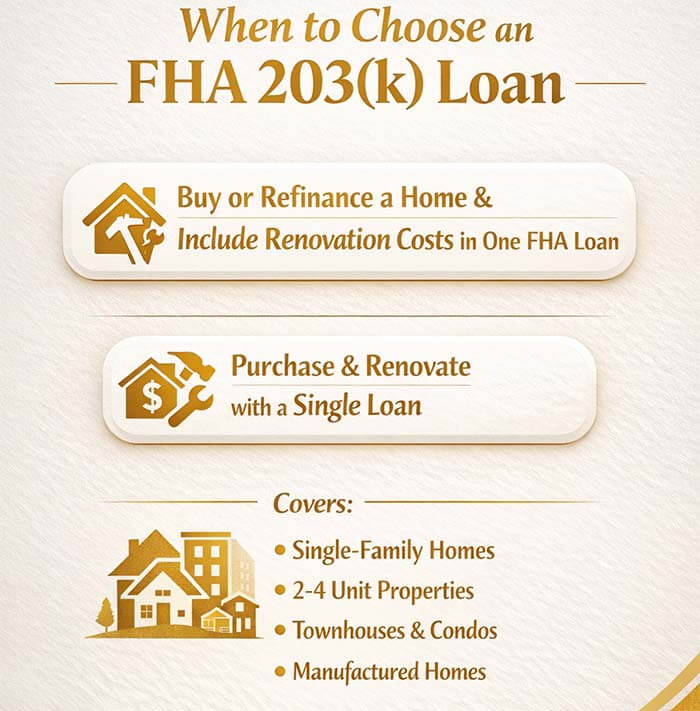 Conversely, if you need to purchase or refinance a home and wish to include renovation costs in a single FHA mortgage, the FHA 203(k) program is generally preferable.
Title I focuses on property improvements, while the 203(k) program combines purchase or refinancing with rehabilitation funding.
HUD indicates that the 203(k) program covers single-family and certain two-to-four-unit structures, townhouses, condos eligible for interior-only renovations, and some manufactured homes affixed to real estate and not structurally altered.
Comparative Analysis: FHA Title I Loans and FHA 203(k) Loans
On the other hand, borrowers who already own the residence and only need funding to make modifications may be better suited to the secondary market, specifically the FHA Title I program. This clarification helps potential borrowers avoid wasting time because many individuals begin their search for the wrong FHA rehabilitative program. Grasping the distinction early on helps determine which lender to apply to and manage expectations.
How to Apply for an FHA Title I Loan
Applying for an FHA Title I Loan is a simple process, especially now that many lenders offer online applications. Here’s what you need to do:
Find an FHA-Approved Lender:
- Not all lenders offer FHA Title I Loans, so you’ll need to find one that does.
- Gustan Cho Associates, for example, specializes in these loans.
Prepare Your Documentation:
- Gather your financial documents, including income statements, credit reports, and details about the home improvement project.
Submit Your Application:
- Complete the application with your chosen lender.
- They will evaluate your creditworthiness and determine the loan amount and terms.
Receive Funds:
- Once your request is approved, you will get the funds as a single lump sum or in multiple installments, depending on the specific project.
Pros and Cons of FHA Title I Loans
Like any financial product, FHA Title I Loans come with their own set of pros and cons. Here’s a quick overview:
Pros:
- No Equity Required: You can get a loan even if you have little equity in your home.
- Fixed Rates: No surprises with variable rates—your payments remain stable.
- Wide Range of Uses: Perfect for essential improvements like roof repairs, solar panels, and more.
- Government-Backed: Because the FHA insures these loans, they’re easier to qualify for.
Cons:
- Loan Limits: The loan amounts are capped, making them unsuitable for major renovations.
- Interest Rates: The interest rates on unsecured loans might be higher than those on traditional home equity loans.
- Limited Lenders: Not all lenders offer FHA Title I Loans, so your choices may be limited.
Want to Renovate Your Home? FHA Title I Loans Make It Easy to Finance Home Improvements!
Contact us today to find out how you can secure a loan to enhance your living space.Alternatives to FHA Title I Loans
While FHA Title I Loans are a great option for many homeowners, they may not be the best fit for everyone. Here are a few alternatives:
Home Equity Loans:
- A home equity loan might offer lower interest rates if you have significant equity.
Personal Loans:
- A personal loan could be quicker and easier to obtain for smaller projects.
Cash-Out Refinance:
- If you want to tap into the equity of your home for larger projects, a cash-out refinance could provide more funds.
Final Thoughts: Is an FHA Title I Loan Right for You?
If you’re a homeowner or a first-time buyer looking to make necessary improvements to your property, an FHA Title I Loan could be the perfect solution. These loans offer flexibility, government-backed security, and the ability to finance essential projects without requiring a ton of equity.
FHA Title I Loans: What to Know for 2026
FHA Title I Loans provide a reliable and straightforward option for those looking to upgrade their homes in 2026, whether by installing solar panels, fixing a leaky roof, or updating an HVAC system.
Ready to take the next step? Contact a lender like Gustan Cho Associates to explore your options and get started on your home improvement journey.
Remember, home improvements not only make your living space more comfortable but can also increase your property’s value—making an FHA Title I Loan a smart investment in your future.
FAQs: What You Need To Know About FHA Title I Loans in 2026
Can I Use An FHA Title I Loan To Add A Pool?
No, FHA Title I Loans cannot be used for luxury items like pools or outdoor kitchens.
Do I Need A Home Inspection To Qualify?
No, a home inspection is not required for an FHA Title I Loan, but your lender may request one to ensure necessary improvements.
Can I Combine An FHA Title I Loan With Another Loan?
Yes, you can combine it with a traditional mortgage or other types of financing, but make sure to discuss this with your lender.
How Long Does It Take To Get Approved?
The approval time varies by lender and typically spans a few weeks. However, if you collaborate with a seasoned lender, the process could be expedited.
Can I Use An FHA Title I Loan For Rental Properties?
Yes, as long as the property has up to four units and you meet the other eligibility requirements.
Can I Use An FHA Title I Loan To Make My Home More Energy-Efficient?
Yes, FHA Title I Loans are perfect for energy-efficient upgrades, such as installing solar panels, new windows, or energy-efficient HVAC systems. These improvements can reduce utility bills and increase your home’s value.
What Happens If I Sell My Home Before I Repay The FHA Title I Loan?
If your FHA Title I Loan is unsecured, you can sell your home immediately without paying off the loan. However, if the loan is secured by your home (loans over $7,500), you must pay it off at closing as part of the property sale.
Are There Any Fees Associated With FHA Title I Loans?
Yes, like most loans, FHA Title I Loans may have fees, such as application fees, closing costs, or loan origination fees. Before applying, it’s important to ask your lender for a detailed breakdown of these fees, as they can vary depending on the lender.
Can I Refinance My FHA Title I Loan Later?
Yes, refinancing is possible, but it depends on the lender’s terms and your current financial situation. If interest rates drop or your financial situation improves, refinancing could help lower your monthly payments.
Is There A Prepayment Penalty For Paying Off My FHA Title I Loan Early?
FHA Title I Loans do not have prepayment penalties. You can settle your loan ahead of time without incurring additional fees, potentially saving you money on interest in the long run.
Is An FHA Title I Loan The Same As An FHA 203(k) Loan?
No. HUD describes the 203(k) as a mortgage that combines purchase or refinance financing with rehabilitation funds. HUD specifically notes that borrowers who need rehabilitation financing without buying or refinancing the property may want to consider the Title I Property Improvement Loan Program instead.
Do FHA Title I Loans Have Fixed Rates?
HUD states that Title I Property Improvement Loans have fixed interest rates, generally based on the most common market rate in the area and negotiated between the lender and borrower. HUD also states there is no prepayment penalty.
If you have any questions about FHA Title I Loans, please contact us at 800-900-8569. Text us for a faster response. Or email us at alex@gustancho.com. The team at Gustan Cho Associates is available 7 days a week, on evenings, weekends, and holidays. This blog about What You Need To Know About FHA Title I Loans in 2026 was updated on August 23rd, 2026.