Credit card balance impacts credit scores mainly through revolving utilization, which compares reported balances with available credit limits. High utilization on a single card or across all cards may lower your scores, even when every payment is made on time. Paying down balances may help after creditors report the updated amounts. This differs from mortgage DTI, which generally uses required monthly payments instead of utilization percentages.
Why Credit Card Balances Affect Scores More Than Loan Balances
Credit card balances usually affect credit scores more than balances on auto, student, or personal loans. Credit cards are revolving accounts, which means borrowers can repeatedly charge purchases, repay the balance, and borrow again. Credit scoring models compare each reported balance with the card’s credit limit. This percentage is known as credit utilization.
For example, a credit card with a reported balance of $1,800 and a $2,000 limit has a 90% utilization ratio. Even if every payment has been made on time, using most of the available credit can lower the borrower’s score. Scoring models may review utilization on each card and across all revolving accounts.
Installment loans work differently. These loans begin with a fixed amount and are repaid through scheduled monthly payments. A borrower is expected to owe a large percentage of the loan balance shortly after opening the account. Because the balance normally falls over time, it does not create the same revolving-utilization concern as a nearly maxed-out credit card. Payment history remains important for both types of accounts.
Late payments on either a credit card or an installment loan can damage credit. However, when all payments are current, revolving utilization is often the reason a credit balance impacts credit scores more quickly. Paying down highly utilized cards may help after the creditors report the lower balances, although the amount of any score change cannot be guaranteed.
How Credit Utilization Is Calculated
Credit utilization measures how much of your available revolving credit is being used. To calculate it, divide the reported credit card balance by the credit limit and multiply the result by 100. For example, a credit card with a $2,000 reported balance and a $10,000 credit limit has a 20% utilization ratio: $2,000 ÷ $10,000 = 20% Credit scoring models may review utilization in two ways. Individual utilization measures the balance on each card compared with that card’s limit. Overall utilization combines the reported balances and limits across all revolving accounts. Suppose you have two credit cards:
- Card one has a $1,500 balance and a $5,000 limit.
- Card two has a $500 balance and a $5,000 limit.
Your combined balance is $2,000, and your combined credit limit is $10,000. Therefore, your overall utilization is 20%. However, the first card has 30% individual utilization, while the second has 10%. A highly utilized individual card may affect your score even when your overall utilization appears reasonable. Credit bureaus typically calculate utilization based on the balances creditors report, not necessarily the balances shown in your online accounts today. This reporting difference helps explain how credit balance impacts credit scores. Paying down a card may not affect your score until the creditor reports the updated balance.
Credit Utilization Versus Mortgage DTI
Credit utilization and mortgage DTI measure different things. Credit utilization compares reported revolving balances with available credit limits and can affect credit scores. Mortgage DTI compares required monthly debt payments with gross monthly income.
Paying down a credit card may lower utilization and reduce the required payment, but the results do not always happen together. A higher credit limit can lower utilization when the balance stays the same, but it normally does not reduce DTI because the required payment has not changed.
Learn more about how credit card balance affects debt-to-income ratio and how lenders determine the qualifying payment.
Don’t Pay Down the Wrong Accounts Before Closing
Paying down credit cards can help, but timing, statement dates, available cash, and underwriting documentation matter. Get guidance before moving money around.Overall Versus Individual Credit Card Utilization
Credit scoring models can analyze an applicant’s overall and individual credit card utilization. Overall utilization compares the total credit extended and the total credit reported across all revolving accounts. Individual utilization assesses the balance compared to the credit limit for that individual account. Let’s say you have four credit cards with a total credit limit of $20,000 and total balances reported of $4,000.
This yields an overall utilization of 20%. But if one of the cards has a balance of $1,900 with a limit of $2,000, that individual account is 95% utilized. A personal account can negatively impact your credit score, even when your total credit utilization remains low. This explains why carrying a credit balance on one card is riskier to your credit score than carrying the same balance across multiple cards. People getting ready to apply for a mortgage should also calculate both forms of utilization.
If you have a lot of credit card debt, focus on paying off the cards nearing their utilization limits instead of making small payments across multiple cards. This is because the credit scoring model takes your overall credit report into consideration.
Current Balance Versus Reported Balance
Your current balance is the amount shown in your credit card account today. It can change whenever you make a purchase, receive a credit, or submit a payment. Your reported balance is the amount the credit card company most recently sent to Equifax, Experian, and TransUnion. That is generally the balance used to calculate credit utilization and credit scores.
For example, if your credit report displays a $3,000 balance on a card with a $5,000 limit. You then make a $2,500 payment, reducing the current balance to $500. Your credit report may continue showing $3,000 until the creditor submits its next update. During that period, the scoring model could still calculate utilization using the older 60% ratio instead of the new 10% ratio.
Many credit card companies report around the end of the billing cycle, but reporting schedules vary. The statement closing date is also different from the payment due date. Paying by the due date can help you avoid a late payment, while paying before the balance is reported may help a lower amount appear on your credit reports. This reporting delay helps explain how a credit balance impacts credit scores even after a borrower has paid down debt.
Before applying for a mortgage, review all three credit reports and allow enough time for creditors to report the updated balances. A lower current balance will not affect the score until the new information is reported to the credit bureaus.
When Credit Card Companies Report Balances
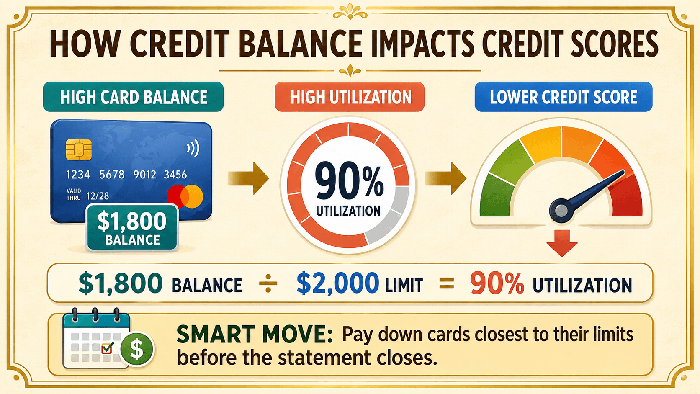
Most credit card companies report your account information to credit bureaus about once a month. Many report this information shortly after your statement closing date, but each creditor has its own schedule. The date they report does not always match your payment due date, and the three credit bureaus may not update their records at the same time.
This timing is important when you’re preparing for a mortgage. If you make a large payment after the creditor has already reported for the month, your credit report might still show the old balance until the next month’s update. Your credit scores may reflect a higher utilization, even if your online account shows a lower balance. To ensure a lower balance is reported, try to make your payment a few days before the statement closing date. You can check your billing statement or contact your credit card company to find out when they typically close your account and when they send information to the credit bureaus.
Remember to keep making at least the minimum payment by the due date. Understanding this reporting schedule can help you see how your credit balance affects your scores from month to month. If you plan to apply for a mortgage, review your balances early and allow time for updates to show on your credit reports. Paying down a card won’t automatically increase your score right away.
Why Mortgage Credit Scores May Differ From Scores You See Online
The credit score shown by a bank, credit card company, or monitoring service may not match the score obtained by a mortgage lender. Borrowers do not have one universal credit score.
A score can differ based on the scoring model, the credit bureau providing the information, and the date the score was calculated. Reported balances may also vary because creditors do not always update all three bureaus simultaneously. The Consumer Financial Protection Bureau confirms that scores can differ by model, data source, loan type, and calculation date.
Mortgage credit-score requirements are also evolving. The Federal Housing Finance Agency is updating the models permitted for mortgages sold to Fannie Mae and Freddie Mac. During this transition, the scoring model used may depend on the lender, loan program, and current requirements.
For that reason, do not assume the score you see online will be the qualifying score used for your mortgage.
What Is a Good Credit Utilization Ratio?
There is no single credit utilization percentage that guarantees a good credit score. Many borrowers have heard that utilization must remain below 30%, but 30% is not a firm scoring cutoff. A reported balance may affect a score on either side of that number.
Credit scoring models may review both the utilization on each card and the combined utilization across all revolving accounts. A card close to its limit may raise concerns even when overall utilization appears reasonable.
Lower utilization is generally better, but no percentage guarantees a specific increase in score. The effect depends on the borrower’s complete credit report and the scoring model being used. Borrowers also do not need to carry debt or pay interest to build credit.
Which Credit Card Balances Should You Pay Down First?
If your goal is to improve your credit before applying for a mortgage, begin by paying down credit cards that are maxed out, over their limits, or close to their limits. Credit scoring models may evaluate the utilization of each card in addition to your overall utilization. Reducing a heavily used account can therefore be more helpful than dividing the same payment equally among all cards.
For example, suppose one card has a $1,900 balance and a $2,000 limit, while another has a $4,000 balance and a $10,000 limit. The first card is 95% utilized, and the second is 40% utilized. Paying down the first card may address the more serious individual-utilization problem, even though its dollar balance is smaller. A practical order is to:
- Bring over-limit and maxed-out cards below their limits.
- Pay down cards with the highest individual utilization.
- Continue lowering overall revolving utilization.
- Make every required payment on time.
- Avoid adding new balances after paying down the cards.
The best strategy for improving a score may differ from the best strategy for reducing interest costs. Paying the highest-interest card first can save more money, while paying the most-used card first may better address how credit balances affect credit scores. Before using a large amount of cash to pay down cards, speak with your mortgage loan officer. You may still need money for the down payment, closing costs, and required reserves. No paydown strategy can guarantee a specific increase in score because every credit profile is different.
Can Paying Down Balances Raise Your Score Quickly?
Paying down credit card balances may raise your credit score once the lower balances are reported to the credit bureaus. The change can sometimes appear during the creditor’s next monthly reporting cycle. However, making a payment does not normally update your credit reports or scores immediately. The potential improvement depends on several factors, including:
- How high the utilization was before the payment
- How much of the balance was paid down
- Whether one or several cards were highly utilized
- The borrower’s payment history and other credit information
- When the creditor reports the new balance
- The credit scoring model being used
A borrower who reduces a nearly maxed-out card may experience a more noticeable change than someone whose utilization was already low. This is one reason credit balance impacts credit scores differently for each person. No lender, credit company, or loan officer can guarantee a specific number of points. If a mortgage application is already in progress, the lender may request a rapid rescore upon receiving acceptable proof of the lower balance.
A rapid rescore does not erase accurate negative information or guarantee a higher score. It only asks the credit bureaus to update verified account information sooner than the normal reporting process. Before paying down large balances, ask your loan officer which accounts to address and how much cash must remain available for the mortgage transaction.
When to Pay Down Balances Before Applying for a Mortgage
When possible, review your credit card balances two to three months before requesting a mortgage preapproval. This gives you time to identify highly utilized accounts, make planned payments, and allow the creditors to report the lower balances. It also provides time to correct an inaccurately reported balance.
If you are paying down a card to reduce utilization, try to make the payment before the statement closing date. Many card issuers report the statement balance, although reporting schedules vary. Paying only by the due date may prevent a late payment, but may not cause the lower balance to appear during the current reporting cycle.
Do not wait until the mortgage is in underwriting to begin planning. A lender may check your credit again before closing, and new purchases can raise reported balances after the initial credit review. Keep card usage low and avoid financing furniture, appliances, vehicles, or other major purchases without first speaking with your loan officer.
Understanding how credit balance impacts credit scores can help you time payments more effectively, but do not use all your available cash to lower utilization. You may still need verified funds for the down payment, closing costs, prepaid expenses, and reserves. Before making large payments, ask your loan officer to review your credit profile. The best accounts to pay down and the amount needed will depend on your scores, available cash, loan program, and mortgage timeline. Do not close paid-down credit cards unless there is a specific reason, because closing an account can reduce your available credit and increase overall utilization.
Final Thoughts on How Credit Balance Impacts Credit Scores
Understanding how credit balance impacts credit scores can help you make better decisions before applying for a mortgage. Credit card balances matter because scoring models compare the reported balance on each revolving account with its credit limit. A card that is close to its limit may lower your score even when every payment has been made on time.
Focus first on cards with the highest individual utilization, then work on lowering your overall revolving utilization. Make payments before the statement closing date when possible, confirm when each creditor reports, and continue paying every account on time. Avoid running the balances back up after paying them down.
Lower balances may help improve your mortgage credit scores once the updated information is reported to the credit bureaus. However, the size and timing of any change depend on your complete credit profile and the scoring model being used. No specific increase in score can be guaranteed. Before using a large amount of cash to pay down debt, make sure you will still have enough money for your down payment, closing costs, prepaid expenses, and reserves.
If you’re about to buy or refinance a home, Gustan Cho Associates can assess your credit profile and identify the best balance-reduction steps for your mortgage.
Frequently Asked Questions About How Credit Balance Impacts Credit Scores
Can Increasing My Credit Limit Help My Credit Score?
A higher credit limit can reduce your utilization if your balance remains unchanged. However, the card issuer may perform a hard credit inquiry when reviewing your request, which could temporarily affect your score. Ask whether the request requires a hard inquiry before applying, especially if you plan to seek a mortgage soon.
Can a Decrease in Credit Limit Lower My Credit Score?
Yes. A lower limit can raise your utilization even when your balance has not changed. For example, a $1,000 balance represents 20% utilization with a $5,000 limit but 40% utilization with a $2,500 limit. The effect depends on the other information in your credit profile.
Will a Balance Transfer Improve My Credit Score?
A balance transfer can help or hurt, depending on how it is completed. Opening a new card may create a hard inquiry and reduce the average age of your accounts. Moving debt may change individual card utilization, but it does not eliminate the balance. The greatest benefit generally comes from using the lower interest rate to pay down the debt.
Do Authorized-User Balances Affect Credit Utilization?
An authorized-user account may affect your utilization when it appears on your credit report. A card with a high limit and low balance could help, while a nearly maxed-out account could hurt. The result also depends on the card issuer’s reporting practices and the scoring model.
Do Business Credit Card Balances Affect Personal Credit Scores?
Business card balances may affect personal credit when the issuer reports the account to consumer credit bureaus. Some issuers report regular activity, some report only serious delinquencies, and others report only to commercial bureaus. Ask the issuer about its policy before applying.
Do I Need to Carry a Credit Card Balance to Build Credit?
You don’t need to carry a balance or pay interest to build credit. Responsible card use and timely payments are key to establishing a positive credit history. While a reported balance reflects card usage, you can pay it off in full by the due date. High balances can increase credit utilization and potentially lower your credit score.
What Caused My Credit Score to Drop After Paying Off a Credit Card?
Paying off a credit card does not guarantee an immediate increase in your credit score. The creditor may not have reported the new balance yet, another account may have changed, or the score may have been calculated with a different scoring model. Your score may also change if the paid-off card was closed, the credit limit was reduced, or all revolving accounts reported zero balances. Review the updated credit reports before assuming the payoff caused the decrease. You do not need to carry debt or pay interest to earn credit-score points.
This article about “How Credit Balance Impacts Credit Scores for Mortgage Approval” was updated on September 9th, 2026.