In this guide, we will discuss and cover past due versus collection and charge off accounts when qualifying and getting pre-approved for a mortgage loan. FHA loans are the most popular mortgage loan programs today for first-time home buyers.
Learn how considering past due accounts, collection accounts, and charge-off accounts can affect your FHA, VA, USDA, and Conventional mortgages. Learn what you can do prior to applying.
Credit reports list several forms of unpaid debt. Past-due, collection, and charge-off accounts all reflect unpaid debts, but they do not function the same way. Understanding the differences helps applicants avoid improper payments and reduce the risk of detrimental impacts on their debt-to-income ratios and suspicious underwriting conditions.
What is the Difference Between Charge-Off and Collections?

Charge-off and collections are distinct stages in the process of handling overdue debts. If a creditor determines that a debt is unlikely to be repaid, it will be charged off. This means the debt will be removed from the books as an accounts receivable. The borrower remains responsible for the debt, negatively impacting their credit report and score. Conversely, collections involve efforts to recover delinquent debts through internal means or third-party agencies. This may include phone calls, letters, or legal action. One collection account might not prevent mortgage approval.
Mortgage Guidelines on charge-off and collections depend on the mortgage loan program, property type, debt age, reasons for the lapse, and recent payment history.
A past-due account or a recent late payment would be viewed more seriously. Resolving debt in collections can update the borrower’s account status. The repercussions of a charge-off can linger on their credit report. Unresolved debts can lead to further consequences, such as wage garnishment. Overall, charge-off signifies the creditor’s acknowledgment of an uncollectible debt, while collections represent ongoing attempts to recoup the outstanding amount. Both stages have significant implications for the borrower’s financial standing and creditworthiness.
What is the Difference Between a Past Due Account, a Collection Account, and a Charge-Off?
Past Due Accounts
Past due accounts remain open with the original creditor, but the payment becomes past due. It can be recorded as due in increments of 30, 60, or 90 days.
During mortgage underwriting, accounts that are currently past due are more serious than older unpaid collection accounts because they illustrate that the prospective borrower now has a serious payment issue.
For conventional loans that are processed through Fannie Mae’s Desktop Underwriter, any non-mortgage accounts that show as past due (not in collections) have to be made current prior to closing.
Collection Accounts
Collection accounts indicate that the original creditor has either sent the unpaid debt to a collection agency or sold it. Collections may come from a variety of sources, from an old credit card or a medical or utility bill to a personal loan or even an unpaid balance for an apartment. Just because a borrower has a collection does not mean they will be automatically disqualified from receiving a mortgage. Underwriters will consider the borrower’s credit history after the collection, the type and age of the debt, and whether the debt is in collections or is a medical debt.
Charge-Off Accounts
A charge-off occurs when a creditor removes an unpaid debt from an asset account because it considers it a loss. Just because the creditor has charged off the debt does not mean the borrower no longer owes it.
The creditor can still seek to collect the debt or sell it to a collection agency. A charge-off may appear alongside a collection account.
Therefore, a creditor may report both the charged-off account and the collection agency account that relates to the same debt. The lender must ensure that the debt is not reported twice. HUD defines a charge-off as a borrower’s debt that the creditor has essentially given up on collecting.
The Grounds for Mortgage Underwriters Reacting to These Accounts Differently
Looking at credit scores is not the only function of a mortgage underwriter. In addition to credit scores, they examine payment patterns, recent late payments, and charge-offs. They also review outstanding liabilities, provide justifications for derogatory credit, and determine whether the borrower can handle the additional mortgage payment.
A collection account and a charge-off may relate to a prior financial hardship caused by a loss of employment, a serious medical condition, a divorce, reduced working hours, or a shuttered business.
Therefore, a borrower with a 1-year-old collection account and no other reported late payments may be viewed more favorably than a borrower with multiple reported late payments. The objective for all of the above is to demonstrate that the collection of all financial hardships has ended. Some factors that may strengthen a mortgage file include stable employment, on-time payments, low credit utilization, cash savings, and clear rationales.
HUD Guidelines on Past Due versus Collection and Charge Off Accounts
FHA loans are also the best loan program for homebuyers with the following credit and income profile:
- have less than perfect credit
- lower credit scores
- prior bankruptcy
- prior foreclosure
- judgments
- tax liens
- unpaid collection accounts
- charge off accounts
- late payments
- past due debts
FHA Loans are not just for consumers with bad credit. They are beneficial to consumers who have great credit but have higher debt to income ratios. HUD, the parent of FHA, allows non-occupant co-borrowers to qualify for a home loan. Conventional loans have a maximum debt to income ratio cap set at 50%. HUD caps the debt to income ratios at 56.9% back end and 46.9% front end to get an approve/eligible per automated underwriting system findings. All loan programs, including FHA, have mortgage guidelines on past due versus collection and charge off accounts.
Can an Account be Charged Off and Past Due?
Yes, an account can be past due and charged off, although these terms represent different stages in the debt collection process. When an account is past due, the borrower has failed to make the required payments on time, leading to a delinquent status. This can happen after missing one or more scheduled payments. If the borrower continues to miss payments, the account may remain past due, accumulating more late fees and penalties over time.
If the delinquency persists without resolution, the creditor may decide to charge off the account. Charging off an account occurs when the creditor writes the outstanding debt uncollectible for accounting purposes.
Typically, this happens after a certain period of non-payment, often around 180 days past due. Despite the charge-off status, the borrower is still legally obligated to repay the debt, though the creditor may pursue collections to recover the outstanding amount. Therefore, an account can be past due, indicating ongoing delinquency, and charged off, signifying the creditor’s acknowledgment that the debt is unlikely to be fully collected.
Can a Collection Account Show a Past Due Balance?
A collection account can show a past-due balance, but the specifics depend on how the collection process unfolds. When a debt is handed over to a collection agency by the original creditor or an internal collections department, the account is considered to be in collections. Working with the collections agency to resolve the outstanding debt can mitigate further damage to their credit score and financial situation.
Persistent non-payment can lead to escalated consequences, including legal action or additional negative impacts on creditworthiness, making it urgent for borrowers to engage with creditors to find a resolution.
At this point, the collections agency takes charge of attempting to recover the debt from the borrower. Suppose the borrower fails to make payments or doesn’t fully settle the debt. In that case, the collection account may continue to amass additional charges, such as interest, fees, or penalties, as per the terms of the original agreement or any subsequent agreements reached with the collection agency.
Can You Obtain a Mortgage with Past-Due Accounts?
Yes, this may be the case. However, most lenders require borrowers to clear most past-due accounts prior to closing. In many cases, creditors would also expect the borrower to pay the account in full or agree to a settlement. Late mortgage payments are more concerning to lenders, since they relate to the type of credit the borrower is requesting.
For loans issued by Fannie Mae, a mortgage tradeline showing a 60-day (or greater) delinquency reported in the last 12 months is deemed to have excessive prior mortgage delinquency.
An explanation for a late payment on a credit card or auto loan may be easier to provide than for a late mortgage payment, although it will still be a concern. The underwriter will still be interested in the reason for the late payment, whether the account is paid, and whether this is a recurring problem. These additional charges contribute to the account’s past-due status despite already being in collections. Addressing collection accounts promptly is crucial for borrowers.
Collection Accounts and Conventional Mortgage Guidelines
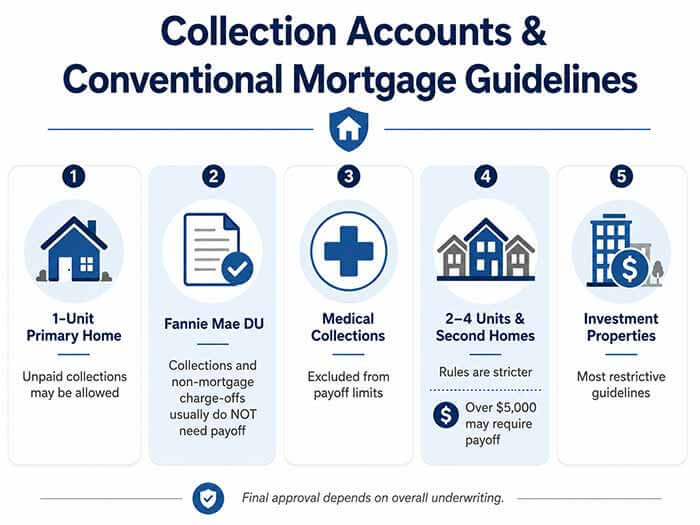
For a conventional mortgage, collection accounts may remain unpaid and still allow the mortgage to close. The specifics will depend on how far the file advances in automated underwriting, whether it is manually underwritten, and the nature of the property being financed.
For a one-unit primary residence underwritten through Fannie Mae Desktop Underwriter, outstanding collections and non-mortgage charge-offs usually do not need to be repaid, regardless of the amount.
Medical collections are not included in Fannie Mae’s collection-account payoff limits. The rules become stricter for some property types. For collections and non-mortgage charge-offs over $5,000, Fannie Mae Desktop Underwriter loans usually require payoff for two- to four-unit owner-occupied properties and second homes. Investment-property rules are more restrictive.
How Underwriters view Charge Off and Collection Accounts on Manual Underwriting
Manually underwritten loans are usually more restrictive for the payoff of collections. According to Fannie Mae, non-medical collection accounts and non-mortgage charge-offs must usually be paid if the individual collection account exceeds $250 or the total of collection accounts exceeds $1,000.
Medical collections may be considered less detrimental than other unpaid debts; however, like other accounts, they must be paid and/or will be analyzed. Medical collection accounts will not be ignored simply because they are old or small.
It’s acceptable for one lender to require a payoff when other lenders do not. Borrowers should consider whether the payoff requirement is due to Fannie Mae, Freddie Mac, the automated underwriting system, or the lender’s internal guidelines.
HUD Collection and Charge-Off Account Guidelines on FHA Loans
The guidelines for FHA collection and charge-off accounts can be more accommodating than those for most conventional lending. FHA lenders consider the borrower’s overall credit history and ability to pay back the new mortgage. HUD’s active FHA Single Family Housing Policy Handbook is Handbook 4000.1, effective November 26, 2025. FHA underwriting concerns include collection accounts, charge-off accounts, late payments, disputed derogatory accounts, and debt-to-income ratios.
Collection accounts typically do not have to be paid in full; however, the lender must evaluate the borrower’s capacity to pay the account, existing debt, and the proposed housing payment.
For FHA loans, collection accounts could warrant additional consideration, particularly when the account balance is high. The lender could confirm the collection account was paid, document an agreement for repayment, or include the monthly payment in the borrower’s debt-to-income ratio, among other options. For charge-off accounts, lenders do not have to consider the account a monthly debt for FHA loan qualification. However, a history of charge-offs, a recent pattern of late payments, or a lack of responsible fund management may prompt the underwriter to require a letter of explanation and supporting documentation, as these issues affect credit risk.
VA Mortgage Guidelines for Collections and Charge-Offs
Collection accounts and charge-offs do not always have to be paid prior to closing under VA mortgage guidelines. According to the VA, collection and charge-off accounts do not have to be paid, though the underwriter may require an explanation and some documentation. Having a signed repayment plan may help positively influence the decision.
Responsibly paying old collections does not remove the negative payment history. There is always an unsatisfactory credit pattern when accounts are paid, and no repayment plan is in place, according to the VA.
Judgments, federal debt, liens, and some other types of obligations are exceptions to the rule. Those accounts may have to be paid in full, or a repayment plan be documented. A VA underwriter will usually take a full credit profile into consideration. A borrower may have old unpaid collections and still qualify if housing history and income are recent and stable, residual income is sufficient, and the borrower has a good payment history for the last 12 months, because these factors support repayment capacity.
When Collection or Charge-Off Accounts Must Be Paid
A collection account or charge-off may need to be paid prior to closing due to the loan program, automated underwriting results, property type, a lender overlay, or a legal requirement, as any of these can affect the risk decision. Mortgage charge-offs have more serious repercussions than utility charge-offs or credit card charge-offs.
Fannie Mae considers charge-offs on mortgage accounts to be material derogatory credit events that can trigger certain waiting-period provisions.
This also applies to certain Judgments, Tax Liens, Child Support Arrears, Federal Debt, and other debts that could potentially create a lien against the subject property. A borrower cannot assume that there will be no consequence of an unpaid debt simply because it is not a charge-off.
Should You Pay a Collection Before Applying for a Mortgage?
There may be some circumstances where paying the collection is the best move, but it is not always the case. Before you pay down an old collection, determine if it is legitimate, the proper collection, if the collection is a duplicate, who the current creditor is, and if paying the collection is a requirement of your mortgage program.
Paying a collection could remove a condition for underwriting, allow a reduced DTI requirement, or give the lender more comfort with the file, but the collection will not be removed from your credit report, and your credit score will not improve significantly.
Request a payoff or settlement statement before paying the collection. Maintain proof of payment, the settlement, and your balance confirmation. These documents may be required to prove that a collection was paid if the collection is not removed from the credit report during mortgage underwriting.
Can You Get a Mortgage With Past-Due or Charged-Off Accounts?
Yes—depending on the account type and lender guidelines. We’ll show you how to qualify.Past Due versus Collection and Charge Off Accounts on Mortgage and Non-Mortgage Credit Tradelines
The Federal Housing Administration has very lenient lending guidelines with regards to past due versus collection and charge off accounts than any other loan programs. However, mortgage guidelines on past due versus collection and charge off accounts are different for single-family homes, two to four-unit properties, and investment properties.
Minimum Credit Score Requirements to Qualify and Getting Pre-Approved on FHA Loans
For all FHA loans, the minimum credit score required to qualify for a 3.5% down payment FHA loan is 580. With regards to past due versus collection and charge off accounts with borrowers buying a single-family home or anyone unit property such as a condominium or townhome is that all past due accounts need to be brought current. Past due accounts are different than collection accounts.
Do Borrowers Need to Come Current with Charge Off and Collection Accounts
With regard to collection accounts, borrowers are not required to pay any outstanding collection accounts or non-mortgage related charge off accounts. This holds true regardless of how much the amount outstanding collection balance and/or charge off account is. Collection accounts are classified as non-medical collections and medical collection accounts. Medical collection accounts are exempt from credit disputes.
Medical Collections versus Non-Medical Collection Accounts
Medical collections are exempt from debt-to-income calculations on outstanding collection balances. However, if the borrower has a total outstanding collection balance of greater than $2,000 from the combination of all non-medical collection accounts, then 5% of the outstanding collection balance will be used to calculate the borrower’s debt to income ratios. This holds true even though the borrower does not have to pay anything and this payment is a hypothetical debt.
How Large Outstanding Collections Impact Debt-to-Income Ratios
Consumers with substantial large balances can enter a written payment agreement with the collection agency and/or creditor for a monthly payment agreement. That monthly payment agreement will be used to calculate the debt-to-income ratios in lieu of the 5% of the outstanding collection account balance.
For Example, here is a Case Scenario Study:
- if the consumer has an outstanding collection balance of $10,000
- 5% of the $10,000 outstanding collection balance, or $500, will disqualify borrower due to high debt to income ratios
- then the borrower can enter into a written payment agreement with the collection agency or creditor for a lesser amount
- that lesser amount will be used as the monthly payment in calculating the borrower’s debt to income ratios and not the $500
Credit Disputes Will Halt Mortgage Process
Credit disputes can be deal killers and have an extremely negative impact on any type of loan program. Cannot have credit disputes on any non-medical collection accounts with outstanding balances of greater than $1,000 (a combination of all non-medical collection accounts on credit report ). Charge off accounts do not matter no matter what the outstanding charge off amount is. However, cannot have any credit disputes on charge-off accounts.
Credit Disputes on Non-Medical versus Medical Collection Accounts
Before consumers can proceed with the mortgage process, all non-medical collection accounts and charge-off credit disputes need to be removed. The credit report needs to reflect that. Unfortunately, when consumers retract credit disputes off a credit report, that will lower credit scores. Most often credit scores can drop significantly.
There are instances where borrowers can no longer meet the minimum credit score requirements. Can have credit disputes with non-medical collection accounts that have zero balances on them.
Medical collection accounts do not count. Can have credit disputes with medical collection accounts. Non-medical disputes with zero balance are exempt from retraction. Any credit disputes where the date of last activity is older than 24 months (DLA) are exempt from retraction.
What is the Difference Between a Charge-Off and a Delinquent Account?
An account that hasn’t been paid on time as specified in the loan or credit agreement is delinquent. The borrower is considered to have failed to make payments on time for this account. A delinquent account is overdue, meaning it has missed one or more payments.
Delinquency can occur for various reasons, such as financial hardship or forgetfulness, but it typically results in late fees, penalties, and a negative impact on the borrower’s credit score.
On the other hand, a charge-off occurs when a creditor decides that a delinquent debt is unlikely to be collected and writes it off as a loss for accounting purposes. This typically happens after the account has been delinquent for an extended period, often around 180 days.
Do Consumers Hold Liability on Debt That Has Been Charged Off
While a delinquent account reflects ongoing missed payments, a charge-off signifies the creditor’s acknowledgment that the debt is unlikely to be fully recovered. Even though the debt has been charged off, the borrower still has a legal obligation to repay it, which means the creditor can continue to attempt to collect the outstanding amount. However, a charge-off has more severe implications for the borrower’s credit report and score than a delinquent account.
Conforming Mortgage Guidelines on Collection Accounts on 2 To 4 Unit Properties and Second Homes
Fannie Mae Guidelines on collection accounts on 2 to 4 Unit Properties and Second Home Purchases are different than those of single-family homes or one-unit homes such as condominiums and townhomes. For two to four-unit owner-occupant properties and for second home properties here are the mortgage guidelines. Fannie Mae Guidelines on collections and charge off accounts that total more than $5,000 need to be paid off prior to closing or at closing.
Past Due versus Collection and Charge Off Accounts on Investment Properties
Fannie Mae mortgage guidelines with regards to collection accounts and charge off accounts on investment properties are much stricter than single-family homes and two to four-unit properties. Any collection accounts and/or non-mortgage charge off accounts that are equal and/or greater than $250.00 needs to be paid off prior to or at closing on two to four-unit homes and investment properties.
Things to Consider Before Getting a Loan
Start the Process by Pulling a Credit Report
It is a good idea to pull your credit report prior to looking for homes. When reviewing, note any items showing as past due, collection items, charged-off accounts, disputed accounts, paid collection accounts, or settled accounts for less than the full balance. Watch for duplicate items, incorrect balance reporting, accounts of other people, and reporting of old paid debts.
The Goal Should Be To Resolve Past Due Accounts
Before going through the application process, bring any past-due accounts to the current status. Current delinquent accounts are of much greater concern to lenders than older collection accounts, given past hardship.
Improving Approval Chances Is Not a Reason to Dispute
Improving your chances of account approval is not a good reason to dispute accurately reported negative accounts. Inaccurate reporting of negative accounts will only delay the underwriting process and may cause further unnecessary investigation.
Explain the Credit Report Anomaly
If you have credit report anomalies, the best way to address them is a short, truthful letter with supporting documents. In your letter, address what the credit report anomaly is and why you don’t foresee it happening again, along with what the improvements are. Supporting documents may include medical documents, documents relating to job loss or divorce, proof of a settlement, payment plans, or proof that the account was paid.
Protect Your Recent Payment History
The months leading up to mortgage approval are crucial for maintaining a payment history. There should be no late payments or new collection accounts. Avoid excessive credit card use, inquiries, and new debts. A cleaner recent payment history will help balance older credit history issues.
Past Due vs. Collection and Charge-Off Accounts: Final Thoughts
All three negatively affect your mortgage approval but should be approached in completely different ways. A past-due account needs your attention right away. The mortgage program and the underwriter will help you determine the next steps for a collection or charge-off, which generally involves older accounts and may not even need to be paid. The optimal option is to pay off old debt after the full mortgage review.
A skilled loan officer will help you determine which accounts should be paid, which ones may remain unpaid, which ones need a payment plan, and which errors in the credit report need to be fixed prior to applying.
If you have any questions on Past Due Versus Collection and Charge Off Accounts Mortgage Guidelines or you need to qualify for loans with a lender with no overlays on government or conforming loans, please contact us at Gustan Cho Associates at 800-900-8569. Text us for a faster response. Or email us at alex@gustancho.com . The team at Gustan Cho Associates is available 7 days a week, on evenings, weekends, and holidays.
FAQs: Past Due versus Collection and Charge Off Accounts in Mortgage Loans
Can I Qualify for a Mortgage if I Have a Collection Account from an Apartment?
It is possible. An apartment collection may be a greater concern than a small credit card collection since it relates to your housing. You may need to provide an explanation and proof of payment. You may need to show that the balance collection is not related to unpaid rent, apartment damages, or an active lease.
What Does it Mean if a Debt is Charged Off and a Collection is Reported?
In this situation, the lender must analyze whether both represent the same debt. You cannot be liable to pay the same account twice. Provide letters of clearance, collection letters, or statements from the creditors who currently hold the debt and indicate the balance.
Can I Pay the Collection to Close the Deal, Even if I Am Paying Less Than Full Value?
Possibly. Some lenders may agree to the deal if it is documented and clearly states the deal terms, and the account will be closed once payment is made. Do not rely on the collector’s verbal deal.
Will Paying the Collection Remove It From My Credit Report?
In most cases, payment will simply update the account status to paid/settled. This payment will not remove the account history from the report. Removal of the account is typically due to an error, an agreement with the creditor, or the account’s expiration.
Is it Possible for a Collection Account to Report on the day of Closing?
Yes. The lender may conduct an updated credit pull, and a collection account may trigger additional questions, updated underwriting, and a delay in closing. You must contact the lender once this account has been reported to do a proper review.
What Do You Do if an Old Collection Account Isn’t Yours?
You can dispute it with the credit reporting agency and the debt collector. Keeping copies of the documents related to the collections, the results and reports from any investigations, the police reports, and any letters from the creditor will be helpful. Submit these to your mortgage lender.
Will a Payment Plan Make it Easier to Get a Mortgage?
A payment plan can indicate that the collection is being addressed. However, the lender may require that the monthly payment be included in your debt-to-income ratio, meaning the payment plan should be evaluated before signing.
Should I Pay Collection Fees Using a Credit Card or a Personal Loan?
Taking on additional debt before a mortgage is typically not advised. Assuming a credit card balance or a personal loan can result in a lower credit score and a higher debt-to-income ratio, which creates new underwriting concerns. Evaluate the mortgage in its entirety before deciding to pay a collection.
What is the Difference Between Charge-Off and Collections?
Charge-offs and collections represent different stages in handling overdue debts. When a debt is unlikely to be repaid, it’s charged off, indicating it’s removed from accounts receivable. The borrower remains responsible, impacting their credit. Collections involve efforts to recover delinquent debts, potentially updating the account status, but charge-off repercussions linger on credit reports. Both stages affect the borrower’s financial standing significantly.
Can an Account be Charged Off and Past Due?
Yes, an account can be both past due and charged off. Being past due reflects ongoing missed payments, while charge-off occurs when the creditor writes off the debt as uncollectible, typically after an extended period of non-payment. The borrower is legally obligated to repay despite charge-off, and collections may still be pursued to recover the debt.
Can a Collection Account Show a Past Due Balance?
Yes, a collection account can display a past-due balance. Additional fees may accrue once a debt is in collections, contributing to a past-due status. Addressing collection accounts promptly is crucial to mitigate credit score damage and further financial repercussions.
What is the Difference Between a Charge-Off and a Delinquent Account?
A delinquent account signifies missed payments, while a charge-off acknowledges the debt as uncollectible—delinquency results in late fees and impacts credit scores. In contrast, charge-off involves removing the debt from accounts receivable, with severe credit report implications, though the borrower remains liable.
Conforming Mortgage Guidelines on Collection Accounts and Investment Properties
Fannie Mae guidelines differ based on property type. For single-family homes, collection accounts over $5,000 should be paid off. For two to four-unit properties or second homes, accounts exceeding $5,000 must be settled. Investment properties require payment for any account above $250. These guidelines aim to manage risk in mortgage lending.
This blog about Past Due Versus Collection And Charge Off Accounts Mortgage Guidelines was updated in July 6, 2026.