HUD Manual Underwriting DTI Guidelines for FHA Loans: 2026 Approval Guide
Getting a Refer result from an automated underwriting system does not necessarily mean your FHA mortgage application is over. Some FHA loans can be approved through manual underwriting, in which an FHA Direct Endorsement underwriter reviews the borrower’s complete financial profile rather than relying solely on an automated recommendation. One of the most important parts of that review is the borrower’s debt-to-income ratio. The HUD Manual Underwriting DTI Guidelines establish specific limits for manually underwritten FHA mortgages.
FHA Manual Underwriting DTI Guidelines
Depending on the borrower’s credit score and documented compensating factors, the maximum ratios may range from 31%/43% to 40%/50%. However, approval for higher ratios requires more than stable employment or general savings. HUD identifies specific compensating factors and documentation requirements that must be satisfied.
Borrowers with a 580 or higher decision credit score may qualify up to 37/47 with one approved compensating factor, 40/40 with no discretionary debt, or 40/50 with two approved factors.
HUD manual underwriting DTI guidelines generally cap FHA manual loans at 31/43 without compensating factors. Borrowers with scores of 500–579 or no credit score generally cannot exceed 31/43. Approval also depends on credit, payment history, income, assets, reserves, and lender requirements.
What Are HUD Manual Underwriting DTI Guidelines?
HUD manual underwriting DTI guidelines are the debt-to-income rules that apply when an FHA mortgage must be manually underwritten. FHA’s Automated Underwriting System process uses the TOTAL Mortgage Scorecard to help assess mortgage applications. HUD explains that an Accept recommendation generally allows the lender to continue without a full manual underwriting review unless a manual downgrade is required.
FHA Refer Manual Underwriting
A Refer recommendation means the mortgage must be reviewed by an FHA Direct Endorsement underwriter. A loan that originally received an automated Accept recommendation may also have to be manually downgraded when certain conditions identified in HUD Handbook 4000.1 are present. Manual underwriting does not mean that HUD overlooks risk. It means the underwriter must evaluate the borrower’s credit history, income, assets, debts, housing history, reserves, and overall ability and willingness to repay the mortgage in accordance with FHA’s manual underwriting requirements.
What Is Debt-to-Income Ratio on an FHA Loan?
The debt-to-income ratio compares monthly financial obligations with gross monthly qualifying income. FHA manual underwriting uses two important ratios.
What Is the FHA Front-End DTI Ratio?
The front-end ratio is sometimes called the housing ratio or payment-to-income ratio. It compares the proposed total monthly mortgage payment with the borrower’s effective monthly income.
The mortgage payment generally includes principal, interest, property taxes, homeowners’ insurance, FHA mortgage insurance, homeowners’ association dues when applicable, and other required housing expenses.
For example, if a borrower earns $6,000 per month in qualifying income and the proposed housing payment is $1,800, the front-end ratio is 30%.
What Is the FHA Back-End DTI Ratio?
The back-end ratio includes the proposed mortgage payment plus the borrower’s other recurring monthly debt obligations. Those obligations may include automobile loans, credit card minimum payments, student loans, personal loans, child support obligations, installment debts, and other liabilities that must be included under FHA guidelines. If the borrower earns $6,000 per month and total monthly obligations, including the mortgage, are $2,700, the back-end DTI is 45%.
- This is why FHA ratios are commonly written as 31/43, 37/47, or 40/50.
- The first number is the housing ratio.
- The second number is the total debt ratio.
FHA Manual Underwriting DTI Ratios for 2026
HUD does not use one maximum DTI ratio for every manually underwritten FHA borrower. The maximum depends primarily on the borrower’s Minimum Decision Credit Score and whether HUD-approved compensating factors can be documented. HUD’s current manual underwriting structure contains five important paths.
FHA 31/43 DTI With a 500 to 579 Credit Score
Borrowers with a Minimum Decision Credit Score between 500 and 579 are generally limited to maximum ratios of 31% front-end and 43% back-end on a manually underwritten FHA mortgage. Compensating factors cannot be used to increase those ratios. This difference matters.
A borrower with a 550 credit score, six months of savings, minimal payment shock, and excellent residual income generally cannot use those strengths to obtain the 40/50 manual underwriting ratio.
The score itself limits the manual underwriting DTI. FHA borrowers with scores from 500 to 579 are generally limited to 90% loan-to-value financing, while borrowers with qualifying scores of 580 or higher may be eligible for maximum FHA financing, subject to all other requirements.
FHA 31/43 DTI With a 580 or Higher Credit Score
A borrower with a Minimum Decision Credit Score of 580 or higher may generally qualify with ratios up to 31/43 without needing a compensating factor. This is the standard starting point for manual underwriting. The borrower still needs to satisfy all other FHA manual underwriting requirements. Having ratios below 31/43 does not automatically result in approval if there are unresolved issues with credit history, income stability, assets, housing payments, or other underwriting risks.
FHA 37/47 DTI With One Compensating Factor
Borrowers with a Minimum Decision Credit Score of at least 580 may potentially qualify for ratios up to 37% front-end and 47% back-end if at least one qualifying HUD compensating factor is documented.
For the 37/47 tier, HUD Permits One of the Following:
- Verified and documented cash reserves.
- A minimal increase in the housing payment.
- Residual income meeting HUD’s applicable requirements.
- The significant additional income compensating factor is not one of the standalone factors HUD identifies for the 37/47 tier.
FHA 40/40 DTI With No Discretionary Debt
HUD also provides a separate 40/40 manual underwriting path for qualifying borrowers with credit scores of 580 or higher. People often overlook this category. It does not simply mean the borrower has very little debt. HUD’s no-discretionary-debt standard requires the borrower’s housing payment to be the only open account with an outstanding balance that is not paid off monthly. The credit report must show established credit lines in the borrower’s own name that have been open for at least six months.
The borrower must also document that those accounts have been paid in full each month for at least the previous six months.
Someone who has no established credit other than housing generally cannot use this provision. Authorized-user accounts also do not satisfy the established-credit requirement. This category permits a housing ratio of up to 40%, but because the borrower carries no qualifying discretionary debt, the back-end ratio is also capped at 40%.
FHA 40/50 DTI With Two Compensating Factors
The highest standard manual-underwriting DTI tier under HUD’s matrix is 40% front-end and 50% back-end. The borrower must have a Minimum Decision Credit Score of 580 or higher. HUD requires two qualifying compensating factors from the approved list.
Two qualifying factors must actually meet HUD’s documentation standards. An underwriter cannot just pick two general strengths from the application and count them as compensating factors.
Those factors are verified cash reserves, a minimal increase in housing payments, significant additional income not included in effective income, and residual income.
High DTI? FHA Manual Underwriting May Still Work
A higher debt-to-income ratio does not always mean denial. We’ll review your income, debts, housing history, reserves, and compensating factors to see what options may apply.Can FHA Manual Underwriting Go Above 50% DTI?
Under the standard HUD manual underwriting ratio matrix, 50% is the maximum back-end DTI for the 40/50 category. Having three or four compensating factors does not create a 51%, 52%, or 55% manual-underwriting tier.
HUD’s manual underwriting matrix does not work that way. A loan being manually underwritten must satisfy the applicable manual requirements.
This differs from some FHA loans receiving automated approval, where AUS findings and the overall risk assessment may permit ratios that would not meet the manual underwriting matrix. Borrowers sometimes receive FHA automated approval at a back-end DTI above 50% and assume a manually underwritten loan can use the same ratio.
What Are the FHA Manual Underwriting Compensating Factors?
A compensating factor is a documented financial strength that HUD allows an underwriter to use when approving certain manually underwritten mortgages with ratios exceeding the normal 31/43 benchmark.
Not Every Positive Part of a Mortgage Application Counts as a HUD Compensating Factor:
- A long employment history may strengthen the overall file.
- A larger down payment may reduce risk.
- Excellent credit may make the borrower more attractive.
However, these characteristics do not automatically substitute for the compensating factors HUD specifically identifies for the higher manual DTI tiers. The recognized factors used in the 37/47 and 40/50 calculations have detailed requirements.
Cash Reserves as an FHA Compensating Factor
Cash reserves can be one of the strongest compensating factors in a manual underwrite. But there is a key difference between the minimum reserves needed for manual underwriting and the amount needed to use reserves as a compensating factor.
Minimum Reserves Required for FHA Manual Underwriting
For a manually underwritten one- or two-unit property, HUD generally requires reserves equivalent to at least one month’s PITI after closing. For a three- or four-unit property, the standard is generally at least 3 months of PITI. When qualifying rental income from an accessory dwelling unit is used on an eligible one-unit property, separate reserve requirements may apply. Meeting the minimum reserve requirement does not necessarily mean the borrower can count reserves as a compensating factor.
Reserves Needed to Count as a Compensating Factor
To use documented cash reserves as a compensating factor, HUD generally requires reserves equal to at least three total monthly mortgage payments for a one- or two-unit property. For a three- or four-unit property, reserves generally must equal at least six total monthly mortgage payments.
The calculation is made after subtracting the funds required to close. Gift funds, borrowed money, and certain cash received at closing cannot simply be counted toward this compensating-factor reserve requirement.
This difference is important for borrowers aiming for the 37/47 or 40/50 ratios. Having one month of reserves may satisfy the basic manual underwriting reserve requirement on a one-unit home. It does not automatically give the borrower a cash reserve compensating factor.
Minimal Increase in Housing Payment as a Compensating Factor
A borrower who has already demonstrated the ability to make a housing payment close to the proposed new mortgage payment may qualify for the minimal-increase-in-housing-payment compensating factor.
HUD generally requires the new total monthly mortgage payment to exceed the borrower’s present monthly housing obligation by no more than $100 or 5%, whichever is less.
The borrower must also have a documented 12-month housing-payment history with no more than one 30-day late payment. A borrower with no current housing payment cannot use this compensating factor.
Example of the 5% or $100 Payment-Shock Rule:
- Suppose a borrower currently pays $2,000 per month in rent.
- Five percent of $2,000 is $100.
- The proposed FHA housing payment is $2,075.
- The increase is $75.
- Assuming the borrower’s housing payment history meets HUD’s documentation requirements, the minimal housing increase factor may be available.
Now Suppose the Proposed Payment is $2,200:
- The increase is $200.
- Even if the borrower feels comfortable with the new payment, the increase does not meet HUD’s minimal-increase rule.
Example of FHA Compensating Factors
Residual income looks at how much income remains after major monthly obligations and estimated living expenses are considered. HUD permits residual income to be used as a manual underwriting compensating factor when the required amount is properly documented.
For this purpose, FHA references the applicable residual-income standards in the Department of Veterans Affairs Lenders Handbook, based on geographic region and household size.
The calculation considers more than the debts appearing on a credit report. Taxes, Social Security, and retirement deductions, fixed payments, maintenance and utilities, certain job-related expenses such as child care, and other items can affect the result. A borrower can therefore have a fairly high DTI while still showing high residual income. This is one reason why residual income can be especially helpful in a well-documented FHA manual underwrite.
Significant Additional Income Not Used for Qualifying

The lender must verify that the borrower has received the additional income for at least one year and that it is likely to continue.
If the additional income were included in effective income, it must be sufficient to reduce the qualifying ratios to no more than 37/47. Income belonging to a non-borrowing spouse or another person who is not obligated on the mortgage cannot simply be used under this provision. HUD also states that this factor may only be cited together with another compensating factor when the ratios exceed 37/47 but do not exceed 40/50.
Why Job Stability Alone Is Not an FHA Compensating Factor
Stable employment is important in mortgage underwriting. An underwriter needs to determine that the qualifying income is stable, verifiable, and likely to continue, as required by applicable FHA rules.
Borrowers should not mistake a strong work history for one of HUD’s specific DTI compensating factors. Someone who has worked for the same company for 20 years may have an excellent overall loan profile.
That fact alone does not automatically allow a manual underwriter to move the loan from 31/43 to 37/47 or from 37/47 to 40/50. The required compensating factors must still satisfy HUD’s specified standards.
FHA Manual Underwriting Credit Requirements
DTI is only one part of a manually underwritten FHA loan. The underwriter also reviews the borrower’s overall credit behavior. HUD directs the manual underwriter to evaluate the overall pattern rather than focusing only on an isolated slow payment.
Under the current FHA manual credit guidance, satisfactory credit generally includes making housing and installment debt payments on time during the previous 12 months, subject to additional requirements regarding the previous 24 months and serious revolving credit derogatories.
When the payment history does not meet HUD’s satisfactory-credit standard, additional analysis is required. The underwriter must determine whether the delinquencies resulted from disregard for financial obligations, inability to manage debt, or documented extenuating circumstances. This is why a borrower might meet the DTI requirement yet still fail manual underwriting. The entire credit profile matters.
Does FHA Manual Underwriting Require Rental Verification?
Housing payment history receives significant attention during manual underwriting. HUD allows lenders to verify a borrower’s housing obligation through sources such as the credit report, direct verification of rent from an eligible landlord, direct verification from a mortgage servicer, or canceled checks covering the applicable period.
Rental verification can become especially important when the borrower wants to use minimal payment shock as a compensating factor.
In that situation, HUD requires documentation of the previous 12 months of housing payments. A borrower living rent-free cannot claim a minimal increase in housing payment because there is no current housing payment to compare with the proposed mortgage.
FHA Manual Underwriting With a 500 Credit Score
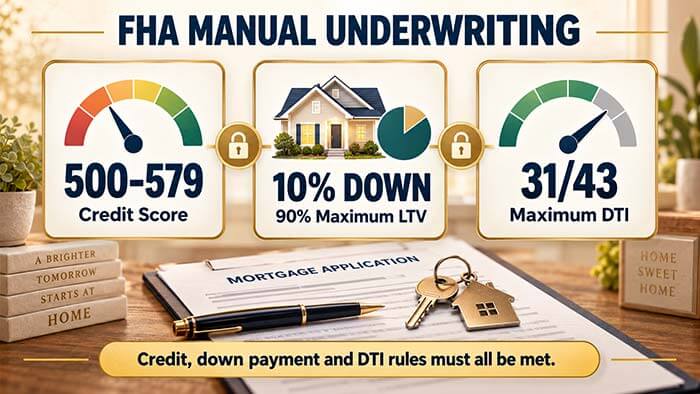 FHA guidelines allow certain borrowers with credit scores from 500 through 579 to qualify for FHA-insured financing. However, borrowers in this credit range are generally limited to 90% loan-to-value financing. For a purchase, that normally means at least a 10% down payment.
More importantly for manual underwriting, borrowers with decision credit scores below 580 generally cannot exceed the 31/43 manual underwriting ratios.
Qualifying for FHA financing with a 500 score does not mean a borrower can combine a low score with a 50% manual DTI. Both sets of rules must be satisfied.
FHA Manual Underwriting With Chapter 13 Bankruptcy
Manual underwriting can also play an important role for borrowers who are currently in a Chapter 13 bankruptcy repayment plan. HUD states that Chapter 13 bankruptcy does not automatically disqualify a borrower from obtaining an FHA-insured mortgage. At least 12 months of the bankruptcy payout period generally must have elapsed by the FHA case-number assignment date.
The lender must determine that the required payments during the applicable period were made on time and in a satisfactory manner.
The borrower must also obtain written permission from the bankruptcy court to enter into the mortgage transaction. Qualifying during Chapter 13 still requires the borrower to satisfy the FHA manual underwriting requirements, including the applicable DTI, credit, income, asset, and reserve standards. Bankruptcy court permission does not, by itself, guarantee mortgage approval.
Does a Refer Result Mean Your FHA Loan Is Denied?
No. A referral result and a mortgage denial are not necessarily the same thing. HUD states that a Refer recommendation from FHA TOTAL means the mortgage must be underwritten by an FHA Direct Endorsement underwriter.
The manual underwriter then determines whether the borrower satisfies FHA’s requirements. Some lenders do not offer manual underwriting at all.
Other lenders impose internal requirements that are more restrictive than HUD guidelines. Those additional requirements are commonly called lender overlays. As a result, a borrower may be told that an FHA loan cannot be approved when the real issue is that a particular lender does not offer the manual-underwriting option required by the file. That does not mean every Refer file can be approved elsewhere. It means the borrower should determine whether the obstacle is an actual HUD requirement or a lender-specific rule.
Does Manual Underwriting Mean a Higher Mortgage Rate?
Not necessarily. HUD’s manual underwriting rules establish underwriting standards, documentation requirements, credit requirements, and allowable ratios. HUD does not set a separate FHA interest rate solely for manually underwritten mortgages.
Borrowers should review their Loan Estimate and loan terms rather than assuming that manual underwriting always leads to a higher rate.
The actual rate depends on the borrower’s credit profile, loan-to-value ratio, market conditions, lender pricing, discount points, loan structure, and other factors. Individual lenders may price or restrict manual-underwriting loans differently.
How to Improve Your Chances of FHA Manual Underwriting Approval
The best manual underwriting files are usually well prepared before they reach the underwriter. Start by accurately calculating both the front-end and back-end ratios. Do not assume a back-end DTI under 50% is enough. Determine which specific HUD ratio category applies based on the borrower’s Minimum Decision Credit Score. Next, identify legitimate compensating factors.
If reserves are being used, verify that enough money will remain after closing to meet the compensating-factor threshold rather than merely the minimum reserve requirement.
If minimal payment shock is being used, document the full housing-payment history and calculate the $100-or-5% test before submitting the file. If residual income is necessary, calculate it before underwriting rather than waiting for the underwriter to discover whether the borrower passes. Credit explanations should also be clear, factual, and supported by documentation when necessary. A manual underwriter is reviewing the entire risk profile. A well-organized file that answers potential questions is much stronger than one that leaves the underwriter looking for explanations.
Common FHA Manual Underwriting Problems That Delay Approval
One common problem is assuming that any positive characteristic counts as a compensating factor. That is not the case. Another problem is confusing the minimum reserve requirement with the larger reserve amount needed to claim cash reserves as a compensating factor.
Borrowers also run into trouble when their housing payment history cannot be verified. A large payment shock can eliminate one of the most useful compensating factors.
Unexplained late payments, overdrafts, undisclosed debts, inconsistent income documents, new credit obligations, or large undocumented deposits can also create additional questions. Another frequent mistake is when borrowers believe a 40/50 ratio is automatically available simply because their score is above 580. The two required compensating factors still must meet HUD’s documentation standards.
Example of an FHA 37/47 Manual Underwrite
Consider a borrower with a 620 credit score. The proposed housing ratio is 36%, and the back-end DTI is 46%. The borrower has sufficient verified reserves remaining after closing to satisfy HUD’s cash-reserve compensating factor requirement. Because the ratios are below 37/47 and the score is at least 580, one properly documented qualifying compensating factor may support the applicable DTI tier. The file must still satisfy every other FHA underwriting requirement.
Example of an FHA 40/50 Manual Underwrite
Consider another borrower with a 640 credit score. The front-end ratio is 39%, and the back-end ratio is 49%. The borrower has verified reserves sufficient to satisfy HUD’s compensating-factor requirement.
The proposed mortgage payment also represents only a minimal increase from the borrower’s documented current housing payment and meets HUD’s $100-or-5% standard.
Those two properly documented factors may support consideration under the 40/50 manual underwriting tier. This does not mean the loan will be approved automatically. The underwriter still evaluates credit history, income, assets, liabilities, housing history, and the total risk of the transaction.
Can Gustan Cho Associates Help With FHA Manual Underwriting?
Gustan Cho Associates works with borrowers who may have difficulty obtaining mortgage approval through traditional automated underwriting. Manual underwriting can be especially important for borrowers with prior credit problems, high debt-to-income ratios, Chapter 13 bankruptcy, limited credit history, or an FHA Refer recommendation.
The first step is determining whether the loan actually meets HUD requirements. The next step is identifying whether a lender overlay is preventing an otherwise eligible loan from moving forward.
An experienced mortgage professional can review the DTI calculation, identify potential compensating factors, evaluate reserves and payment shock, and determine whether manual underwriting may offer a realistic path forward. No lender can promise approval. Borrowers who understand the HUD Manual Underwriting DTI Guidelines before submitting their loan are in a better position to identify problems early and structure the mortgage correctly.
Denied Because of FHA DTI Ratios? Get a Second Opinion
Some lenders add overlays or stop after automated findings. We’ll review your full file and look for an FHA manual underwriting path that may still work.Final Thoughts on HUD Manual Underwriting DTI Guidelines
FHA manual underwriting can provide an important path to homeownership when automated underwriting does not produce an approval. But manual underwriting does not allow you to bypass FHA lending standards. HUD provides a defined framework.
- Borrowers with scores below 580 are generally limited to 31/43.
- Borrowers with scores of 580 or higher may potentially qualify at 31/43 without compensating factors.
- 37/47 with one approved factor.
- 40/40 under the no-discretionary-debt standard.
- Or 40/50 with two qualifying compensating factors.
- Documentation is key to meeting HUD’s threshold.
- Payment shock must satisfy the $100-or-5% test.
- Residual income must meet the applicable standard.
- Additional income must satisfy its own requirements.
And the borrower’s complete credit and financial profile must still support the underwriter’s decision. Understanding these rules before your loan goes to underwriting can help avoid unnecessary denials, delays, and surprises. Contact us today at 800-900-8569, text us for faster responses, or email us at gcho@gustancho.com. We are available 7 days a week, on weekends, and even on holidays. Let’s work together to make your dream of homeownership a reality.
Frequently Asked Questions About HUD Manual Underwriting DTI Guidelines:
What is the Highest DTI Allowed on an FHA Manual Underwrite?
The standard maximum under HUD’s manual underwriting matrix is generally 40% front-end and 50% back-end for borrowers with a Minimum Decision Credit Score of at least 580 and two qualifying compensating factors. A separate 40/40 category is available to borrowers who meet HUD’s no-discretionary-debt requirements.
Can an FHA manual underwrite have a 50% back-end DTI?
Yes. A borrower with a decision credit score of at least 580 may potentially qualify with a back-end DTI up to 50% when the front-end ratio does not exceed 40%, and two HUD-approved compensating factors are properly documented.
Can the FHA manual underwriting exceed 50% DTI with three compensating factors?
The standard HUD manual underwriting matrix does not provide a tier above 40/50. Additional positive factors may strengthen the overall file, but they do not create a published 41/51 or 45/55 manual-underwriting category.
How many months of reserves do I need for FHA manual underwriting?
The basic manual underwriting reserve requirement and the compensating-factor requirement are different. A one- or two-unit manually underwritten mortgage generally requires at least one month’s PITI after closing, while three- and four-unit properties generally require three months. To use cash reserves as a compensating factor, HUD generally requires at least three total monthly mortgage payments for one- or two-unit properties and six for three- or four-unit properties.
What is considered a low payment shock for FHA manual underwriting?
HUD’s minimal-increase compensating factor generally requires the proposed total mortgage payment to exceed the borrower’s current housing payment by no more than $100 or 5%, whichever is less. A documented 12-month housing-payment history is also required.
Can I get an FHA manual underwrite with a 500 credit score?
Potentially. FHA permits certain borrowers with scores from 500 to 579, but they are generally limited to 90% LTV, and the manual underwriting ratios cannot exceed 31/43. Compensating factors cannot be used to stretch the ratios above that level.
Can I buy a house with an FHA while still in Chapter 13 bankruptcy?
Potentially. HUD allows FHA financing during an active Chapter 13 repayment plan when at least 12 months of the payout period have elapsed, required payments have been made satisfactorily and on time, and the borrower has written bankruptcy-court permission to enter into the mortgage transaction. The borrower must still satisfy the remaining FHA underwriting requirements.
Does FHA manual underwriting automatically have a higher interest rate?
No universal FHA rule requires a higher interest rate merely because the mortgage is manually underwritten. Actual pricing depends on the borrower’s loan profile, lender, market conditions, credit, loan-to-value ratio, points, and other pricing factors.
Can I Buy a House While I Am in Chapter 13 Bankruptcy?
Yes, qualified borrowers may be able to purchase a home while an active Chapter 13 bankruptcy is still being repaid. FHA, VA, and certain USDA loans can provide potential options. The borrower must satisfy the mortgage program requirements and obtain any required bankruptcy authorization.
How Long After Filing Chapter 13 Can I Get an FHA Loan?
HUD requires at least 12 months of the Chapter 13 payout period to have elapsed by the FHA case number assignment. During the applicable period, required payments must have been made on time, and the borrower must have written permission from the bankruptcy court to enter into the mortgage transaction.
Do I Need a Motion to Incur Debt to Buy a House During Chapter 13?
Possibly. The specific procedure varies by bankruptcy district and individual case. Some borrowers may need their attorney to file a formal motion or application, while other jurisdictions may use different procedures. Your bankruptcy attorney should determine what is required.
Can I Refinance My Mortgage While in Chapter 13 Bankruptcy?
Potentially, yes. FHA, VA, or another eligible program may permit refinancing while the Chapter 13 case remains active if the borrower meets the mortgage guidelines and obtains the required authorization to incur the new mortgage debt.
Can I Get a VA Loan While in Chapter 13?
VA guidance permits lenders to give favorable consideration when a borrower has satisfactorily made at least 12 months’ worth of Chapter 13 payments and the trustee or bankruptcy judge approves the new credit. The borrower must still satisfy all other VA underwriting requirements.
Can I Get a USDA Loan While in Chapter 13?
Potentially. USDA’s guaranteed-loan handbook addresses Chapter 13 plans that are still in progress. Required payments must be made on time, and written permission from the court or the trustee is generally required. GUS Refer and manually underwritten files have additional requirements, including documentation that 12 months of the restructuring plan have elapsed.
Can I Get a Conventional Mortgage While My Chapter 13 Is Still Active?
Generally, an active Chapter 13 is not compatible with standard Fannie Mae conventional eligibility. Fannie Mae’s Desktop Underwriter treats certain Chapter 13 cases that remain neither discharged nor dismissed as Ineligible. Conventional eligibility typically becomes more relevant after discharge or dismissal and completion of the applicable waiting period.
Does Chapter 13 Trustee Approval Guarantee That My Mortgage Will Be Approved?
No. Trustee or bankruptcy-court approval only allows the borrower to incur new debt. The lender must still approve income, credit, debt-to-income ratio, assets, property, and all other mortgage requirements. To strengthen this page, include a clear by line and author page for a licensed mortgage professional. Add a ‘Reviewed for mortgage guideline accuracy’ line only if an actual review has been completed. Link this guide to related pages about FHA loans during Chapter 13, VA loans during Chapter 13, manual underwriting, lender overlays, FHA debt-to-income ratios, mortgages after bankruptcy, and Chapter 13 cash-out refinancing to build topical authority without excessive keyword repetition.
This Guide About “HUD Manual Underwriting DTI Guidelines: Your Approval Guide” Was Updated on September 7, 2026.