In this guide, we will be comparing the skyrocketing mortgage rates versus housing prices. We will cover the forecast of mortgage rates versus housing prices. If you’re buying a home in Chicago, you have a lot to think about when it comes to mortgage rates and home prices. A lower mortgage rate can help you save on your monthly payment. On the other hand, buying a less expensive home means you’ll need a smaller loan, a lower down payment, and you’ll pay less interest overall.
In 2019, rates were as low as 2.5% on a 30-year fixed-rate conforming loan. Home prices were surging like never before. Homebuyers felt helpless, unable to find a home to make an offer on.
Mortgage rates and home prices don’t always move in opposite directions. Even if higher rates make some buyers pause, the limited number of homes in Chicago often keeps prices steady or even pushes them higher. That’s what’s happening in the current market. The American Dream of owning a home seemed to fade away as days, weeks, and months passed by. To make matters worse, mortgage interest rates were surging to new levels. Everyone is concerned about today’s surging mortgage rates versus housing prices. Will the surging mortgage rates cause housing prices to plummet?
What Are Today’s Mortgage Rates versus Housing Prices
As of July 9, 2026, the average 30-year fixed mortgage rate was 6.49%, and the average 15-year fixed rate was 5.82%. These rates are the Freddie Mac rates based on qualifying conventional purchase applications for the week. Mortgage rates will vary based on the loan program, credit, loan amount, type of collateral, down payment, occupancy, property type, points, and risk factors.
Quick Answer: Which Is More Important, Mortgage Rates or Housing Prices?
Both mortgage rates and home prices matter when it comes to your monthly payment. Looking at just one doesn’t give you the full picture. If home prices are lower, you’ll probably need to borrow less. If you get a lower mortgage rate, your loan will cost less. Either way, you could make your home more affordable, but how much you save depends on how much prices or rates change.
Homebuyers Should Take into Account the Entire Housing Expense, Which Includes:
- Mortgage Principal
- Interest
- Homeowners Insurance
- Mortgage Insurance
- Flood Insurance (if applicable)
- Property taxes
- Condo or Homeowners Association Dues
- Special Assessments
- Don’t forget to factor in the cost of maintaining your home or condo, in addition to insurance.
- A cheaper home isn’t always more affordable.
- High property taxes, expensive association fees, big repairs, or special assessments can make it cost as much as a pricier home.
Mortgage Rates vs Housing Prices in the 2026 Housing Market
Mortgage rates are much higher than they were during the pandemic. The upside is that they’ve settled in the mid-6% range, so buyers now have more predictability than in the past few years. On the other hand, National housing prices have been on a continuous upward trend.
According to the National Association of REALTORS®, the median existing home price in June 2026 was $440,600, a 1.8% increase compared to June 2025.
Housing inventory in the U.S. was about 1.56 million homes, a 4.6-month supply. According to the Federal Housing Finance Agency, home prices across the U.S. increased by 1.7% from Q1 2025 to Q1 2026. On the other hand, Illinois experienced a 7.3% annual increase, the largest reported statewide appreciation by FHFA for the time period. Elgin, Illinois, experienced the largest annual appreciation at 10.8% of the FHFA’s top 100 metropolitan areas.
How Do I Know Right Now is the Right Time to Buy a House
Homebuyers cannot assume that home prices will decrease, as the Chicago housing market illustrates the relationship between home supply and prices. As of May 2026, the median sales price for the City of Chicago and the rest of the housing market in May 2025 was $420,000 and $390,000, respectively, representing increases of 7.7% and 6.7% from the previous year, respectively. The annual supply of homes for sale decreased by 30%, and the annual sales of homes decreased by only 1.5%.
In the nine-county Chicago metropolitan area, the median sales price in May 2026 was $399,990, a 5.5% annual increase. The supply of homes decreased by 14.6%, while annual home sales decreased by only 1%.
The Chicago metropolitan area includes the counties of Cook, DuPage, Lake, Kane, McHenry, Will, Kendall, DeKalb, and Grundy. Even though mortgage rates are higher, many buyers are still looking. Because there aren’t many homes for sale, competition is strong, especially for move-in-ready homes in good school districts or near transit and jobs. Chicago and its suburbs each have their own unique housing markets, with different trends and characteristics. The demand, association fees, and financing options for a downtown condo look very different from those for a single-family home in places like Naperville, Schaumburg, or the North Shore.
Homebuyers Ought to Consider:
- The most recent comparable sales
- Currently active listings
- Days on market
- Price reductions
- Seller concessions
- Condition of the Property
Local Property Taxes
- Association finances
- The anticipated demand from school districts
- The planned development in the area
- National housing forecasts can’t replace a close look at a specific property and neighborhood.
The Relationship between Mortgage Rates and Homebuying Power
When mortgage rates increase, the cost of principal and interest for the homebuyer increases.
In That Instance, a Homebuyer May Be Compelled To:
- Buy a less expensive home.
- Provide a larger down payment.
- Have a less desirable debt-to-disposable-income ratio.
- Accept a higher monthly payment.
- Select a different type of mortgage.
- Buy a home with seller-funded closing costs and a rate buydown.
- A higher mortgage rate can hurt your debt-to-income ratio, which means you might have less money available to spend on a home.
What Does It Mean It Is a Seller’s Market?
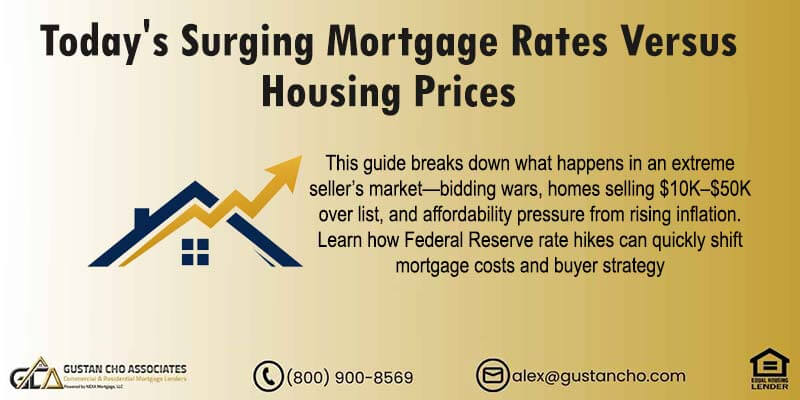
It was an understatement to say it was a seller’s market. The minute a house was lister, dozens of buyers were bidding on the house. Homes selling $10,000 to $50,000 over list price was the norm. Inflation soared to double digits with no signs of retraction. The Federal Reserve Board was in a panic mode and started increasing rates.
The Difference Between Buyers and Sellers Markets
Surging home prices have taken a break but demand for homes still remains strong. Today, rates are over 7.0% PLUS 2 to 4 discount points. In the following paragraphs, we will cover and discuss mortgage rates versus housing prices and whether rates will soon be dropping. Inflation rates are soaring and many would-be homebuyers are afraid of pulling the trigger in buying a house for fear home prices will plummet.
The Surge in Home Prices Post-COVID ERA
There is a definite correlation between mortgage rates versus housing prices. Home prices have been increasing for the past 3 years.
Many Americans were hoping there would be a housing market correction when the coronavirus outbreak broke out in February 2021. However, home prices went in the opposite direction and surged upwards.
Home prices have gone up between 40% to 50% in the past two to three years. Many homeowners are sitting in a lot of equity right now. However, those unfortunate Americans who could not have a chance to buy a home are contemplating whether to buy a home now or wait and hope home prices drop.
Will Real Estate Prices Go Down to Affordable Levels?
In many areas, home prices appreciated double digits year after year despite the highest mortgage rates since the 2008 Housing Meltdown. The Federal Reserve Board have made no secret they are going to be increasing interest rates in the months to come to combat inflation. The news of the Feds and surging inflation have skyrocketed mortgage rates to an all-time high since the 2008 Financial Collapse. Mortgage rates are at a twenty-year high. In April 2021, mortgage rates were at a low of 2.25%.
Comparing Mortgage Rates versus Housing Prices Today
Back in early 2019, Federal Reserve Board Chairman Jerome Powell announced the FEDS will not increase interest rates in the first quarter of 2019. Many pre-approved home buyers were priced out of the housing market due to the combination of high home prices and high rates. Many borrowers were closing their home loans with rates between 5% to 5.75% in 2018. Loan Level Pricing Adjustments were factored into these rates. Today, home prices surged over 40% since 2018 and rates are now over 7.0%. Besides rates north of 7.0%, prime borrowers also need to pay discount points. The home refinance mortgage market is completely dead. What will high mortgage rates versus housing prices be in the near future? Will home prices drop?
An Example Mortgage Payment for a Potential Homebuyer
Let’s say the purchase price of a home is $420,000 with a $42,000 (10%) down payment. This means the estimated mortgage would be $378,000.
- For a 30-year fixed-rate mortgage, the interest would be approximately $2,387 per month.
- If the home’s purchase price drops by 5% to $399,000, the estimated loan amount with a 10% down payment would be $359,100.
- At the same 6.49% fixed interest rate, the mortgage would be $2,267.
- This would represent an approximately $120 monthly savings.
Let’s say the price of a house is kept at $420,000, but the interest rate drops from 6.49% to 5.99%. For a $378,000 mortgage, the estimated payment would be around $2,264 a month.
- A 0.5% reduction in interest rates yields savings in monthly payments similar to a 5% price reduction on the house.
- These numbers are just examples.
- They don’t include property taxes, insurance, mortgage insurance, HOA fees, special assessments, closing costs, or other housing expenses.
Get Pre-Approved Before Rates or Prices Move Again
A strong pre-approval helps you understand your budget, act quickly, and negotiate with confidence when the right home appears.
Why We Don’t See Lower Home Prices With Higher Mortgage Rates
Interest rates affect buyers, but are not the only thing that affects the price of a home.
Less Inventory Means Higher Prices
- The ratio of homes for sale and qualified buyers greatly determines home prices.
- If demand for homes exceeds the number of homes for sale, the seller has the upper hand in negotiations.
- Buyers may submit multiple offers on a home, even when rates are high.
- This is why home prices in Chicago can keep rising, even when not many homes are selling.
Homeowners Who Refinanced When Rates Were Low May Be Stuck
Because many homeowners refinanced to lower their mortgage rates (or bought homes) in a lower-mortgage-rate environment, they may be hesitant to sell, since they would likely need to give up their lower mortgage rate to finance the purchase of a new home at the prevailing higher mortgage rates. Because of this, many homeowners decide to stay put. In real estate, this is called the “rate-lock effect,” which means there are fewer homes for sale than usual.
New Construction May Not Meet Local Demand
Development of new housing may be constrained by land costs, construction financing costs, labor and building materials, local building and zoning regulations, and the timeframe required to obtain approvals. New construction may also be focused on price ranges or in localities that may be out of reach for most first-time homebuyers. In these situations, the new housing supply is insufficient to meet the demand needed to lower existing home prices.
Local Employment and Household Demand Matter
Housing Prices in Chicago May Also Be Affected By:
- Local employment and income
- The movement of population and the formation of households
- The accessibility of transportation
- The quality of school districts
- Property Taxes
- Insurance Costs
- Demand from investors
- The rental market
- The redevelopment of neighborhoods
Because of all these factors, mortgage rates can affect different types of properties and neighborhoods in different ways.
Forecast on Mortgage Rates versus Housing Prices
Mortgage rates keep on increasing despite bad economic news and soaring inflation numbers. Home prices have somewhat slowed, but demand still remains strong. Benchmark par 30-year fixed mortgage rates hit an all-time high at 6.52%. Rates have been increasing the past few weeks after FEDS Announcing inflation is soaring and expected higher rates. Last week, the mortgage hit a 20-year high again at 6.54%. This week mortgage rates of 6.52% hit a 20-year high again beating last week’s 6.34%. 15-year fixed rates hit 5.93%.
When Will Mortgage Rates versus Housing Prices Stabilize?
Par mortgage rates will no doubt be heading towards the 8.0% mark in the coming weeks. Par conforming rates for prime borrowers with 740 FICO with a 20% down payment will no doubt be over 6.50%.
Other loan programs such as FHA, VA, and USDA mortgage rates follow conforming mortgage rates. Pricing adjustments need to be added to par mortgage rates.
Loan Level Pricing Adjustments are interest rate hits. Example of pricing adjustments is lower credit scores, type of property, loan size, LTV, DTI, and manual versus automated underwriting.
Comparing Mortgage Rates Over 12-Month Span
The Federal Reserve Board has been increasing rates and to make it worse, Jerome Powell announced the Feds will keep on increasing interest rates. Due to high mortgage rates, refinance applications came to an abrupt halt. Mortgage rates versus housing prices: Rates still remain high for homeowners to realize a net tangible benefit to refinance. Alex Carlucci, a senior loan officer, and an Associate Contributing Editor at Gustan Cho Associates is a housing market and interest rate expert and issued the following statement:
Homeowners Holding Back In Refinancing
Refinance loan applications hit a historic low. This is due to high mortgage rates. There are many borrowers with co-borrowers that need to refinance to take co-borrowers out of the mortgage. Folks who get divorced often need their ex-spouse off the loan. High mortgage rates last year affected many folks who needed to refinance. Although the drop in rates is not significant, it seems like we are making progress.
Will Mortgage Rates Drop Again?
What impact will there be on mortgage rates versus housing prices. Will rates drop again? When is a good time to lock rates in? Nobody can answer these questions.
Rates can easily go back up next month. Or it can continue to drop. Many borrowers lost the chance of getting a mortgage back in 2021 when rates were at historic lows of 2.25%.
According to data from the Mortgage Bankers Association’s weekly survey recently, refinance loan applications came to almost an abrupt halt from last week’s activity. This translates to a 40% decrease in mortgage loan applications from last week. The same data showed only showed a 0.54% increase in home purchase mortgage loan applications.
Does the Federal Reserve Control Mortgage Rates?
The Federal Reserve does not have the direct authority to set 30-year mortgage rates. The Federal Open Market Committee (FOMC) establishes a target range for the Federal Funds Rate, the interest rate at which overnight interbank loans are made, which can impact mortgage rates. However, fixed mortgage rates are determined in the larger bond market and securitized mortgage markets.
The Following Factors Can Affect Mortgage Rates:
- Inflation
- Treasury yields
- Pricing of mortgage-backed securities
- Growth in the economy
- Employment
- Demand
- Financial conditions
- Lender capacity and competition
- Perceived credit and prepayment risks
- If the Federal Reserve lowers rates, mortgage rates might not drop by the same amount or right away.
- Other economic factors can push mortgage rates up, and sometimes the market has already adjusted for the Fed’s changes.
Reasons Your Mortgage Rate Will Differ From Freddie Mac’s Quoted Average
The Freddie Mac average is not a personalized quote; it is a benchmark for the average market rate.
Mortgage Rates Can Be Affected By:
- Credit scores
- Downpayment amounts
- Mortgage-to-Value ratios
- Mortgage programs
- Type of property
- Type of occupancy
- Size of mortgage
- Length of mortgage
- Rate-lock period
- Debt-to-income ratio
- Points
- Underwriting
Type of Mortgage
The Consumer Financial Protection Bureau suggests analyzing different scenarios when comparing mortgages, as interest rates and costs can vary dramatically based on credit scores, down payment amounts, and the type and term of the mortgage.
Interest Rate versus APR
The cost of borrowing money is reflected in the interest rate, and APR includes the interest cost plus certain fees. The overall cost of borrowing is best understood by considering both the interest rate and the APR. In addition to evaluating both numbers, borrowers should pay attention to the itemized fees and the total closing costs. Should Chicago Homebuyers Wait for Lower Rates? There isn’t one answer that fits everyone. No one can predict exactly how rates and prices will change. Instead of guessing, it’s better to focus on your own financial and personal situation when making a decision.
Buying a Home Makes Sense If Buying a Home is a Reasonable Option if Homebuyers Have:
- a solid, documented, and stable income
- a full mortgage payment they can afford
- closing costs and emergency funds
- a commitment to remain at home
- found a home of their choice
- gone through the property tax and insurance
- had home inspection and appraisal issues
- are not counting on a fast refinance
- a fully underwritten mortgage
Mortgage rates might get better in the future, and you could refinance then. But it’s best to think of refinancing as a future option, not as a way to make buying a home affordable right now.
Waiting May Be Wiser When
The Buyer:
- Has unreliable employment or variable income
- Would need to deplete savings to afford closing costs
- Needs to build credit
- Has too much debt
- Plans to move in the near future
- Is unsure about the property or area
- Can’t afford the permanent mortgage
- Is being asked to forgo important rights
- Needs to sort out tax, title, or legal matters
- If you decide to wait, it should be because you want to improve your finances—not because you expect Chicago home prices to drop.
How Chicago Property Taxes Affect Your Affordability
Illinois property taxes impact the ability to finance and the monthly payment. Two homes in Chicago might cost the same but have very different property taxes. Don’t just look at the principal and interest payment when deciding if a home is affordable.
Before You Offer:
- Look at past property tax bills.
- Look at current tax exemptions.
- Check how the property has been assessed.
- Look at pending assessments.
- Look at past tax appeals.
- Assess the likelihood of current exemptions.
- Check for possible tax impacts.
- The lender will use verified property taxes when calculating the monthly housing payment.
Condo Costs Affect Mortgage Approval
The condominium project may also be analyzed to assess the following:
- Adequate Insurance
- Financial Reserves
- Delinquent Association Dues
- Pending Litigation
- Special Assessments
- Commercial Space
- Owner-Occupancy Levels
- Structural or Safety Concern
How To Improve Your Mortgage Rate Without Waiting for the Market
You can’t control the national economy, but you can take steps to improve your own mortgage rate by focusing on things you can change.
Review Credit Before Applying for a Mortgage
Credit scores and histories are an integral part of the mortgage lending process. Therefore, before applying for a mortgage, the prospective borrower should do the following:
- Check all three credit reports
- Correct legitimate reporting errors
- Reduce high revolving credit balances
- Ensure all payments are made on time
- Avoid new credit
- Avoid closing old credit accounts without consultation
- Avoid large purchases prior to closing
- Avoid DTI impacting credit decisions.
- Consult with an experienced mortgage loan officer before making any credit-related decisions, as many actions can negatively impact mortgage credit scores.
Increase the Down Payment When Financially Practical
- A larger down payment reduces the mortgage amount and improves the loan-to-value ratio.
- It may also affect the cost of mortgage insurance and improve the loan’s pricing.
- Sometimes, keeping extra cash for repairs, moving costs, insurance, or emergencies is more helpful than making the biggest down payment possible.
Monthly Debt Obligations
Paying off or reducing certain monthly debts may improve the debt-to-income ratio and increase homebuying power. The biggest debt isn’t always the one you should pay off first. Talk to a mortgage professional to find out which debt will help you qualify for a loan before you move your money around.
Assessing Multiple Loan Estimates
When evaluating Loan Estimates, borrowers should use Loan Estimates for the same loan type, property, down payment, and rate-lock period.
Consider the Following:
- Interest rate
- APR
- Discount points
- Origination charges
- Lender credits
- Mortgage insurance
- Estimated cash to close
- Prepaid expenses
- Rate-lock Details
- According to the CFPB, borrowers should seek multiple Loan Estimates to identify variations in mortgage costs and terms.
Should Discount Points Be Purchased to Decrease the Mortgage Rate?
Discount points are fees that a borrower pays to purchase a lower mortgage interest rate. Each point costs 1% of the mortgage loan amount, and one point does not guarantee a rate decrease. The reduction of the rate will depend on the pricing of mortgage loan offerings and the specifics of the mortgage transaction. For example, if a borrower has a $400,000 mortgage and purchases 1 point, they pay $4,000 to reduce the interest rate on their loan. To determine what the approximate break-even period for that borrower is, divide the cost of points by the amount by which the payment is decreased. If points cost $4,000 and the payment is decreased by $100, then the break-even period is 40 months. If the borrower does not refinance, sell, or pay off the mortgage in the 40-month period, then purchasing points is financially beneficial. If the borrower plans to refinance, sell, or pay off the mortgage in less than that time, then purchasing points is financially detrimental.
How The Economy Affects Mortgage Rates versus Housing Prices
After President Trump took office, the economy has been hot. The United States has the lowest unemployment rate in decades. Economic numbers are setting historical records year after year. The Dow Jones Industrial Average was strong and there was no market volatility. The housing market was booming with no signs of a correction. Inflation was at a steady pace at 2%.
Surging Mortgage Rates versus Housing Prices
The Federal Housing Finance Agency (FHFA) has increased conforming loan limits to $647,200 for 2022 due to high home prices. HUD, the parent of FHA, followed FHFA and increased FHA Loan Limits to $420,680 due to high home prices.
When we have an uncertain economy under the Biden administration. The Federal Reserve Board normally increases rates to slow the economy down.
This is what happened in 2018 when the FEDS increased interest rates four times. Nobody knows what mortgage rates are headed to in the coming days, weeks, or months. Home buyers and homeowners should take the low mortgage rates versus housing prices today to lock in their home loans. We will be watching the impact on mortgage rates versus housing prices.
Can Seller Credits Help With Higher Mortgage Rates?

Depending on the mortgage program, the contract, the appraisal, and contribution limits, seller credits may be applied to certain closing costs, prepaid items, or an interest-rate buydown. Seller credits are typically not provided to the homebuyer in cash and cannot exceed the buyer’s costs.
Permanent Mortgage Rate Buydown
In a permanent buydown, funds are used to buy down the note rate for the life of the mortgage. The cost of the buy-down should be weighed against the monthly savings and the expected duration to breakeven.
Temporary Mortgage Rate Buydown
With a temporary buy-down, the mortgage rate does not change, but the borrower is required to make reduced payments for a certain period. Typically, a borrower will be required to pay the full mortgage rate after the temporary buy-down period, and the buy-down will not be a factor in qualifying for the mortgage.
Mortgage Programs for Chicago Homebuyers
Choosing the right mortgage program can make a bigger difference in affordability than a small change in national interest rates.
Conventional Loans
Conventional loans may be a good option for borrowers with good credit, a reliable income, and the ability to make a down payment and cover closing costs. The cost of a mortgage and mortgage insurance may be influenced by a credit rating, the loan-to-value ratio, occupancy, and the type of property.
FHA Loans
If you have a low credit score or not much money for a down payment, an FHA loan could be a good option. FHA loans include insurance that protects lenders, so they’re often easier to qualify for. Be sure to compare the total payment to what you’d pay with a conventional loan.
VA Loans
If you’ve served in the military or are the surviving spouse of someone who has, you might qualify for a VA loan. VA loans don’t focus only on your credit score.
USDA Loans
USDA loans help people buy homes in certain areas. Most rural parts of Illinois qualify. There are a lot of assistance programs, eligibility requirements, and loan underwriting restrictions for a USDA loan.
Jumbo Mortgages
If a loan exceeds the amount set by lending rules, a Jumbo Mortgage is needed. Lenders offering jumbo loans look closely at your credit history. Interest rates for jumbo loans can vary a lot between lenders.
Non-QM and Alternative Mortgage Programs
If you can’t get a loan because you don’t have traditional income documentation, there are still other options available. Some of these options include Bank-statement loans, 1099-only Mortgages, Profit-and-loss statement loans, Asset-depletion loans, DSCR investment-property loans, and Recent-credit-event programs. Non-QM loans usually cost more because they have stricter requirements and higher interest rates. Investing in Chicago Mortgage rate and housing price are only two of the many factors Chicago real estate investors must evaluate when investing in a property.
Here are Some Items Which May Form Part of a Detailed Investment Analysis:
- Expected monthly rent
- Vacancy allowance
- Property taxes
- Insurance
- Repairs
- Maintenance
- Capital improvements
- Association dues
- Management costs
- Financing costs
- Closing costs
- Operating income
- Cash-on-cash return
- Debt-service coverage
- Emergency reserves
A cheap property can end up losing money if the rent doesn’t cover taxes, repairs, vacancies, or loan payments. A property should be suitably stressed with a conservative approach to rentals and costs by investors using DSCR loans, conventional investment-property loans, bank-statement loans, or commercial financing.
Things To Consider Before Putting In Your Chicago Home Offer
Prior to signing a real estate contract, the mortgage loan officer should be able to answer the following:
- What is my approximate payment if payments start today?
- Is the payment all-inclusive of taxes, insurance, and mortgage insurance?
- Is the rate quoted in a locked position, or is it floating?
- Are discount points part of the offer?
- How long will the rate remain locked?
- What is the cost of borrowing in relation to the return?
- How much will I need to provide to close?
- Will the property I want to purchase negatively impact the quoted rate?
- Is the offer I want to close on a seller credit?
- Will I become eligible to borrow more if I pay down my debt?
- What is the best payment to use if I need to perform a financial stress test?
- Does the condominium or homeowners association need to approve my offer?
- A fully reviewed preapproval is based on my income, assets, verified credit, my debt, and my employment, whereas a preliminary qualification is based on an online calculator.
- Therefore, I have more confidence in a fully reviewed preapproval.
Final Remarks on Housing Costs Compared to Mortgage Costs
There’s no single right answer when you compare mortgage costs and housing costs for a specific home. Purchasing at a lower price means borrowing less, which may lead to better equity positions. Lower mortgage rates reduce monthly payments and the total cost of the mortgage over the long term.
Also, rates may drop, improving purchasing power. However, as rates drop, more people may qualify for and obtain mortgages, resulting in more competition, which may reduce concessions and increase prices.
There is also no guarantee pricing will drop over time. The best choice is to buy a home that fits your needs and is affordable at today’s rates. If you’re thinking about refinancing later, don’t count on changes in equity as your main reason to buy now. Overlays, foreclosures, and bankruptcies may cause you to be denied a mortgage. If you have encountered these issues, Gustan Cho Associates may offer an alternative. Gustan Cho Associates may be contacted at 800-900-8569.
How Soon After I Get Preapproved Can I Expect to Receive a Mortgage?
Can the Mortgage Rate Change After I Get Preapproved?
Yes, because the rate isn’t locked when you get preapproved. Rates may change after you are preapproved and before you secure a rate. Be advised of the rate, how long the rate is secured for, and if any additional costs will be incurred, especially if the deal is delayed.
Can a Seller Help Pay for Discount Points?
Depending on the specific loan program, purchase contract, appraised value, and the buyer’s eligible expenses, a seller may assist with paying discount points or covering certain closing costs. It is best for the mortgage loan officer to confirm the feasibility of such a contribution before the buyer makes a purchase offer.
What are the Options When the Appraisal is Less Than the Purchase Price?
A low appraisal may require the buyer and seller to negotiate a purchase price, challenge the appraisal by submitting a competing appraisal, modify the payment terms, or the buyer may pay the difference. This will largely depend on the specifics of the sales contract, the appraisal and financing contingencies, the loan program, and the parties’ willingness to negotiate.
Why is the APR Different?
The loan interest rate represents the cost of the loan principal. The APR represents the interest rate plus other loan costs, such as discount points and a mortgage broker fee. The APR allows a borrower to compare costs among loan options; however, a borrower should fully review the Loan Estimate.
Am I Locked into My Old Mortgage Contract Until Rates Improve?
The borrower must refinance in order to obtain a new mortgage. This requires the borrowing party to meet the credit, income, debt, and other requirements of the mortgage contract at closing. The cost to refinance and the time it will take to make the new loan’s costs equal to the old loan’s must also be considered.
Will My Home Appraise for Less with Interest Rates Going Up?
Not right away. Appraisers consider the property itself, recent sales, the state of the market, the property’s location, the property’s condition, and valuation methods. Rising mortgage rates may slow sales and reduce comparable sales, but this will not directly or automatically decrease appraised value.
Mortgage Disclosure:
Rates, Loans, and qualification metrics will change with no notice. This is for education only and is not a legal commitment. Final lending will be based on credit and the underwriting of the loan chosen.
This guide on Mortgage Rates versus Housing Prices was written by Gustan Cho, NMLS 873293, senior loan officer and associate contributing editor at Gustan Cho Associates We will keep our viewers posted on the impact of today’s surging mortgage rates versus housing prices.
Know Your Real Monthly Payment Before You Shop
A lower home price does not always mean a lower payment if rates are higher. We’ll estimate principal, interest, taxes, insurance, HOA, and mortgage insurance so you know the true cost.