
Veteran Administration loans, more commonly called VA loans, are one of the most valuable home financing benefits available to eligible service members, veterans, and some surviving spouses. Backed by the U.S. Department of Veterans Affairs, these loans are designed to make homeownership more accessible with features such as no down payment in many cases, no monthly mortgage insurance, and flexible qualifying standards.
Many borrowers find it surprising to discover that VA loans can be more lenient compared to other mortgage options. Depending on the full loan file, eligible borrowers may qualify with moderate credit, limited savings, or higher debt levels than they expected. That is one reason VA loans remain a popular option for first-time homebuyers and returning homeowners alike.
In this guide, you will learn what Veteran Administration loans are, who may qualify, how the process works, what costs to expect, and what to watch for before applying. If you are exploring your VA home loan benefit for the first time, this overview will help you understand the program step by step.
What Are Veteran Administration Loans?

Veteran administration loans, also known as VA home loans, are mortgage loans insured by the U.S. Department of Veterans Affairs. The VA does not lend the money directly. Instead, loans are funded by authorized private lenders, such as banks and mortgage firms. At the same time, the VA provides a guarantee for a portion of the loan in the event of default.
Because of this government guarantee, lenders can offer veteran administration loans with more flexible terms than most other mortgage programs. These loans are designed to reward military service by making homeownership easier, safer, and more affordable.
How Veteran Administration Loans Work
When you apply for VA loans, your lender reviews your income, credit, assets, and military eligibility. The VA sets the core guidelines, including service requirements and residual income standards. As long as the lender follows VA guidelines, the VA will guarantee the loan if it ever defaults.
This guarantee reduces the risk for lenders. Because of this, they can offer VA loans without requiring a down payment, no monthly mortgage insurance, and some very competitive interest rates. You still make a standard principal and interest payment every month, just like any other mortgage, but your costs are usually lower.
Who Is Eligible for Veteran Administration Loans?
Not everyone is eligible for Veterans Administration loans. You must meet specific service and eligibility rules set by the Department of Veterans Affairs. In general, you may qualify if you fall into one of these groups:
- Eligible veterans with enough qualifying service time and an honorable discharge.
- Active-duty service members with the required length of service.
- Certain members of the National Guard and Reserves.
Some spouses of veterans who passed away while serving or from injuries related to their service are still eligible for benefits.
Service Requirements for VA Loans
The service requirements for VA loans depend on when and how you served, so the exact rules can vary by borrower. In general, VA loan eligibility may apply to eligible veterans, active-duty service members, certain National Guard and Reserve members, and some eligible surviving spouses. Final eligibility is typically confirmed through the Certificate of Eligibility (COE) rather than relying solely on a short summary.
Here are the general categories many borrowers fall into:
- Veterans: Many veterans may qualify if they meet the VA’s service requirements and were discharged under conditions other than dishonorable.
- Active-duty service members: Active-duty borrowers may qualify after meeting the required service threshold and documenting current service.
- National Guard and Reserve members: Eligibility is based on qualifying Guard or Reserve service, including certain periods of federal active service or qualifying full-time National Guard duty.
- Eligible surviving spouses: Some surviving spouses may qualify for a VA-backed home loan benefit, but the rules are case-specific. The best way to confirm this is through the VA’s surviving-spouse eligibility guidance and the COE process.
If you are unsure whether you qualify, treat this section as general guidance only. The most reliable next step is to confirm eligibility with the VA or obtain a Certificate of Eligibility.
Certificate of Eligibility (COE)
A Certificate of Eligibility, or COE, is the document that shows a lender you qualify for a VA-backed home loan based on your service history and duty status. It is one of the first documents needed in the VA loan process because it confirms basic eligibility for the benefit.
There are several common ways to get a COE:
- Online through VA.gov: Many eligible borrowers can request, view, or download their COE directly through the VA website.
- Through a lender: In many cases, a lender can request the COE through the VA portal during pre-approval.
- By mail: Borrowers can also complete VA Form 26-1880 and send it to the appropriate VA regional loan center. Mail requests may take longer than requesting online or through a lender.
If a COE is not issued right away, that does not automatically mean the borrower is ineligible. It may mean the VA needs more documentation to review the request.
Many borrowers choose to have their lender help request the COE during pre-approval, but the important point is that the COE confirms eligibility and helps move the VA loan process forward.
Key Benefits of Veteran Administration Loans
Veteran administration loans offer several major benefits that are hard to match with other mortgage programs:
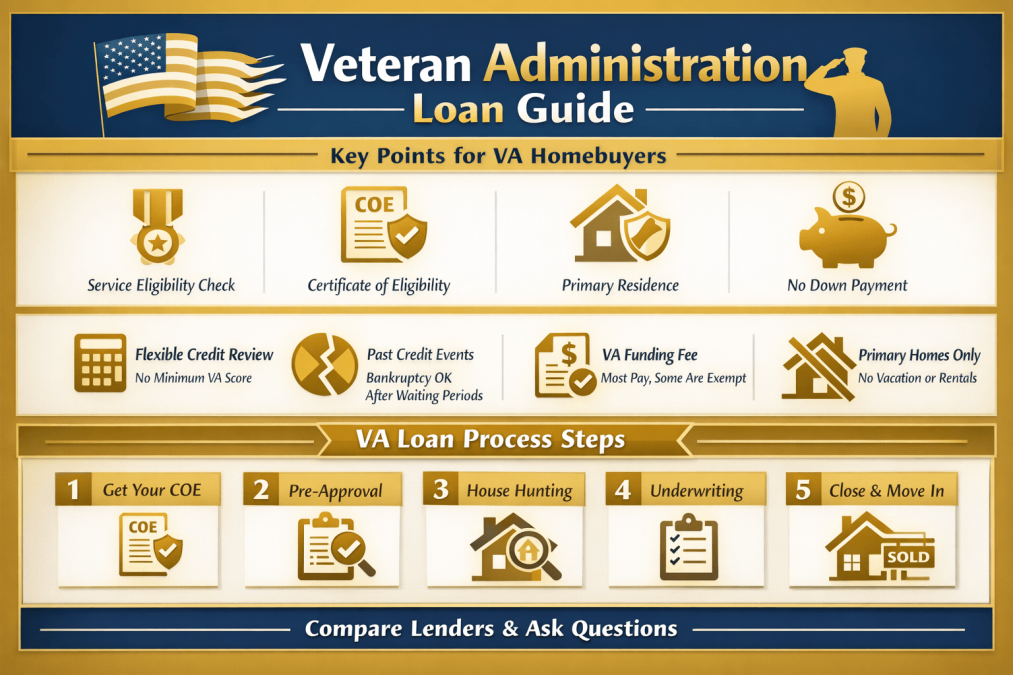
- No down payment required: You can usually get a loan that covers the entire cost of the house.
- No monthly mortgage insurance: VA loans don’t come with the monthly mortgage insurance fee that FHA and many conventional loans do.
- Competitive interest rates: VA-backed loans often have lower rates than similar conventional mortgages.
- Flexible credit guidelines: There is no official minimum credit score requirement set by the VA.
- High loan amounts: There is no official maximum VA loan limit for eligible borrowers with full entitlement.
- Assumable loans: In many cases, a future buyer can assume your VA loan, which can be a big advantage if rates rise.
These benefits make veteran administration loans especially attractive for first-time homebuyers, buyers with limited financial resources, and veterans recovering from past credit or financial difficulties.
Disabled Veteran? You May Save Even More
See if you qualify for VA funding fee exemptions and special benefits
Credit, Debt-to-Income, and Bankruptcy Guidelines
One of the reasons veteran administration loans are so powerful is their flexibility with credit and debt-to-income ratios compared to other loan types.
Credit Score Guidelines
VA loans are often more flexible than many borrowers expect when it comes to credit. The program does not rely on a single universal credit score rule, as many borrowers assume. Instead, lenders usually review the overall file, including recent payment history, current obligations, income stability, and the strength of the application as a whole.
That said, lender standards can still vary. Some lenders apply stricter internal credit requirements than others, even when working within VA loan guidelines. This is one reason two borrowers with similar credit profiles may receive different answers from different lenders.
For many applicants, the most important point is that a credit score is only one part of the review. A borrower with past credit challenges may still have a path forward if the rest of the file shows stability, acceptable income, and the ability to handle the proposed housing payment.
Debt-to-Income and Residual Income
There is no hard maximum debt-to-income (DTI) ratio set by the VA for veteran administration loans. Instead, the VA focuses on residual income. Residual income is the money left over each month after you pay your mortgage, taxes, insurance, and all other debts and obligations.
If your residual income meets VA standards for your family size and region, it is possible to get approved for VA loans with higher DTIs than other programs allow. Our team works with many veterans who have been turned down elsewhere due to high DTI but qualify through the VA residual income rules.
Collections, Charge-Offs, and Bankruptcy
VA guidelines are often more flexible than many borrowers expect when it comes to past credit events. Instead of focusing on one isolated issue, lenders usually look at the overall picture, including recent payment history, current income, and whether the borrower has re-established financial stability.
Collections and charge-offs: In some cases, older collections or charged-off accounts may not need to be paid before closing, especially if they do not materially affect the borrower’s ability to qualify. What matters most is how those accounts affect the overall loan profile and underwriting decision.
Chapter 7 bankruptcy: Many borrowers may become eligible for a VA loan after a sufficient period has passed since discharge and after they have re-established satisfactory credit habits.
Chapter 13 bankruptcy: Some borrowers may qualify while still in a Chapter 13 repayment plan if they have made a sufficient number of on-time payments and meet any required court or trustee approval standards.
Because these situations can vary by file, borrowers with prior credit events should not assume they are automatically disqualified. The best approach is to have the full file reviewed based on current income, payment history, and overall loan strength.
Why Lender Guidelines Can Vary on VA Loans
Not every lender evaluates VA loans the same way. While the VA sets the core framework for the program, some lenders apply stricter internal standards on top of those guidelines. That can affect how they view credit scores, debt ratios, past credit events, or documentation requirements. As a result, borrowers who are declined by one lender may still have options elsewhere.
Property and Occupancy Rules for Veteran Administration Loans
VA loans are intended primarily for owner-occupied homes, meaning the borrower is expected to use the property as a principal residence rather than a vacation home or purely an investment property. In most cases, the borrower must certify that they intend to occupy the home within a reasonable time after closing, and VA guidance generally uses 60 days as the standard expectation.
The property must also meet the VA’s Minimum Property Requirements (MPRs), which set basic standards for safety, soundness, and sanitation.
Eligible property types can include:
- Single-family homes
- Certain VA-approved condominiums
- Some manufactured homes that meet VA requirements
- Multi-unit properties with up to four units, as long as the borrower lives in one of them
Because property eligibility and occupancy details can vary by loan scenario, borrowers should treat this section as general guidance and confirm specifics during pre-approval and underwriting.
Funding Fee and Closing Costs on Veteran Administration Loans
If you’re getting a VA-backed home loan, you’ll probably have to pay a VA funding fee. It’s a one-time charge from the Department of Veterans Affairs.This fee helps support the VA home loan program. It reduces the need for monthly mortgage insurance, which is one reason VA loans can be so attractive compared with many other mortgage options.
The amount of the funding fee depends on several factors, including:
- whether the loan is a purchase, cash-out refinance, or other VA loan type
- whether this is the borrower’s first use or subsequent use of the VA home loan benefit
- the size of the down payment, if any
Many borrowers choose to finance the funding fee into the loan amount instead of paying it out of pocket at closing.
Some borrowers don’t have to pay the funding fee. This usually includes veterans who are getting VA compensation for a service-related disability, certain surviving spouses, and some service members with qualifying ratings.
In addition to the funding fee, borrowers should still expect standard closing costs, including title charges, recording fees, prepaid taxes, homeowners’ insurance, and other settlement-related expenses. Some of these costs may be offset through seller concessions or lender credits, depending on the transaction.
How to Apply for Veteran Administration Loans: Step-by-Step
Applying for a VA loan usually follows a straightforward process. While details can vary by lender and borrower profile, most applicants can expect these core steps:
1. Confirm Your Basic Eligibility
Start by reviewing your service history, discharge status, and whether you may qualify for VA home loan benefits. This helps you understand whether the program is a fit before you move deeper into the mortgage process.
2. Obtain your Certificate of Eligibility (COE)
The COE shows that you meet the VA’s basic eligibility requirements. Many borrowers receive this from their lender during pre-approval, while others request it directly from the VA.
3. Gather Income, Asset, and Housing Documents
Many lenders typically request paperwork like pay stubs, W-2 forms, tax returns if applicable, bank statements, and identification. Preparing these documents in advance can accelerate the pre-approval process and help avoid delays down the line.
4. Complete a Mortgage Pre-Approval
During pre-approval, the lender reviews your credit score, income, debts, and overall loan situation. This helps figure out how much you can afford and shows sellers that you’re a genuine buyer.
5. Shop for a Home Within Your Budget
Once you are pre-approved, work with a real estate agent to find a home that fits your needs and meets all the VA occupancy and property requirements.
6. Make an Offer and Begin Loan Processing
After your offer is accepted, the lender orders the appraisal, updates documents as needed, and submits the loan for underwriting review.
7. Satisfy Underwriting Conditions
The underwriter may request updated statements, explanations, or other supporting documents before issuing final approval. Responding quickly can help keep the closing on track.
8. Close on the Home and Move in
Once the loan is cleared to close, you sign the final documents, complete the transaction, and receive the keys to your new home.
If you want help reviewing your eligibility, COE, or pre-approval options, Gustan Cho Associates can walk you through the VA loan process step by step.
Why Choose Gustan Cho Associates for Veteran Administration Loans?
Not every lender approaches Veteran Administration loans the same way. While the Department of Veterans Affairs sets the basic framework for the program, lenders may still apply their own internal standards for credit, debt ratios, documentation, and past credit events.
This means one borrower may receive different answers from different lenders, even when applying for the same type of VA loan. In some cases, the difference comes down to how a lender interprets risk, reviews the full file, or applies internal guidelines on top of the base program requirements.
For borrowers, the key takeaway is simple: a denial from one lender does not always mean the loan is impossible. It may mean the borrower needs a lender with a different credit policy, stronger VA loan experience, or a more flexible approach within program guidelines.
That is why it is important to compare options, ask questions, and work with a lender that clearly explains how they review VA loan files. At Gustan Cho Associates, we help borrowers review VA loan options and understand how lender guidelines can vary from one lender to another.
Ready to Use Your VA Home Loan Benefit?
Get a step-by-step walk-through from our Veteran Administration Loans: Complete VA Home Loan Guide team
Final Thoughts
Veteran administration loans remain one of the strongest benefits offered to our nation’s heroes. By using VA loans the right way, you can buy a home with little to no money down, flexible credit guidelines, and long-term payment stability. These veteran administration loans are designed to honor your service by opening the door to affordable homeownership.
Frequently Asked Questions About Veteran Administration Loans:
Do Veteran Administration Loans Require a Down Payment?
In most cases, Veteran Administration loans do not require a down payment. That is one of the biggest advantages of the VA home loan program. Still, a down payment can sometimes reduce the VA funding fee, and some borrowers may choose to put money down to lower their loan amount or monthly payment.
What Credit Score Do You Need for Veteran Administration Loans?
The VA does not set one universal minimum credit score for all VA-backed home loans. Instead, lenders review credit, income, occupancy, and the overall loan file. That said, many lenders apply their own internal credit standards, which is why credit score expectations can vary from one lender to another.
Who Pays the VA Funding Fee, and Can It Be Waived?
Most borrowers using Veteran Administration loans pay a one-time VA funding fee. This fee helps keep the program running since VA loans usually don’t need a down payment or monthly mortgage insurance. Some borrowers are exempt, including many veterans receiving compensation for a service-connected disability and certain eligible surviving spouses.
Can You Use Veteran Administration Loans More Than Once?
Yes. In many cases, eligible borrowers can use Veteran Administration loans more than once. The benefit is reusable, although entitlement, prior loan payoff status, and the type of transaction can affect how the next VA loan works.
Can Veteran Administration Loans Be Used for Investment Properties or Vacation Homes?
No, Veteran Administration loans are intended for primary residences, not for vacation homes or purely investment properties. Usually, the borrower has to promise to move into the property as their main home soon after closing.
Is It Hard to Qualify for Veteran Administration Loans?
Veteran Administration loans are often easier to qualify for than many borrowers expect, especially because they offer features like no down payment and no monthly mortgage insurance. Approval still depends on meeting lender and VA requirements for income, credit, and occupancy, but many eligible borrowers find the program more flexible than other loan types.
This article about “Veteran Administration Loans: Complete VA Home Loan Guide” was updated on March 11th, 2026.
First Time Using Your VA Benefit?
Use this Complete VA Home Loan Guide to go from “just curious” to fully approved