The appraisal transfer policy is a set of rules that let you move your home appraisal from one lender to another. Changing mortgage lenders often allows an appraisal to be transferred. The appraisal transfer policy will vary by loan program and the requirements of the receiving lender. FHA and VA loans will have specific transfer processes, and conventional lenders will fall under Fannie Mae and Freddie Mac guidelines and appraisal-independence rules. Non-QM lenders will have their own rules. Even with a transfer, the new lender will have to review and accept the appraisal.
What Is an Appraisal Transfer?
A transfer of appraisal occurs when a borrower’s lender changes, and the original appraisal can be transferred to the new lender before closing. Each individual lending program has its own appraisal transfer policy. Typically, a transfer means the new lender is not required to approve the original appraisal or the mortgage. The new lender will review the appraisal and ensure that the loan complies with the relevant program, investor, and lender guidelines. Often, the appraiser does not simply alter the name on the report. FHA, VA, USDA, Fannie Mae, and Freddie Mac all have their own requirements around appraisals when a borrower’s lender changes.
FHA Appraisal Transfer Policy
FHA has specific rules governing the transfer of an appraisal when a borrower moves an FHA loan to a new lender. According to applicable federal regulations and HUD instructions, lenders must transfer an existing appraisal to a new lender within 5 business days upon the borrower’s request. HUD also allows the original lender, if the appraisal cost has not been recouped, to retain the report and delay transferring it until the cost is recovered. Thus, the original appraiser is not obligated to send the report to the new lender, and there is no requirement to redo the appraisal if a new FHA lender takes over the loan.
Can the New FHA Lender Have the Appraisal Readdressed?
The incoming FHA lender cannot ask the appraiser to revise the appraisal to address the new lender. The new lender is required to review the appraisal as is. If the lender notes deficiencies in the appraisal and cannot accept it as is, HUD mandates that the lender procure a new appraisal rather than have the report readdressed. This is important to note as transferring an FHA appraisal does not guarantee the second lender will accept it.
How FHA Case Number Transfers Work
FHA case number transfers and FHA appraisal transfers are different, but related. HUD mandates the original mortgagee to assign the FHA case number to the new mortgagee through the Case Transfer function in FHA Connection. HUD states that the original mortgagee must complete the case-number transfer at the borrower’s request. The borrower cannot complete the transfer in FHA Connection. Rather, this is between the FHA-approved lenders. The transfer of case numbers and processing documents cannot be charged to the borrower. HUD says the original and new mortgagees have the right to negotiate certain fees related to providing processing documents.
FHA Case Transfer Does Not Transfer the Loan Approval
Moving the FHA case number to another lender does not automatically transfer the original lender’s loan approval decision. As with any other lender, the new lender will have to conduct its own borrower qualification process, review the appraisal, verify the documents, and confirm that the mortgage meets the requirements of the FHA as well as the lender’s underwriting criteria.
VA Appraisal Transfer Policy
VA allows a Veteran to change lenders after a VA appraisal has been ordered or completed. The Veteran must request a change in the lender in writing. The original lender is responsible for facilitating the transfer and cannot simply refuse to do so because the Veteran has chosen to use another lender.
How a VA Appraisal Transfer Works
The original lender’s Staff Appraisal Reviewer (SAR) can transfer the appraisal case to the receiving lender via WebLGY. The receiving lender should provide its VA lender identification number and contact information so the case can be assigned correctly. The transfer moves the appraisal case to the new lender, but it does not transfer the original lender’s underwriting decision, loan approval, interest rate, or loan terms. The receiving lender must complete its own review of the borrower, property, and appraisal.
The VA Notice of Value Does Not Transfer
A Notice of Value issued by the original lender does not transfer to the receiving lender. After reviewing the appraisal, the receiving lender must issue a new NOV through WebLGY. If the receiving lender does not participate in the Lender Appraisal Processing Program, it should contact VA Construction and Valuation for assistance with the transfer and issuance of the new NOV. Changing VA lenders does not automatically require another appraisal. However, the receiving lender must review the transferred report and determine whether it satisfies current VA requirements.
How Does the Requested Transfer Affect the VA Notice of Value?
The VA Notice of Value (NOV) must also be considered separately. A NOV issued by the original lender’s SAR will not transfer to a new lender. When a case is transferred to a new lender who is a part of the LAPP program, the new lender’s SAR must review the appraisal and issue a new NOV. If the new lender is not part of LAPP, the lender change request must be handled by the appropriate VA Regional Loan Center, which then issues the NOV. Changing VA lenders do not necessarily require another property appraisal. However, the receiving lender must still comply with certain requirements to have the right to rely on the existing valuation.
USDA Appraisal Transfer Policy
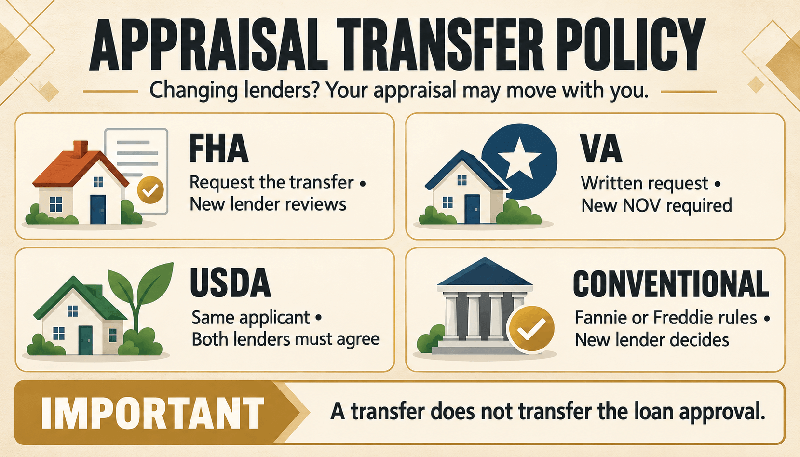
USDA allows an appraisal ordered through one lender to be transferred to another lender for the same applicant. However, the original lender must agree to release the appraisal, and the receiving lender must accept responsibility for reviewing and relying on the report. An appraisal cannot be transferred from one borrower to another.
The receiving lender must determine whether the appraisal meets current USDA requirements and remains acceptable for the transaction. Transferring the report does not transfer the original lender’s underwriting decision, loan approval, or conditional commitment.
Any required repairs, inspections, corrections, or appraisal updates must still be completed. If an appraisal update is needed, the receiving lender is responsible for engaging the original appraiser. The need for an update does not automatically invalidate an otherwise acceptable transfer. Borrowers switching USDA lenders should provide the new lender with the property address, the original lender’s contact information, the loan number, the appraisal invoice, and any available appraisal documents. The new lender can then determine whether accepting the transferred appraisal will save time or require a new appraisal.
Conventional Appraisal Transfer Rules
Conventional appraisals may also be transferred between lenders. The issue for the receiving lender is whether it can accept the appraisal and comply with Fannie Mae or Freddie Mac requirements, including their appraisal review issues. Fannie Mae permits a lender to use an appraisal obtained through another lender when the report complies with Fannie Mae’s Appraiser Independence Requirements and all other applicable Selling Guide requirements. Fannie Mae also confirms that a lender may accept a transferred appraisal, provided that the Appraiser Independence Requirements and the Selling Guide are met. Freddie Mac similarly states that the responsibility for ensuring compliance with the appraisal independence, appraisal review, and property valuation requirements of the appraisal rests with the lender. Freddie Mac’s current Guide recognizes that appraisals may have been ordered by another lender, with the receiving lender responsible for determining compliance and the appraisal’s acceptability.
The Receiving Lender Makes the Final Decision
A conventional appraisal transfer policy is not the same as automatically having the right to reuse an appraisal. Fannie Mae or Freddie Mac rules permit a transferred appraisal, but receiving lenders must still review the report to determine its acceptability. The lender may reject the appraisal for a variety of reasons, e.g., it may not meet agency, appraiser independence, investor, or the lender’s own documented appraisal policies. As a result, a conventional lender may consider an appraisal complete, but another may require additional review and, even if allowed, a new appraisal.
Switching FHA Lenders? Your Appraisal May Be Transferable
FHA appraisals are often tied to the FHA case number and may be transferred to a new lender when the proper process is followed. Get your file reviewed before ordering another appraisal.Fannie Mae and Freddie Mac Appraisal Age Requirements
The age of a transferred appraisal is measured from the appraisal’s effective date to the applicable loan closing or note date. A report accepted by the original lender may require an update or replacement before the new lender can use it.
Fannie Mae Appraisal Age Requirements
For most Fannie Mae loans:
- If the appraisal is four months old or less, an update is generally not required based solely on its age.
- If the appraisal is more than four months but less than 12 months old, an appraisal update is required.
- If the appraisal is more than 12 months old, the lender must obtain a new appraisal.
- If an appraisal update shows that the property’s value has declined, a new appraisal is required.
Desktop appraisals follow a stricter rule. If the effective date of a desktop appraisal is more than 4 months before the note and mortgage date, the lender must obtain a new appraisal. A standard appraisal update cannot be used to extend the desktop appraisal.
Freddie Mac Appraisal Age Requirements
Freddie Mac has separate appraisal-age requirements. Except for desktop appraisals, an appraisal update is generally required when the appraisal’s effective date is more than 120 days before the note date. The original appraisal and any permitted update cannot be used indefinitely. If the appraisal is outside Freddie Mac’s maximum allowable age, the lender must obtain a new appraisal. A desktop appraisal more than 120 days old generally requires a new appraisal rather than an appraisal update. The receiving lender must confirm that the report and any update satisfy the current Freddie Mac Guide requirements before relying on the transferred appraisal.
Non-QM Appraisal Transfer Policy
There is no uniform Non-QM loan appraisal transfer policy. Non-QM loans are generally underwritten by lenders and/or investors based on the guidelines established by the lenders and/or investors. Some Non-QM lenders are open to appraisals that were transferred. Others may require appraisals to be performed by an approved appraisal management company or vendor. Whether an appraisal is accepted is dependent upon:
- the age of the appraisal;
- the type of property;
- the amount of the loan;
- the format of the appraisal;
- the appraiser or appraisal management company;
- the requirements of the investors; and
- whether the lender is able to review and rely on the report.
Potential borrowers need to know if an appraisal transfer is allowed before assuming that an appraisal need not be ordered again.
Can Desktop and Hybrid Appraisals Be Transferred?
A desktop or hybrid appraisal should not automatically be treated as a traditional appraisal when a borrower changes lenders. The receiving lender must confirm that the valuation method remains eligible for the loan and property. A desktop appraisal is carried out by an appraiser without physically inspecting the property. The appraiser develops the value opinion using available information, including multiple listing service data, public records, photographs, floor plans, and other reliable sources. A hybrid appraisal uses recent property data collected by a trained and vetted property data collector. The collector observes and documents the property’s characteristics and condition. The appraiser then uses that information, along with market data and other sources, to develop the value opinion. The appraiser signing the hybrid appraisal ordinarily does not perform the personal on-site inspection. When a desktop or hybrid appraisal is transferred, the receiving lender must determine whether the original valuation method still meets the agency, investor, appraisal independence, and lender requirements. The fact that the first lender accepted the appraisal format does not require the new lender to accept it.
New Lenders May Have Different Valuation Requirements
The original lender could have determined eligibility for a desktop or hybrid appraisal based on their underwriting analysis and the loan’s characteristics. A borrower is not guaranteed to receive the same valuation option if the original lender is replaced with a new lender. The new lender is responsible for setting their own underwriting parameters and approving the permitted valuation method for the property. This is particularly relevant for desktop appraisals because Fannie Mae states that a new appraisal is required if a desktop appraisal is more than 4 months old.
UAD 3.6 Changes and Conventional Appraisal Transfers
As of September 23, 2026, Fannie Mae and Freddie Mac permit lenders to submit appraisal reports using either UAD 2.6 or UAD 3.6. UAD 3.6 becomes mandatory for new appraisal reports initially submitted to the Uniform Collateral Data Portal on or after November 2, 2026. This deadline applies to conventional appraisal reports submitted through UCDP for Fannie Mae and Freddie Mac loans. It is not a universal November 2 deadline for FHA, VA, USDA, or Non-QM appraisals. Those programs follow their own appraisal systems, implementation schedules, and investor requirements.
What UAD 3.6 Means When Switching Lenders
The UAD transition does not prevent an eligible conventional appraisal from being transferred. When a loan moves to another lender, the receiving lender may use the original lender’s Document File ID and successful Submission Summary Report when delivering the loan to Fannie Mae or Freddie Mac. A receiving lender cannot create a new UCDP submission by reusing another lender’s Document File ID. Instead, the original DocFile ID and successful SSR may be used during loan delivery when the transferred appraisal otherwise meets the applicable agency requirements. If a UAD 2.6 appraisal was successfully submitted to UCDP before November 2, 2026, qualifying revisions may continue to be submitted under the existing DocFile ID during the transition period. The appraisal must still satisfy the applicable age, appraisal independence, review, and loan delivery requirements. The receiving lender remains responsible for determining whether it can rely on the transferred appraisal. The UAD format does not transfer the original lender’s underwriting decision or require the new lender to accept the report.
How to Transfer an Appraisal to a New Lender
Start by telling the new lender that an appraisal has already been ordered or completed. The receiving lender should review the loan program, appraisal date, report format, property type, and available documents before requesting the transfer. The borrower may be asked to provide:
- Borrower’s full name
- Property address
- Original lender’s name and contact information
- Receiving the lender’s name and lender identification number
- Original loan number
- FHA, VA, or other applicable case number
- Appraisal invoice or proof of payment
- Written authorization to transfer the appraisal
Social Security numbers and other sensitive information should only be sent through a secure communication method.
FHA Appraisal Transfer
For an FHA loan, the borrower requests that the FHA case number and appraisal be transferred to the receiving FHA lender. The original mortgagee must transfer the appraisal report within five business days of the borrower’s request, but may withhold the report until it has been reimbursed for the appraisal cost. The receiving lender may collect the appraisal fee and send it to the original lender. The original lender must then refund the appraisal fee that the borrower previously paid. The appraisal does not need to be readdressed to the new lender.
VA Appraisal Transfer
A Veteran changing VA lenders must request the transfer in writing. The original lender is responsible for facilitating the transfer. Its Staff Appraisal Reviewer can transfer the appraisal case to the receiving lender through WebLGY. The original Notice of Value does not transfer. The receiving lender must review the appraisal and issue a new NOV. A lender that does not participate in the Lender Appraisal Processing Program should contact VA Construction and Valuation for assistance.
USDA Appraisal Transfer
USDA permits an appraisal to transfer between lenders for the same applicant. The original lender must agree to release the report, and the receiving lender must accept responsibility for reviewing and relying on it. The transfer does not move the original lender’s underwriting decision or conditional commitment. Required repairs, inspections, updates, and other property conditions must still be completed.
Conventional and Non-QM Appraisal Transfers
For a conventional loan, the receiving lender must determine whether the appraisal complies with Fannie Mae or Freddie Mac requirements, appraisal-independence standards, and its own review procedures. The lender may request the appraisal report, the XML file, the Submission Summary Report, the appraisal-independence certification, the invoice, or other supporting documents. Non-QM lenders follow their own investor and vendor requirements. Some will review a transferred appraisal, while others require a new report from an approved appraiser or appraisal management company.
How Long Does the Transfer Take?
FHA requires the original mortgagee to transfer the appraisal within five business days after the borrower’s request, subject to the reimbursement rule. VA, USDA, conventional, and Non-QM transfers do not have a universal timeline. The transfer may take longer when payment remains outstanding, the written authorization is missing, lender information is incomplete, or the receiving lender needs additional appraisal documents. Borrowers working under a purchase contract deadline should request the transfer as soon as they decide to switch lenders. An appraisal transfer does not transfer the previous lender’s loan approval, interest rate, rate lock, disclosures, or underwriting decision. The new lender must independently approve the borrower, property, and mortgage.
When the New Lender May Require a New Appraisal
An appraisal that is eligible for transfer is not automatically acceptable to the receiving lender. The new lender must review the report and determine whether it can rely on the appraisal for the proposed loan. A new appraisal may be required when:
- The existing appraisal is outside the program’s allowable age.
- The appraisal format is not eligible for the new loan.
- The report does not meet appraisal-independence requirements.
- Required transfer documents, data files, or certifications are unavailable.
- The appraisal contains material deficiencies.
- The property has changed since the appraisal’s effective date.
- The borrower changes to a loan program with different appraisal requirements.
- The appraisal was ordered by a party that was not permitted to select or engage the appraiser.
- A Non-QM investor requires an approved appraiser, AMC, or valuation provider.
For Fannie Mae loans, an appraisal more than four months but less than 12 months old generally requires an appraisal update. An appraisal more than 12 months old requires a new report. A desktop appraisal more than four months old requires a new appraisal rather than an update. For FHA loans, the receiving lender cannot ask the appraiser to readdress the report. If the receiving FHA lender finds deficiencies that prevent acceptance, it must order a new appraisal.
Does a Low Value Automatically Require Another Appraisal?
A low appraised value does not automatically justify ordering another appraisal. Depending on the loan program and the nature of the problem, the borrower may be able to request a reconsideration of value through the lender. A reconsideration request should identify factual errors, missing property information, or relevant comparable sales. Borrowers, loan officers, real estate agents, and other interested parties should not contact or pressure the appraiser directly. Before paying for another appraisal, the borrower should ask the receiving lender why the transferred report cannot be used and whether an appraisal update, correction, clarification, or reconsideration of value is permitted. If a new appraisal is required, the lender should explain the applicable program, investor, or appraisal-review requirement.
Final Thoughts on Appraisal Transfer Policy
Transferring mortgages and conducting appraisals do not always require starting the whole process again or incurring the cost of a new appraisal.
The appraisal transfer policy will depend on the loan program. FHA and VA have established guidelines for lender changes, and conventional appraisal transfers will depend on the agency’s requirements and the new lender’s approval. Non-QM policies are decided by the lender and investor.
It is very important that the new lender be informed of the appraisal by the potential borrower so that an appraisal is not ordered again. The new lender will determine whether there is a transferable report, whether new appraisal work is necessary, or whether the existing valuation can be used for the new loan. Appraisal transfers do not convey the previous lender’s approval to the new lender. The new lender will review the property and the new borrower for a mortgage based on their requirements.
Appraisal Transfer Policy FAQs
If I Paid for the Appraisal, Do I Own it?
Paying the appraisal fee does not make you the appraiser’s client or give you the authority to assign the report to another lender. The lender that ordered the appraisal is generally the client. However, for a loan secured by a first lien on a home, the lender must provide you with a free copy of the appraisal or other written valuation.
Can a Seller’s Appraisal or a Private Appraisal be Used for My Mortgage?
Usually not. A pre-listing appraisal, a tax-appeal appraisal, or an appraisal ordered privately by the buyer may provide useful information, but mortgage lenders generally require that the appraisal satisfy appraisal-independence and lender-engagement requirements. For example, Fannie Mae does not permit a lender to accept an appraisal selected or ordered by the borrower, real estate agent, mortgage broker, or loan officer.
Can I Keep the Same Appraisal if I Change Loan Programs?
Possibly, but an appraisal that works for one loan program may not satisfy another program’s requirements. Changing from conventional financing to FHA, VA, or USDA financing may introduce different requirements for appraiser eligibility, property condition, reporting, case numbers, or reviews. Ask the new lender to evaluate the existing appraisal before changing programs or paying for another report.
Can a Purchase Appraisal be Reused for a Refinance?
Do not assume it can. The new lender must determine whether the appraisal qualifies for the refinance transaction, remains within the applicable age limits, and reflects the property’s current condition. Fannie Mae permits an appraisal from a previous transaction to be used for certain subsequent limited cash-out refinances, but only when all of its eligibility conditions are satisfied.
What Happens if the Original Lender Closes or Will Not Cooperate?
Tell the new lender immediately and provide the appraisal company’s name, the appraiser’s contact information, your payment receipt, and any report or tracking number you received. The new lender may try to obtain the required file through the appraisal management company, agency portal, or other available records. If the complete appraisal package and transfer documentation cannot be obtained, a new appraisal may be necessary.
Do Appraisal-Required Repairs Disappear When I Switch Lenders?
No. Transferring the appraisal does not erase property deficiencies, required inspections, or repair conditions identified in the report. The receiving lender must review those findings and may require the repairs or inspections to be completed before closing. For FHA loans, a lender cannot order another appraisal simply to eliminate repair requirements or obtain a higher value.
This article about “Appraisal Transfer Policy: Can You Transfer an Appraisal to a New Lender?” was updated on September 23rd, 2026.