How Secured Credit Cards Can Be Used To Boost Credit Scores For Mortgage Approval
The best and easiest way to rebuild and re-establish credit to qualify for a mortgage is using secured credit cards to raise credit scores and have timely payments on all of your debt payments for the past 12 months.
Learn how using secured credit cards can improve your credit score, strengthen your credit history, and enhance your chances of mortgage approval.
The combination of these two tasks increases your chances greatly to get an approve/eligible per the automated underwriting system. Secured credit cards are the same as unsecured credit cards, except the creditor requires a deposit. The deposit amount is the credit limit the credit card company will issue.
How Secured Credit Cards Can Enhance Your Likelihood of Securing a Mortgage
Using a secured credit card is an effective way for homebuyers to rebuild credit before applying for a mortgage. Many face challenges such as late payments, high balances, collections, bankruptcies, foreclosures, or limited credit history.
When used responsibly, secured cards can generate positive credit activity. Lenders focus on payment history, revolving credit usage, and overall credit management.
According to Fannie Mae, both credit score and revolving credit utilization are key risk factors in mortgage underwriting. Regularly paying down revolving credit and increasing positive activity on credit reports are viewed favorably. Most borrowers seek more than a higher credit score; they want a strong, stable credit profile to support mortgage approval. Secured credit cards, when used as part of a broader strategy, can help achieve this goal.
How Mortgage Borrowers Can Improve Their Scores Using Secured Credit Cards
To get a secured credit card, you pay a refundable security deposit. This lowers the risk for the card issuer, so people with low or no credit can usually qualify. The card issuer usually reports your activity to the major credit bureaus, which helps you build or improve your credit history.
Both the Consumer Financial Protection Bureau and Experian recommend secured credit cards for building credit, provided you use them responsibly.
Every mortgage borrower’s situation is unique, particularly for those with past financial difficulties. If your credit is damaged, waiting alone may not be sufficient. Establishing new, positive credit accounts, such as a secured credit card, can demonstrate responsible credit use and add positive activity to your credit report.
What Are Secured Credit Cards and How Do They Work
A secured credit card requires an upfront cash deposit, typically equal to your credit limit, and functions like a standard credit card. You can make purchases and pay your bill monthly. If the issuer reports to the credit bureaus, timely payments and low balances can help yA secured card is beneficial only when used correctly. Maxing out the card, missing payments, or opening multiple new accounts can harm your credit score. your credit score.
Rebuilding Credit After Bankruptcy and Foreclosure For Mortgage
The team at Gustan Cho Associates has helped thousands of homebuyers rebuild and re-establish their credit after bankruptcy. Most of our clients we helped raise their credit scores to over 700 FICO in less than one year after the bankruptcy discharge date.
Do not apply for unsecured credit cards if your credit scores are under 680 FICO and if you recently filed for bankruptcy, had a recent foreclosure, deed-in-lieu of foreclosure, or short-sale.
A substantial number of our borrowers at Gustan Cho Associates may not be ready to qualify for a mortgage but can qualify after a few quick credit fixes in weeks or months. The team at Gustan Cho Associates will work with borrowers who need credit fixes until they qualify and meet the minimum agency mortgage guidelines. 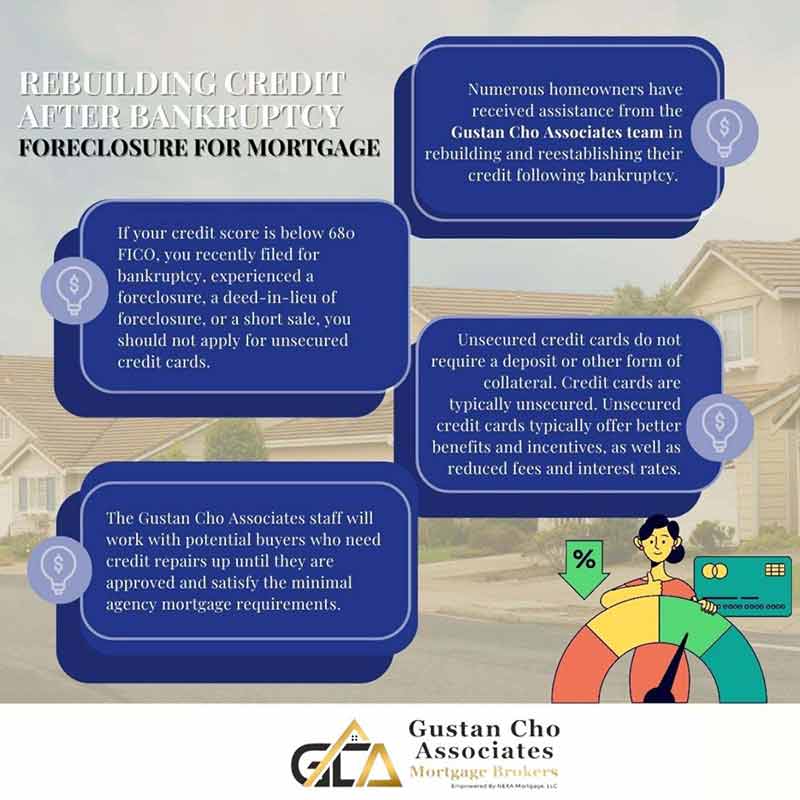
Why Secured Credit Cards Can Help Build Credit for a Mortgage
Secured credit cards help build credit because lenders and scoring models value similar behaviors. Credit history length and payment history are most important. Missed payments significantly lower your score, though the impact is less severe with a clean history.
Payment History is Important
Consistently paying a secured credit card each month builds a recent positive payment history, which is valuable when preparing for a mortgage. Lenders seek evidence of improved financial habits, not just past issues.
Low Credit Utilization Can Strengthen a Mortgage Profile
How much of your credit you use is a big factor in mortgage approvals. FICO says that the amount you owe is a big part of your score, and using less of your available credit helps. Keeping your balances low and paying down credit utilization are significant factors in mortgage approvals.
FICO notes that the amount owed greatly affects your score, and using less available credit is beneficial. Maintaining low balances and paying them off regularly reduces lenders’ perceived risk.isions based on a single factor.
They assess the total credit profile. This includes the overall score and changes over time, recent payment patterns, the overall length/depth of credit history, credit card usage patterns, and collections. As a borrower, do you manage revolving credit debt conservatively? In Fannie Mae’s underwriting notes, credit card use by borrowers and available credit play a significant role in borrower assessment.
Buying in 30–90 Days? Let’s Optimize Your Credit the Safe Way
Timing matters. Before you apply, we’ll review your credit profile and recommend the safest moves that can help your score without creating underwriting issues.How Secured Credit Cards Help Build Credit for a Mortgage
Fannie Mae also notes that available credit and credit usage behavior over time are used to assess borrower behavior on revolving credit accounts. Using secured cards is not solely about increasing your score. Establishing good credit habits can improve your chances of mortgage approval. Fannie Mae’s guidelines, widely used by lenders, indicate that a borrower with a slightly higher score and a clean recent history is more likely to be approved than one with a higher score but recent risky behavior.
The Difference Between Secured Versus Unsecured Credit Cards
Unsecured credit cards are very difficult to get approved if you do not have established credit with at least a 680 credit score. You cannot have late payments in the past 12 months and recent collection and charged-off accounts to get approved for an unsecured credit card. Dale Elenteny, a senior mortgage loqn originator says the following:
If you get three to five secured credit cards and make timely payments for six to 12 months, you will be eligible for unsecured credit cards.
In many instances, secured credit card companies will increase your credit limit after you make timely payments for six to 12 months. You would not get accepted for unsecured credit cards if you had late payments or recent derogatory credit tradelines in the past 12 months. We recommend at least three to five secured credit cards with at least a $500 credit limit on each card. There are other types of credit we recommend which we will cover later in this blog. This article will cover the best and easiest way to rebuild and re-establish your credit so you can qualify for a mortgage.
FHA Loan Requirements With Bad Credit

There are other home mortgage loan programs available for homebuyers with bad credit, but FHA loans, by far, are the most popular home loan program.
The key to qualifying for a home loan with bad credit is to have been timely on all monthly payments for the past 12 months. FHA loan requirements with bad credit allow borrowers with outstanding collection and charged-off accounts to qualify for an FHA loan.
FHA Loan Requirements After Bankruptcy And Foreclosure
Homebuyers can qualify for an FHA loan after the Chapter 7 Bankruptcy discharge date by waiting a two-year mandatory waiting period after the Chapter 7 bankruptcy discharge date. However, just passing the waiting period does not automatically guarantee an FHA loan approval. You cannot have any late payments after bankruptcy or foreclosure. You need timely payments after bankruptcy and re-established credit. There is a three-year waiting period after foreclosure, a deed-in-lieu of foreclosure, short sale. Rebuilt and re-established credit is required. No late payments after the housing event.
Rebuilding Credit After Bankruptcy And Foreclosure To Qualify For A Mortgage
For consumers who have bad credit and need to improve their credit scores to re-establish credit, secured credit cards are the best vehicle for good credit. Secured Cards are the easiest and fastest way of improving credit to qualify for mortgage loans. A bankruptcy or foreclosure can easily plummet credit scores by 150 points or more. One 30-day late payment will drop scores by at least 40 points. A late mortgage payment will drop credit scores by at least 70 points. A recent collection account on the credit report will drop credit scores by 60 points or more. Each hard-pull credit inquiry will drop credit scores by 2 points or more. Consumers with bad credit or no credit should start re-establishing credit with secured cards. Getting secured cards is the easiest and fastest way to reestablish credit and boost credit scores.
Why Secured Credit Cards?
It will be difficult for consumers with under 700 credit scores to get unsecured credit cards. Secured Credit Cards are a great bridge to raise credit scores to get to 700 plus credit scores in a rather short period of time. Secured credit cards are just like any other unsecured credit card.
The only difference is that the secured credit card company will require a deposit from the consumer. Secured credit card companies will issue a credit limit equivalent to the deposit amount.
If the secured credit card holder defaults on the payments, the secured credit card company will take the deposit. They will use that to offset the loss and close the credit card account. This article will discuss raising credit scores with secured credit cards to qualify for a mortgage.
Re-Establishing Credit With Secured Credit Cards
Secured credit cards are a great way to establish new credit. Consumers with bankruptcy, foreclosure, judgments, tax liens, and late payment histories will likely find it difficult to obtain new credit. They need to re-establish credit, and the chances of getting approved for unsecured credit with bad credit are slim to none.
By getting secured credit cards, consumers will be able to establish credit. The consumer credit profile will be stronger as time passes and the credit cards age.
Secured credit cards report the cardholder’s payment history to all three major credit reporting agencies. The late payments will be reported to credit bureaus for consumers who are late with monthly secured credit card payments. Late payments will stay on consumer credit reports for seven years and drop credit scores.
Where Can I Get Secured Credit Cards?
Consumers can obtain secured credit cards online by searching various keywords such as secured credit cards for reestablishing credit. Many secured credit card options are available at your local bank or via an internet search. By researching the internet, consumers can apply for secured credit cards here at www.gustancho.com, another great place to get a selection of recommended secured credit cards. Secured credit cards are the best tool for establishing credit and improving credit scores.
How To Best Improve Your Score Using Secured Credit Cards
If you obtain a secured card to prepare for a mortgage, use it primarily to build credit. Make small purchases, maintain a low balance, and always pay on time. Having a Balance Does Not Help Your Credit Scores.
Many borrowers have a misconception about what it takes to build credit. The CFPB states, “You do not need to carry a balance to achieve a good credit score.
Paying a balance each month can assist you in keeping interest costs down, and even help your scores.” The most recent CFPB guidance for rebuilding credit states that you can build credit and still keep a good rating by using your credit card and paying the balance each month. This is particularly important for mortgage applicants. Carrying a balance increases your credit utilization and may make you appear riskier to lenders.
Keep Utilization Low on the Secured Credit Card
Experts, including the CFPB, recommend keeping credit utilization at or below 30%, with lower utilization being preferable, especially when planning to apply for a mortgage. (Consumer Financial Protection Bureau)
Why Having One New Account Is Better Than Having Multiple New Accounts
Opening multiple accounts in a short time span can hurt a borrower’s credit history. The CFPB warns that consumers’ credit scores can drop when multiple credit accounts are opened in a short period. For this reason, it is best to use secured credit cards cautiously. Managing one secured card effectively is usually preferable to opening multiple new accounts before applying for a mortgage.
Applying For Mortgage With Low Credit Scores
All mortgage loan programs have minimum credit score requirements. There are minimum mortgage guidelines on credit scores. FHA Loans are the most popular loan programs in the U.S. FHA loans benefit home buyers with lower credit scores, previous bad credit, higher debt-to-income ratios, and low down payment requirements.
Use Secured Credit Cards to Boost Your Score for a Mortgage
Secured cards can help you build positive payment history and improve utilization—two of the biggest score drivers for mortgage approval. Get a step-by-step plan based on your timeline to buy.FHA Credit Score Requirements
Here are the minimum HUD Mortgage Guidelines to qualify for FHA loans:
- For a 3.5% down payment home purchase FHA loan, HUD requires a 580 credit score
- Mortgage Loan Applicants can qualify for FHA Loans with outstanding collections and charge-off accounts without paying out the outstanding balances.
- HUD allows up to 46.9% DTI front end and 56.9% DTI back end
- HUD allows multiple non-occupant co-borrowers
- There is no maximum number of co-borrower the main borrower is allowed to add to the FHA loan.
- To qualify for a 3.5% down payment home purchase FHA loan with non-occupant co-borrowers, the non-occupant co-borrower needs to be related to the main borrower by blood, law, and marriage.
- HUD allows non-occupant co-borrowers not related to the main borrower by blood, law, or marriage but a 25% down payment is required
Cases Where Borrowers Do Not Meet Minimum FHA Credit Score Requirements
There are cases where FHA Loans borrowers or co-borrowers do not quite meet the 580 credit score requirements. Many borrowers do not understand why they have low credit scores when they have been paying all of their bills timely and making a good income. Low credit scores are usually due to not having active revolving credit tradelines.
The best and quickest method of increasing your credit scores to get mortgage approval is by getting secured credit cards. The recommended numbers get three secured cards with at least a $500 credit limit.
Consumers can boost credit scores substantially. Secured Cards are the fastest and easiest tool for boosting credit scores to qualify for mortgage loans. Home Buyers who want to qualify for a home loan with no lender overlays, please contact us at Gustan Cho Associates at 1-800-900-8569 or text us for a faster response. Or email us at gcho@gustancho.com. We are available seven days a week, evenings, weekends, and holidays. Gustan Cho Associates has a national reputation for its no-lender overlay business model on government and conventional loans.
How To Pick The Most Suitable Secured Credit Card To Use For Credit Building
Not all secured credit cards are the same. Choose cards that report to major credit bureaus, have reasonable fees, can convert to unsecured status, and offer a credit limit that supports low utilization. Experian notes that cards convertible to unsecured status are especially beneficial, solely as credit builders without real benefits. The key is to choose a card that helps you create a clean, stable credit history to improve your chances of getting a mortgage.
Common Mistakes That Can Hurt Credit Scores Before Applying for a Mortgage
Obtaining a secured credit card does not guarantee a higher score. Avoid common mistakes such as missing payments, which can significantly damage your progress. High balances are viewed as risky, even with timely payments. Opening multiple new accounts or closing older credit cards before mortgage preapproval can also negatively impact your score by reducing available credit. Some people think a secured credit card will solve all their credit problems.
When Rebuilding Credit Ends And Mortgage Pre-Approval Prep Begins
A secured credit card alone will not resolve all credit issues. It is essential to correct errors, pay off collections, and bring past-due accounts current. Ignoring these issues will continue to harm your score, even with a new secured card.
A secured credit card is not a magical answer, and credit building is a slow, long process. The Consumer Financial Protection Bureau explains how mortgage lenders typically view credit histories.
If you previously had high balances or limited credit, you may see initial improvements in your score. However, building credit is a gradual process, and for mortgage purposes, several months of consistent, positive history are ideal. Consistent payments yield the best results.
When Is the Right Time to Reconstruct Credit and Start Getting Ready for Mortgage Pre-Approval?
Eventually, you should transition from rebuilding credit to preparing for a mortgage. This involves halting new credit applications, maintaining low balances, avoiding large credit purchases, and consistently paying on time. Lenders favor steady, consistent credit activity before pre-approval. Secured cards are only one component of a comprehensive mortgage preparation plan. In addition to improving your credit, focus on your income, assets, debts, and savings for a down payment. Credit improvement should align with overall mortgage readiness.
How to Use Secured Credit Cards to Rebuild Credit After Bankruptcy, Foreclosure, or Payment Issues
It can be tough. Rebuilding credit after bankruptcy, foreclosure, charge-offs, or major late payments can be challenging. Secured credit cards offer an opportunity to demonstrate positive credit habits, with consistency being essential. Lenders prioritize evidence of financial recovery over past issues. One should rush to get a secured credit card. Some accounts are harder to rebuild than others, and if you’re close to applying for a mortgage, your loan officer might advise you to wait before opening new credit. If you’re still working on your credit, though, a secured card can be helpful if you use it wisely.
What Else Should Borrowers Do When Opening a Secured Credit Card?
Check all three of your credit reports, bring any overdue accounts up to date, review all three credit reports, update any overdue accounts, and avoid new negative marks. Maintain low balances on all credit cards.
A secured credit card is most effective when integrated into a comprehensive credit improvement plan. Automatically setting a minimum due may help strengthen their payment history, as noted by Experian.
Consider adjusting your approach to credit. Use your card for small purchases, pay off the full balance whenever possible, and minimize overall credit card usage. This strategy will help strengthen your payment history.
Final Thoughts On Using Secured Credit Cards To Improve Scores For Mortgage Success
Secured credit cards can improve your score before applying for a home loan. They help establish a positive payment history, support effective credit management, and demonstrate responsible credit use to lenders.
The key benefit is achieved by using the card wisely, maintaining low balances, and making timely payments. Mortgage borrowers typically seek a strong, positive credit profile rather than just a high score.
With the right strategy, patience, and timing, a secured credit card can help you achieve this goal. If you are concerned about your credit and plan to buy a home, incorporating secured cards into your approach can improve your mortgage profile, revolving credit, and recent credit history.
How Soon Will A Secured Credit Card Help Me Get A Mortgage?
The timeline varies depending on your credit situation and how you manage the secured card. While some borrowers see quick improvements, most lenders prefer several months of positive credit history over rapid changes.
Should I Maintain A Balance On A Secured Credit Card To Improve My Credit Score?
No. Your score No. Carrying a balance does not improve your score. It is best to use the card minimally, pay the balance in full each month, or keep the reported balance very low. This approach manages your utilization ratio and avoids unnecessary interest charges.
Best Way To Use A Secured Credit Card Prior To Applying For A Mortgage?
The best approach is to make one or two small purchases each month, keep your balance low relative to your credit limit, and never miss a payment. Also, avoid opening multiple accounts at once and do not spend beyond your credit limit.
Will I Be Able To Use Secured Credit Cards After A Bankruptcy Or Foreclosure To Help Increase My Score?
Yes. Many individuals use secured cards after bankruptcy, foreclosure, short sales, or serious delinquencies. By consistently developing positive credit behaviors, you may qualify for a mortgage in the future, supported by a clean payment history and improved financial management.
Does Applying For A Secured Credit Card Negatively Impact Credit When Preparing For Mortgage Pre-Approval?
Applying for a secured credit card may cause a small, temporary decrease in your score due to a new account and inquiry, making timing important. If you are several months from applying for a mortgage, the long-term impact can be positive. However, if you are close to pre-approval, consult your loan officer before applying for new credit.