
Buying a home shouldn’t feel confusing. If you’ve had credit bumps or don’t have a big down payment, using FHA loans to buy a home can open the door fast. In this quick guide, we explain who qualifies, how much you need down, what the mortgage insurance is, and the simple steps from pre-approval to keys. Real numbers and tips that help you close with confidence.
Buying a home with an FHA loan makes it easier for many people to become homeowners, thanks to the lower down payment and more flexible credit requirements.
FHA loans are offered by private lenders and insured by the Federal Housing Administration. Keep in mind, the FHA does not lend money directly to buyers. To get the most out of an FHA loan, you usually need a credit score of at least 580. If your score is between 500 and 579, you’ll likely need a 10% down payment. You also need to buy a primary residence, have a qualifying income, and meet the lender’s other requirements.
So, How Do You Actually Buy a Home with an FHA Loan?
To start, you’ll need to apply for an FHA-backed mortgage. The lender will look at your income, job history, assets, credit, and debts to figure out how much you can borrow. Once the borrower has been pre-approved for the loan, they can search. After you’re pre-approved, you can look for a home that meets FHA guidelines and make an offer. Next, you’ll need an FHA appraisal and a final review by the lender. Once everything checks out, you’re ready to close on your new home.HA loan limits apply at the county level.
What Is an FHA Loan?
FHA loans are mortgages from approved, private lenders that the Federal Housing Administration insures. The FHA insures a loan to help mitigate a lender’s risk from a borrower defaulting on the loan.
FHA mortgage insurance helps lenders offer loans to people who might not qualify for a regular mortgage because of a smaller down payment, lower credit score, or less-than-perfect credit history.
First-time homebuyers are not the only homebuyers eligible for FHA loans. Homebuyers who have FHA loans aren’t just for first-time buyers. If you’ve owned a home before, you may still qualify for an FHA loan.e for its program that may allow a borrower to qualify for the loan, but the lender still has to approve the individual loan. Under the FHA’s rules, some lenders may have additional requirements for a loan. These additional requirements are termed lender overlays.
FHA Credit Score and Down Payment Requirements
The U.S. Department of Housing and Urban Development (HUD) has considered the following for its credit score and down payment requirements:
- A HUD score of 580 or above allows the borrower to have maximum FHA financing.
- A score of 500-579 allows financing that is limited to a 90% loan-to-value ratio.
- A score of less than 500 is typically ineligible for financing that is FHA-insured.
3.5% is the minimum investment required for a borrower to receive maximum FHA financing for a standard FHA loan. A borrower with a score of 500 to 579 is required to have a minimum investment of 10% for a standard FHA loan. These are the FHA’s basic standards, but some lenders may ask for a higher credit score, especially if your credit history has some risks.
Requirements of Income and Employment
A good credit score isn’t enough on its own. Lenders also want to see that you have a steady income and can keep up with payments.
Factors Affecting Income Approvable May Be:
- Wages and Salary
- Bonus and Commission
- Income from Business
- Income from the Sale of Assets
- Social Security and Pension
- Income from Support and Alimony
- Income from Rent
- Other Recurring Income
The kind of income you have affects what paperwork you’ll need. If you’ve recently changed jobs, started working for yourself, or your income varies, you might need to provide extra documents.
Debt-to-Income Ratio and Automated Underwriting
The debt-to-income ratio is determined by comparing total monthly obligations to gross monthly income. Most FHA loans are reviewed by an automated system, which looks at your whole financial picture—not just your debt-to-income ratio. It also considers factors such as income stability, loan amount, credit history, and savings.
A file with a REFER finding may be eligible for manual underwriting. HUD’s guidelines allow for a manual-underwriting housing ratio of 31% with a total-debt ratio of 43%.
If the borrower has adequate compensating factors, a housing ratio of 37% with a total debt ratio of 47%, or a housing ratio of 40% with a total debt ratio of 50%, is acceptable. Because manual underwriting has unique requirements, reference GCA’s dedicated FHA manual underwriting guide rather than repeating that entire article here.
Primary-Residence Requirement
- FHA loans are only for homes you plan to live in as your main residence.
- You’ll need to confirm this and usually move in soon after closing.
- FHA financing cannot be used to buy a second home or a property that will be a recreational home or an investment property.
FHA Loan Limits for 2026
You can’t use FHA loans to buy a second home, vacation property, or investment property. The one-unit loan-limit floor will be $541,287 with a one-unit loan-limit ceiling of $1,249,125 in high-cost areas. Greater limits will apply to eligible two-, three-, and four-unit properties.
The FHA Loan Limit is Determined by the Property’s County
Even if your county has a high loan limit, you’ll only qualify for what you can afford based on your income, debts, credit, and other factors.
How Much Cash Do You Need for an FHA Purchase?
When buying a home, your out-of-pocket costs include the down payment, closing costs, prepaid expenses, escrow deposits, inspections, moving, and other expenses you’ll face as a new homeowner.
First-Time Homebuyer? FHA May Be a Smart Starting Point
FHA financing may be a good fit if you have limited savings, past credit challenges, or need a more flexible approval option. We’ll help you understand the steps before you shop.FHA Down Payment
For Someone Purchasing a Home for $350,000 and Putting Down 3.5%, the Basic Calculation Would Be:
- Purchase price: $350,000
- Down payment: $12,250
- FHA loan amount: $337,750
- This example doesn’t include closing costs, prepaid expenses, or mortgage insurance.
- Down payment sources that may be acceptable and documented include the buyer’s own funds, gifts, second mortgages, grants, and down payment assistance programs.
FHA Seller Contributions
For FHA financing, an interested party in the purchase, which may include the seller, may contribute up to 6% of the sales price toward the buyer’s closing costs or prepaid expenses. Of the 6%, some loan costs and the upfront mortgage insurance may be prepaid. Seller contributions may not be used to meet the buyer’s down payment requirement. Seller contributions that exceed the buyer’s actual closing costs are not allowed to be provided to the buyer in cash. A seller credit can help lower the cash needed at closing, but it should be in line with what’s typical in your local market.
Funds and Down Payment Assistance
If you’re using gift money for your down payment, you’ll need to provide a gift letter and proof that the funds have been given or are available. Down payment assistance programs may offer grants, forgivable loans, or repayable second mortgages. Programs may have different income limits, credit and property restrictions, and homebuyer education requirements. Make sure your lender approves your down payment assistance program before you make an offer. Not every FHA lender works with every program.
FHA Mortgage Insurance
FHA mortgage insurance is not for the borrower. Most FHA mortgage insurance protects the lender, not the borrower. Most FHA loans require you to pay mortgage insurance both upfront at closing, and as a yearly premium.d-at-closing, or upfront, mortgage insurance premium is 1.75% of the loan amount and can be financed on the mortgage and paid later.
Using the Previous Example with a Base Loan of $337,750:
- Base loan: $337,750
- Base loan with Upfront MIP: $343,660
- The financed premium will increase the loan amount;
- Financing the insurance premium will raise your loan amount, but your required 3.5% down payment stays the same.
- Insurance will be paid in a monthly premium.
- The rate and the duration of premium payments are determined by the loan term, the loan-to-value (LTV), and the base loan amount.
- The annual MIP is 0.55% for many typical 30-year FHA loans, with loan-to-value ratios greater than 95%.
- For loans with LTV ratios greater than 90%, annual MIP is likely to be charged for the full term of the loan.
- For loans with LTV ratios of 90% or less, the term is typically 11 years.
- Complete FHA loan annual MIP calculations and compare the total monthly payments.
- Be sure to calculate the annual mortgage insurance and compare your total monthly payments and overall costs to other loan options.
- Just an estimate.
- Lenders should check credit, income, employment, assets, and obligations before borrowers make home purchase offers.
- It’s best to address any credit issues during preapproval.
- Waiting until after you sign a contract can cause delays or problems at closing.
Snapshot: Loan Limits, Insurance, and Seller Help
The Federal Housing Administration (FHA) set new loan limits. The minimum loan amount for one-unit homes is $541,287, and the maximum is $1,249,125. These limits apply to case numbers starting on or after January 1, 2026. Higher amounts are available for two to four-unit properties and in areas like Alaska, Hawaii, and U.S. territories. This update reflects changes in the housing market and aims to address different housing costs across regions.
For mortgage insurance, borrowers will pay an upfront mortgage insurance premium (UFMIP) of 1.75% of the loan amount. This fee can be added to the loan.
There are also annual mortgage insurance premiums (MIP) that vary based on the loan amount, loan-to-value ratio (LTV), and loan term, according to HUD policy, and these can change. To help with closing costs, sellers can contribute up to 6% of the purchase price, but this does not include down payment assistance.
Who Benefits Most from Using FHA Loans to Buy a Home?
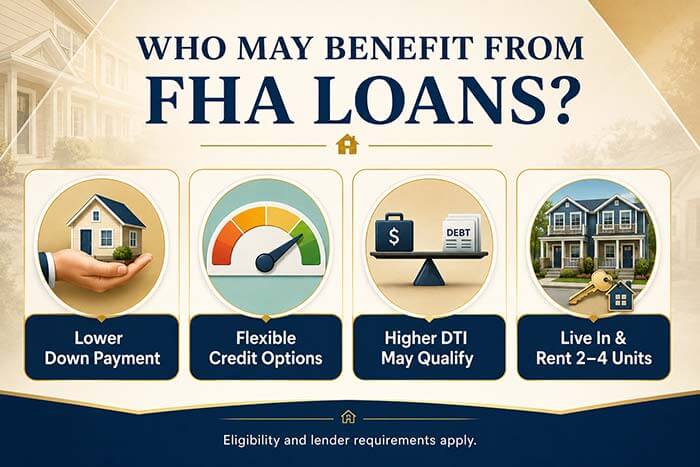
- First-time buyers who need a low down payment.
- Buyers with 500–679 scores who want easier approvals.
- Buyers with higher DTI that still pass automated underwriting. (Manual underwriting uses stricter ratio caps.)
- House-hackers: Live in one unit of a 2–4 unit primary home and rent the others (subject to FHA rules).
FHA Basics
Minimum Credit Score and Down Payment
To get FHA loans, you need to have a certain credit score and put down a specific amount for the down payment. If your credit score is 580 or higher, you only have to put down 3.5%. If your score is between 500 and 579, you need to make a 10% down payment. Unfortunately, if your score is below 500, you won’t qualify for FHA loans.
Debt-to-Income (DTI)
To qualify for FHA loans, a minimum credit score is required, along with a specific down payment. If your credit score is 580 or higher, you only need to put down 3.5% for an FHA loan. If your score is between 500 and 579, you’ll need to come up with a 10% down payment. But if your score is below 500, unfortunately, you probably won’t qualify for an FHA loan.
Mortgage insurance (MIP)
Mortgage insurance (MIP) has two main parts. First up, there’s the Upfront Mortgage Insurance Premium (UFMIP), which is a one-time fee of 1.75%. You can actually roll this cost into your loan. Then, there’s the Annual MIP, which you pay monthly. This amount can change based on things like how much you’ve borrowed compared to the value of the home (that’s called the loan-to-value ratio or LTV), the duration of the loan, how big the loan is, and what year you’re in with your policy.
Property Types
1–4 unit primary homes, approved condos, and some manufactured homes; must meet FHA Minimum Property Standards and pass an FHA appraisal.
Develop a Purchase Budget
Your homebuying budget can’t be higher than the maximum loan amount your lender approves.
The Following Must be Covered in a Purchase Budget:
- Principal and interest
- Taxes
- Insurance and mortgage insurance
- HOA dues (if applicable)
- Flood insurance (if applicable)
- Utilities, maintenance, repairs
- Emergency/Contingency Funds
Search for Eligible Properties
In order to be eligible, the property must meet the county’s loan limit and other statutory requirements for FHA financing. Let your real estate agent know you’re using FHA financing. This way, they can review the contract, seller credits, appraisal terms, and any property issues before you make an offer.
Submit the Purchase Contract
Once the seller has accepted the offer, the signed contract is sent to the lender to prepare the loan disclosures. The lender will confirm the sales price, the amount of earnest money, any seller contributions, the proposed closing date, and any personal property included in the transaction. Don’t open new credit accounts, run up your credit cards, change jobs, or move money between accounts without telling your lender and providing documentation.
Order the FHA Appraisal
The FHA-approved Appraiser will establish the property’s market value and provide an appraisal and a determination of its compliance with FHA requirements. An FHA appraisal isn’t a full home inspection. It’s a good idea to hire your own inspector to check for any other issues.
Complete Mortgage Underwriting
The Underwriter Will Review the Entire Loan File and Assess the:
- Income and Employment
- Credit and Debt Analysis
- Appraisal
- Title Work
- Homeowners Insurance
- Required Explanations
- The underwriter may provide requirements for updated statements, deposit slips, and letters of explanation.
Receive the Clear to Close
Clear to close means the lender has approved the remaining conditions for the borrower and the property. Review your Closing Disclosure, double-check the cash you need to bring to closing, and get wire instructions from a trusted source. Always verify these instructions to avoid wire fraud.
Sign, Fund, and Receive the Keys
The borrower signs the mortgage note, security instrument, and any other documents required at closing. The closing agent receives the funds, and the transaction is complete in accordance with local procedures.
FHA Appraisal and Property Requirements
- Two objectives are satisfied by an FHA appraisal: determining the market value of a property and assessing its eligibility for FHA mortgage insurance.
- In the course of appraisal, issues may be identified that pertain to health or safety, as well as structural problems.
- Common issues include peeling paint in older homes, exposed wiring, broken heating systems, or damaged roofs. Updated cabinetry, bad paint, or a color that is not preferred do not necessarily make a home ineligible.
- When an appraisal is made conditional, the parties involved have to agree on the cost and who will undertake the repairs.
- Most of the repairs will need to be completed and verified prior to the closing, unless a specific FHA program or an allowed repair agreement is in place.
What Properties Can FHA Financing Buy?
FHA Financing can be used to purchase many different types of owner-occupied housing.
One to Four-Unit Dwellings
- FHA Financing can be used to purchase an eligible single-family residence or a dwelling with two, three, or four units.
- The borrower is required to occupy one of the units as their principal residence.
- According to FHA underwriting policies, the borrower may use the anticipated rental income from the other units to qualify.
Condos
- A condominium may be eligible if the project is FHA-approved or if the individual unit is eligible through FHA’s single-unit approval process.
- Check if a condo is FHA-approved before making an offer. Waiting until later can delay the appraisal or closing.
Manufactured Homes
- Some manufactured homes may qualify if they meet specific FHA construction, foundation, title, property classification, and other eligibility requirements.
- Financing a manufactured home is more specialized than financing a typical site-built home.
- Make sure both the lender and property meet FHA requirements before making an offer.
- A 203(k) loan is a single mortgage covering both purchase and rehabilitation of a home.
- The Limited 203(k) permits only non-structural rehabilitation work with a cost threshold of $75,000.
- The Standard 203(k) is a more flexible option that covers structural work as well, and is subject to the requirements of the 203(k) and the FHA loan limits.
Because FHA 203(k) Loans are More Complicated and Require Extra Paperwork, Repair Plans, and Inspections, Check Out GCA’s Full Guide for All the Details:
- FHA Loan vs Conventional Loan
- FHA loans aren’t always the cheapest option for every buyer.
However, an FHA Loan is a Good Option When a Buyer Has Any of the Following:
- A low down payment
- A low credit score
- A history of poor credit
- A high debt-to-income ratio
- Gift funds or down payment assistance
- A requirement for manual underwriting
- On the other hand, if you have a large down payment, great credit, or can get cheaper private mortgage insurance, an FHA loan might not be your best choice.
- The Consumer Financial Protection Bureau states that FHA loans may be cheaper than conventional loans for some borrowers with lower credit and higher down payments.
- For borrowers with good credit and a 10% to 15% down payment, conventional loans may be cheaper than FHA loans.
- The only way to determine which is cheaper is to get quotes and compare interest rates, mortgage insurance, cash to close, and the total cost of the loans.
Problems Frequently Encountered with FHA Loans and Solutions
Applying for Additional Credit Prior to Closing
- Taking out new loans or buying big-ticket items before closing can hurt your credit and debt-to-income ratio.
- Avoid financing things like furniture or cars until after your loan closes.
Moving Large Sums of Money
- If you move or deposit large amounts of money, it can slow down your loan process unless you provide documents showing where the money came from.
Assuming Prequalification Equates to Guaranteed Approval
- A full preapproval is different from prequalification, which is just a quick credit check.
- Prequalification doesn’t guarantee you can make an offer.
Disregarding Property Eligibility
- A borrower may qualify, but the property might not. Make sure the property meets FHA standards.
- Confirm condos or manufactured homes are eligible before proceeding.
- Discuss any employment changes with the lender before they occur, if possible.
- HUD sets the basic FHA rules, but lenders can add their own.
- If one lender turns you down, you might still qualify with another.
FHA Home Purchase Illustration
Let’s Look at the Case of a Borrower Buying a Primary Home for $350,000. The Borrower Has:
- A 620 credit score
- Stable W-2 Income
- 3.5% for a down payment
- Gifted funds for part of the closing costs
- Automated underwriting approval
- No lender overlay requiring a higher score
- In this example, the buyer needs at least $12,250 for the down payment, resulting in a base loan amount of $337,750.
- If the buyer adds the 1.75% upfront mortgage insurance, the loan amount goes up to about $343,660.
- There are other closing costs the borrower will have to pay, including title, lender, and appraisal fees, prepaid property taxes, homeowner’s insurance, and the first deposit for an escrow account.
- A seller concession will lower the buyer’s closing costs, but will not offset the required down payment.
- This is just an example. Your actual terms will depend on your situation, the property, the loan amount, the interest rate, and the lender.
What does Gustan Cho Associates do for FHA Homebuyers?
Gustan Cho Associates helps borrowers who have been turned down by other lenders due to overlays, lower credit scores, manual underwriting, or other complicated financial situations.
Our Team Will Help Evaluate:
- FHA eligibility and down-payment standards
- Automated vs. manual underwriting
- High debt-to-income ratio
- Gift funds and seller contributions
- History of bankruptcy/foreclosure
- FHA Appraisal issues
- 2 to 4 unit and manufactured housing
- FHA 203(k) renovation loans
- You should only make an offer on a home after your pre-approval has covered any financial concerns.
Manual Underwriting (when AUS says “Refer”)
If the file is manually underwritten, plan around these caps:
| Compensating Factors | Max Housing/Total DTI |
| None | 31/43 |
| One | 37/47 |
| Two or more | 40/50 |
Reserves, low payment shock, or strong residual income can help. This is where having a no-overlays lender matters. Using FHA loans to buy a home successfully often comes down to working with underwriters who know the rules.
Final Thoughts on FHA Home Loans
FHA loans give buyers a way to purchase a home with a lower down payment and flexible requirements. But approval takes more than just a minimum credit score. Lenders will check your income, debts, assets, and credit history, and the home must meet FHA standards.
Be sure to compare FHA loans to conventional loans, know your monthly payment, and get a thorough pre-approval before making an offer.
Sometimes, a lender may deny your loan because their standards are stricter than the FHA’s minimum rules. If that happens, you might still qualify with another lender. For an FHA loan, call us at 800-900-8569 or email us at gcho@gustancho.com.
FAQs About Using FHA Loans to Buy a Home:
What Credit Score Do I Need When Using FHA Loans to Buy a Home?
580+ for 3.5% down; 500–579 needs 10% down.
How Much is FHA Mortgage Insurance When Using FHA Loans to Buy a Home?
UFMIP = 1.75% upfront (can be financed) plus an annual MIP paid monthly; actual annual % depends on LTV/term/amount and current HUD policy.
Can the Seller Pay My Closing Costs When Using FHA Loans to Buy a Home?
Yes—up to 6% of the price for actual closing costs (not down payment).
Can I Get Two FHA Loans at Once if I’m Relocating?
Possible with specific exceptions, commonly for job relocation (often referenced with a 100-mile move). Talk to your LO about docs required.
What if AUS Says “Refer” While Using FHA Loans to Buy a Home?
You may still qualify with manual underwriting at 31/43, 37/47, or 40/50 depending on compensating factors.
Is Using FHA Loans to Buy a Home Faster or Slower Than Conventional?
Timelines are similar. Repairs from the appraisal can add time—plan ahead and choose a lender who communicates well.
Can I Use Gift Funds When Using FHA Loans to Buy a Home?
Yes—gift funds are allowed for the down payment and closing costs (documented with a gift letter).
Does Using FHA Loans to Buy a Home Work for Condos?
Yes, if the condo is FHA-approved or eligible via single-unit approval (ask your LO to check).
Is Using FHA Loans to Buy a Home Good for House-Hacking?
Yes—2–4 unit primary homes are eligible, and that rental income can help qualify.
This Guide About “Using FHA Loans to Buy a Home: Powerful Tips That Work” was updated on July 27, 2026.