This guide covers HUD mortgage guidelines on having multiple FHA loans at the same time. One of the most frequently asked questions from homebuyers is: Can I qualify and get approved for multiple FHA loans at the same time? FHA loans are for owner-occupant primary homes. A homeowner can live in one property. Some homeowners need to relocate for one or more reasons and buy another home without selling their existing home.
Multiple FHA Loans at the Same Time: HUD Guidelines and Exceptions for 2026
Can you have more than one FHA loan at the same time? In cases, the answer is no. FHA loans are meant for your home, so HUD usually does not allow two FHA-insured mortgages on different primary residences at the same time. There are some important exceptions that may apply.
You might qualify for another FHA-insured mortgage if you meet conditions. These include moving for a job, having legal dependents, leaving a jointly owned home, or being a co-borrower who does not live in the property. Even if you qualify for an exception, that does not mean your mortgage will be approved. Each application is still reviewed based on the standards.
You still need to meet all the requirements for the FHA loan. This includes income requirements, employment history, credit history, debt-to-income ratio, available assets, occupancy rules, FHA loan limits, property eligibility, and the lender’s underwriting standards. This guide covers when you can have than one FHA loan, what documents underwriters might ask for how the 100-mile and 75% loan-, to-value rules work and what to think about before applying for a second FHA mortgage.
Is it Possible to Have More Than One FHA Loan at the Same Time?
Yes, but only in cases that are approved by HUD. HUD’s general policy is not to provide insurance for more than one property that is to be used as the borrower’s principal residence. FHA financing is not designed to offer low-down-payment financing for investment properties, second homes, or rental properties. This does not mean a borrower can never have two active FHA loans.
There are reasons why a homeowner might leave an FHA-financed property without selling it right away. For example a new job might require moving to an area.
A growing family might find that their current home no longer fits their needs. One borrower could move out of an owned home while the other stays. It’s also possible for someone to have an FHA mortgage even if they don’t live in the home. HUD addresses these situations by offering special exceptions to the one-principal-residence rule.
How Do You Know When the FHA Will Allow a Second FHA Loan?
A person who already has an FHA-insured mortgage may, in some cases, be able to obtain another FHA mortgage for a new main residence if the application falls within one of the four exceptions set out by HUD.
- The first instance is a relocation connected with employment to a new main residence more than 100 miles from the present main residence.
- The other case is when the number of legal dependents increases because the present home no longer satisfies the family’s housing requirements.
- In such a case, the existing home usually has to have a loan-to-value ratio of 75% or below. This ratio is calculated from the outstanding mortgage balance and a recent appraisal of the property.
- This rule applies when the borrower permanently leaves a jointly owned main residence and the residence remains occupied by an existing co-borrower.
- The fourth option concerns non-occupying co-borrowers.
- A non-occupying co-borrower on an existing FHA mortgage can in theory get an FHA loan for a house that will be their home.
- Also HUD lets a person with an FHA mortgage on their home be a non-occupying co-borrower, on another FHA mortgage.
HUD also looks after borrowers who later go back to their original area. A borrower who previously moved under the exception is not necessarily obliged to return to the original property before establishing another main residence, as long as the relevant relocation requirements are satisfied.
FHA Principal Residence and Owner-Occupancy Requirements
To understand multiple FHA loans, you first need to understand what FHA considers a principal residence. A principal residence, according to HUD, is one in which the borrower currently lives or will live as their permanent place of residence and that they usually occupy for most of the calendar year.
The HUD Handbook on FHA loans is currently in use, and also specifies that the borrower generally has to move into the property financed by the FHA within 60 days of signing the security instrument and must intend to remain in the home for at least 1 year.
There is, however, an exception for certain FHA 203(k) transactions that have different occupancy requirements. So, the main issue isn’t just how many properties a borrower owns. A borrower can own more than one property. For example, they might have an FHA mortgage on one home and a different type of mortgage on another. The rule applies when someone has more than one FHA-insured mortgage for their main residence and doesn’t qualify for a HUD exemption. HUD usually restricts borrowers to one FHA-insured principal residence.
The Mortgage Insurance Offered by the FHA is Primarily Designed to Support Owner-Occupied Homes.
Without the one-residence restriction, borrowers could potentially use FHA’s relatively low down-payment requirements to accumulate investment properties by representing each new transaction as an owner-occupied purchase.
FHA mortgage insurance is specifically stated not to be used to obtain investment properties. It’s important to know the reason for buying the new property.
Just wanting a different home, wanting to keep a favorable. Interest rate on your current FHA mortgage, wanting to become a landlord, or wanting to find a newer property nearby does not mean you qualify for an exception. The lender must show that the transaction meets a HUD-approved exception and that the new property will truly be your main residence.
HUD’s Four Exceptions for Multiple FHA Loans
Employment-Related Relocation and the FHA 100-Mile Rule
One of the most common reasons why a borrower might be eligible for several FHA loans is employment relocation. The HUD program permits a borrower to obtain a different FHA-insured mortgage without having to sell the property securing the existing FHA loan if the borrower is moving or has already moved for an employment-related reason and is establishing a new main residence more than 100 miles from the present main residence.
The requirement is that the current main residence and the area where the new main residence will be set up are more than 100 miles apart. It could be the case if the person taking out the loan gets a new job, is transferred by their employer, changes work addresses, or otherwise makes a valid employment-related move that meets HUD’s requirements.
Just because a new job is inconvenient to commute to does not mean that the person will automatically qualify. The file must meet both HUD’s employment-related relocation standard and the distance requirement. Underwriters handling mortgages may request a variety of documents, including an employment offer, a letter regarding a transfer, verification of employment, pay stubs, the addresses of both properties, and a written explanation for the move.
Example of the FHA Relocation Exception
Suppose that a homeowner has obtained an FHA mortgage for a property in Illinois and then takes up a permanent job several hundred miles away in a different state.
The person who borrowed the money would like to retain the property in Illinois rather than sell it outright and then buy a new house close to their new place of work.
Since the move is related to employment and the new principal residence will be more than 100 miles from the present residence, the borrower may be eligible for HUD’s relocation exception. The lender must determine whether the borrower is financially eligible for the second FHA mortgage. The fact that the 100-mile rule is met does not remove the normal FHA underwriting requirements.
Multiple FHA Loans Due to an Increase in Family Size
HUD provides an exception for people whose families have grown and who now find that their present homes do not meet their housing needs. In order to claim this exception, the borrower has to produce satisfactory evidence that there has been an increase in the number of legal dependents and that the property in question no longer fulfills the family’s needs.
There’s also an Important Fairness Rule
The loan-to-value ratio for the current principal residence must not exceed 75%, or the mortgage must be paid down until the property has reached a maximum loan-to-value ratio of 75%. The calculation must be made using the outstanding mortgage balance and the most recent residential appraisal.
What Does the 75% LTV requirement mean?
A loan-to-value ratio of 75% typically means the amount still owed on the mortgage cannot exceed 75% of the home’s current appraised value. For example, suppose the current home is valued at $400,000.
- An LTV of 75% would be $300,000.
- The property would be under the 75% LTV threshold if the outstanding mortgage balance were $285,000.
- The borrower would fail to meet the 75% requirement based on that appraisal if the mortgage balance were $335,000, unless the loan had been paid down enough.
- Don’t confuse this with a general rule that always requires 25% equity to get two FHA loans.
- The specific 75% LTV requirement is included in HUD’s exception for an increase in family size; it is not the requirement for all cases involving multiple FHA loans.
What Situation Counts as an Increase in the Size of a Family?
The language used by the HUD emphasizes the increase in the number of legal dependents and whether the property in question still fulfills the family’s needs.
- That’s why simply wanting a bigger house isn’t enough.
- Moving from a three-bedroom house to another four-bedroom house nearby just because its newer, has a bigger yard or is, in a preferred neighborhood does not qualify for this exception.
- The person borrowing must have a documented change in their household circumstances that meets HUD’s requirements.
- You shouldn’t order an appraisal or make plans to keep your current FHA-financed home until your mortgage lender has reviewed your situation.
Vacating a Jointly Owned Property
There is another exception to the HUD rules in the case where a borrower is departing from a jointly owned main residence with no intention of returning, while an existing co-borrower remains in the property.
- A typical example could be divorce or separation.
- Imagine that two borrowers have jointly bought a house using FHA financing.
- Afterward, their relationship ends, with one of the co-borrowers staying in the house while the other has moved out permanently and wishes to buy a new home as their main residence.
- Even if their name is still on the existing FHA loan, the person who is moving out may be eligible for a different FHA-insured mortgage.
- The lender must assess the existing mortgage obligation when calculating the borrower’s debt-to-income ratio, unless FHA rules permit treating the debt differently based on the documentation in the file.
- FHA’s exception to its multiple-loan rule does not mean that a mortgage debt is automatically excluded from the underwriting process.
FHA Loans for Non-Occupying Co-Borrowers
Another area in which borrowers are often given incorrect information concerns the exception for the non-occupying co-borrower. A person who is already a co-borrower on an FHA-insured mortgage but does not live in the property might when buying a property to make it their main home, possibly qualify for another FHA mortgage.
HUD also says that someone who already has an FHA-insured mortgage, on their home can act as a non-occupying co-borrower on a different FHA-insured mortgage.
It is important in cases where a family member has helped another person qualify for an FHA loan but has not lived in the property. The fact that a person has an existing FHA mortgage does not automatically prevent them from using FHA financing for their main residence, provided that HUD’s rules regarding non-occupying co-borrowers are met.
Find Out If You Qualify for a Second FHA Loan
Wondering if HUD will allow you to keep your current FHA home and buy another? Call Gustan Cho Associates at 800-900-8569 and let our FHA experts review your situation.Is it Possible to Retain Your First FHA Home and Use it as a Rental?
It’s possible. The fact that someone has kept an FHA-insured house and converted it into a rental property is not in itself sufficient to qualify them for a second FHA loan. The borrower must first meet one of HUD-approved exceptions, which allow for an additional FHA-insured mortgage.
Rental Income Involves a Distinct Underwriting Consideration
A lender may consider rental income from property the borrower keeps, but the FHA has specific requirements for documentation and how it is calculated. If the income from a property is derived from a property being left, and the borrower has no prior record of rental income, the FHA’s underwriting rules might require proof of the market rent and equity.
Currently, the FHA’s guidance on rental income considers income from a former residence especially relevant when the move involves a relocation of more than 100 miles, and that income is used to meet qualification requirements.
Under the right circumstances, the documentation could consist of an appraisal, market-rent forms, the lease agreement, proof of the security deposit or the first month’s rent, and the tax returns if there is already a rental history. So, don’t assume that just signing a lease means your existing mortgage payment will automatically be excluded from your debt-to-income ratio.
Many Homeowners Need to Move to Another Home Due to the Following Reasons:
- Growing Family so they may need to move to a larger home
- Downsizing: Children may move out of the home to either go to college or start their own families so they may need to move to a smaller home
- Job Relocation: Homeowner may need to move to another home closer to their place of employment
- If you are a non-occupant co-borrower, you can qualify for an FHA loan as the main borrower
- If two people are on a current FHA loan but one of them needs to move out, they can qualify for an FHA Loan
In the following paragraph, we will cover the frequently asked question can a home buyer qualify for multiple FHA loans at the same time. We will discuss the HUD guidelines of qualifying and getting approved for multiple FHA loans at the same time.
The 25% Equity Rule for Departing-Residence Rental Income Is Different From the Second-FHA-Loan Rule

This distinction causes a great deal of confusion. Both the 75% LTV requirement set by HUD for the family-size exception and the equity requirements established by FHA when rental income from certain departing residences is used address different underwriting issues,, even though, in effect, they can both amount to 25% equity.
The rule to be applied to determine whether the borrower is eligible for the exception relating to an increase in family size is the one that permits an additional FHA mortgage.
There is also the question of whether rental income from another property could be regarded as effective qualifying income in cases where the borrower has limited or no rental history. Don’t assume that having 25% equity automatically allows you to take out multiple FHA loans. You still need to meet a specific HUD exception.
Can You Obtain a Second FHA Loan Just Because You are Downsizing?
Downsizing is not one of the four exceptions listed by HUD. For instance, a homeowner whose children have moved away might conclude that a smaller house would be cheaper and easier to look after. Although that could be a fully reasonable personal choice, it by no means meets the FHA’s requirements for keeping an existing FHA-insured mortgage while securing a further FHA mortgage.
Learn when HUD allows more than one FHA loan at a time, including the 100-mile relocation rule, exceptions for growing families, the 75% LTV rule, and co-borrower guidelines.
To do so, the borrower would have to satisfy another applicable HUD exception or opt for an alternative financing strategy. There are several alternatives available, such as selling the current home, refinancing the existing FHA mortgage into a different type of loan if suitable, or buying the next house with conventional financing or another appropriate form of financing.
Could You Get Another FHA Loan Just Because You Want to Live Closer to Where You Work?
Not always. The relocation exception provided by HUD applies only when the move is related to employment and the new main residence is more than 100 miles from the present main residence. It is not enough just to move ten, twenty, or fifty miles in order to meet the FHA relocation requirement of more than 100 miles. Even if applicants do not meet the criteria for the FHA exemption, they may still have other mortgage options, such as conventional financing, depending on their credit situation, income, down payment, and overall qualifications.
FHA Loan Multiple Approval Documents
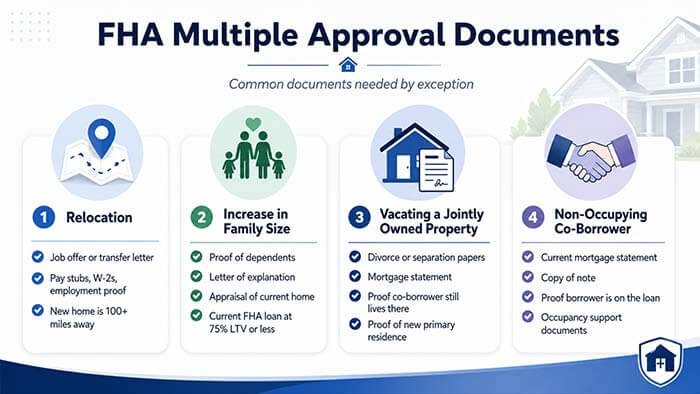
The specific documents depend on the exception. In cases of relocation, the lender may require a job offer, transfer letter, employment verification, pay stubs, W-2s, and proof that the new residence is more than 100 miles from the primary residence.
Qualifying for Two FHA Mortgage Payments
The fact that someone is allowed to have several FHA loans is entirely separate from their financial qualification to hold them. The borrower’s total monthly obligations have to be examined by the new lender. This usually involves the new amount proposed for the housing payment, as well as the debts associated with the property currently owned that cannot be excluded or offset under the FHA underwriting rules. The amount suggested for the payment on the new home could include the principal, interest, property taxes, homeowners’ insurance, FHA mortgage insurance, homeowners’ association fees, if applicable, and any other housing obligations. The lender will likewise examine revolving accounts, installment debts, student loans, support obligations, and all other liabilities required by FHA guidelines. So, even if you meet one of HUD’s exceptions for multiple FHA loans, you might still not qualify if your overall debt-to-income ratio is too high.
How Can One Qualify for Multiple FHA Loans at the Same Time
Borrowers can have more than one FHA loan at the same time under certain circumstances. A borrower can qualify for more than one FHA loans at same time. This holds true if they are relocating and establishing primary residency in an area or location that is beyond reasonable commuting distance. The relocation needs to be at least 100 miles or more from the work of employment. Out of state employment is a good reason. The borrower was or will be a non-occupant co-borrower with a joint interest in a real estate property that is purchased by other members of his or her family as their primary residence.
Does the Use of Automated Underwriting Result in the Automatic Approval of Multiple FHA Loans at the Same Time?
No. The borrower-eligibility and occupancy requirements of HUD do not get replaced by an Automated Underwriting System finding. The lender must be responsible for providing documentation of the basis for the borrower’s eligibility for an additional FHA-insured mortgage.
A borrower who qualifies for an exception must still meet FHA’s usual requirements for credit, income, debt-to-income ratio, property, occupancy, loan limits, and underwriting. In complex situations, it’s best to determine whether a HUD exception applies before making an offer on a new home.
To complete the final underwriting, a file must clearly state which HUD exception applies and include the relevant supporting documentation. That’s why it’s important to review multiple FHA loan files carefully before pre-approval, not after the borrower has already signed a contract.
Documents You May Need for a Second FHA Loan
The type of documentation will vary depending on the exception that is being used. In the case of an employment-related relocation, the lender may require evidence of the employment-related reason for the move, the location of the new job, and the distance between the old and new main residences.
In the case of the family-size exception, the lender must have satisfactory proof of an increase in the number of legal dependents, documentation that the present home no longer meets the family’s needs, and a current residential appraisal supporting a maximum loan-to-value ratio of 75% for the existing property.
When a person is leaving a jointly owned property, the necessary documentation should show that the borrower is permanently moving out, while the other co-borrower will continue living in the main residence. In the case of a non-occupying co-borrower, the lender must record the borrower’s status on the existing FHA mortgage and their occupancy of the new main residence. Each borrower must likewise fill out the standard FHA mortgage application and has to certify their intention to occupy the property as required by HUD.
What We Review Before Submitting a Multiple FHA Loan File to Underwriting
FHA loan files require more preparation than a normal mortgage application, since the borrower must meet the standard requirements for FHA eligibility and obtain an exception to HUD’s general rule limiting loans to one residence. The first question is: Which HUD exception applies? If it cannot be clearly answered, then the file should not be organized around securing another FHA loan.
Lender overlays can also affect your loan, since HUD sets the minimum requirements for the FHA program, but individual mortgage lenders may add their own extra underwriting standards.
It should not be necessary for an underwriter to speculate about why the borrower is moving, whether the move is related to a change of employment, who will live in the present home, whether the borrower has sufficient equity, or whether the new property will, in fact, become the main residence. The file also needs to make sense financially. It’s a good idea to review the borrower’s current housing expenses, proposed rental income, employment income, assets, mortgage payment history, reserves, and total debt before making an offer. At Gustan Cho Associates, our goal is to spot these issues before approval, not right before closing.
Common Reasons a Second FHA Loan Can Be Denied
Even if the borrower thinks there is a good reason to move, their application for a second FHA loan could still be rejected. A common issue is that the person who is borrowing does not satisfy one of the exceptions set out by HUD. A different situation arises when the move is related to employment, and the new home is within 100 miles of the present principal residence.
A family-size mortgage application will fail if the borrower cannot provide proof of an increase in the number of legal dependents, or if the loan-to-value ratio of the existing property exceeds 75%.
Other files encounter difficulties since the borrower is unable to qualify while still paying the existing mortgage, the proposed rental income cannot be shown in line with FHA requirements, the income is unstable, the recent housing payments are delinquent, or the documentation does not match the stated occupancy plan.
FHA Loan Limits Still Apply to the New FHA Mortgage
The fact that a borrower qualifies for an FHA loan exception does not mean that the FHA loan limits are waived. The national floor for one-unit FHA loans for case numbers assigned in the calendar year 2026 is $541,287, and the ceiling for one-unit high-cost areas is $1,249,125. However, the actual limits may differ by county, metropolitan statistical area, and number of property units.
Not all mortgage lenders have the same lending requirements on FHA loans. Even though a borrower meets HUD guidelines on HUD guidelines at the same time, the lender may not want to finance the borrower due to lender overlays.
For eligible two-, three-, and four-unit properties the upper limits are higher, and special exception areas may have different ceilings. Before deciding on your maximum FHA loan amount, check the FHA mortgage limit for the county where your new property is located.
Is it Possible to Have Several FHA Loans to Build Up a Portfolio of Rental Properties?
No. The exceptions provided by HUD are not meant as a strategy for repeatedly obtaining rental properties using FHA financing. The property that is financed by the FHA must meet the FHA’s requirements for principal residence, and the arrangement must not be designed in such a way as to use the FHA mortgage insurance to obtain investment properties. Anyone who wishes to buy an investment property should usually obtain financing intended for investment real estate rather than structuring the transaction as an FHA owner-occupied purchase.
Ready to See If Multiple FHA Loans Are Possible?
Complete a quick application or send your scenario. We’ll review your current FHA loan, occupancy plans, qualifying exception, income, debts, and next steps toward approval.Alternatives When You Do Not Qualify for Multiple FHA Loans at the Same Time
If You Aren’t Eligible for a Second FHA Loan, You Can Still Buy Another Primary Residence
One way to proceed is to sell the current property and use the proceeds to pay off the FHA mortgage before completing the transaction for the new FHA-financed house. A further option is to refinance the current FHA mortgage on to conventional financing provided that the borrower has adequate equity and meets all other requirements.
For eligible veterans and service members, VA financing could be an option, provided the VA entitlement and occupancy requirements are met.
After the original FHA-insured debt has been replaced, the multiple-FHA restriction will no longer cause the same problem. A person who is borrowing might also obtain a conventional loan to buy their next principal residence rather than an FHA loan, provided that the requirements relating to credit, income, assets, and the down payment are met. The best option depends on your whole financial situation, not just which program has the lowest down payment.
Multiple FHA Loans versus Using FHA More Than Once During Your Lifetime
Sometimes people misunderstand the rule and think they can use FHA financing only once. That is incorrect. There is no general rule that a person can have only one FHA mortgage throughout their lifetime. This guide explains what happens when someone has more than one FHA-insured mortgage for their main residence. A person who sells their home and uses the proceeds to pay off the existing FHA mortgage can usually obtain FHA financing again, provided they would otherwise qualify. The same person might be able to use FHA financing more than once over the course of their lifetime as their housing needs change.
Why Multiple FHA Loan Files Need to Be Structured Correctly Before Underwriting
The loans are usually more complicated than standard FHA purchase transactions because the underwriter must address two separate questions.
First of All, Does HUD Allow the Borrower to Have Another Mortgage Insured by FHA?
- Well, does the person taking out the mortgage have the necessary financial qualifications?
- A strong loan file should answer both questions before final underwriting.
- In the case of an employment relocation, the file must state the reason for the relocation, the distance involved, the occupancy plan, the existing housing obligation, and how any proposed rental income is to be treated.
- The file must list the legal dependents, show that the present property is no longer suitable for the family’s requirements, and prove the necessary LTV by means of an up-to-date residential appraisal.
- In the case of a jointly owned property or when one of the co-borrowers is not occupying the property, the title, occupancy, the mortgage liability, and the borrower’s relationship to the existing FHA obligation should all be clearly documented.
- The sooner your documentation is complete and clear, the less likely you are to run into avoidable underwriting issues later in the mortgage process.
Current HUD Guidance on Multiple FHA Loans
The main source for FHA rules on single-family mortgages is the HUD FHA Single Family Housing Policy Handbook 4000.1.
HUD released the update to Handbook 4000.1 on August 12 2026. The current version of the handbook still says that the FHA will usually not insure than one property, as a borrowers principal residence. This rule has exceptions when the circumstances allow it as described in the handbook.
Mortgage guidelines are subject to change, so when arranging a new FHA mortgage,, borrowers and mortgage professionals should check the current HUD requirements, especially in cases where occupancy is unusual, rental income is involved, multiple properties are being financed, or a second FHA mortgage is in use.
Final Thoughts on Multiple FHA Loans at the Same Time
At any given time, most borrowers who obtain an FHA loan can have only one principal residence insured by FHA. However, more than one FHA loan may be allowed if the borrower meets the requirements of a particular HUD exception. The main exceptions are those involving a relocation connected with employment and covering a distance of more than 100 miles, cases where there is a clearly recorded increase in the number of legal dependents together with the requirement that the LTV on the existing home should be 75%, situations in which a jointly owned property is permanently left vacant even though an existing co-borrower continues to occupy it, and the qualifying circumstances that apply to co-borrowers who are not occupying the property.
Borrowers should avoid thinking that just being able to afford the payments is enough. Even if a borrower has a good income, substantial savings, and a perfect record of mortgage payments, they will still not be able to obtain a second FHA loan unless the transaction meets HUD’s requirements for multiple mortgages.
Lenders can have higher lending requirements than HUD agency mortgage guidelines. For more information on this topic or other mortgage-related topics, please contact us at Gustan Cho Associates at 800-900-8569. Text us for faster response. Or email us at gcho@gustancho.com. The Team at Gustan Cho Associates are available 7 days a week, evenings, weekends, and holidays.
FAQs: HUD Guidelines on Multiple FHA Loans at Same Time
Can I Have Multiple FHA Loans at the Same Time?
Yes, it’s possible to have more than one FHA loan at the same time, but some specific guidelines and circumstances allow this, such as relocating for work or having a growing family.
What Situations Allow Me to Get a Second FHA Loan?
You can get a second FHA loan if you’re moving to a new home due to a job relocation at least 100 miles away or need a bigger home because your family is growing.
Can I Keep My Current Home and Still Get Another FHA Loan?
Yes, you can keep your current home and get another FHA loan if the existing home has at least 25% equity or if you’re moving far away for work.
Do I Need to Sell My Current Home to Get Another FHA Loan?
Not necessarily. Suppose your situation meets HUD guidelines, like job relocation or needing a different-sized home. In that case, you may not need to sell your home to qualify for another FHA loan.
Can I Get a Second FHA Loan if My Current Home is Nearby?
Generally, you can only get a second FHA loan for a similar home near your current one if you have a valid reason, like job relocation far away.
What if I’m a Co-Borrower on an FHA Loan? Can I Get Another FHA Loan?
If you are a non-occupying co-borrower on an FHA loan, you are eligible to qualify as the primary borrower for a separate property with another FHA loan.
Do I Need Equity in My Current Home to Get Another FHA Loan?
If you want to keep your current home and get another FHA loan, your existing home should have at least 25% equity.
Can I Qualify for Multiple FHA Loans if I’m Downsizing?
Yes, if you’re moving to a smaller home because your kids moved out or you need less space, you can qualify for another FHA loan, but there are specific conditions to meet.
Can I Get Another FHA Loan if I Move Closer to My Job?
Yes, if you are moving over 100 miles from your current home due to a job relocation, you may qualify for a second FHA loan.
Are There Different Rules for Different Lenders When Getting Multiple FHA Loans?
Yes, some lenders may have stricter rules than HUD’s guidelines, so it’s important to work with a lender that doesn’t have additional requirements (overlays) when applying for multiple FHA loans.
If I Sold My Previous FHA Home, Can I Get Another FHA Loan?
Yes. If the previous FHA loan was paid off by a sale or refinance, borrowers may qualify for FHA financing for a new principal residence. The primary concern with multiple FHA loans is whether borrowers are keeping the existing FHA-insured mortgage and taking out another FHA-insured mortgage.
Will FHA Count My Spouse’s Existing FHA Loan?
Maybe. It depends on the loan, how the new loan is structured, title, occupancy, and state law. In community property states, a non-borrowing spouse’s debts may be considered. Lenders will evaluate the spouse’s FHA loan obligation and whether the new transaction complies with FHA occupancy and underwriting requirements.
Do I Need 25% Equity in My Current FHA Home?
You may need at least 25% equity using the increase-in-family-size exception. According to HUD, the current primary residence must be at 75% loan-to-value or lower, or have the mortgage paid down to that level, based on the current mortgage balance and a recent residential appraisal. (per HUD)
Can Rental Income From My First FHA Home Help Me Qualify?
Possibly, but rental income may help only if it complies with FHA and lender requirements. The lender may ask for a lease with rental payment documentation, a mortgage payment history, and other documentation to show that the home is being rented in a legitimate manner. Even if rental income is considered, the borrower must meet at least one valid exception for the second FHA loan.
Can I Buy a Duplex with an FHA Loan if I Already Have One?
When the borrower lives in one of the units as a primary residence, a duplex may qualify for FHA financing. However, the borrower must also satisfy one of HUD’s other FHA loan exceptions, as the first FHA loan is still open.
Can a Military Move Help with Another FHA Loan?
When a military move supports an actual relocation and the borrower will live in the new home as their primary residence, it may be possible. The lender will consider the borrower’s orders, the distance, the plans for occupancy, the borrower’s income and other debts, and whether the other FHA residence will stay open.
Can I Be a Non-Occupying Co-Borrower if I Already Hold an FHA Loan?
Yes, if a borrower has an FHA loan on their primary residence, they can be a non-occupying co-borrower on other FHA loans, per HUD. However, the lender must still be responsible for analyzing the borrower’s debt, income, credit, and repayment ability.
Why Would One Lender Deny a Second FHA Loan While Another Would Approve It?
One lender can have overlays more stringent than the FHA’s minimum requirements. Another lender might be more willing to review the file if the borrower meets a strong HUD exception and has strong documentation. The file still needs to meet the FHA requirements, but lender overlays can change the approval course.