This guide covers rebuilding credit during Chapter 13 Bankruptcy repayment plan. Rebuilding credit during Chapter 13 Bankruptcy is highly recommended for those who want to purchase or refinance their current home.
Consumers do not have to wait until Chapter 13 Bankruptcy has been discharged to re-establish their credit.
To qualify for a mortgage with an FHA or VA loan while in Chapter 13 Bankruptcy, you need to meet the minimum agency mortgage guidelines of HUD for FHA and VA for VA loans. In the following paragraphs, we will cover rebuilding credit during Chapter 13 bankruptcy repayment plan.
Getting A Mortgage At The Same Time As Chapter 13 Bankruptcy?
HUD requires a credit score of 500 FICO to qualify for an FHA loan with a 10% down payment. To qualify for an FHA loan with a 3.5% down payment, you need a 3.5% down payment.
The Veterans Administration does not have a minimum credit score requirement to qualify for VA loans.
Lower credit scores mean high mortgage rates and possible discount points. It is best to boost your credit to the maximum potential before applying for a mortgage loan to get the best rates and not pay discount points.
Can You Rebuild Your Credit After Chapter 13?
With patience and commitment to sound financial habits, it is possible to rebuild your credit after filing for Chapter 13 bankruptcy. While Chapter 13 bankruptcy remains on your credit report for up to ten years from the filing date, its impact diminishes over time. To start the process, review your credit report from all major bureaus to ensure its accuracy.
Chapter 13 Bankruptcy Payment Plan Overlay
To obtain any Fannie Mae/Burp Loan, there must be proof of the Chapter 13 payment plan bankruptcy, trustee approval, and court permission to end the payment plan bankruptcy.
Deviation Of The Chapter 13 Bankruptcy Overlay
There must be proof of the bankruptcy petition and schedules for the court in deviation of the Chapter 13 Bankruptcy loan overlay.
Approval Of The Fannie Mae Guidelines
There must be proof of payment and proof of rent or deferred payment from the lender.
The Fannie Mae Guidelines Extension Of Credit Flyers
We do not endorse any brokers or companies. Chapter 13 bankruptcy can help improve credit when proper guidelines are followed.
The Right Mortgage Lender Makes A Major Difference
Choosing the right mortgage lender can help individuals in Chapter 13 bankruptcy work toward homeownership.
Improving Credit Toward Mortgage Eligibility in Chapter 13 Bankruptcy
Establishing a realistic budget that allows for timely bill payments is crucial. If you handle them responsibly, secured credit cards can help rebuild your credit. You can manage your spending by providing a deposit that becomes your credit limit while gradually improving your credit score. Maintaining low credit utilization ratios and timely payments on all accounts are key steps.
New Credit Strictness After Chapter 13 Bankruptcy
Credit-builder loans or becoming an authorized user on someone else’s credit account can also help establish a positive credit history.
Monitoring your credit score regularly is essential to track progress and promptly address any errors or discrepancies.
While rebuilding credit post-Chapter 13 bankruptcy may take time, consistency in financial management will gradually improve your creditworthiness.
Rebuild Your Credit While in Chapter 13
You don’t have to wait until discharge to improve your credit or qualify for a mortgage. Start rebuilding now and prepare for homeownership sooner.Can Credit Repair Fix Bankruptcy?
With patience and commitment to sound financial habits, it is possible to rebuild your credit after filing for Chapter 13 bankruptcy. While Chapter 13 bankruptcy remains on your credit report for up to ten years from the filing date, its impact diminishes over time. To start the process, review your credit report from all major bureaus to ensure its accuracy.
Timely Payments To The Chapter 13 Trustee Are Important For Lenders
Establishing a realistic budget that allows for timely bill payments is crucial. If you handle them responsibly, secured credit cards can help rebuild your credit. You can manage your spending by providing a deposit that becomes your credit limit while gradually improving your credit score. Maintaining low credit utilization ratios and timely payments on all accounts are key steps.
Exhibit Caution Discretion With Credit Cards
Credit-builder loans or becoming an authorized user on someone else’s credit account can also help establish a positive credit history.
Monitoring your credit score regularly is essential to track progress and promptly address errors or discrepancies.
While rebuilding credit post-Chapter 13 bankruptcy may take time, consistency in financial management will gradually improve your creditworthiness.
How Do I Recover From Chapter 13?
Recovering from Chapter 13 bankruptcy requires diligent financial planning and strategic credit rebuilding. To effectively manage your income and expenses, begin by assessing your financial standing and creating a budget. Prioritize essential expenditures while also setting aside funds for savings and emergencies.
Rebuilding Credit With Secured Credit Cards
To rebuild credit, consider obtaining a secured credit card and making timely payments to demonstrate creditworthiness. Additionally, explore options such as becoming an authorized user on another credit card or applying for a small loan to diversify your credit mix.
Timely Payments On All Credit Tradelines With No Late Payments
Consistent, on-time payments and low credit utilization are crucial for improving your credit score. While recovery may take patience and persistence, each positive financial decision contributes to rebuilding your financial health and paving the way for a more secure future. Consulting a financial advisor or credit counselor can help you create a customized plan for your financial recovery after bankruptcy.
Can You Have Good Credit With Bankruptcies?
Yes, it is possible to have good credit despite having a bankruptcy on your record. While bankruptcy can significantly negatively impact your credit score, it’s not necessarily a permanent barrier to achieving good credit. You can gradually improve your creditworthiness with responsible financial management and strategic credit-rebuilding efforts.
Late Payments After Filing Bankruptcy Considered Second Offender
If you have filed for bankruptcy, shifting your focus toward rebuilding your credit score is important. To achieve this, you should make timely payments, keep your credit card balances low, and diversify your credit mix. Developing healthy credit practices, like timely bill payments and maintaining low credit utilization, can greatly mitigate the adverse effects of bankruptcy on your credit score.
Forming Consistency of Paying Bills On Time After Bankruptcy
It is important to consider these habits as they can go a long way in mitigating the consequences of bankruptcy.
Demonstrating financial stability and responsibility over time can outweigh the negative effects of bankruptcy in the eyes of lenders.
It’s important to note that rebuilding credit after bankruptcy takes time and patience. However, consistently practicing good financial habits and making informed credit decisions can eventually achieve good credit despite past bankruptcy filings.
Chapter 13 Bankruptcy Rebuilding Credit For Mortgage Applications
Rebuilding credit during Chapter 13 bankruptcy requires several steps. Start by strictly following your trustee’s plan. Manage all payments and income accurately to support approval from bankruptcy professionals.
Having steady employment and sufficient income are also important. Lenders consider these factors when evaluating FHA, VA, or other loan applications.
Many buyers can begin rebuilding credit during bankruptcy. Chapter 13 bankruptcy allows individuals with steady income to repay their debts over time through a restructured plan. According to the U.S. Court, a debtor in a Chapter 13 bankruptcy will pay a set amount on a scheduled basis to the debtor’s trustee. The trustee will then disperse the funds to the creditors in the agreed-upon order. Chapter 13 bankruptcy can demonstrate financial recovery when applying for a mortgage. You may be eligible to apply during or shortly after your case if you have made timely trustee payments, kept housing payments current, rebuilt your credit, and avoided new negative marks. Many clients at Gustan Cho Associates have been denied financing by other lenders due to Chapter 13 bankruptcy. Often, these denials result from lender overlays, which are additional lender-specific rules, not agency or direct mortgage guidelines.
Can a Borrower Obtain a Mortgage While in a Chapter 13 Case?
The primary requirement is a strong payment history: lenders typically require evidence of 12 months of on-time Chapter 13 trustee payments and a signed order or filing from the bankruptcy trustee granting permission to obtain the mortgage loan.
Borrowers can meet mortgage financing requirements even while in a Chapter 13 case. Specifically, FHA and VA loans are often the most accessible options.
It is important to note that being in Chapter 13 bankruptcy alone does not qualify you for a mortgage. You must also meet additional requirements, including good credit, sufficient income, a reasonable debt-to-income ratio, a down payment, steady employment, and compliance with FHA loan standards.
Trustee Payments Must Be Made On Time
For FHA and VA loans, the key factors are on-time trustee payments, absence of new late payments, stable income, and trustee or court approval.
Conventional loans impose stricter requirements and typically require you to wait until after your Chapter 13 is discharged or dismissed.
Mortgage lenders treat these bankruptcies differently. In Chapter 13, borrowers have time to repay, allowing lenders to review trustee payments and post-bankruptcy behavior. Consistent payments may help borrowers qualify for more favorable mortgage terms.
Mortgage Approvals Post Chapter 13 Bankruptcy
Obtaining a mortgage after Chapter 13 bankruptcy is more complex. Lenders review the bankruptcy documents, the filing date, the payment plan, payment history to the trustee, income, credit score, housing payment history, and approval from the trustee or the bankruptcy court.
Chapter 13 differs from Chapter 7 bankruptcy. Chapter 13 involves repaying debt, while Chapter 7 results in the liquidation of debt.
Title 11 of the U.S. Code Section 523 post-bankruptcy relief is a consideration, but underwriters are also interested in the post-relief status. For a borrower, the payment history post-Chapter 13 bankruptcy will be evaluated, as will credit history. What will be further evaluated are the new credit lines (and their payment history), employment stability, and the history of reserves and savings for closing costs. A borrower who has rebuilt credit after Chapter 13 bankruptcy may be viewed as a strong mortgage candidate, often more favorably than someone with recent or significant credit issues.
FHA Guidance Post Chapter 13 Bankruptcy
FHA loans may be an option during Chapter 13 bankruptcy due to lower down payment requirements, flexible debt-to-income ratios, and more lenient credit standards. These features provide better opportunities for credit recovery. FHA may allow a borrower to qualify for a mortgage while still in Chapter 13 bankruptcy after at least 12 months of on-time payments under the bankruptcy plan, out-of-pocket expenses, and permission, in writing, from the bankruptcy court or trustee to incur the new mortgage obligation. FHA-related guidance requires a borrower to have a verified 12-month payment history, have paid financially after bankruptcy, and have documented the payment history as defined under FHA guidelines. Furthermore, FHA Loans allow a borrower to obtain approval after 12 months of payments, as applicable in Chapter 13 and bankruptcy proceedings. This provides a direct link to the 12-month payment history. FHA Chapter 13 borrowers must prove that Chapter 13 trustee payments have been timely made for a 12-month period. This is true for FHA loans, as there are certain FHA guidelines. FHA loans have certain minimal requirements that each borrower must meet. Mr. Chapter 13 borrower, like cost and incurred live, debt, and after the application has been paid, constraints, as are the limitations and ratios, and the associated requirements. Specific rules apply to new mortgage loans during Chapter 13 bankruptcy. The repayment plan must ensure that mortgage payments do not interfere with your ability to complete your Chapter 13 plan. Lenders must confirm you can manage both obligations.
Manual Underwriting Necessities during Chapter 13
Many FHA loans during Chapter 13 bankruptcy require manual underwriting, which involves a human review instead of automated processing. Manual underwriting can benefit borrowers by allowing a more thorough review of their financial situation. Compensating factors such as stable employment, low payment shock, cash reserves, and verified income may strengthen the application.
VA loan policies during Chapter 13 Bankruptcy
VA loans can be highly beneficial for first-time applicants who are veterans or active-duty members. These loans offer favorable terms and do not require a down payment for eligible borrowers. Borrowers who have remained in compliance with Chapter 13 for the past twelve months and have received approval from the trustee or bankruptcy court may be eligible for new loans.
VA Loans and Borrower Credit Flexibility
VA loans may offer more flexibility regarding credit requirements. Veterans in Chapter 13 bankruptcy who have made on-time trustee payments, have sufficient income, and have approval from the trustee or court may be eligible to apply for a mortgage.
Borrowers Usually Need 12 Months Of On-Time Trustee Payments
Similar to FHA, VA borrowers are required to have 12 months of trustee payments in Chapter 13 cases. The VA Trustee payment history is a key document and needs to be reviewed. s After Chapter 13 Bankruptcy In most cases, obtaining a loan during or after Chapter 13 bankruptcy presents significant challenges.
Fannie Mae Chapter 13 Bankruptcy Guidelines on Conventional Loans
Conventional Loan Guidelines are apparent. In the published Selling Guide of Fannie Mae, a distinction is made between Chapter 13 bankruptcy dismissal and Chapter 13 bankruptcy completion, as they only require Chapter 13 dismissal and the waiting period completion. For FHA and VA loans, the cases mentioned above are more applicable and can provide better options. Conventional loans, on the other hand, offer better options, particularly once the borrower has rebuilt credit and completed the waiting period.
Why Getting Conventional Loans During an Active Chapter 13 Is Much More Difficult
Most conventional loans require automated underwriting and stronger credit, making approval during Chapter 13 bankruptcy more difficult. However, this does not mean the longer post-bankruptcy waiting periods before approving loans. They typically do not approve loans for clients who currently have active conventional financing, as that option is not available in the future. Clients will simply need to complete the Chapter 13 plan, get their credit discharged, and wait before the agency guidelines provide conventional eligibility.
Importance of Credit After Bankruptcy
After a significant derogatory credit event, Fannie Mae expects clients to restore their credit. Credit is considered restored once the waiting period and other requirements are met, typically demonstrated by a traditional line of credit. For this reason, it is generally advisable to begin rebuilding credit during the Chapter 13 plan, provided the Trustee and Bankruptcy Court grant approval in the entered order, rather than waiting until after bankruptcy.
Rebuilding Credit in a Chapter 13 Bankruptcy
It is important to rebuild credit efficiently and responsibly. The primary goal is to improve your credit, not to accumulate additional debt. Mortgage underwriters notice trends. A borrower with old credit issues but who has cleaned up their credit after filing a Chapter 13 bankruptcy may be viewed more favorably than a borrower who has late payments, collections, overdrafts, or unstable income.
Trustee Payment
The Chapter 13 trustee payment is the top mortgage payment priority. When the borrower wants to qualify for a mortgage while in Chapter 13 bankruptcy, the trustee payment must be current. A late trustee payment will stop the mortgage process. Borrowers should treat the trustee payment like a mortgage payment. It has to be done on time every month.
Make Sure Rent or Mortgage Payments Are Done on Time
If the borrower is renting, the lender can request a rent verification. If the borrower is a homeowner, then the mortgage payment history will be checked. Thus, housing payments, whether in the form of rent or a mortgage, must be made on time. A 12-month history of making these payments can demonstrate the borrower’s ability to afford them. Late payments during a Chapter 13 bankruptcy will negatively impact the underwriter.
Open New Credit Only With Proper Approval
If you are a borrower in a Chapter 13, you need to consult your bankruptcy attorney and trustee before opening a new line of credit.
The U.S. Courts state that debtors cannot open a new credit line without first consulting the trustee, as such a line could hinder the debtor’s plan.
This is particularly important if the debtor intends to open a new line of credit to become a homeowner. If you open a new line of credit without the consent of the bankruptcy court and the lender, mortgage issues are inevitable.
Use Secured Credit Cards Carefully
Obtaining a secured credit card can be a great help in rebuilding your credit after bankruptcy,, but the trustee must approve the card. If you obtain a secured credit card, go ahead and begin rebuilding your credit.
You must use this credit card and keep it close to a zero balance,, and if you are a borrower, you must also pay your credit card and ensure you do not max out the card limit.
This card is not to be used to get money. The objective of this card is to improve your payment history to pass bankruptcy.
Keep Credit Card Balances Low
Credit usage is very critical. If a borrower wants to open a credit card with a high credit limit and immediately use it to the limit, the credit score is likely to go very south. Underwriters use this as a great cause for concern. You may use a credit card, but it is important to do so sparingly and pay off the balance promptly. This approach keeps payments low and can improve your credit score during bankruptcy.
Filing Bankruptcy Then Making Late Payments
In mortgage underwriting, new late payments after filing Chapter 13 bankruptcy are a great concern. Bankruptcy is a legal response to financial difficulties. It does not excuse late payments after the new court-ordered borrower protection is in place. Borrowers should avoid late payments on rent, mortgages, auto loans, student loans, credit cards, utilities, and any other accounts reporting to the credit bureaus.
Common Credit Mistakes During Chapter 13 Bankruptcy
Many borrowers hurt their mortgage chances during Chapter 13 bankruptcy because they do not understand what underwriters look for. The following mistakes can delay or prevent mortgage approval.
Missing Trustee Payments
Missing a trustee payment is one of the most damaging mistakes. FHA and VA lenders generally require 12 months of on-time trustee payments. One missed payment can result in a denial or require the borrower to wait longer.
Opening Credit Without Permission
Borrowers should not open credit cards, auto loans, personal loans, furniture financing, or other new debt without proper approval. New debt can affect the Chapter 13 plan and mortgage debt-to-income ratio.
Maxing Out New Credit Cards
A maxed-out credit card can lower a borrower’s credit score and make them look financially stretched. Even if the payment is made on time, high balances can hurt the mortgage application.
Ignoring Credit Report Errors
Credit reports after bankruptcy often contain errors. Accounts may show incorrect balances, statuses, duplicate reporting, or incorrect late payments. Borrowers should review all three credit reports before applying for a mortgage.
Applying With Lenders That Have Overlays
Many borrowers are denied because they apply with a lender that has stricter rules than the FHA or VA requires. These extra rules are called lender overlays. A lender overlay may require a higher credit score, lower debt-to-income ratio, longer waiting period, or automatic denial for active Chapter 13 bankruptcy. Borrowers should work with a lender experienced in Chapter 13 mortgage approvals.
Documents Needed For A Mortgage During Chapter 13 Bankruptcy
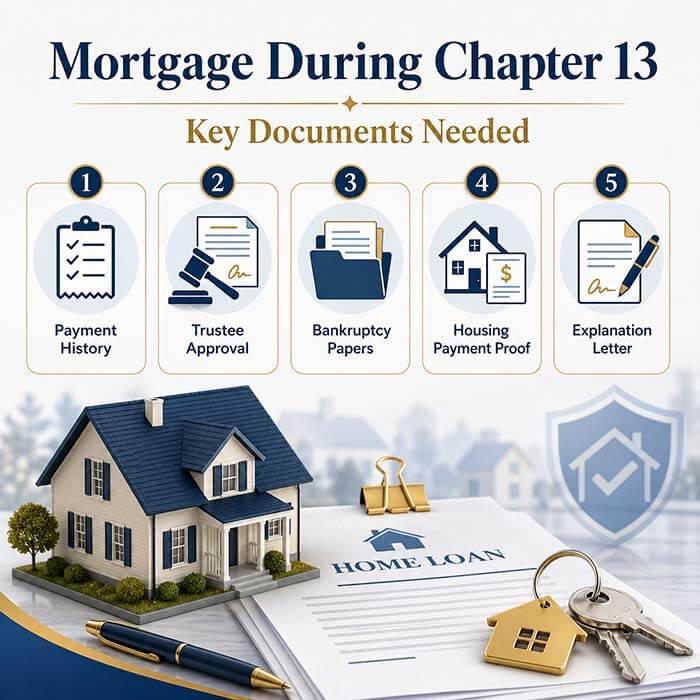 Borrowers applying for a mortgage during Chapter 13 bankruptcy need to be prepared. The more organized the file is, the smoother the process can be.
Chapter 13 Payment History
The lender will need proof that the borrower has made trustee payments on time. This payment history may come from the trustee, bankruptcy attorney, or other approved source.
Trustee Approval Or Court Permission
The borrower must usually provide written approval from the bankruptcy trustee or bankruptcy court to incur new mortgage debt. The lender cannot ignore this requirement.
Bankruptcy Petition And Schedules
The lender may request the bankruptcy petition, schedules, repayment plan, and related court documents. These documents help the underwriter understand the borrower’s debts, payment plan, and bankruptcy status.
Verification Of Rent Or Mortgage Payments
A clean rent or mortgage payment history can help strengthen the file. Borrowers should be ready to document housing payments with canceled checks, bank statements, rent verification, or mortgage payment history.
Letter Of Explanation For Bankruptcy
The borrower should prepare a clear letter of explanation. This letter should explain what caused the bankruptcy, what has changed, and why the financial hardship is unlikely to happen again. The letter should be honest, concise, and factual. Avoid assigning blame or providing excessive detail. Underwriters seek to understand the nature of the hardship and to confirm that the borrower has recovered.
Why Lender Overlays Matter During Chapter 13 Bankruptcy
Lender overlays are among the biggest reasons borrowers in Chapter 13 bankruptcy are denied. FHA or VA guidelines may allow a borrower to qualify, but an individual lender may have stricter internal rules. Here is how lender overlays work:
For example, one lender may require a 620 credit score on an FHA loan, even though FHA guidelines allow lower credit scores with the required down payment. Another lender may refuse to approve any borrower in active Chapter 13 bankruptcy, even if the borrower has 12 months of on-time trustee payments and court approval.
This is why choosing the right mortgage lender matters. Gustan Cho Associates specializes in helping borrowers who were denied by other lenders because of overlays. Many borrowers who come to Gustan Cho Associates have already been told no elsewhere.
How Gustan Cho Associates Helps Borrowers Rebuilding Credit During Chapter 13 Bankruptcy
Gustan Cho Associates helps borrowers understand whether they may qualify for a mortgage during or after Chapter 13 bankruptcy. The team reviews the borrower’s credit, income, trustee payment history, rent or mortgage history, debt-to-income ratio, and loan program options.
The goal is not just to take an application. The goal is to structure the file correctly before it goes to underwriting.
Borrowers in Chapter 13 bankruptcy need a lender that understands manual underwriting, trustee approval, FHA guidelines, VA guidelines, compensating factors, and lender overlays. Many borrowers are not mortgage-ready the first day they call. That is okay. A proper mortgage plan can help borrowers know what to fix, what to avoid, and when to apply.
Yes, You Can Qualify for a Mortgage in Chapter 13
Many lenders say no. We say yes. Our team helps borrowers in active bankruptcy get approved—while rebuilding their credit.Getting Approved For an FHA or VA Loan During Chapter 13 Bankruptcy
FHA and VA loans may allow qualified borrowers to be approved after 12 months of on-time trustee payments and trustee or court approval, even while in Chapter 13 bankruptcy. Conventional loans usually require a longer waiting period after a Chapter 13 discharge or dismissal.
The key message is that Chapter 13 bankruptcy does not preclude home ownership. It can serve as a rebuilding phase prior to mortgage approval.
With effective credit rebuilding, a clean payment history, and the support of a lender without restrictive overlays, borrowers can transition from bankruptcy recovery to homeownership. Gustan Cho Associates helps borrowers who need a second chance, including homebuyers rebuilding credit during Chapter 13 bankruptcy, borrowers with lower credit scores, and borrowers who were denied by other lenders because of overlays.
The Fastest Way of Rebuilding Credit During Chapter 13 Bankruptcy
The best way of re-establishing credit during Chapter 13 Bankruptcy is by getting new credit and having the payment history report on credit reports. Many consumers are told they cannot get new credit during the Chapter 13 Bankruptcy repayment plan. This is not the case. Don’t apply for unsecured credit cards for rebuilding credit during Chapter 13 Bankruptcy.
Rebuilding Credit By Becoming Authorized Credit Card User
You can have family members with great payment histories and low credit card balances to add you on as authorized users or get three to five secured credit cards: Re-established credit, high credit scores, and a strong credit profile mean lower mortgage rates, insurance premiums, and better job opportunities or promotion opportunities.
Re-Establishing Credit By Adding New Credit
Consumers can get secured credit cards and a credit rebuilder loan during the Chapter 13 Bankruptcy repayment plan. Bankruptcy Trustees will approve secured credit cards with at least $500 credit limits and a credit rebuilder loan program while in the Chapter 13 Bankruptcy repayment period.
Rebuilding Credit During Chapter 13 Bankruptcy To Qualify For a Mortgage
FHA and VA loans allow homebuyers to qualify for a home mortgage during a Chapter 13 bankruptcy repayment plan with Trustee Approval via manual underwriting. Chapter 13 Bankruptcy does not have to be discharged.
How Credit Gets Improved During Chapter 13 Bankruptcy
There is no waiting period after the Chapter 13 Bankruptcy discharge date. Homebuyers can only qualify for an FHA or VA loan during and after Chapter 13 Bankruptcy if they need to go through manual underwriting. FHA and VA loans are the only two mortgage loan programs that allow manual underwriting.
Credit Practices During Chapter 13 Bankruptcy
People can qualify for a mortgage during the Chapter 13 Bankruptcy repayment period. Bankruptcy trustee approval is required. As long as it is a modest home and the homebuyer can afford the new mortgage payments, 100% of the bankruptcy trustees will approve a new home purchase during the Chapter 13 Bankruptcy repayment period.
Manual Underwriting Is Often Required During Chapter 13
The loan must be manually underwritten if the Chapter 13 Bankruptcy discharge has not been seasoned for two years. The borrower’s credit scores determine mortgage rates. Chapter 13 Bankruptcy repayment plans are normally 60 months. Homebuyers and homeowners expecting to apply for a mortgage during the Chapter 13 Bankruptcy repayment plan should start re-establishing their credit.
Do The Courts Allow Rebuilding Credit During Chapter 13 Bankruptcy
Generally, most bankruptcy attorneys will tell you you cannot take on new credit or a new loan during the Chapter 13 Bankruptcy Repayment period. Most Chapter 13 repayment plans are for a term of 60 months. Most Trustees frown on consumers taking on unnecessary new debt during the Chapter 13 repayment period.
Add New Credit Tradelines During Bankruptcy Repayment Plan
Small secured credit cards and a small credit rebuilder loan program are normally not problematic for most bankruptcy trustees. This only holds true if the consumer makes timely payments on their repayment plan.
Most Trustees will approve an auto loan if you need to trade in your junk car for a new car. You need a car these days to use for transportation. It is more of a necessity than a luxury.
Any debt that is greater than $5,000 needs bankruptcy trustee approval. A new car falls in the category of needing trustee approval. However, most trustees will not approve an RV. RVs are a luxury unless the person will use them as housing.
Getting New Credit During Chapter 13 Bankruptcy To Re-Establish Credit For a Mortgage
Most bankruptcy trustees will not have a problem for consumers to get a couple of secured credit cards to re-establish their credit during the Chapter 13 Bankruptcy repayment plan. The ideal amount of secured credit cards for maximum credit optimization is 3. Get three secured credit cards with at least a $300 to $500 credit limit. Borrowers should start rebuilding credit during Chapter 13 Bankruptcy as soon as they file.
Credit Status May Vary During or After Bankruptcy
Adding secured credit cards and credit rebuilder cards while in Chapter 13 Bankruptcy will skyrocket your credit scores. Each secured credit card will boost your credit by 20 to 50 points. Besides the three secured credit cards, get at least one installment loan. The best credit rebuilder program is www.self.inc. You are making a $25 to $50 monthly payment.
Exercise Caution When Opening New Credit
Self Credit Rebuilder will deposit that monthly payment towards your 12-month FDIC CD account. The monthly payments will report to all three credit bureaus. After your fourth payment, Self Credit Rebuilder Installment Account will issue a $150 secured credit card without you needing to deposit.
Gustan Cho Associates are experts in helping homebuyers qualify for a home mortgage while in Chapter 13 Bankruptcy.
The team at Gustan Associates can help borrowers rebuilding credit during Chapter 13 Bankruptcy Repayment and after Chapter 13 discharge without any waiting period. If you follow the above steps, you will have a credit score of over 700 FICO in just 12 months after starting the credit rebuilding program after filing Chapter 13 Bankruptcy.
Avoid Mistakes with Trustee Payments
As mentioned above, the easiest and fastest way rebuilding credit during Chapter 13 Bankruptcy repayment plan so you can qualify for a mortgage with the lowest rates is by getting three to five secured credit cards and one to three credit rebuilder accounts such as the Self Credit Rebuilder or a credit rebuilder account from a credit union or bank.
Final Thoughts On Rebuilding Credit During Chapter 13.
If you are Rebuilding Credit During Chapter 13 Bankruptcy For a Mortgage or you need to qualify for loans with a lender with no overlays on government or conforming loans, please contact us at Gustan Cho Associates at 800-900-8569. Text us for a faster response. Or email us at alex@gustancho.com . The team at Gustan Cho Associates is available 7 days a week, on evenings, weekends, and holidays.
FAQ: Rebuilding Credit During Chapter 13 Bankruptcy For a Mortgage
Can I Rebuild Credit During Chapter 13 Bankruptcy Repayment?
Yes, you can. It’s highly recommended, especially when considering purchasing or refinancing a home. You can start re-establishing credit before your Chapter 13 bankruptcy is discharged.
What Are The Credit Score Requirements For FHA And VA Loans During Chapter 13 Bankruptcy?
A credit score of at least 500 FICO is mandatory for FHA loans if you plan to make a down payment of 10%. However, if you plan to make a down payment of 3.5%, you need a minimum credit score of 580 FICO. On the other hand, VA loans do not have a minimum credit score requirement.
How Can I Get The Best Mortgage Rates During Chapter 13 Bankruptcy?
To secure the best rates, boosting your credit score as much as possible before applying for a mortgage is essential. Lower credit scores may result in higher mortgage rates and potential discount points.
Is It Possible To Have Good Credit Despite Bankruptcy?
Yes, it is possible. With responsible financial management and strategic credit rebuilding efforts, you can gradually improve your creditworthiness over time, even with a bankruptcy on your record.
How Can I Qualify For A Mortgage During Chapter 13 Bankruptcy?
Borrowers can qualify for a mortgage while repaying their Chapter 13 bankruptcy with the help of FHA and VA loans, provided that their bankruptcy trustee approves. Manual underwriting is required, and borrowers must meet agency mortgage guidelines.
Does The Bankruptcy Court Allow Rebuilding Credit During Chapter 13 Bankruptcy?
Generally, small secured credit cards and credit rebuilder loans are acceptable for rebuilding credit during Chapter 13 bankruptcy, provided that timely payments are made on the repayment plan and any new debts are approved by the bankruptcy trustee.
What’s The Fastest Way To Rebuild Credit During Chapter 13 Bankruptcy?
The fastest way is to obtain secured credit cards and credit rebuilder loans. These can significantly boost credit scores, allowing you to qualify for a mortgage with the lowest rates once your bankruptcy is discharged.
This Guide About Rebuilding Credit During Chapter 13 Bankruptcy For a Mortgage was updated on April 24, 2026.